Life Coach Resume: Example, Template and 7 Writing Steps

Nour
Founder, Coachful
How do you write a life coach resume when your best work happened in confidential conversations, not public projects? Describe the clients you are qualified to support, the work you actually delivered and the credentials a reviewer can verify. You do not need a suspiciously perfect success rate to make a credible application.
A strong life coach resume usually includes a targeted professional summary, relevant coaching experience, accurate training and credential details, earlier experience that matters to the role, and practical delivery skills. Use a simple chronological structure, then tailor the evidence to the employer or associate-coach opportunity.
This guide is for life, career and executive coaches applying for professional coaching work, not sports-coaching positions. You will find seven writing steps, a copyable template and fictional examples. None of the examples represents a real applicant, customer result or open Coachful vacancy.
What is the difference between a coaching resume, CV and bio?
A resume is an applicant document: it helps a reviewer decide whether your experience fits a particular role. A CV may serve a similar purpose, although local conventions and requested detail differ. Follow the recipient's instructions rather than arguing over the label.
A coaching bio introduces you to potential clients or an audience. A capability statement describes what your practice can supply. Neither substitutes for a resume when the reviewer needs employment dates, individual qualifications and relevant responsibilities. A moving origin story is not a work history.
If you are pursuing an associate panel rather than employment, the practice may request a coach profile, application form and credential verification instead of a traditional resume. Supply the requested format first. A polished extra document is not useful if it leaves the actual application incomplete.

1. Start with the role you want, not your entire career
Read the opportunity and identify its real selection questions. Who will you coach? In which format? What qualifications are essential? What delivery, availability and record-keeping responsibilities belong to the role? Those answers determine what deserves space.
Create a private two-column note: requirement and supporting evidence. For an audience requirement, identify work with that audience. For group facilitation, identify groups you actually facilitated. For a named credential, check that you currently hold it. If an essential requirement is missing, wording cannot manufacture it.

For example, a role supporting newly appointed managers may make your prior people-management experience relevant. A role delivering established career-transition sessions may care more about your coaching process and adult career context. These are different applications, even when the same coach could pursue both.
Use the recipient's terminology when it accurately describes your work. Do not copy a list of assessment tools you have never used or claim clinical skills because a sample resume includes them. Keyword matching is not permission to overstate competence, and no layout or phrase guarantees an applicant-tracking result.
2. Write a specific professional summary
Use a short paragraph that names your coaching focus, relevant background and delivery approach. Add a current credential only when you genuinely hold it. Avoid opening with “passionate, results-driven professional,” which tells the reviewer almost nothing they can evaluate.
Fictional example: “Life and career-transition coach supporting adults who are evaluating their next professional step. Uses agreed decision criteria, practical experiments and follow-up reflection within a clearly contracted coaching engagement. Brings previous experience in people management.”
That example describes a scope and method without inventing years, clients or outcomes. A real applicant should replace it with their actual experience, then adjust the emphasis for the role. If a credential is essential and verified, include its precise name prominently rather than hiding it behind vague certification language.
Do not turn the summary into a service guarantee. “Helps clients consider career options” describes a contribution. “Gets every client promoted” claims a result beyond your control. The difference matters both ethically and when an interviewer asks how you know.
3. Build an evidence record before writing achievement bullets
For each role or period of independent practice, collect the correct title, dates, audience, delivery format and responsibilities. Add only substantiated delivery totals or outcomes that are relevant and permitted to share. Keep the underlying evidence private; the resume needs an accurate summary, not your session notes.

A practice-management record may help you locate experience, but check what a total actually includes. Distinguish coaching, training, mentoring and consulting. Verify whether a count refers to sessions, hours or unique clients. Do not relabel a platform number as independently audited experience.
Group independent client work under an honest practice entry, such as “Independent Life Coach, [practice name], [dates].” You usually do not need a separate identifiable entry for every private client. Name organizations only when you have an appropriate basis and permission to do so.
Use this bullet structure: audience or context + your actual contribution + relevant method or defensible evidence. For example: “Coached adults exploring a career change, using agreed decision criteria and reviewing client-chosen experiments at follow-up sessions.” Only use that wording if it is true of your work.

Useful evidence does not have to be a dramatic percentage. Clear descriptions of contracting, session preparation, appropriate records, delivery formats and review points can show how you work. When you do use numbers, define their period and meaning, and be prepared to explain the source.
A participant saying they feel more confident is not proof that coaching caused a promotion. Attendance is not goal achievement. Never estimate an impressive success rate because another resume guide recommends quantifying everything. A precise process claim is better than an invented outcome.
4. Separate credentials, training and memberships
Use the exact award name and issuing organization for professional credentials you hold. Check current standing through the issuer's available verification route before submission. Record relevant training separately, with the actual provider, program and completion status.
Association membership, completion of a training program and a professional credential are different facts. “Training completed” does not mean “credential awarded.” Working toward an award does not entitle you to put its initials after your name. If an application is pending, describe that status plainly and accurately.

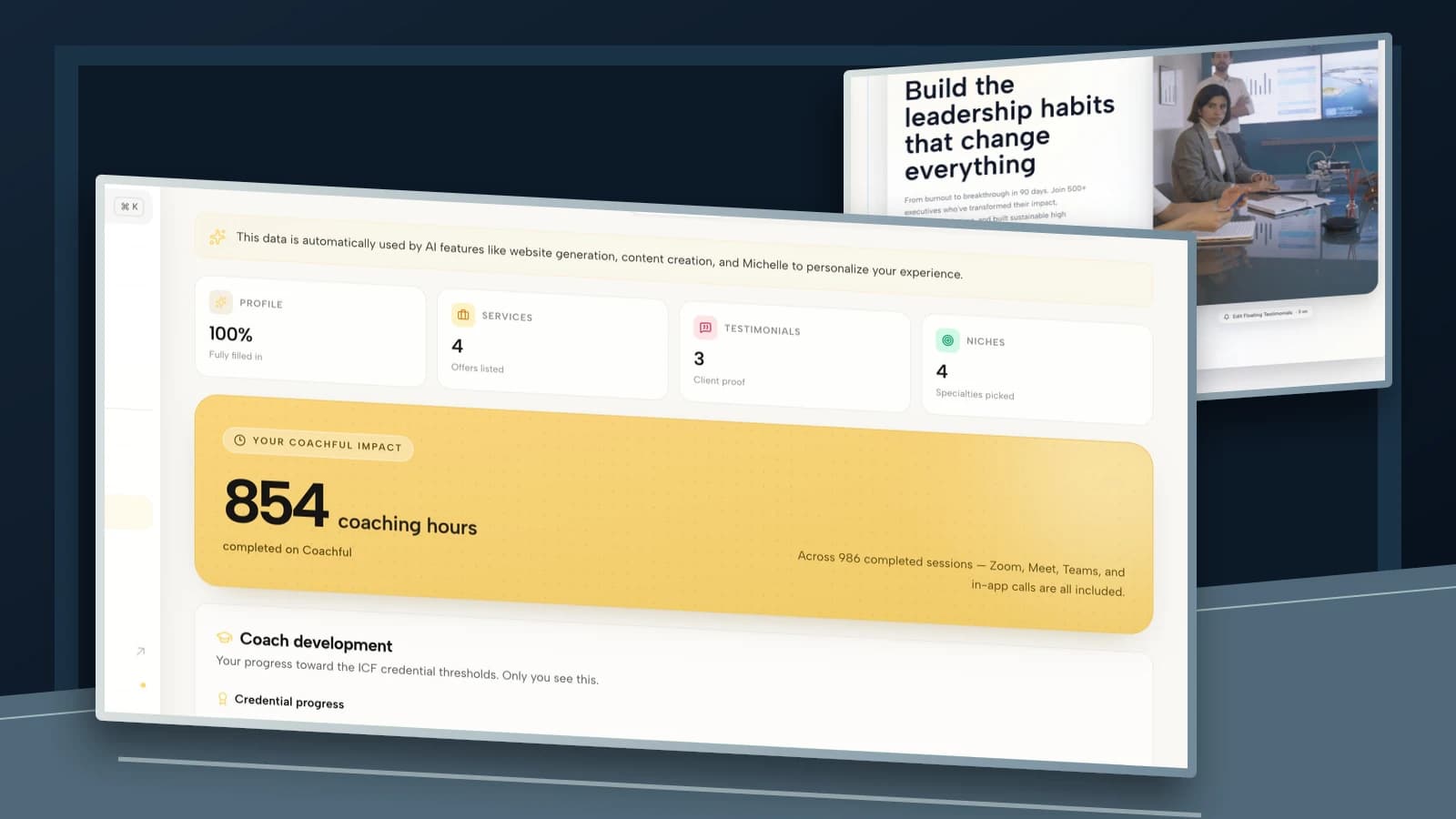
Internal progress tools can help you organize development, but they do not independently confer or verify an award. Even a screen that labels a threshold achieved should not be copied into a resume as proof of a credential. The issuing body's decision and current standing are what you must verify.
The ICF Code of Ethics emphasizes accurate statements, professional integrity and confidentiality. Apply that standard to an application as carefully as to a public offer. A reviewer should not have to untangle whether “certified” means a course certificate, a membership or an independently awarded designation.
List assessment qualifications only when relevant and accurate. Do not imply that coaching training authorizes diagnosis, treatment or use of an instrument outside your competence. Requirements depend on the work, the issuer and applicable local rules; this is writing guidance, not a professional licensing determination.
5. Show delivery skills without borrowing your clients' stories
Select practical skills that the role actually needs: contracting, goal clarification, individual coaching, group facilitation, appropriate record keeping, sponsor communication or remote delivery. Connect major skills to experience elsewhere in the document. A long unsupported skills inventory is not persuasive.

If you designed a program, say you designed it. If you delivered it, describe the delivery separately. A program sitting in your library does not establish that people completed it, benefited from it or paid for it. Distinguish curriculum creation from coaching delivery and facilitation.
Protect confidentiality even when a client story would make a strong bullet. Removing a name may not prevent identification if you include a rare role, employer, timing and distinctive circumstances. Generalize appropriately or obtain the necessary permission; do not add fictional details and present the result as real experience.
For employer-funded work, explain your professional role without promising unrestricted sponsor access. A suitable process description might mention agreed administrative updates and confidentiality boundaries. Avoid implying that sharing private session content is evidence of good corporate service.
Keep references separate unless the application specifically requests them. Ask a referee before sharing their contact information and agree what they can discuss. An application to a new practice is not a reason to forward private client correspondence.
6. If you are new, label relevant experience honestly
You can write a useful resume without pretending to be an established coach. Separate completed training, accurately labeled practice work and earlier professional experience. A reviewer can evaluate a newcomer with clear boundaries more easily than someone whose document blurs every category.

Fictional early-career summary: “Career-transition coach with previous people-management experience and [actual completed coach training]. Building practice through [accurately described supervised, practice or pro bono work]. Interested in a supported associate role with clearly defined delivery responsibilities.”
Replace the bracketed fields and remove anything that is not true. Do not call classroom exercises paid engagements or rename managerial conversations as professional coaching hours. Earlier leadership experience can demonstrate relevant context without being counted as coaching tenure.
For each earlier role, choose a small number of relevant responsibilities. Managing a team, facilitating learning or handling sensitive information may matter to the opportunity. Describe the actual work and dates; leave unrelated duties out rather than trying to make every previous task sound like coaching.
If the role requires a qualification you have not earned, check whether the stated requirement allows an alternative or a developing-practitioner route. If not, look for a better-fitting opportunity. A resume should clarify fit, not conceal a material mismatch until the interview.
Copyable life coach resume template
This structure is a writing scaffold, not a credential claim or a completed application. Replace every field, remove unsupported sections and follow the employer's required format. Keep contact information professional and exclude unnecessary sensitive personal details.
[Your name]
[Accurate professional title]
[City or service location, if relevant] | [Business email] | [Phone, if appropriate]
[Relevant website or professional profile]Professional summary
[Coaching audience and focus]. [Relevant background or verified current credential]. [Actual delivery approach or role-related strength].Relevant coaching experience
[Role and practice or organization] | [Actual dates]
• [Audience, work delivered and relevant method]
• [Specific delivery responsibility or substantiated evidence]
• [Appropriate process, coordination or review responsibility]Earlier relevant experience
[Role and organization] | [Dates]
• [Actual responsibility relevant to the target opportunity]Credentials and coach training
[Exact current credential and issuer, if held]
[Actual training program, provider and completion status]
[Relevant assessment qualification, only if accurate]Education and relevant development
[Actual qualification, institution and date where useful]
[Relevant ongoing development accurately described]Delivery skills
[A short role-specific list supported by your experience]
The structure is deliberately plain. Your evidence should do more work than decorative icons, skill meters or a headshot. If a recipient requests additional information, supply it through their process rather than shrinking an entire application into unreadable type.
7. Check the document and the evidence behind its links
Follow the submission instructions for file type and length. When no format is specified, a readable, single-column document with conventional headings is a sensible starting point. Use enough space for relevant evidence, but do not pad a short career or compress an established one into tiny text.
If you submit a PDF, check that its text is selectable, its reading order is sensible and its links work. Open it on a phone as well as a desktop. Copy its text into a plain editor to catch obvious ordering problems. These checks improve usability; they do not guarantee compatibility with every recruitment system.

Check any public page linked from the resume. Names, role descriptions and credentials should agree across the document, website and professional profile. A current application beside an outdated public biography creates avoidable doubt. Correct the discrepancy rather than hoping nobody clicks.
Coachful's demo includes an internal coaching record, development-progress view, program library and website editor. Those surfaces can help you understand the difference between private evidence, actual delivery scope and a public profile. They are not independent credential verification, an applicant-tracking service or proof of a client's results.
If you want to review that evidence-to-profile workflow before changing your own practice, Try the interactive demo. Keep the actual resume in your document editor, verify qualifications with their issuers and publish only information you are entitled to share.
Before you send: a final applicant check
- Fit: The opening makes the target audience and relevant contribution obvious.
- Accuracy: Every date, role, number and qualification can be explained and supported.
- Confidentiality: No private client detail or unapproved reference contact is exposed.
- Usability: The file is readable, selectable where appropriate and follows the requested format.
- Consistency: Linked public profiles agree with the application.
- Completion: Required application questions are answered, not replaced with a generic attachment.
Frequently asked questions
Can I write a life coach resume with no paid clients?
Yes. Describe actual training, accurately labeled practice or pro bono work and relevant prior experience. Do not manufacture paid clients or outcome metrics. Whether you meet a particular role's requirements is a separate question from whether you can write a clear resume.
Should I put client names on a coaching resume?
Not by default. Describe the audience and work without revealing private details. Check permissions, agreements and re-identification risks before naming a client or organization. Use an agreed reference process when the reviewer needs further evidence.
Do I have to include an ICF credential?
Only claim one if you hold it. Some opportunities require a particular credential; others use different criteria. State your actual qualifications and status. Never turn progress toward a threshold into an award you have not received.
Can the same resume work for life and executive coaching?
Keep one accurate master history, then select evidence for each role. An executive-coaching opportunity may emphasize organizational context and sponsor boundaries. A life-coaching role may emphasize a different audience and scope. Do not change the facts to suit the title.
Sources and scope
This guide draws on the ICF Code of Ethics for professional accuracy and confidentiality, and career.io's life coach resume writing guide for the applicant-document convention of summary, experience and qualifications. The fictional templates are original editorial examples, not externally verified applicant records. Hiring requirements, privacy obligations and professional rules vary by role and jurisdiction.