Gifts for Coaching Clients: 5 Thoughtful Ideas and Boundaries

Coachful
Editorial Team
Should you give your coaching clients a gift, and what can you send that feels thoughtful rather than like another piece of branded clutter?
Choose something modest, optional and connected to a preference the client has actually expressed. A personal note, a requested book, a useful digital resource, a practical object or a donation they choose can work. None is compulsory, and a sincere acknowledgement without a purchase is a perfectly good answer.
A client gift should say “I noticed,” not “now you owe me.” Keep it separate from renewal conversations, referral requests, reviews and the materials already included in the coaching fee. This guide gives coaches five options, a selection method and wording to adapt without creating an awkward obligation.
These are editorial suggestions, not evidence that gifts increase retention or a professional rule requiring them. The examples are fictional. Check the policies and professional standards relevant to your work, especially when an employer, public institution or other sponsor is involved.
Before choosing a gift, decide whether to send one at all
A present can be welcome and still be unnecessary. Clients have different tastes, beliefs, access needs and relationships with receiving things. A gift that feels generous to the sender may feel personal, wasteful or uncomfortable to its recipient.
There is no need to build a holiday-gifting machine just because other practices have one. In a Prosperous Coach episode about client gifts, Rhonda Hess describes moving away from routine gifts and preferring small, relevant gestures. By contrast, a Forbes Coaches Council gift-ideas roundup shows a range of practitioners choosing gifts. These are differing practitioner views, not comparative outcome research.
Use three questions before buying anything:
- Would the recipient reasonably welcome this? Use something they volunteered, not a guess based on a stereotype or a private difficulty.
- Can they accept or decline without consequence? The answer should not affect their access, your attention or the tone of the next session.
- Would I still send it if they never renewed or referred anyone? If not, you may be planning an incentive rather than a thank-you.
For corporate work, ask about the recipient organisation’s gift policy before sending anything of value. A coach should not choose an amount first and hope it falls under a limit. Some recipients cannot accept gifts at all, and policies may distinguish physical items, hospitality, vouchers and donations.
1. A short personal note acknowledging a specific milestone
Best for: almost any practice that wants to acknowledge a client without adding cost or logistics. Trade-off: personal wording takes care, and “personal” must not become invasive.
A good note recognises something the client chose to work on. It does not claim credit for their progress or announce that they are now transformed. You can acknowledge effort, a decision or the completion of the engagement without judging their life.
For a fictional career-coaching client, a simple version might be: “Thank you for the care you brought to our work. You gave yourself time to examine the options rather than rushing into the first available answer. I hope the next chapter gives you room to use what you learned.”

Use the client’s own description of what mattered. A progress record can refresh your memory, but it is not permission to reproduce sensitive information. Avoid putting an employer dispute, relationship problem, diagnosis or financial difficulty into a card that someone else may open.
A private email can be better than post when you do not know whether a home address is appropriate. Do not surprise someone by using an address collected for billing as if that automatically made it a preferred gift-delivery address. Ask first if delivery is relevant.

Keep the message complete without a sales link. “Thank you for working with me” does not need a second sentence asking for a testimonial. If you want feedback, a renewal conversation or permission to quote the client, make that a separate, clearly identified request.
Skip this option when: you cannot write something genuine without making assumptions. A brief, warm thank-you is better than an elaborate interpretation of who the client has become.
2. A book the client has said they want to read
Best for: a client who enjoys reading and has expressed interest in a specific book or subject. Trade-off: an unsolicited self-improvement book can sound like criticism or additional homework.
The useful distinction is between remembering a preference and prescribing a personality upgrade. “You mentioned wanting this book” is very different from “I think you need to read this.” The latter can turn a thank-you into another assessment.

Ask about format if you are unsure. Print, ebook, audio and accessible editions are not interchangeable for every reader. Check whether an electronic gift can be redeemed in the recipient’s country and whether it requires an account or subscription they do not want.
An adaptable message is: “You mentioned this title in our conversation. Would you enjoy a copy, and is there a format you prefer? There is no reading assignment attached.” If you do not know a specific title, offer the choice rather than making them explain why your selection missed.
Do not give books that make medical, therapeutic or financial promises as though they were part of your professional recommendation unless that recommendation is appropriate to your competence and role. A gift label does not remove the need for sound judgment.
Skip this option when: the client already feels overloaded with reading, has not shown interest, or might reasonably interpret the title as a comment on a sensitive issue. You do not need to solve every gift decision with a book.
3. One genuinely useful digital resource, with no hidden commitment
Best for: an online practice where the client has asked for a particular reference, exercise or learning resource. Trade-off: digital gifts can quietly become an extra course, a login problem or an excuse to continue marketing.
Give one thing that answers a real interest, not a folder of everything you have ever produced. A brief reference sheet, a relevant optional lesson or a carefully curated resource list may be easier to use than a large bonus library.

Make the distinction between a gift and delivery explicit. A worksheet, recording or resource promised in the paid package is not an additional gift when you finally provide it. Clients should not have to thank you for receiving what they already bought.
For an optional resource, state what it is, why you thought it might be useful, and any actual access period or restrictions. Do not imply permanent access unless you can honour it. Check licences before distributing third-party content; buying a resource does not necessarily permit giving copies to every client.

A fictional invitation might read: “You asked about keeping your weekly review simple. I made a short reference sheet you may find useful. Would you like the link? It is optional, and it does not add any sessions or ongoing messages.” Replace that wording with the facts of the resource you can actually provide.
Before sending, test the recipient’s experience. Open the link from an appropriate test account or signed-out view, as relevant. Confirm that the intended person can read it, that another client’s details are not visible, and that the resource works on a phone. Check the file’s accessibility rather than assuming a beautiful PDF is usable.

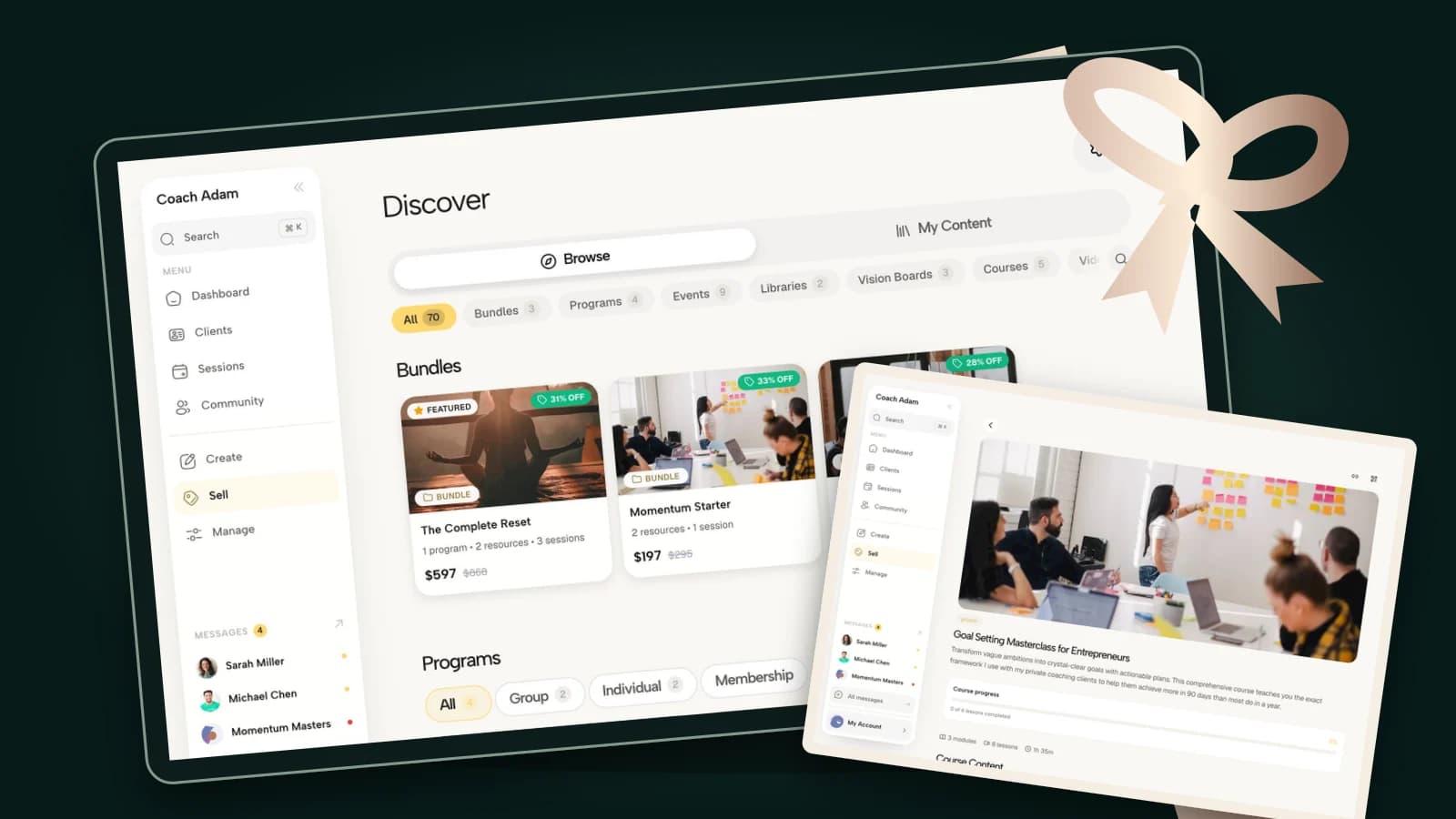
The Coachful screenshots here demonstrate real resource, course and client-portal surfaces in the demo. They do not establish a native gift-sending feature, automatic free access or a transferable gift entitlement. Test the exact access arrangement you intend to use, and choose a simple alternative if the platform cannot support it honestly.
Skip this option when: the “gift” mainly creates another obligation or leads straight into an upsell. Do not require a review, referral, newsletter subscription or renewal to receive it.
4. A small practical object the recipient will actually use
Best for: a client whose preferences are known and whose organisation permits the gift. Trade-off: objects bring storage, delivery, sustainability and taste decisions that a note avoids.
A simple notebook, reusable bottle or other everyday item can work when the person has expressed a use for it. The item should not require a new habit, a replacement purchase or an explanation of why they do not want it.

Choose the recipient’s utility over your logo exposure. A large branded slogan turns the object into promotional merchandise. That may be appropriate for an openly advertised event giveaway, but it is a different job from a personal client acknowledgement.
Be cautious with food, alcohol, fragrance, plants and personal-care items. Preferences, allergies, beliefs, household circumstances and maintenance needs can make an apparently universal gift unsuitable. You do not need to collect sensitive details to solve this. Offer a modest choice or use a non-physical alternative.
Ask before arranging delivery: “I would like to send a small thank-you. Would that be welcome, and is there a suitable delivery address? A message instead is completely fine.” Do not make someone disclose their home address to avoid appearing ungrateful.
Skip this option when: shipping is complicated, the gift policy is unclear, or you know almost nothing about what the client would use. A bulk order is convenient for you, not evidence of relevance for them.
5. A modest donation to a cause the client chooses
Best for: a client who has explicitly said they prefer charitable giving to receiving objects. Trade-off: choosing a cause on their behalf can impose your beliefs or imply an endorsement they never gave.
Ask whether a donation would be welcome before offering it as the thoughtful option. Let the client choose an eligible organisation, within a clear modest limit you can afford. It is also fine for them to decline or prefer a note.
Do not share the client’s name, email, address or coaching relationship with the organisation unless that disclosure is necessary and appropriately agreed. You may be able to donate in your own name while privately telling the client what you did. Confirm the actual donation and keep the receipt.
Wording to adapt: “You mentioned preferring fewer physical things. If you would welcome it, I would like to make a modest donation to a registered charity you choose. There is no need to participate, and I will not share your details without asking.” Adjust the eligibility wording for your location and circumstances.
A donation is not automatically tax-deductible, and the client does not necessarily receive any tax benefit from your payment. Check accounting treatment with an appropriate adviser rather than making tax claims in the gift message.
Skip this option when: you are guessing at the person’s values or trying to signal your own. Respectful neutrality is often more personal than a cause selected without consultation.
Set a gift budget that includes delivery and your time
Choose a consistent policy before shopping. Decide the occasions you will acknowledge, who is eligible, the maximum spend, and what you will do for clients who cannot or do not want to accept something. The policy can be modest enough that you can use it without resenting it later.

In a hypothetical budget, twenty-four gifts costing twelve currency units each require 288 units. Add seventy-two for packaging and delivery and the cash total becomes 360. Administrative time is additional. These are illustrative numbers, not a suggested spending level or an industry benchmark.
You can choose a lower-cost option for the entire practice rather than varying generosity by the perceived value of each client. If you use different arrangements for corporate and private clients, document the reason, such as organisational policy, rather than making the difference a secret reward for spending more.
Keep only the information you need to administer the gesture. A basic record might contain the occasion, consent to delivery where relevant, the item or message, actual cost and completion date. It should not become a permanent dossier of personal preferences or sensitive details. Apply your normal retention and access controls.
Five boundaries that keep a client gift from becoming a sales tactic
- No exchange for praise. Do not tie a gift to a positive review, testimonial or referral. If you run a separate incentive arrangement, disclose and assess it separately rather than disguising it as gratitude.
- No surprise obligation. A free session, course or event invitation is only welcome if the client wants the time commitment. Explain the scope and let them choose.
- No confidentiality leak. A public post, a delivery label or a note can reveal that someone works with you. Ask before identifying a client or sharing a milestone.
- No emotional debt. Avoid extravagant gifts, overly intimate messages or anything that suggests the client should comfort, reassure or reciprocate with the coach.
- No substitute for service recovery. If a client has complained, address the problem and any appropriate remedy directly. A present does not resolve a missed promise.
Also consider the timing. A large gift immediately before a renewal decision can feel like pressure even when that was not your intention. Keep ordinary service decisions transparent, and avoid making a present carry the weight of a conversation you need to have directly.
Frequently asked questions about gifts for coaching clients
Do coaches need to send Christmas or birthday gifts?
No. A warm message or no gift at all can be appropriate. Do not assume every client observes the same holidays or wants birthday contact. You do not need to collect dates of birth merely to create a gifting schedule.
How much should a coach spend on a client gift?
There is no universal amount. Use an affordable, consistent limit, check relevant gift policies and include delivery and administration. A more expensive present is not inherently a better acknowledgement.
Can I offer a free coaching session as a gift?
Only if it is genuinely optional, appropriately scoped and within your capacity. State whether the session expires, how booking works and whether any terms apply. Do not quietly turn it into a discovery call or use it to pressure someone into restarting.
Are client gifts the same as coaching gift certificates?
No. This article is about a coach giving an acknowledgement to a client. Selling someone a voucher for coaching creates purchase, redemption and delivery obligations. That separate workflow is covered in how to sell coaching gift certificates.
What if a client declines the gift?
Thank them for telling you and move on. Do not ask them to justify their preference or replace the item repeatedly until they accept something. The relationship should feel exactly as professional afterwards.
Choose the smallest gesture that communicates real attention
The best starting point is not a shopping list. Ask whether the gesture is welcome, relevant, modest and free of strings. If a note does that job, stop there. If a digital resource is the right choice, test the content and recipient access before you promise it.
To explore the resource and client-portal surfaces shown here before deciding whether they suit that optional next step, Try the interactive demo. The point is dependable access to something useful, not a more elaborate gift campaign.