Group Business Coaching: How It Works and How to Run It

Coachful
The professional coaching industry has grown into a substantial global services market, and the scale figures explain why cohort formats are suddenly worth designing properly. The International Coaching Federation's Global Coaching Study estimated that by 2022 the number of coach practitioners had passed 100,000 for the first time, reaching 109,200, up 54% on the 2019 estimate, with estimated annual industry revenue of $4.564 billion, a 60% increase on the 2020 estimate. Those numbers describe the profession as a whole, not group delivery, but they tell you something practical: there are now enough buyers who have worked with a coach before that a structured cohort offer no longer needs a long explanation.
Here's the distinction that matters. Group business coaching is one coach facilitating a small cohort of founders, executives or owner-operators through a designed program that mixes short teaching, facilitated peer exchange and individual commitments made in front of witnesses. It isn't a webinar with breakout rooms, and it isn't one-to-one coaching sold at a discount.
Think of it as the difference between a private tutor and a seminar. In tutoring, the entire hour bends around one person's gaps. In a good seminar, the tutor still knows your name, your numbers and the thing you've been avoiding, but you also hear eight other people wrestle with the same problem and you learn from their mistakes before you make them.
What Group Business Coaching Is and Who It Serves
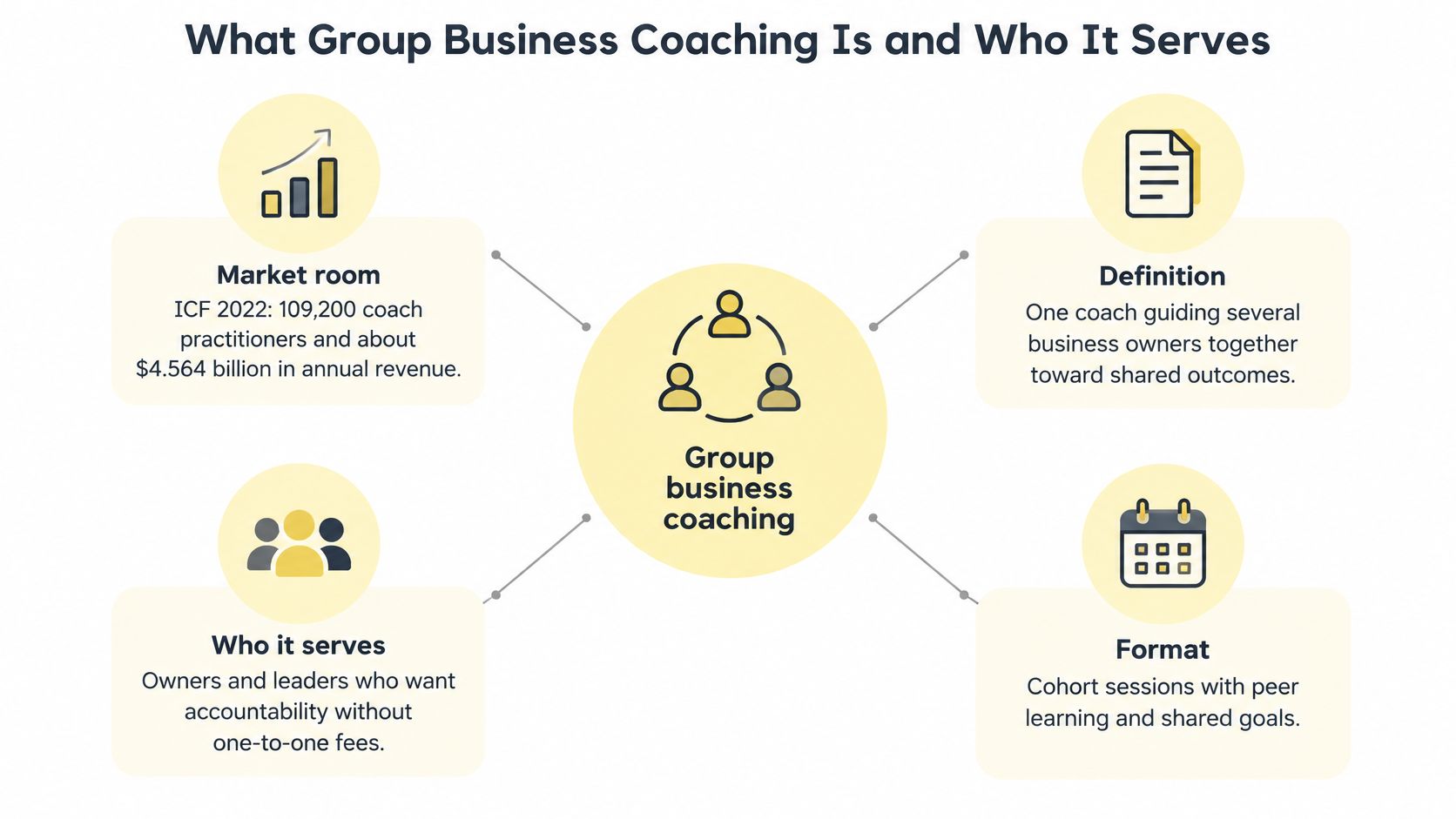
The mechanism has two layers, and programs fail when a coach runs only one of them. The coach supplies structure and behavioral accountability: a defined curriculum, a session arc, assignments between meetings and a record of what each member promised. The peers supply feedback, challenge, social comparison and perspectives you can't get from one room. An executive who has never fired anyone hears from an owner who has done it four times.
That peer layer only works under two conditions. The group has to be small enough that people speak candidly, and every member has to work from the same coaching framework so the conversation doesn't drift into unstructured advice-giving. A literature review of psychodynamic group executive coaching identifies economies of scale and perspective diversity as the core mechanisms, and effectiveness depends on carefully managed group processes rather than placing executives in the same discussion.
The design test: if your program would still work with the peer conversation removed, you've built a course. If it would collapse without the coach holding the frame, you've built a networking group. Group business coaching needs both layers load-bearing.
Who does this serve best? Founders and small-business owners working on delegation, hiring, pricing and strategy are the strongest fit, because their problems repeat across companies and they rarely have a peer group that understands the trade-offs. Leadership teams and managers inside one organisation are the second fit, though the dynamics change when participants report to each other.
Solo consultants come third. They buy the accountability more than the content.
A common question from coaches considering this model is whether they can serve several clients at once without diluting what they offer. Dilution is a design outcome, not an inevitable one. A cohort of twelve with no airtime rules dilutes everything. A cohort of seven with rotating hot seats, pre-work and a written commitment log often produces sharper accountability than a monthly one-to-one, because the commitments are public. Some coaches also run a free business coaching session for entrepreneurs to test whether a prospect can commit to structured work before they join a paid cohort.
None of this is unique to business coaching. Coaches studying how group formats get packaged in other fields can find hyperbaric training coaching sessions sold as scheduled classes, which underlines the point: the value sits in the design, not the topic.
The standard to hold is simple. A stated pricing basis, attendance rules that make peer accountability real, and outcome tracking you would defend to a skeptical finance director. Anything less is one-to-one coaching sold at a discount with extra people in the room.
Group Program Formats, Cohort Sizes and Typical Prices
| Format | Cohort size | Cadence and length | Pricing basis | Typical price |
|---|---|---|---|---|
| Monthly peer-advisory cohort | 6-10 | 2 facilitated sessions per month, ongoing | Fixed monthly cohort fee | $1,000-$3,000 per month (e.g. $2,400 for 6 = $400 each) |
| Executive group program | 6-12 | Weekly or biweekly, 8-12 weeks | Per participant | $2,500-$5,000 per participant |
| Single group session or workshop | 8-30 | One live session | Fixed session fee split across participants | $500-$3,000 per session (e.g. $2,000 with 8 = $250 each) |
| Curriculum-led cohort course | 10-30 | Weekly modules plus live calls, 6-12 weeks | Per participant, often tiered | Self-study entry tier up to a premium tier with live feedback; publish both, and price the top tier at or below your per-participant group rate |
| Individual executive coaching (comparison) | 1 | Weekly or biweekly | Per session | $500-$2,500 per session |
Published executive-coaching pricing guides commonly place multi-session group programs around $2,500-$5,000 per participant, while some group-session models quote roughly $500-$3,000 for the whole session and divide that fee among participants, according to Afterburner's executive coaching cost guide.
The pricing-basis trap
Read those two lines again, because they describe radically different businesses. Charge $2,000 for a session with eight participants and you've generated $250 of revenue per participant. Charge $2,000 per participant and the same meeting produces $16,000. Same room, same hour, sixty-four times the money.
Most underpriced group programs aren't the result of modest positioning. They're the result of a coach who never stated which basis they were quoting. So before you name a figure, write down five things: the basis (per cohort or per person), the cohort capacity, the session count, the preparation included, and the access between meetings. If a prospect can't tell from your page what happens when a ninth person wants in, the price isn't the problem.
The monthly peer-advisory model is where I'd send most business coaches first. Six leaders at a $2,400 monthly cohort fee works out to $400 per participant for two facilitated sessions, and the recurring revenue smooths out the feast-and-famine cycle that one-to-one work creates. Compare that with an individual engagement at $500-$2,500 per session and the value proposition writes itself.
What to charge, in order: pick the format, set the size, choose the basis, then stress-test the per-participant equivalent. If the per-head number makes you flinch, the format is wrong, not the price.
These are published benchmark ranges rather than rules. Where you land inside a range is justified by capacity, preparation and access, and you should be able to explain all three in one sentence. A guide to pricing your coaching program walks through the per-cohort versus per-participant decision in more detail.
How to Structure Sessions and Cohorts
Peer accountability is the most oversold and least operationalised idea in this field. Research on group coaching identifies consistent attendance as a structural requirement: participants have to be available at the same time and willing to adjust their work schedules, and recruitment and scheduling are recurring implementation problems, per a UK Institute for Employment Studies report on group coaching. A 2025 career-development group-coaching study in the same report found that time commitment was the largest barrier, even though interest, completion and satisfaction were high.
That's the gap between a program that works on paper and one that survives contact with a founder's calendar. Here's the build sequence I'd follow.
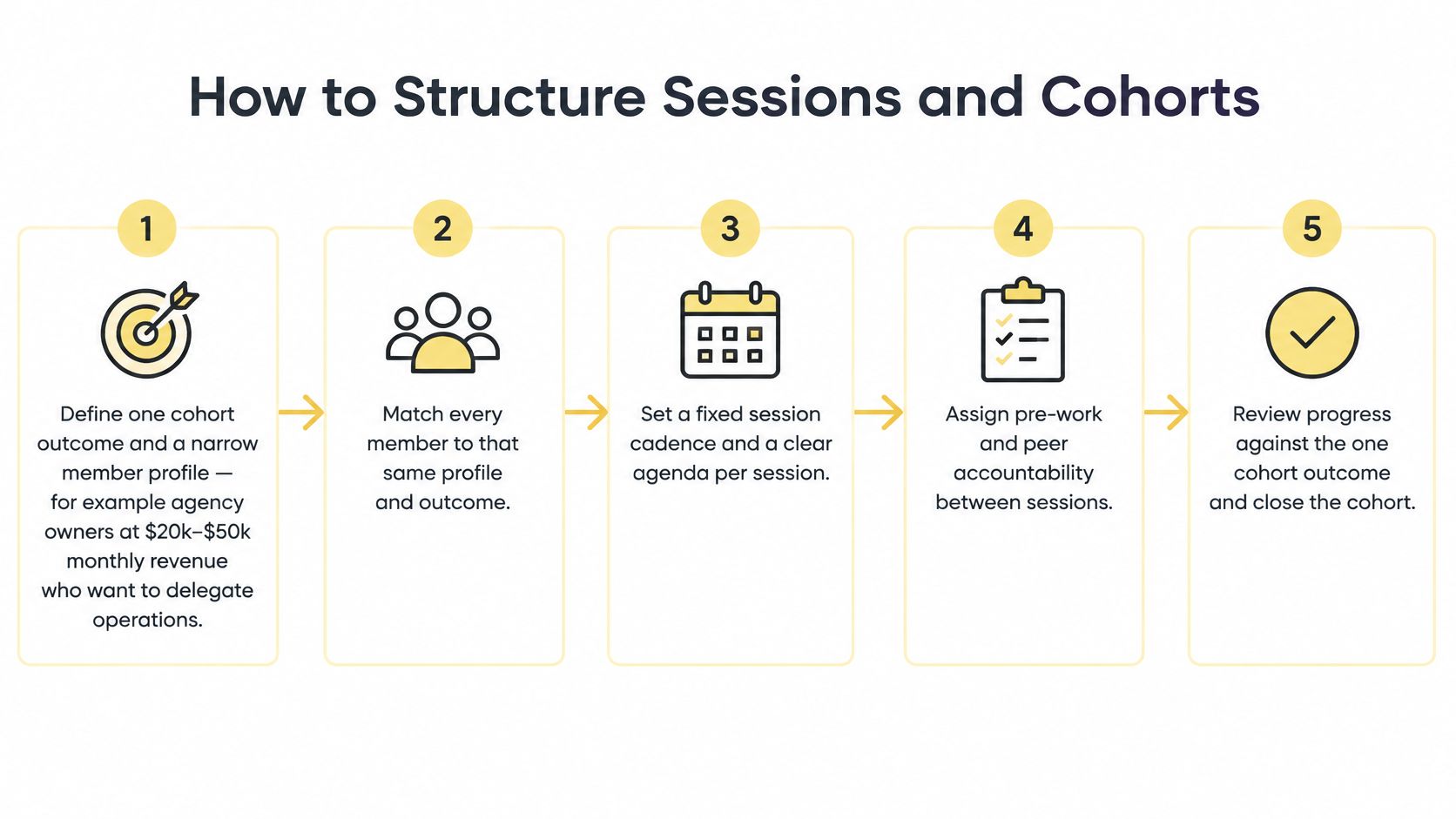
1. Define one cohort outcome and a narrow member profile. Not "business growth" but, for example, agency owners at $20k-$50k monthly revenue who want to delegate operations and stop being the bottleneck. The mistake is a mixed cohort of a pre-revenue freelancer and a $5m founder. Their problems don't overlap enough for peer advice to land.
2. Match size to the interaction the format needs. Discussion-heavy cohorts work at 6-10 members, because each person needs enough airtime for the peer layer to function. A curriculum-led workshop with a Q&A tail can carry 20 or 30. Answering "how big can this get before quality falls" doesn't require a universal rule: it requires you to name what each member must do in the room, then count how many can do it in ninety minutes.
3. Set cadence and length. Two 90-minute sessions per month for 12 weeks is a reliable default for owner-operators. Weekly for 8 weeks suits a cohort with a defined launch or hiring deadline. Anything longer than 12 weeks without a renewal checkpoint tends to lose energy.
4. Use the same session arc every time. Ten minutes checking last round's commitments, 20-30 minutes of teaching, two or three hot seats with structured peer inquiry, then ten minutes of writing new commitments into the shared log. The repetition isn't laziness. It's what lets members stop managing the process and start using it.
5. Plan the between-session layer. Implementation assignments, buddy pairs, a community thread for questions, and optional office hours. A cohort either becomes a group at this stage or dissolves into a recurring meeting.
6. Set attendance and catch-up rules before launch. A minimum live-attendance threshold, say 80%, published in the agreement. Rotating turn-taking. An anonymous question channel. A defined pathway for missed sessions.
Contrarian rule: flexibility isn't automatically good. Unlimited asynchronous participation improves access but can dissolve the shared rhythm and relational continuity that produce peer value. Offer flexibility with limits, or you end up with a collection of loosely connected individual clients who happen to share a calendar invite.
Scheduling rules for conflicting calendars
Time zones, caregiving, travel and shift work are the recruitment problem, so decide the default in advance:
- Shared work week: one fixed live slot per cohort, chosen once and held for the whole program.
- Split time zones: rotating times, alternating one evening and one daytime session, so no member always takes the loss.
- Travel-heavy members: asynchronous case reviews, capped at one per cohort so the live room stays the primary venue.
- Catch-up: office hours are for catch-up, not core teaching. Never let the teaching migrate there.
And the ceiling: a member who can't attend 80% of live sessions moves to a self-paced tier rather than drifting in and out. Quiet members get a fixed turn-taking order and an anonymous question channel so airtime doesn't default to whoever talks fastest.
How to Build Accountability and Measure Progress
The most useful reframe available is to treat a cohort as a longitudinal behavior-change intervention, not a sequence of inspirational meetings. In a quasi-experimental leadership-coaching study summarized in an academic review of coaching evidence, 22 participants who elected follow-on coaching were compared with 21 controls. After the intervention, the coached group reported more focused behavioral objectives, greater goal attainment and stronger links between new learning and their leadership roles.
The same review carries a warning that should shape every pricing conversation. An employee group-coaching program showed improvements in perceived physical and mental health and reduced stress during delivery, but outcomes moved toward baseline 12 weeks after completion. Without reinforcement, gains decay. That single finding justifies a follow-up layer and a renewal checkpoint in the offer.
| Indicator tier | What it captures | Example metrics | When to measure |
|---|---|---|---|
| Proximal engagement | Whether members show up and do the work | Attendance rate, assignment completion, peer feedback given | Every session |
| Behavioral change | Observable leadership and business behavior | Offers tested, sales conversations held, stakeholder-rated delegation, conflict management | Baseline, mid-point, end |
| Perceived change | Confidence, clarity and wellbeing | 1-10 self-ratings for confidence, decision clarity, stress, community | Baseline, end, +12 weeks |
| Lagging business results | Financial and operational outcomes | Revenue, margin, cash flow, staff retention, cycle time | Quarterly and 3-6 months post-program |
Timing discipline
Baseline before session one, never after. Mid-point at the halfway mark, so you can adjust the program while it still matters. End measurement at close. Then a +12-week follow-up, which is the only tier that tells you whether the change held.
The reinforcement layer
Schedule monthly peer sessions for the quarter after the cohort ends. Automate reminders for the assignments members committed to. Build implementation assignments that stand alone, so a member can complete them without a live call. Add a renewal checkpoint at the end of the follow-up window, framed as a decision rather than a pitch.
The reporting rule: commit in advance to the indicators your program is actually designed to influence, then report the change you observed. Not a guarantee, not an industry multiple, an observed result with the dropouts named.
A simple dashboard with four numbers on one screen does the job: attendance rate, assignment completion, goal progression and follow-up ratings. Keep engagement metrics visually separate from outcome metrics, because 100% attendance with no behavioral movement is a curriculum problem, and you'll only see it if the two columns don't blur. If you need a structure for tracking this per member, a cohort management workflow helps you keep session notes, milestones and attendance in one place rather than across three spreadsheets.
Research limitations deserve a line in your own reporting. Much group-coaching evidence uses small, non-controlled samples or suffers participant attrition. Use a comparison period or repeated measures where you can, and never present correlation as causal proof.
Worked Examples of Group Business Coaching Programs
Abstract pricing arguments become much easier once you see the numbers attached to a format. Three configurations, each with what the coach had to define up front.
The in-company leadership cohort. Six leaders from one business, $18,000 total. The ICF/PwC Global Coaching Client Study reported that 86% of companies that could calculate coaching ROI recovered at least their investment, with a median return of approximately 7 times the cost, as summarized by Stratos Coaching's business case for executive coaching. A 7x return on $18,000 implies $126,000 in attributable value, which is where most coaches get themselves into trouble. That figure covers coaching generally and proves nothing about your cohort. So the coach defines the value in advance: reduced regrettable turnover, faster strategic execution, or a measurable revenue improvement in a named line. Then reports what moved.
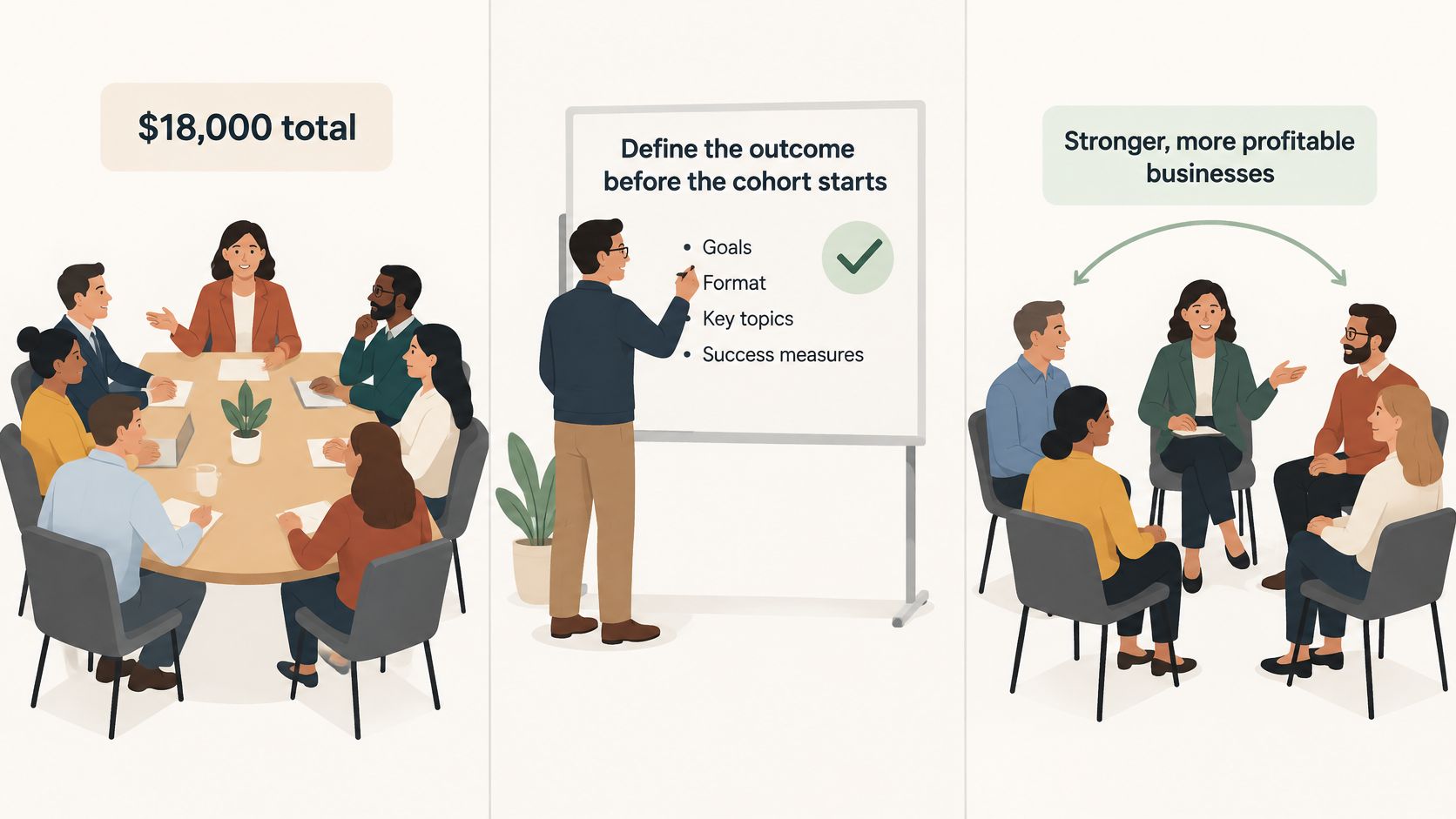
The peer-advisory group. Six founders share a $2,400 monthly cohort fee, $400 each, for two facilitated sessions a month plus buddy check-ins between meetings. Value defined in advance as decision cycle time and delegation of one named function per member. This is the most bankable format because the revenue recurs and the members renew in a group, not one at a time.
The tiered 12-week founder program. Self-study at the bottom, group delivery at $2,500-$5,000 per participant in the middle, and a VIP tier adding a set number of one-to-one sessions at the top. Capped at 12 members with hot seats rotating, so each member presents roughly every three to four weeks.
What protected quality in all three
- Capacity caps published in the offer, not applied informally when the roster gets awkward.
- Hot-seat rotation so the confident members don't absorb the airtime.
- Value metrics named before launch, written into the kickoff, referenced at close.
- A private path for confidential issues, which every group eventually produces.
Common Mistakes and Honest Limits
Four failure patterns account for most disappointing cohorts. All four are design decisions made before the first session, which means all four are fixable before the first session too.
Treating group delivery as discounted one-to-one. One member has a compensation dispute, a co-founder conflict or a personal crisis that doesn't belong in a room of peers. Forcing it in damages both the member and the cohort's safety. Build a VIP tier or a referral path, and say plainly in the offer that highly confidential or highly personalised issues may require separate one-to-one work. The members who need that path will respect you for naming it.
Designing for revenue instead of interaction. A bigger roster looks like an advantage until members stop getting speaking time and decide against renewing. Size the cohort to what the format requires each member to do, then cap it and publish the cap in the offer. A waitlist is a better problem than a dead room, and it gives you pricing evidence for the next cycle.
Ignoring attrition and quiet members. Every cohort contains both introverted and highly vocal participants, and when someone leaves, the damage spreads beyond the empty seat: pairs lose a partner, discussions lose a perspective, remaining members start wondering what the leaver knew. Use turn-taking, buddy pairs and anonymous question channels, and set the missed-session pathway before launch rather than improvising it in week five.
Overclaiming results. Group programs rarely prove causality against market shifts, peer networking, prior capability or survivorship bias. A 2025 review notes continuing weaknesses in how coaching mechanisms and outcomes are specified and measured, published in the Journal of Occupational and Organizational Psychology. The same review describes a group program where conventional professional-fulfillment and burnout instruments failed to capture what changed: community, agency, self-reflection, shared experience. If your measurement stack can't detect the value your format produces, your renewal conversations will run on anecdote.
The honest limit: group delivery is a format choice, not an effectiveness guarantee. Neither group nor one-to-one work is inherently superior. Each produces different benefits and different failure modes.
That last point is deflationary only if you were selling superiority. It's liberating if you're selling access. Group coaching is commercially defensible when it matches one-to-one outcomes at lower cost, or when it adds peer-network benefits a private engagement can't produce. Both claims are testable within your own cohorts: compare completion and outcome ratings across formats, and ask renewing members what they'd have paid for the peer contact alone. I'd rather run a program that makes a modest, provable claim than a flagship built on an assertion I've never checked.
Plan Your First Group Program
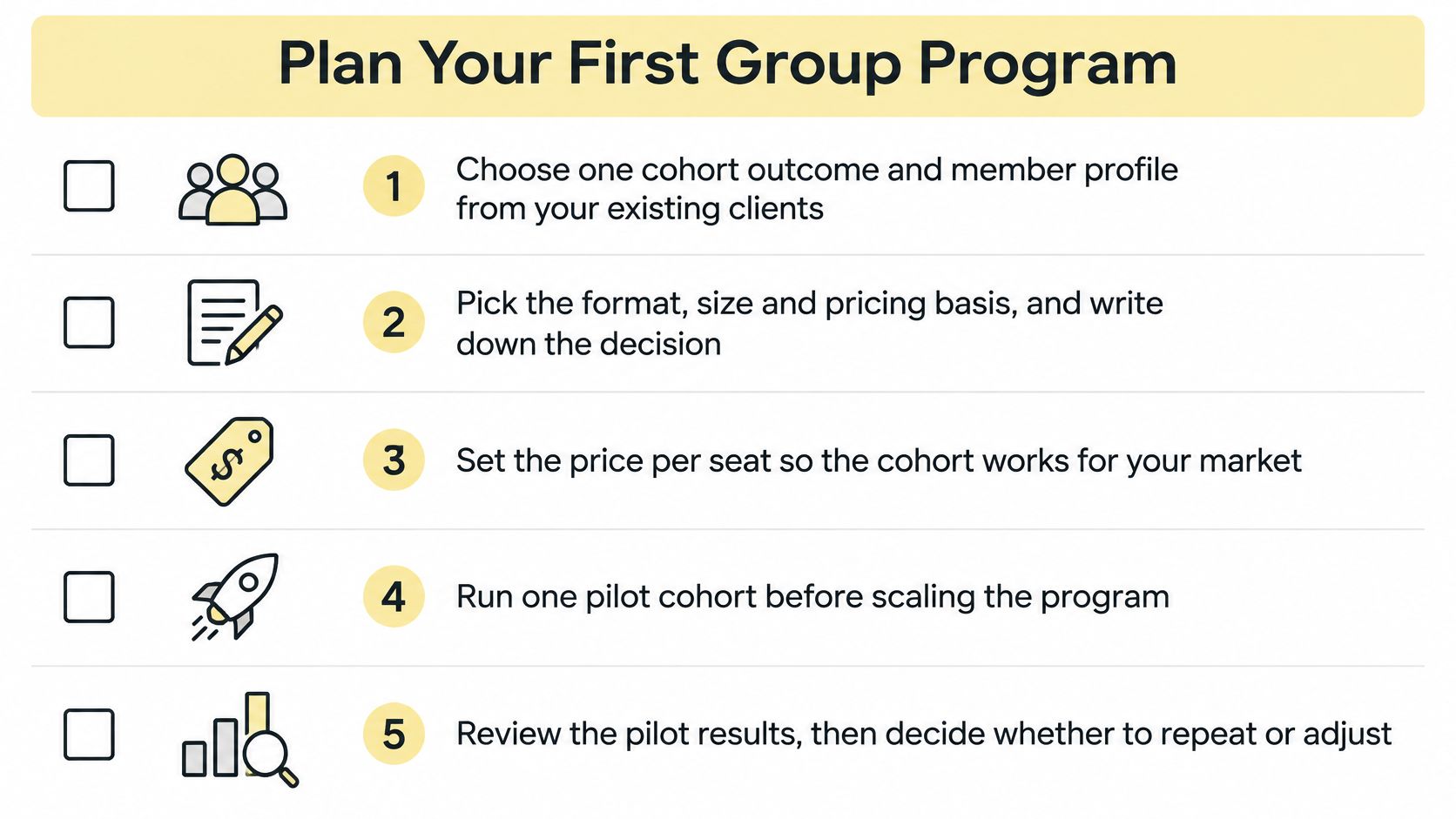
Don't launch a flagship. Run a pilot, measure it, and let the results decide whether you scale.
- Choose one outcome and one member profile from clients you already have. If you can't name five people who fit, the profile is wrong.
- Pick the format, size and pricing basis from the table, and write down the per-participant equivalent before you publish anything.
- Design the session arc and the attendance rules, including the scheduling default for your members' calendars.
- Set the measurement stack with a baseline collected before session one.
- Run six to eight members for one cycle, then review attendance, assignment completion and outcome ratings at 12 weeks. Adjust, then repeat.
Running that workflow across several cohorts gets messy fast if scheduling, payments, notes and progress live in four tools. Coachful brings scheduling, coaching CRM, payments, contracts, group coaching and progress tracking into one workspace, with Squads for cohort community and peer accountability. A single program can carry several tiers, such as self-study, group and VIP one-to-one, each with its own price and checkout link. Settle the pricing basis before you build the checkout, not after.
The admin load is also where a pilot dies. If you'd rather spend the setup time on curriculum than on logistics, it's worth looking at hire Latin American virtual assistants to handle enrolment, reminders and roster management while you run the room.
Group business coaching done well is a designed program: a stated pricing basis, attendance rules that make peer accountability real, and outcome tracking you'd be willing to show a finance director. Done badly, it's a cheaper meeting. The difference is entirely in what you decide before launch.
Coachful gives you one place to run the whole model: scheduling and payments, a coaching CRM that holds goals and session notes, group cohorts with community and peer accountability, and multi-tier programs where self-study, group and VIP one-to-one each have their own checkout. It's built for the version of group business coaching described here, where attendance, assignments and outcomes are tracked rather than assumed. Start with a pilot cohort and see how the workflow holds up at Coachful.