How to Get Coaching Clients From Facebook Groups: 5 Steps

Coachful
Editorial Team
You can get coaching clients from Facebook groups without running a group yourself: participate where your prospective clients already ask relevant questions, give a useful answer without attaching a pitch, and make your public profile a clear route to an optional enquiry. The boundary matters: a member’s post, like or thank-you is not permission to send a sales DM or add them to an email list.
If you have spent an evening answering questions and finished with three likes and no conversations, the answer is not necessarily to post more. You need to check the room, the usefulness of your contribution, and what an interested person finds after clicking your name. This five-step method helps you test those links without turning somebody else’s community into your prospect database.
This guide is about participating in other people’s existing groups. If you want to build and attract members to your own community, read our separate guide to promoting a Facebook group. Neither approach guarantees clients, and an unpaid channel still costs your time.
1. Choose groups by client fit, not member count
Start with the people you coach and the situation that makes them seek help. A career coach supporting experienced people returning after a break might investigate professional returner communities. A leadership coach might look for first-time manager discussions. A business coach serving independent designers might find more relevant conversations in a design-business community than in a group for other coaches.
These are search directions, not recommendations for specific groups. Membership rules, activity and suitability change. Read the description and rules before joining, answer membership questions honestly, and do not pretend to be a potential client to gain access.

Use four selection questions
- Audience fit: Are members actually the people you can help, rather than mostly peers selling to one another?
- Question quality: Do people ask concrete questions, and do substantive replies receive a real conversation?
- Rules and moderation: Is professional participation welcome, and can you contribute without hiding your commercial role?
- Effort: Can you be useful within a fixed weekly time budget?
Look at a small sample of recent threads rather than relying on a displayed member total. A busy feed full of promotional links may offer fewer useful opportunities than a smaller community with thoughtful exchanges. There is no universal minimum group size or posting frequency that establishes commercial value.
For a first test, select two groups, not twenty. Write one sentence about why each fits your audience, which questions you can responsibly answer, and what the rules permit. If you cannot explain the fit without saying “there are lots of people here,” keep looking.

Use broader market research to generate vocabulary, then validate it against the community itself. A content trend does not prove that a particular group contains suitable buyers. Keep only non-identifying research notes, such as “members often ask about preparing for their first management role,” rather than copying personal disclosures into a marketing document.
2. Answer the question completely before thinking about a lead
A useful contribution addresses the actual situation, offers a bounded next step, and acknowledges what you cannot know from a post. It should still be worthwhile if nobody ever visits your profile. “I help people with this, DM me” is a withheld answer wearing a helpful hat.
Choose questions within your competence. Avoid diagnosing someone, interpreting their partner’s motives, or prescribing a medical, legal or financial response. A public thread is not a coaching agreement, and personal details can be visible to more people than the writer expects.
Example: a useful leadership-coaching reply
Hypothetical member question: “I’ve just become a manager. Every time I delegate, the work comes back different from what I wanted. How do I stop redoing it?”
“Before the next handover, try writing down the outcome, the deadline and the decisions the other person can make without checking with you. Ask them to describe their understanding back, including where they might need help. That can reveal a mismatch before either of you has spent hours on the work. If the task involves a skill they haven’t learned yet, clearer instructions alone may not solve it.”
This answer gives an action, explains its purpose and leaves room for a different cause. It does not promise a result or use the person’s frustration as an opening for a sales pitch. You can identify yourself as a coach when relevant, but your title is not the useful part of the reply.
Three contribution formats worth testing
- A practical answer: Address one question and offer a small action the person can adapt.
- A worked example: Show a fictional example of a decision, conversation or planning exercise. Label it hypothetical.
- A helpful distinction: Separate two problems that need different responses, such as unclear delegation versus insufficient training.
Do not recycle the same paragraph across groups or reply to every vulnerable post. Repetition can be intrusive even when the words are polite. If you want to discuss client work, obtain appropriate permission and assess re-identification risk; removing a name does not automatically make a story safe to publish.
When your answer receives a thank-you, accept it. You do not need to turn the exchange into a private conversation. The aim is to demonstrate sound judgment in public, not to extract a lead from every interaction.
3. Make the public-profile handoff easy to understand
Someone who finds your contribution useful may look at your profile. They should be able to understand who you help, the kind of support you provide and where to learn more. They should not have to decode an inspirational slogan or navigate a maze of unrelated offers.
Review what a visitor can actually see under your privacy settings, using the viewing options Facebook currently provides. Do not assume a website link or business description is public just because you can see it while signed in. This is a visibility check, not a reason to expose personal information.

A simple profile description
“Leadership coach for first-time managers who want to delegate and hold clearer conversations. Explore my coaching approach and enquiry options at [your website].”
That is an original hypothetical example, not a promised outcome. Replace it with your actual audience and scope. Avoid invented credentials, unsupported income claims or a guarantee that somebody will become a different person in a fixed number of weeks.
Choose a destination that matches the interest you are creating. A practical career worksheet may suit someone exploring a problem. A service page may suit someone asking how your coaching works. A booking page makes sense when someone already wants to discuss working together. Do not force every visitor straight into a sales call.

On the destination page, explain who the support is for, what it involves, any important exclusions and the next step. If you collect an enquiry, tell the visitor what happens after submission and give a realistic response expectation that you can meet. Check the whole path on your phone, including links and form completion.
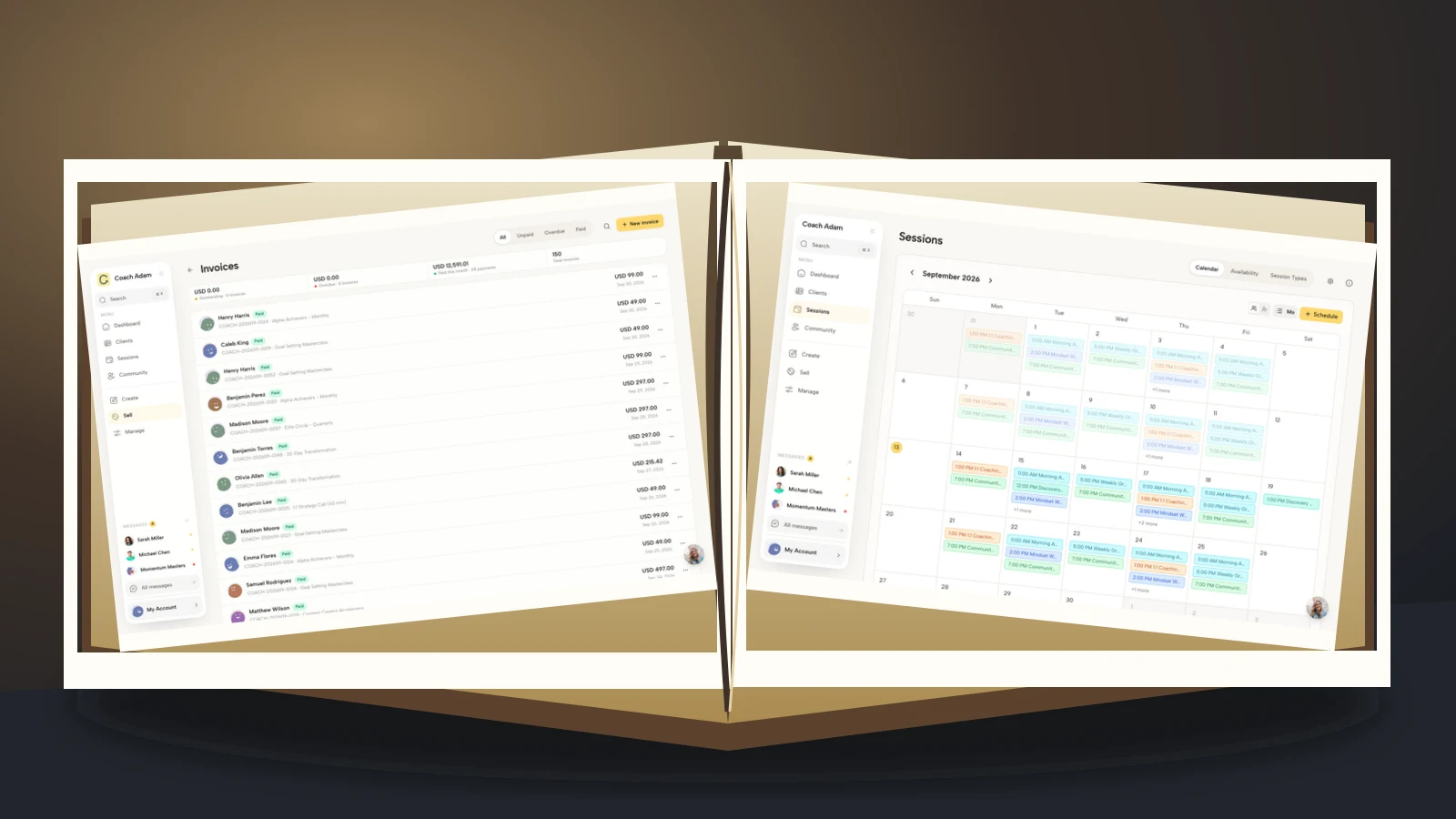
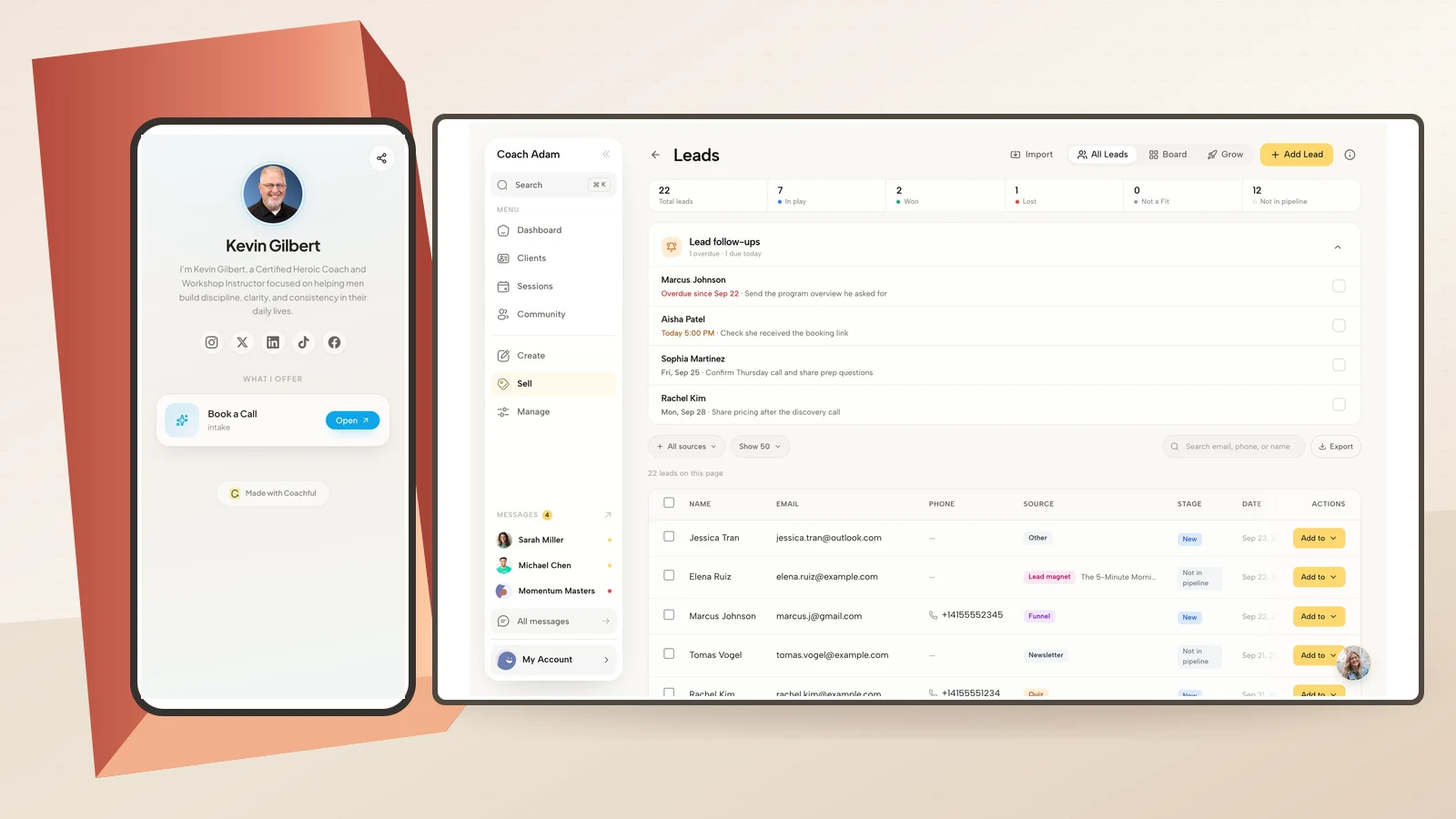
Coachful’s demo shows link management and a website editor that can help you inspect this downstream experience. These screens are not Facebook features, and they do not establish a connection that captures group members automatically. The visitor must choose to leave Facebook and contact you.
4. Move to a private conversation only with permission
There are separate decisions here: whether the group allows the interaction, whether the person wants a private conversation, and whether they want a commercial next step. Permission for one does not imply permission for the others. A reaction to your comment is not agreement to any of them.
When someone explicitly asks for more help
“Happy to explain the exercise further here. If you would prefer a private conversation, you can message me, provided that fits the group rules. Please don’t share confidential workplace information in the thread.”
Use this only when the invitation itself is allowed and appropriate. Some groups prohibit solicitation even when phrased gently. If the rules are unclear, ask the moderator a concise question before offering a private route. Do not use careful wording as a workaround for a clear prohibition.
When someone asks about paid coaching
“Yes, I offer coaching for first-time managers. I can send a short description of the scope, fee and how the initial conversation works if you would like it. There’s no obligation to book.”
If they agree, send what you offered. Do not turn a request for a description into a long qualification interview or an unrequested sales sequence. Make the price, commitment and limitations understandable before asking for a decision. A polite no ends the sales conversation.

Keep an enquiry form proportionate
A lightweight form can ask for a name, contact method, a short description of the coaching interest and the preferred next step. Let the person know how you will use the information and link to an appropriate privacy notice. Avoid asking for diagnoses, trauma histories or detailed employer disputes merely to decide whether to offer an introductory call.
A resource request and a newsletter subscription are also different things. Do not automatically subscribe someone because they requested a worksheet or emailed a question. Review the marketing and privacy rules applicable to your location and the recipient’s location; this article is not legal advice.

Once a person has enquired, keep the minimum operational record needed: their stated interest, where they say they found you, the next step they requested and any agreed follow-up. Do not scrape member lists, export commenters or store screenshots of somebody’s private group disclosure in your sales system.
For source tracking, “Facebook group, self-reported” may be enough. A public profile link with a simple campaign parameter can help identify visits if your analytics supports it, but it cannot prove which comment caused an enquiry. Never put a person’s name or sensitive situation into tracking parameters.

If a call is appropriate, give the person a clear booking route and explain its purpose. Is it a short fit conversation, a paid coaching session or a consultation with a sales component? Name it accurately. Keep any later follow-up to what you agreed, and stop when the person declines.
5. Run a small test and measure the right evidence
Begin with a four-week test of the process, not a promise that four weeks will produce a client. Reserve a manageable amount of time, such as two short participation blocks and one review block each week. This is an editorial starting point; adapt it to your capacity and the community’s rhythm.
- Week one: Read rules, assess the two groups, check your public profile and test the destination page.
- Week two: Contribute to questions where you have something specific to add. Note the topic, not private personal details.
- Week three: Continue useful participation and respond to genuine requests. Check whether the destination answers recurring questions.
- Week four: Review time spent, suitable enquiries and permission-based next steps. Decide what to keep, change or stop.
Track substantive contributions, requested conversations, suitable booked calls and clients who actually buy. Also track time and the quality of the fit. Likes and compliments may be encouraging, but neither is evidence of demand for your paid offer.

A worked example, not a forecast
Suppose a coach makes twelve substantive contributions, receives four requests for further conversation, books two suitable calls and signs one client. Four divided by twelve is approximately 33.3%. That is a descriptive ratio of requests to contributions in this fictional test, not a reliable conversion rate: the sample is tiny, one person may see several comments, and attribution is uncertain.
A more useful question is what happened at each handoff. Were the conversations with people you serve? Did the service page answer their questions? Did the call match what they expected? Did the time required make sense compared with another channel? Avoid announcing that one group “converts” after a single sale.
Use the result to choose a next move
- No relevant questions: Reconsider the group selection rather than increasing posting volume.
- Useful discussion but confused enquiries: Clarify your public description and destination page.
- Suitable enquiries but unsuitable calls: Make the scope, fee or call purpose clearer before booking.
- No commercial interest despite good participation: Reduce the effort or test another channel. A worthwhile community is not necessarily a useful acquisition channel.
Common questions coaches ask
Should I join groups for coaches or groups for clients?
For direct client acquisition, start with communities where the people you serve discuss relevant situations. Peer groups can still be valuable for professional learning and referrals. Keep those purposes separate instead of assuming every room should produce buyers.
Can I post my coaching offer in a promotion thread?
Only if the current group rules permit it, and only within their limits. Make your role and offer explicit, avoid unsupported claims, and do not treat permission to post as permission to message everyone who interacts. A permitted promotion is an option, not a requirement.
Do I need my own Facebook group first?
No. Participating responsibly in an established community does not require you to run one. Building your own group creates a separate moderation and content commitment. Choose it because that community has a useful purpose, not because another coach says every business needs one.
How quickly should I expect a client?
There is no defensible universal timeline. Audience fit, trust, offer suitability, availability and the buying decision all matter. Use the initial test to assess your process and the evidence of fit, not to set an invented deadline for revenue.
Build the destination before increasing the activity
The useful sequence is straightforward: choose an appropriate community, contribute something worthwhile, let interested people choose the next step, and keep the handoff honest. You do not need to persuade someone in every thread. You need to make it possible for a suitable person to understand and request your help.
Before your next participation block, inspect the page and enquiry path an interested visitor would see. If you want to examine how coach links, website pages, forms, leads and scheduling can support that voluntary handoff, try the Coachful interactive demo. It shows the downstream workflow, not a tool for posting to groups or harvesting their members.
Sources and editorial boundaries
Search intent and practitioner language were checked against Debbie Shadid’s episode on Facebook group marketing for coaches and Kaido’s guide to participating in groups you do not own. These are practitioner perspectives, not controlled evidence of acquisition results. Their anecdotes and timing claims are not used as benchmarks here.
The five-step test, scripts and fictional measurement example are original editorial guidance. The real Coachful demo screenshots show generic product surfaces, not actual campaign performance, a Facebook integration or an implemented lead-generation campaign. Check current group rules and applicable privacy and marketing requirements before putting the method into practice.