Cash Flow Forecast Template for Coaches: A 13-Week Example

Coachful
Editorial Team
Can I pay myself this week without leaving the coaching business short next month? Use a rolling cash flow forecast, not your sales total: start with usable bank cash, add the money you reasonably expect to receive each week, and subtract every payment you expect to make. Look for the lowest balance before deciding what to spend.
A corporate invoice can look reassuring while the money is still several weeks away. An upfront package can make the bank balance look generous while you still owe months of coaching. Those are timing problems, and a profit figure alone will not solve them.
This cash flow forecast template for coaches uses thirteen weekly columns, a four-week worked example and a simple late-payment test. All amounts are hypothetical currency units. It is a management tool, not a statutory cash flow statement, tax calculation or individualized financial advice.
What belongs in a coaching cash flow forecast?
A forecast estimates when money will enter and leave the business. A profit and loss statement answers a different question: what revenue and expenses belong to a reporting period under your accounting policy. An invoice, a coaching session and a bank deposit can fall on different dates.
Xero’s cash flow template guidance describes the purpose as putting expected income and costs on a timeline to support spending decisions. The coaching-specific challenge is connecting that timeline to package installments, corporate payment terms, prepaid delivery and your own drawings.
Use one reporting currency and define the bank accounts included. If your forecast covers only the operating account, a transfer to a separate tax account is an outflow from that account. If it covers both accounts together, that internal transfer is not money leaving the business. Choose one boundary and keep it consistent.
1. Start with cash you can actually use
Enter the cleared opening balance for the accounts you are forecasting. Do not add unpaid invoices, unsigned proposals or the advertised value of your packages. A processor balance awaiting payout is not already in the bank; show its expected settlement separately if relevant.
Then identify money you should not casually spend: tax reserves, deposits with refund obligations, restricted funds or amounts needed for committed delivery. Your accountant can help distinguish legal restrictions from your own prudent earmarking. Neither should disappear because you would prefer a more comforting number.
You can show a total cash balance and a separate reserved-cash line, or forecast one operating account after a clearly documented reserve transfer. Do not deduct the same reserve in both places. A reserve is not automatically an expense, and moving money between your own accounts does not create a new tax deduction.
Pick a minimum operating balance for this forecast. Base it on actual commitments and uncertainty, not a universal rule about how many months every coach needs. You will compare the weekly closing balances with this floor. The example below uses 2,500 solely to demonstrate the decision.
2. Put receipts in the week they are likely to arrive
List expected receipts by client or payment reference before summarizing them into weekly totals. Useful fields are the reference, amount, contractual due date, expected arrival date, evidence and collection status. Keep confidential coaching details out of the finance sheet.

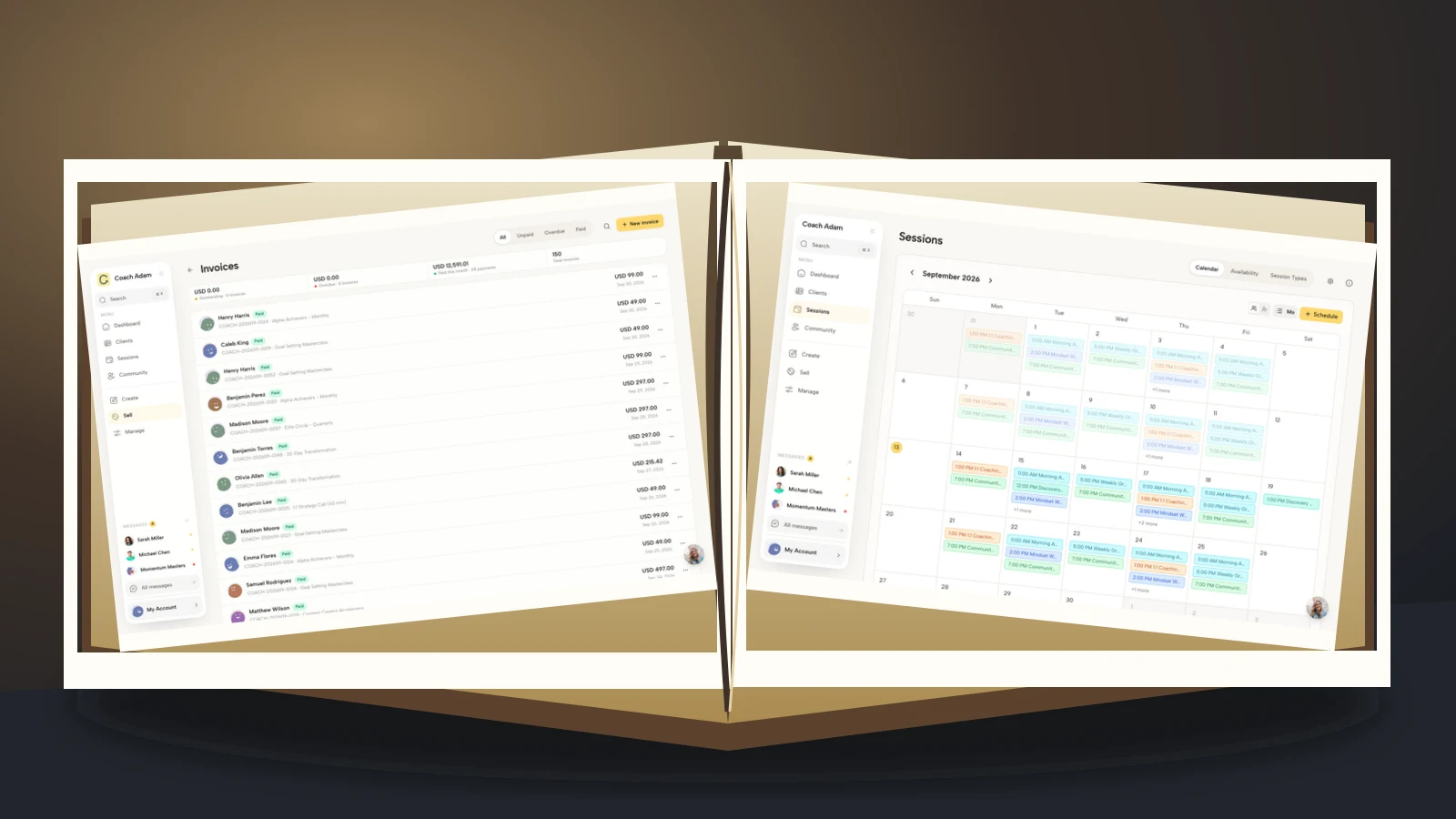
The real Coachful demo invoicing screen illustrates a source record, not a cash forecast. Check the underlying invoice and payment record, then reconcile expected receipts with the processor and bank. A paid label does not tell you that the money has settled into the account covered by your forecast.
- Existing package installments: enter each expected collection separately, considering known payment problems.
- Corporate invoices: check the purchase order, agreed terms, submission requirements and any known approval delay.
- New sales: keep speculative enquiries outside the committed-receipts view. Use a separate scenario for credible but unconfirmed sales.
- Processor payouts: forecast the expected bank receipt, with fees and deductions handled consistently.
- Other funding: identify owner contributions or borrowing separately. They are not coaching sales.
Do not give an overdue invoice a fresh optimistic arrival date every Monday without new evidence. Contact the appropriate accounts-payable person, check whether anything blocks payment and update the assumption. If the date is uncertain, test a later-receipt scenario rather than silently treating hope as cash.

An offer catalog helps you identify the terms behind a sale. It is not a receivables list. If a package costs 1,800 but the buyer pays in three installments, forecasting all 1,800 in the first week defeats the purpose of the exercise. Use the actual agreement and expected collection dates.
3. Include payments that never appear on a coaching dashboard
Gather bank transactions, supplier bills, renewal notices, contractor agreements, tax deadlines and planned personal transfers. Coaching software can provide client-facing records, but it does not necessarily know about your accountant, insurance renewal, equipment purchase or rent.
Group outgoing cash into a few lines you can maintain: delivery costs, recurring overhead, marketing, refunds, taxes, debt payments, equipment and owner payments. Separate contractual commitments from optional spending so you can see which levers are real. Do not assume every future cost can be canceled immediately.

A program library can remind you what you have sold and still need to deliver. Check the actual program commitments and contractor agreements before budgeting facilitation, materials or support. A program thumbnail is not evidence of a delivery cost or an unpaid supplier bill.
Owner drawings belong in this cash plan even when they are not operating expenses in the profit and loss statement. Salary, dividends and drawings have different legal and accounting treatment. Use the correct category for your entity, and ask your accountant before treating business cash as personal spending money.
Include payments when cash is expected to leave. An annual insurance premium is one payment on its expected date, not thirteen equal weekly payments simply because that makes the chart smoother. Conversely, do not put the full value of a future contract into this week unless that amount is actually payable now.
4. Copy the thirteen-week spreadsheet structure
Create a worksheet with column A for the row labels and columns B through N for weeks one through thirteen. Use real week-ending dates in the column headers. Put assumptions and source references on a separate tab, and mark whether each completed week contains actuals or forecasts.
Use this compact row layout. The formulas below assume the first week is column B; adjust them if you add rows. Expenses are entered as positive amounts, then subtracted in the closing-balance formula.
- Opening cash: row 2. Enter the starting balance in B2.
- Existing-client receipts: row 3.
- Confirmed new-client receipts: row 4.
- Other cash in: row 5, with funding labeled separately in your detail tab.
- Total cash in: row 6. B6 is
=SUM(B3:B5). - Delivery payments: row 7.
- Overhead and marketing payments: row 8.
- Taxes, debt, refunds and other payments: row 9, supported by separate detail.
- Owner payments: row 10.
- Total cash out: row 11. B11 is
=SUM(B7:B10). - Net cash movement: row 12. B12 is
=B6-B11. - Closing cash: row 13. B13 is
=B2+B12. - Minimum operating balance: row 14.
- Headroom above the minimum: row 15. B15 is
=B13-B14.
For week two, C2 is =B13. Carry the formulas across to week thirteen. Use =MIN(B13:N13) to find the lowest forecast closing balance, and =MIN(B15:N15) for the lowest headroom. Check these formulas with a small example before trusting them.
Monthly forecasts suit longer-range planning, but weekly columns expose a payment squeeze hidden inside a reasonable-looking month. Thirteen weeks is an editorial starting point, not a compliance requirement. A coach facing an immediate shortage may also need a daily view of the next few payments.

A four-week example: positive cash, uncomfortable timing
Imagine a solo coach starts with 5,000 in the operating account. The forecast already includes the planned owner payments in cash out. There is no sales tax, borrowing, foreign currency or separate restricted account in this simplified example.
- Week 1: opening cash 5,000; receipts 1,200; payments 1,800; net movement −600; closing cash 4,400.
- Week 2: opening cash 4,400; receipts 600; payments 2,200; net movement −1,600; closing cash 2,800.
- Week 3: opening cash 2,800; receipts 2,400; payments 1,700; net movement 700; closing cash 3,500.
- Week 4: opening cash 3,500; receipts 900; payments 1,500; net movement −600; closing cash 2,900.
The lowest closing balance is 2,800 in week two. Against the example’s 2,500 minimum, that leaves only 300 of headroom. The business does not run out of cash in this base case, but that is not the same as having room for an unplanned personal transfer.
Extend the remaining nine weeks using the same structure. Do not fill them with zeros unless zero is the real assumption. Include known annual renewals, later package installments and delivery payments even when they sit beyond the four-week example shown here.
5. Move one receipt and see whether the decision changes
Now assume the 600 expected in week two arrives in week three instead. Nothing else changes. Week two closes at 2,200, which is 300 below the chosen minimum. Week three closes at 3,500 because the delayed 600 arrives then; week four remains 2,900.

The four-week total receipts are unchanged, but the temporary shortage is real. That is why a cash forecast should show timing rather than merely divide expected monthly income by four. The decision is to address the week-two gap before it arrives, not admire the eventual total.
Possible actions include reducing a discretionary owner payment, postponing an optional purchase, confirming the invoice approval path or agreeing different terms for future contracts. Do not change a current client’s payment terms unilaterally or spend tax reserves as though they were spare profit. Seek professional help early if you may be unable to meet obligations.
Keep the base case and downside case side by side. Avoid a probability-weighted receipt that nobody can actually pay: half of a possible 2,000 sale is not a guaranteed 1,000 deposit. Scenarios are often more interpretable for a small practice with a few large invoices.
Prepaid packages need a delivery check as well
An upfront payment enters the cash forecast when you expect to receive it. It does not automatically become available for any purpose. You still need to fund the work promised, honor applicable refund obligations and account for the receipt correctly.

The real Coachful demo bundle library illustrates packaged commitments. If a bundle includes coaching and a course, do not add the component list prices as additional receipts after recording the buyer’s payment. A single payment is not several different sources of cash.

Check future delivery against the calendar before using prepaid cash to fund another launch. A busy calendar is not a bank forecast, but it can reveal the work attached to money you have already collected. Include associated contractor or venue payments when they are actually due.

Maintain a short commitment register beside the forecast: client reference, remaining delivery, expected direct cash cost, relevant refund terms and planned completion. Keep judgments about accounting recognition with your accountant. The register is a practical cross-check, not an invented liability valuation.
Review the forecast once a week
Replace the completed week with actual bank movements, explain material differences and roll one new week onto the end. Preserve a dated copy before changing assumptions so you can learn whether receipts regularly arrive later or costs regularly exceed the plan.
- Reconcile: match the bank and relevant processor movements without counting them twice.
- Refresh: update expected dates from current evidence, not last week’s wish.
- Inspect: find the lowest balance and the earliest week below your minimum.
- Decide: assign one action, one owner and a deadline before the payment date.
If the bottleneck is finding the client-facing invoice, offer or package behind a number, try the interactive Coachful demo and inspect those records. Keep the forecast in your spreadsheet or suitable accounting system. The demo screens do not establish a native cash forecasting feature, automatic accounting integration or bank reconciliation service.
Frequently asked questions
Is a cash flow forecast the same as a profit and loss statement?
No. A forecast estimates future cash movements. A P&L reports revenue and expenses under an accounting policy. Use the separate coaching profit and loss template for that reporting decision, not as a substitute for checking payment dates.
Should I include unpaid coaching invoices?
Include expected collections in the week you reasonably expect the money to arrive, with the assumptions visible. An unpaid invoice is not opening bank cash. If payment is doubtful, show that uncertainty in a downside case and follow up through your agreed process.
Should processor fees be shown separately?
Either forecast gross receipts with the related fee outflow or forecast the net bank payout, provided the treatment is consistent and clearly explained. Do not subtract the same fee again after using a net payout. Real settlements may also contain refunds, reserves or other adjustments.
Can I use the lowest balance as my personal spending allowance?
No. The lowest balance reflects the assumptions and account boundary you chose. Tax, delivery commitments, refund exposure, debt and entity rules still matter. A forecast supports a decision; it does not authorize a drawing, dividend or salary payment.
Make one cash decision before the next Monday
Start with the bank, enter the next thirteen weeks and test one late receipt. Then decide what needs changing before the lowest-balance week. The useful number is not how much you sold. It is how much cash remains when the next obligation falls due.
Sources and limits: Xero’s template guidance supports the forward-looking purpose of a cash forecast. The spreadsheet design, thirteen-week horizon, example amounts, scenarios and review routine are original editorial suggestions. They are not industry benchmarks or personalized accounting, tax, investment or legal advice.