How to Run a Paid Book Club as a Coach: 7 Setup Steps

Coachful
Editorial Team
To run a paid book club as a coach, sell a facilitated application experience, not access to a book. Choose one audience and one practical question, pilot a short reading cycle, and make the fee cover discussion, original exercises and your hosting. Members buy or borrow the book separately. Start with a fixed end date before promising a permanent membership.
The question is whether people will pay you to discuss something they could read alone. They might, when you help them test ideas against real decisions. A recurring conversation with no purpose beyond finishing chapters is a harder offer to explain.
This guide is for coaches building an ethical, manageable small-group offer. It includes a sample offer, a 60-minute agenda, discussion prompts, a pricing method and a launch checklist. All examples are hypothetical, not Coachful customer stories or income claims.
Should your coaching practice offer a paid book club?
A book club fits when your audience already shares a question and you can facilitate that question competently. Career changers might examine how they evaluate options. New managers might compare approaches to delegation. Business owners might test one planning habit between meetings.
Do not launch because a membership sounds like easy recurring revenue. Reading the book, preparing prompts, hosting, moderating and supporting access are real work. If you want a passive product, this is the wrong format.
Distinguish three offers before choosing a name:
- Reading community: the main benefit is conversation and belonging around books.
- Facilitated application club: the main benefit is interpreting an idea, comparing perspectives and testing it in a member's context.
- Group coaching program: the main benefit is a clearly contracted coaching relationship and participant-led goals; the book is supporting material.
None is automatically more valuable. They create different expectations. If you advertise coaching, explain your role, boundaries, confidentiality limits and how individual goals will be handled. Do not describe a reading discussion as therapy or suggest that a particular book can treat a health condition.
1. Define the reader, the question and the finish line
“A personal development book club for everyone” is easy to announce and difficult to choose. Narrow the first cycle around a situation your existing audience recognizes. You are not choosing a lifelong niche; you are giving this particular invitation a reason to exist.
Use this offer sentence: “For [specific people], a [duration] facilitated reading group to explore [practical question], with [meetings] and [original application activity].” Keep the promise about the experience you control, not a guaranteed personal transformation.
For example: “For first-time managers, a four-week reading group exploring how to delegate without taking every task back, with two live discussions and a small workplace experiment between them.” That is clearer than “Become an exceptional leader through the power of books.”
A useful finish line is an artifact members can create: a delegation conversation outline, a career decision checklist or a personal experiment plan. An artifact gives you a way to structure the discussion without claiming everyone will achieve the same result.

Before selecting a title, ask a handful of suitable contacts whether this question matters to them. Ask what they have already tried and what would make a reading group impractical. Treat answers as research, not an invitation to put people on a mailing list without permission.
2. Choose a book people can access and discuss honestly
Pick the book for the question, not because it is fashionable or you have an affiliate link. Read it yourself. Check whether its central claims deserve scrutiny and whether members can disagree without the discussion collapsing into a defense of the author.
Screen candidates against five practical tests:
- Relevance: several sections directly illuminate your group's question.
- Access: participants can obtain suitable editions, including accessible formats where needed.
- Workload: the assigned reading fits the time your audience realistically has.
- Discussion quality: the book permits comparison, disagreement and application, not just summary.
- Scope: the subject stays within your competence and does not require you to give clinical or regulated advice.
Tell members which edition you are using. Refer to chapters and section titles rather than relying entirely on page numbers, because print, ebook and audio versions can differ. Offer an original orientation note so someone who falls behind can still understand the session's question.
Do not upload a purchased ebook, scanned chapters or the author's workbook into your membership. Buying a copy does not grant redistribution rights. Ask members to acquire their own lawful copy and make your supporting resources original. For substantial extracts, recordings or commercial reuse, seek permission or qualified advice.
The U.S. Copyright Office explains that fair use is evaluated case by case. It is not a universal word-count allowance, and other jurisdictions have different rules. Naming a book and discussing ideas is different from distributing its protected content.

3. Package one finite cycle before a subscription
A fixed pilot gives both sides a manageable commitment. Choose one book, a start date, an end date and a small number of meetings. You can invite members into another cycle later; you do not need an indefinite subscription to validate the format.
A fictional first offer might include four weeks of participation, two 60-minute facilitated discussions, one original reflection sheet and a moderated discussion space. The book is not included. No private coaching, emergency support or unlimited direct messaging is included.
State all of that before payment. Also explain meeting times and time zone, access requirements, the minimum enrollment decision, cancellation terms, whether sessions are recorded and how long materials remain available. If enrollment is insufficient, specify whether the cycle will be cancelled, refunded or offered on revised terms with consent.

For a discussion-led pilot, choose capacity from the time available for participation rather than the maximum your call software permits. Eight people in a small group is a different facilitation task from thirty. If you admit a larger group, explain the use of breakouts, written contributions or rotating speaking opportunities.
Keep the relationship with your other services honest. A paid club can stand alone. If you offer individual coaching afterward, make that optional and separate. Do not sell a substantive paid experience and then turn every meeting into a discovery-call pitch.
4. Set a price from the work, not the book's retail price
Members are not paying you to resell the cover price. They are paying for preparation, facilitation, original resources, coordination and the experience of the group. Your pricing decision should reflect those inputs and what your audience is willing to buy.
Estimate the complete delivery workload first: reading or rereading, session preparation, live meetings, moderation, administration and the end-of-cycle review. Add direct costs such as software allocation, venue hire or an agreed guest fee. Include the cost of making your own materials accessible.
A planning formula is: required pilot revenue = delivery hours × internal hourly target + direct costs. Divide that by a conservative number of paying members to get a working seat price before taxes, payment fees and any additional margin or contingency.
Hypothetical arithmetic: ten hours at an internal target of $60 per hour, plus $120 in direct costs, requires $720. At eight paid seats, that is $90 per seat before those additional adjustments. These are invented planning inputs, not market rates, recommended prices or projected earnings.
If the audience will not buy at a sustainable price, change the format or do not run it. Reduce preparation complexity, choose fewer meetings or run the experience inside an existing paid program with transparent scope. Filling the gap with unpaid evening moderation does not make the offer viable.

If you invite a guest author or use an affiliate link, agree any fee, rights and disclosure in advance. Do not promise an appearance you have not confirmed. Avoid pricing the club around hoped-for coaching conversions that may never happen.
5. Run a discussion that becomes a useful experiment
The common failure is a long tour of everyone's favorite quotation. Your job is not to recap the book in order. It is to create a conversation in which participants can examine an idea, notice its limits and decide whether to test anything.
Here is a suggested 60-minute agenda, not a required method:
- 0–5 minutes: welcome, participation options and a reminder of group agreements.
- 5–15 minutes: each person names one question or point of disagreement.
- 15–30 minutes: explore one central idea and where it may not apply.
- 30–45 minutes: connect the idea to real situations without exposing confidential third-party details.
- 45–55 minutes: members choose a small experiment or deliberately choose no action.
- 55–60 minutes: close with the next reading assignment and a brief process check.

Prepare prompts that go beyond “What did you think?” Try: “Which assumption in this chapter would not hold in your situation?” “What would an alternative explanation be?” “What is small enough to test before the next meeting?” “What evidence would make you abandon this idea?”
For the hypothetical managers' club, a member might choose to clarify the decision authority for one delegated task. They do not have to announce a company-wide leadership transformation. At the next meeting, ask what happened, what surprised them and whether they want to change the experiment.
Do not force disclosure or action to make the group look engaged. A participant may pass, contribute in writing or disagree with the premise. Keep advice-giving bounded: ask permission before peers suggest solutions, and separate personal examples from universal instructions.

6. Make the between-meeting space small and safe
You do not need a busy community feed to deliver a good book club. Give the space a narrow job: publish the reading assignment, collect questions and offer one optional experiment check-in. More notifications are not proof of more value.
Pin a welcome note with the current reading, next meeting time, access information and where to ask administrative questions. Explain your moderation hours and expected response window. If the club does not include direct coaching support, say so plainly.

Group confidentiality is an agreement you request, not a guarantee you can make. Ask members not to share identifying workplace or client information, repeat others' disclosures outside the group or take screenshots without permission. Explain how you will respond to breaches.
Decide about recording before enrollment. Recording a short teaching segment is a different proposition from recording members discussing their lives. A written facilitator recap with no attributed personal disclosures may be more appropriate. Obtain meaningful consent for anything recorded and provide participation options.
Accessibility belongs in the design, not the apology afterward. Ask privately about relevant access needs, choose readable original documents, provide session logistics in writing and investigate captioning options for your chosen meeting tool. Do not ask participants to disclose a diagnosis to explain a simple format preference.
7. Invite the right people, then review before renewing
A first invitation needs a relevant question, the book title, the experience, practical terms and one clear enrollment or inquiry path. Tell people what they will actually do together. Avoid implying the author endorses your club or that participation guarantees a particular coaching outcome.
Here is a fictional invitation you can adapt:
I'm piloting a four-week reading group for first-time managers who want to examine how they delegate. We'll use [book and author] as a starting point, meet twice to discuss the ideas, and each choose a small workplace experiment.
The fee is [amount]. Please obtain your own copy of the book. Meetings are [dates, times and time zone]. The group includes an original reflection sheet and a moderated discussion space, but not private coaching.
If this is relevant, read the participation details and cancellation terms here: [your page]. Questions about fit or access are welcome before you decide.

Share it where you have permission and a relevant relationship. Do not add book buyers, group members or event contacts to marketing campaigns without an appropriate basis. If a partner introduces the club, agree who will communicate and avoid transferring personal data unnecessarily.
At the end, review actual delivery hours, paid enrollment, attendance patterns, access problems and what participants found useful. Ask which parts they would keep, remove or change. A private evaluation is not permission to publish a testimonial.
Choose among three honest next steps: repeat the cycle, change the offer or stop. Do not automatically renew people into a new book, new schedule or new price they have not agreed to. If you offer an ongoing membership later, make billing and cancellation terms explicit.
A practical setup path in Coachful
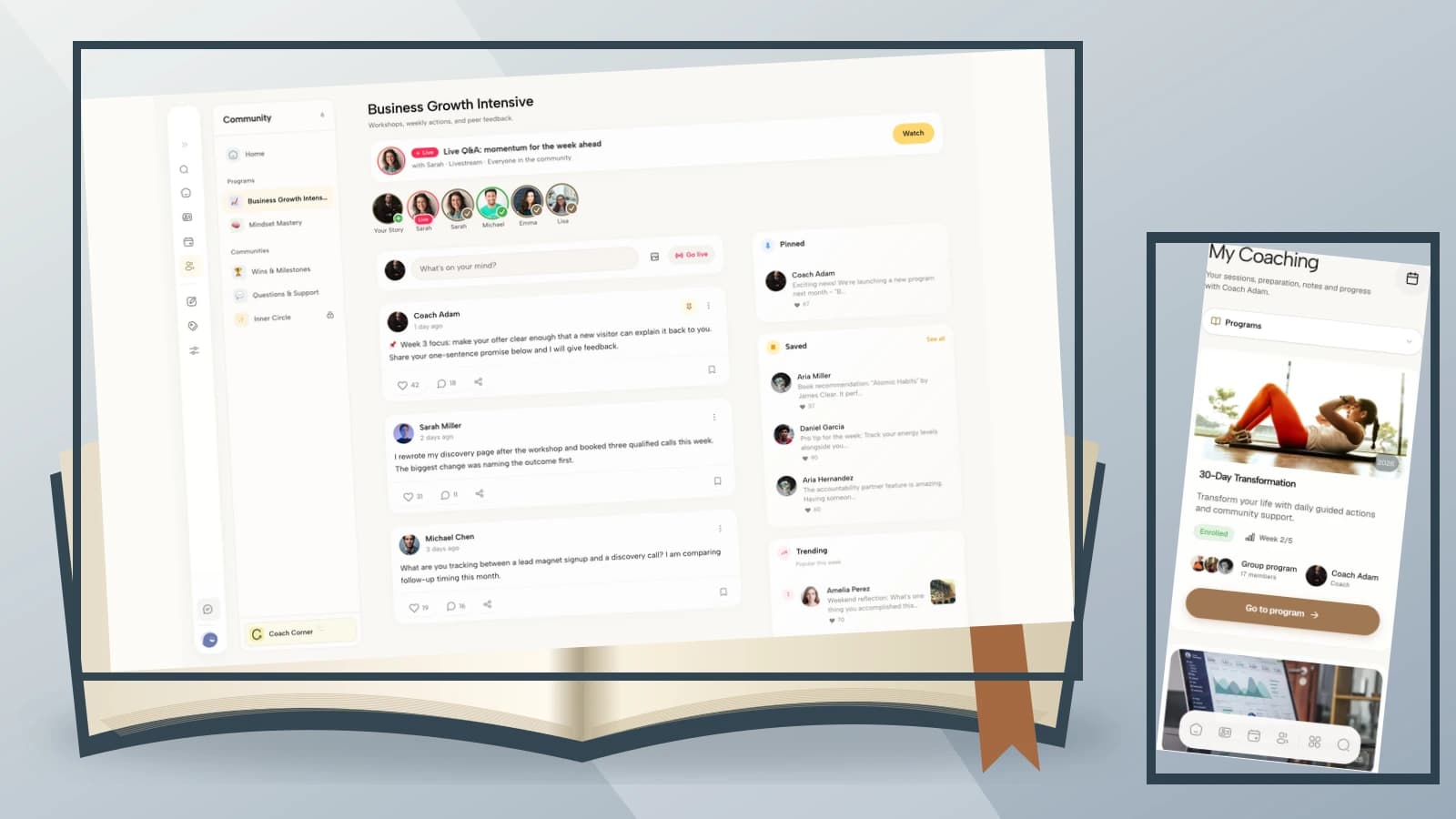
Once the offer is clear, map the administrative jobs: a program outline, the enrollment offer, meeting dates, member discussion and participant communication. The real Coachful demo screens above show those surfaces. They are not a prebuilt book-club template or proof of a particular club's results.
Before committing to any platform, test the actual member journey: can someone understand the offer, join, find the assignment and locate the next meeting without asking you? Then check whether the access and billing rules match what you advertised. Do not assume that a screenshot proves a specific automation or permission setting.
If you want to inspect that setup before building your pilot, try the interactive Coachful demo. Look at programs, the community experience and scheduling with your proposed reading cycle beside you. The point is to check fit for a defined offer, not buy software in the hope that a book club will invent itself.
Frequently asked questions
Can a coach charge for a book club?
You can charge for your own facilitation, original resources and the experience you provide, while handling rights, tax and consumer obligations appropriately. Do not treat that as permission to reproduce or distribute the author's work. Check the relevant rules for your location and seek qualified advice where needed.
How often should a coaching book club meet?
Choose a rhythm your audience can prepare for and you can sustain. A short pilot with two discussions can test the experience without a long commitment. Set the reading workload first, then select dates; do not promise weekly meetings merely because memberships often do.
What if a member has not finished the reading?
Let them participate within the expectations you announced. Offer an original outline of the discussion question, not an unauthorized substitute for the book. Invite listening or written reflection without shaming them, and review whether the assigned workload was realistic.
Should the book club lead to a coaching package?
It may, but it should still deliver the value members paid for. An optional coaching invitation belongs at a clear, appropriate point, not inside every discussion. Build the club to be worth attending even for someone who never buys your other services.
Start with one question, one book and one finish line. If members can describe what the experience helped them examine or try, you have something useful to evaluate. That is a stronger foundation than a perpetual subscription built around the promise to read more.