
How to Start a Mentoring Program: Design, Match, Measure

Coachful
The spreadsheet has 34 names on it. Twelve senior people volunteered three weeks ago, eleven pairs were supposed to have had a first call by now, and four did. Two pairs wrote to say they'd pick things up after quarter end. One mentor hasn't replied at all, and you're deciding whether a second chase makes you look desperate.
Nothing has broken yet. This is what a mentoring program looks like in week three when the enthusiasm is real and the structure isn't. Every pair is working out whether the commitment is optional, and the answer they land on becomes the program's culture.
The decisions that prevent that drift all happen before the first volunteer is approached: who the program is for, how long a match runs, how many mentees one mentor carries, and what "working" gets measured against at day 90. Get those wrong and no matching algorithm rescues you.
Write a Program Charter Before You Recruit
Advice on how to start a mentoring program usually begins with recruitment. It should begin a week earlier, with the charter. The standard mistake is to email the leadership team, collect thirty raised hands, and only then work out who the program is for. Every conversation after that point is a negotiation with people who have already said yes.
A one-page program charter costs an afternoon and prevents most of what goes wrong in month two. It answers eight questions in writing, and the entire value sits in how specific the answers are. "Anyone who wants mentoring" isn't a participant group. "First-year managers at a 200-person firm who stalled after their first promotion" is.
Charter decisions and the warning signs of a vague answer
| Decision | Question to answer | Example answer | Warning sign |
|---|---|---|---|
| Participants | Who is the program for? | First-year managers at a 200-person firm | "Anyone who wants mentoring" |
| Problem | What gap does it close? | Managers stall after their first promotion | No measurable gap is named |
| Outcomes | What changes, and by how much? | Goal progress rated 4 of 5 by month six | The outcome is "feel supported" |
| Format | How do pairs meet? | One-to-one, 60 minutes, monthly plus check-ins | Format differs from pair to pair |
| Duration | How long is one match? | Six-month pilot, then a twelve-month cohort | Open-ended, with no end date |
| Capacity | How many mentees per mentor? | Maximum two | Volunteers accept any number |
Two of the eight questions resist a table because the answers are binary. Safeguarding and confidentiality means deciding, before anyone is matched, what a mentor must never handle alone and where a mentee gets referred, whether that's HR, an employee assistance service or a clinician. Escalation means naming the trigger (two consecutive missed sessions, a mentee who stops replying, a mentor who raises a concern) and the person who acts on it.
The charter isn't the whole operating model, but it forces the same discipline. MENTOR's Elements of Effective Practice for Mentoring organises a program into six standards, running from recruitment and screening through to closure, and its fourth edition sets out 48 implementation benchmarks against them. Every benchmark is easier to hit when the charter already says what the program is for.
Governance is the part organizers skip. The U.S. Patent and Trademark Office mentoring toolkit is blunt about it: assign a program manager, set realistic milestones, and name the owner of each one. A charter signed by nobody in particular is a wish.
The decision to make this week: pick the pilot size and the owner. Eight to twelve pairs is enough to test recruitment, matching, training and measurement without burying one person in administration, and one named person signs the charter before recruitment opens.
If you'd rather not build the paperwork from a blank page, a mentorship program template gives you the charter, intake form and kickoff agenda in one structure.
Recruit and Screen Mentors and Participants Who Stay
Programs rarely fail at recruitment because too few people volunteer. They fail because the ask was open-ended. "Would you be willing to mentor?" invites a warm yes and a slow withdrawal. A defined ask, with a monthly time commitment and a stated end date, gets a real answer, including a real no.
Four channels carry most of the recruiting load, and the last one matters most: a targeted search for mentors with at least five years in the role the participant wants next, rather than the most senior title on the org chart. Internal nominations, alumni lists and professional associations widen the pool beyond one company's bench.
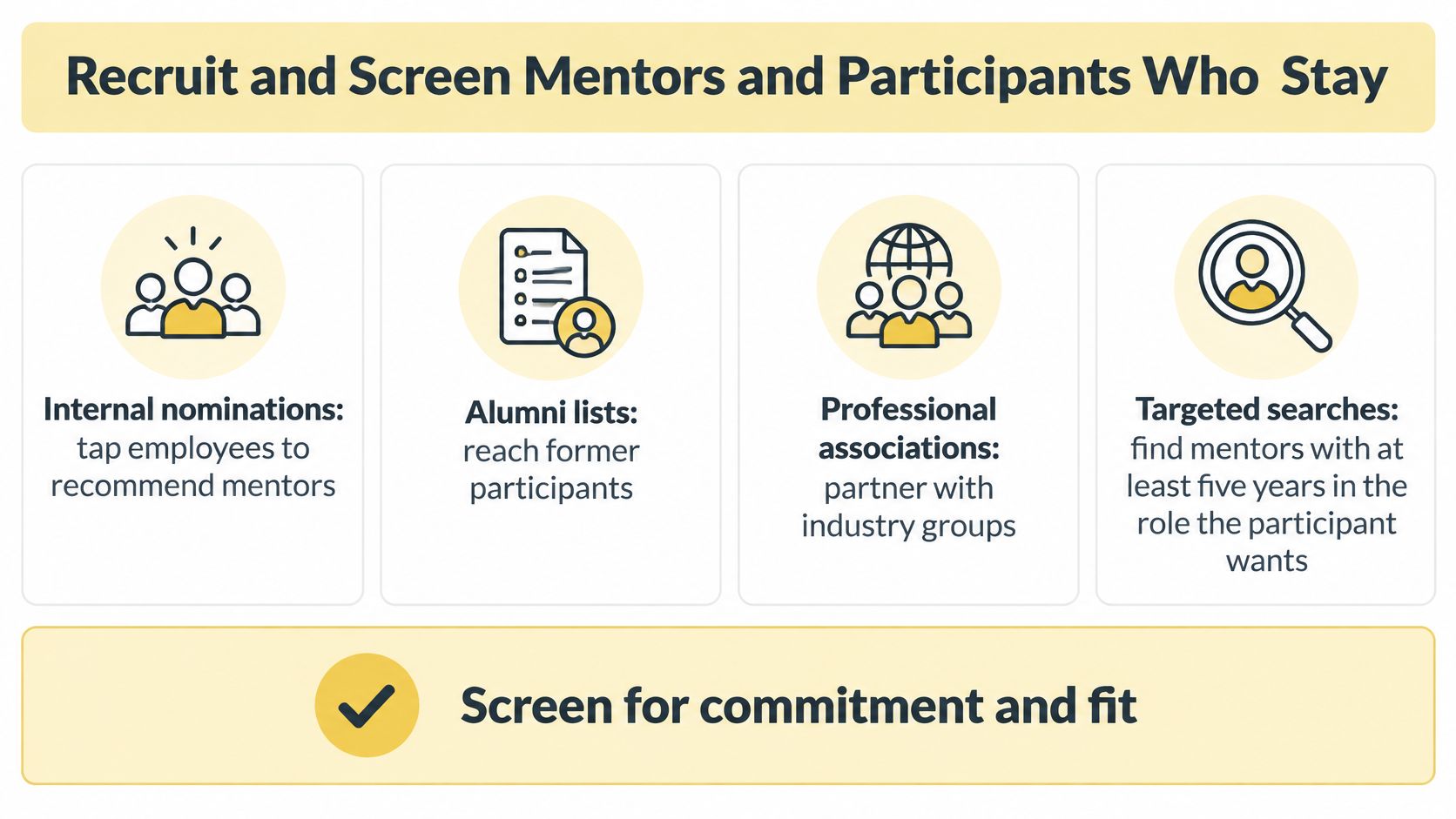
Screen mentors on four things: availability measured against the monthly commitment, some prior experience coaching or managing people, willingness to complete the training, and a short interview that asks why they want to do this. That last question surfaces the volunteer who wants an audience for their own expertise, which is the pairing that goes quiet by session three.
Screen participants for a specific goal, readiness to act between meetings, and realistic time. Then ask one more question most programs forget: do you want a mentor who shares a particular background or identity? Record the answer and respect it. Among Ohio State faculty surveyed on mentoring needs, 89% rated promotion and tenure guidance as very important, 73% prioritized navigating departmental politics, and 66% valued help understanding institutional culture (Ohio State University faculty mentoring report). A single universal match serves none of those needs well, and the same logic applies well beyond academia.
The objection you'll hear in week one is "I don't have time". Name the hours during recruitment and let people decline early, because a no in week one costs far less than a dropout in month three. Avoid the opposite failure too: don't select only the most eager applicants, since eagerness and need aren't the same thing.
Say a fintech firm runs its first cohort and receives 40 applications. It screens 28, trains 14 mentors, and matches 12 pairs. Ten of those pairs are still meeting at month six, and both lapses trace back to a schedule clash the intake form had flagged and nobody read.
Mentor development doesn't stop at the screening call. Programs built inside faith communities tend to treat volunteers as people with their own growth to attend to, and this spiritual formation advice from The Bible Seminary is a practical framing for that longer work.
The five-item screen, run for every candidate
- A specific goal or role, written in the candidate's own words.
- A monthly time block confirmed after the commitment has been stated out loud.
- Training completed or scheduled, never assumed.
- Interview notes recorded with a yes, no or hold decision.
- A needs check answered, with any identity-based preference noted and respected.
Train Mentors Before They Are Matched
Training sits between recruitment and matching, which makes it the step most easily squeezed when recruiting runs late. Squeeze it and every mentor arrives with a different idea of what the role involves.
Two sessions, practised rather than described
Session one covers active listening and goal-setting. The exercise that earns its keep is a role-play: the mentee states a vague goal ("I want to be more confident presenting"), and the mentor has to sharpen it into something testable without offering a single piece of advice. Many participants fail the first attempt and improve on the second.
Session two covers boundaries, confidentiality, cultural competence and referral procedures. Close with a scenario quiz. A mentee discloses a conflict with their manager, or mentions drinking before work: does the mentor coach, refer to HR, refer to an employee assistance service, or escalate to the program lead? Running the scenario and then debriefing the choice is how student diplomacy coaching from Model Diplomat builds judgement in its participants, and the method transfers straight into volunteer training.
The manager who says they don't need it
Experienced managers push back hardest, and their pairs are usually the ones that stall. The most common mentoring failure is advice delivered in week two, before the mentee has worked out what they want. Question-led listening is a skill, and for people paid to have answers it's the harder half of the job.
Training is the cheapest place to fix a program. It's also the first line item cut when recruitment runs late.
Make completion of both sessions a condition of matching. No exemptions for seniority, no "they'll catch up later". Track completion as an implementation metric, because a mentor who skips training is a mentor who skips the check-in when a match gets difficult.
How to Match Mentors and Mentees
Matching is a design decision, not an introduction. The U.S. Department of Labor mentoring guidebook treats matching as one component in a sequence alongside screening, training, monitoring, support and closure, and points to matching on the dimensions that make a relationship more likely to endure. Personality isn't one of them. It's what you notice after the useful filters have already done their work.
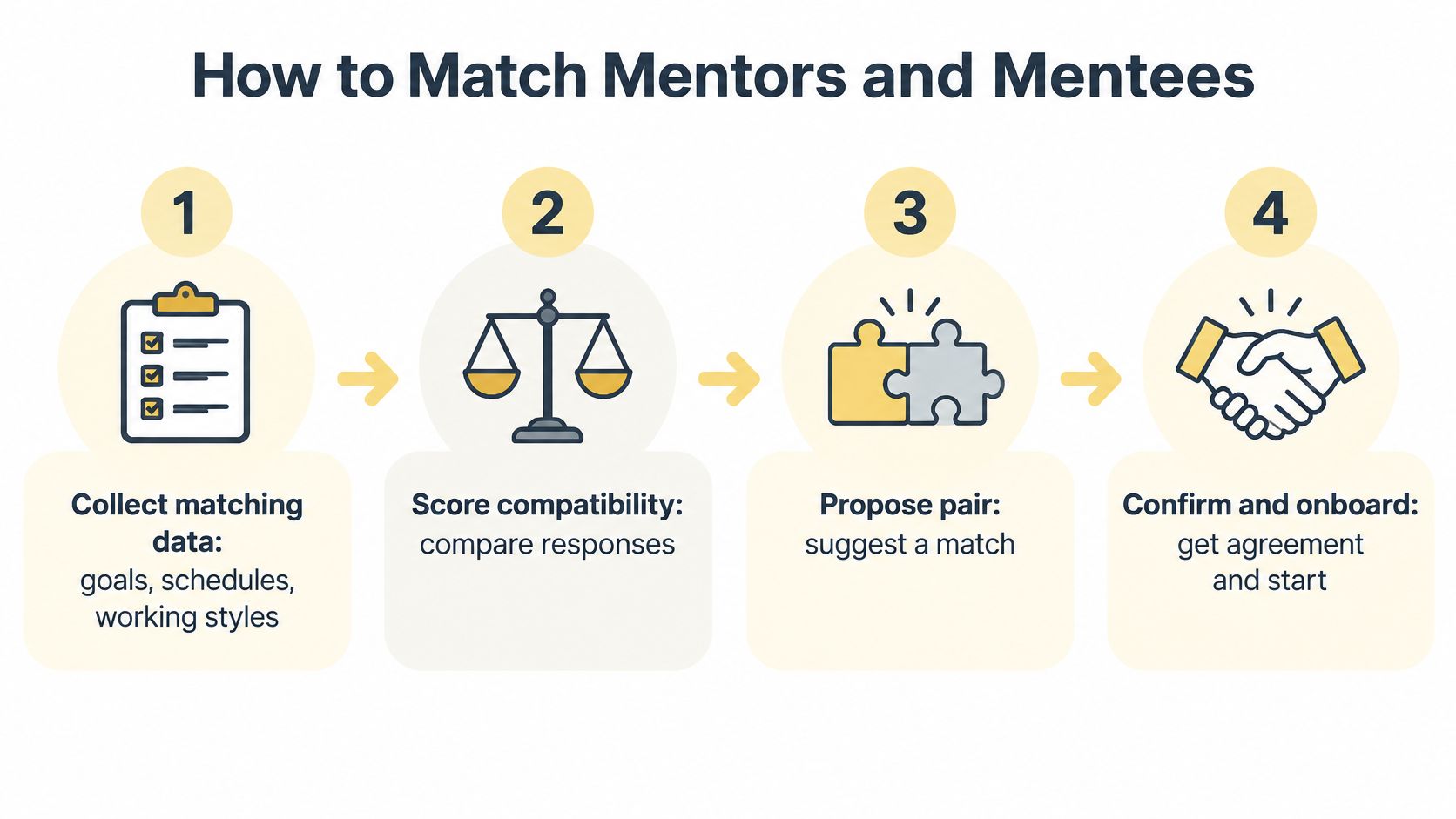
Run the same six steps for every participant.
- Collect the fields. Goals, expertise needed, availability, communication style, language, boundaries.
- Shortlist three mentors using hard filters first. Shared working language, at least one two-hour block of overlap per month, compatible boundaries.
- Score the shortlist. Goal fit carries the most weight; expertise weighs more when the goal is technical.
- Let the participant choose. A pair selected from three is defended differently from one assigned.
- Record the reason in a sentence. "Selected for venture finance experience and Tuesday availability" is enough, and it's what you reread when a match wobbles.
- Book the first meeting within 14 days. Anything longer and the match decays before it starts.
Matching criteria and how to use them
| Criterion | What to collect | How to use it |
|---|---|---|
| Goals | Top two outcomes, in the participant's own words | Score: highest weight, drives the shortlist |
| Expertise | Function, industry and company stage | Score: weight higher when goals are technical |
| Availability | Two-hour blocks per month | Filter: a pair needs at least one overlap |
| Communication style | Written, call or in person, and preferred pace | Score: a mismatch often causes early drop-off |
| Language | Working languages | Filter: must be shared |
| Boundaries | Topics off limits and confidentiality expectations | Filter: must be compatible |
The rematch rule: if no first meeting happens within 30 days, offer a rematch without assigning blame, and log the cause so the criteria get tuned. A mismatch is a repair signal, not a verdict on either person.
Length matters as much as fit. A Nesta review of youth mentoring research found programs running from several weeks to more than two years, with the strongest outcomes in relationships lasting at least 12 months and especially those continuing beyond 21 months (Nesta's review of what makes effective youth mentoring). The same review found better evidence for matching on shared interests and values than on demographics alone, and treated mentee choice as effective. The logic mirrors tips for picking a guitar coach: you don't want the best player in the city, you want the one who teaches the style you're learning and can meet when you're free.
Set Expectations and Run the Kickoff
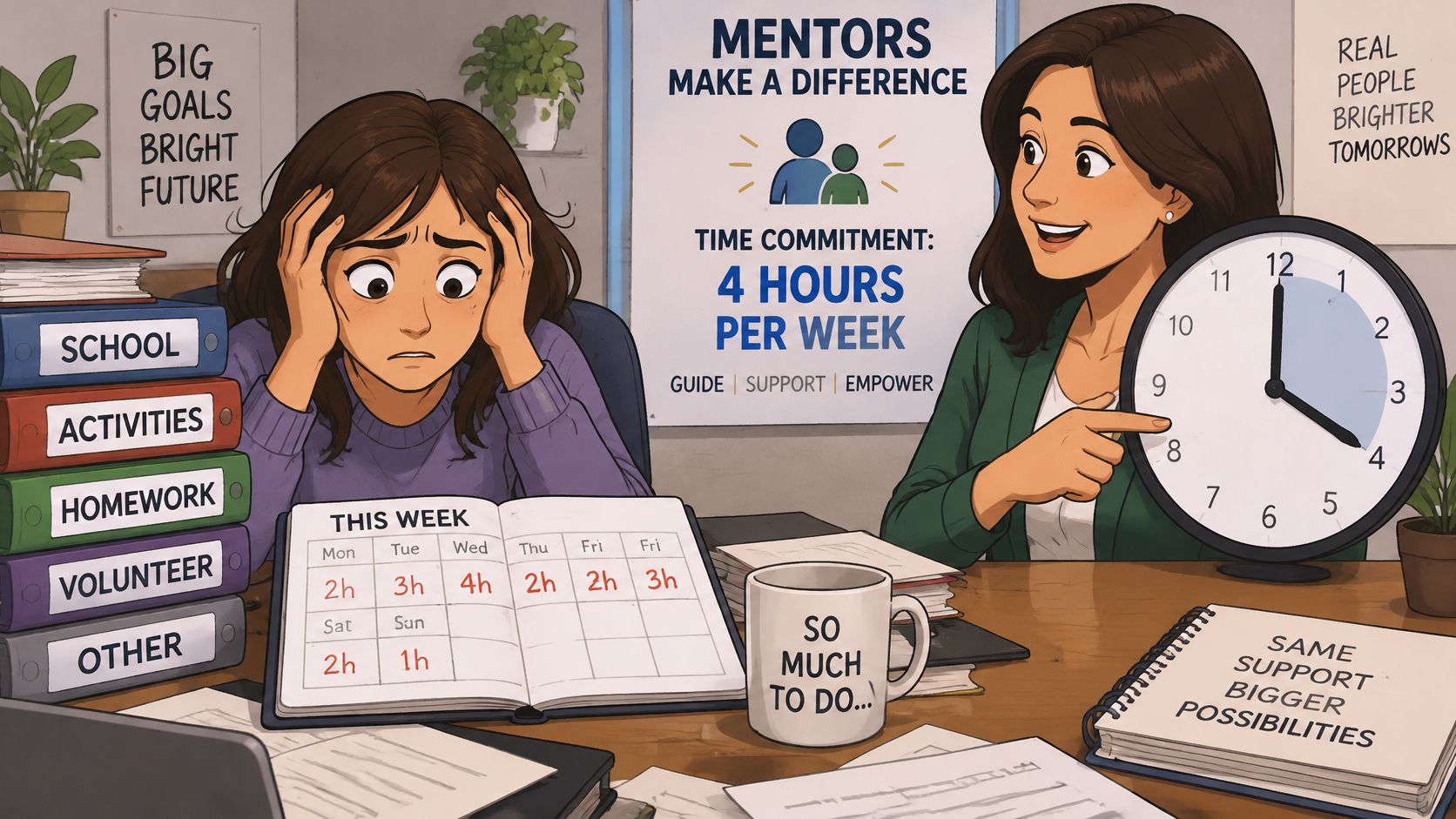
The email lands in week five: "Nobody told me it was this much time." The mentee isn't wrong. The commitment was never stated in hours, only implied by the phrase "ongoing support".
Fix it during recruitment by naming the number. MENTOR's evidence-informed practice guidance sets a concrete minimum: mentors and mentees should meet for at least four hours per month, and the match should last at least one year. A six-month pilot can run two 60-minute sessions monthly plus short between-session work; a year-long cohort should hold the four-hour benchmark directly.
What goes in the one-page agreement
- Cadence and minimum monthly time, written as hours rather than intentions.
- Response time for messages, for example within two working days.
- Confidentiality, including what goes into session notes and who can read them.
- Cancellation rules, including how much notice is expected.
- A goal contract with three goals and a 90-day checkpoint.
- The lapse trigger, for example two missed sessions means the organizer calls.
Then run a 90-minute kickoff: introductions, goal review, working style, and a first 90-day plan. Read three questions aloud and write the answers down while both people are in the room.
"What would make this match a success by day 90?" "How do you prefer to receive feedback, and how will you tell me when something isn't working?" "What's one thing you need from me in the first two weeks?"
"Yes, this feels bureaucratic" is the fair objection. A one-page agreement takes twenty minutes to complete, and it's considerably shorter than a meeting series that dies over four months because nobody wrote down what it was for.
Measure Outcomes at Midpoint and Close
Evaluation usually gets scheduled for the final session, which is the one moment it can't change anything. The U.S. Office of Personnel Management mentoring guidance recommends evaluating mentors, protégés and supervisors at least twice: once at the midpoint and once at the end, and comparing participants with a demographically similar group working in similar conditions where that's feasible.
In a six-month pilot that means surveys in month three and month six. Month three is the decision point. Read attendance, goal progress, relationship quality and open feedback, then change pairings or add support while there's still runway to improve the result.
Participation is not impact
Satisfaction scores run high in programs where nothing changes. The meetings are pleasant, the mentor is kind, the goals drift. Read satisfaction alongside goal attainment or don't read it at all.
Two traps catch first-time organizers. The first is treating satisfaction as the outcome. The second is under-supporting mentors after the match is made: MENTOR's evidence synthesis reports that closer adherence to its benchmarks was associated with longer, stronger matches, though that finding isn't experimental.
Program metrics with calculations and starting targets
| Metric | How to calculate it | Suggested starting target |
|---|---|---|
| Recruitment yield | Applicants ÷ open mentor or participant seats | About 3 applicants per seat |
| Match-start rate | Matches with a first meeting within 30 days ÷ matches made | 80% or higher |
| Meeting frequency | Meetings held ÷ meetings planned | 75% or higher |
| 90-day retention | Pairs still active at day 90 ÷ pairs started | 80% or higher |
| Goal attainment | Goals met with evidence ÷ goals set | 60% for a first pilot |
| Satisfaction | Average 1-5 score from both mentors and participants | Read alongside goal attainment, never alone |
| Escalations | Lapsed matches and how each was resolved | Review monthly, count trending down |
Use denominators so the numbers mean something. Retention is the share of pairs still active at a checkpoint, not a count of active users, and completion needs evidence of the agreed milestone rather than a checkbox.
The week-four rule: if fewer than 80% of pairs have met by week four, fix onboarding before recruiting another cohort. Don't wait for the midpoint to discover your intake form isn't producing workable matches.
A dashboard earns its place when it changes a decision, which is why I'd keep it to those seven numbers and read them monthly. Progress tracking software becomes worth the switch once spreadsheets start arriving in three versions of the same cohort.
Close every match with a review and a transition plan, logged as completed, lapsed or extended. The lapsed count is the most useful figure on the page, because it tells you which criterion to change.
Launch a Six-Month Pilot Before You Scale
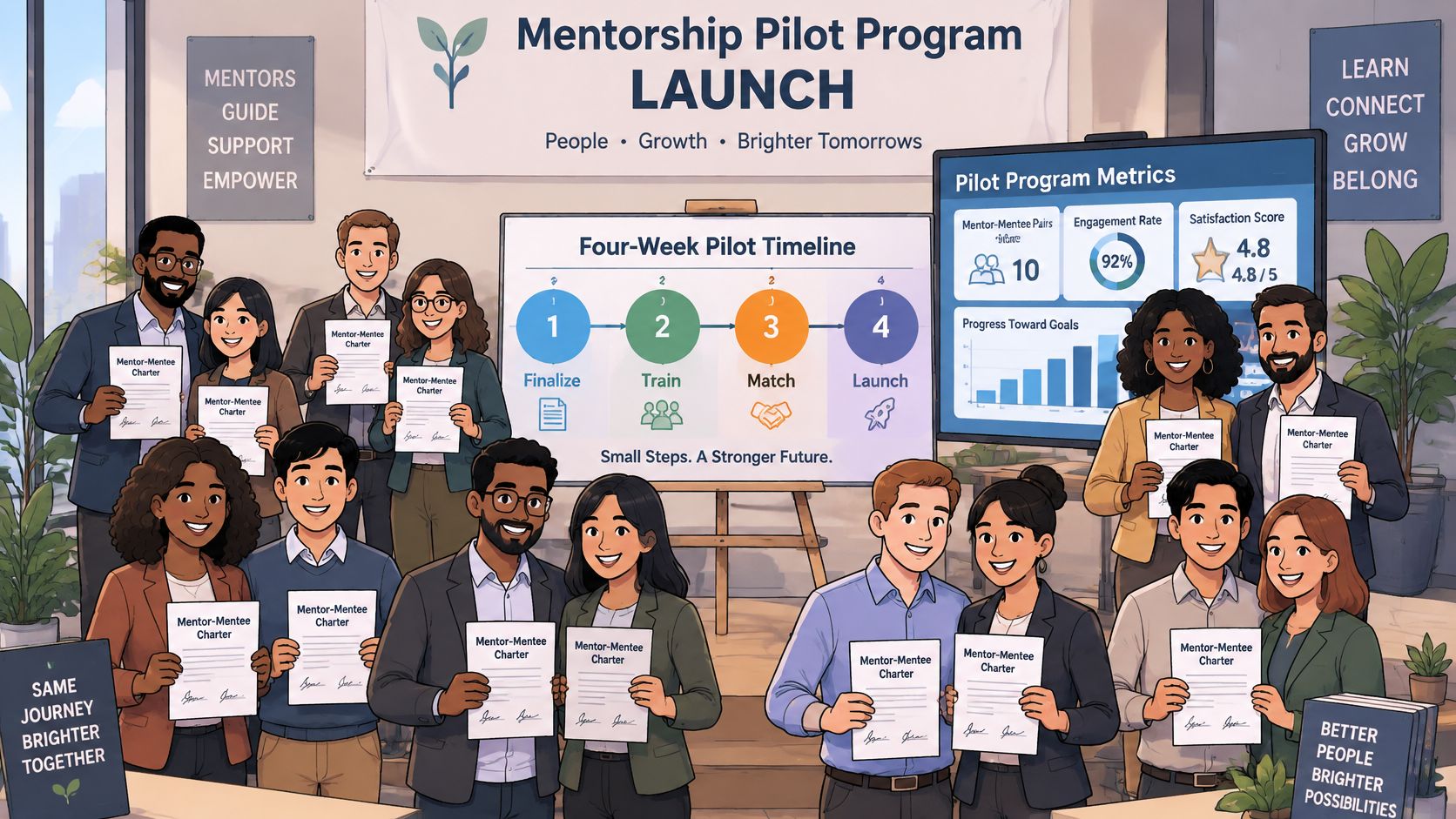
Run 8 to 12 pairs with a signed charter and the metrics live from day one. Not a pilot that measures retroactively, one that reads its own dashboard weekly while the cohort is still running.
The evidence for a bounded, structured design is encouraging but not overwhelming. A 2014 scoping review screened 2,101 search results, identified 13 eligible studies on mentorship for knowledge-translation capacity building, and found that all but one reported improvements in knowledge, skills or behaviour; the programs examined ran from four months to two years, with periodic meetings typically spread over six to twelve months (systematic review of mentoring programs). That justifies a documented six-month cohort. It doesn't guarantee the design works in your organization, which is why the pilot exists.
The launch sequence runs four weeks. Week one: finalize the charter and the intake form. Week two: recruit, screen and train. Week three: match and hold kickoffs. Week four: check the first-meeting rate and repair onboarding if it's under target.
At month six, apply the decision rule you wrote at the start. Say a 10-pair pilot at a 200-person firm reaches an 85% match-start rate but only 62% goal attainment. The organizer keeps the matching process, rewrites the mentor training to cover escalation handling, and runs a second pilot before expanding. That's a good outcome, not a failed one.
Admin is where this usually slips. A client journey that starts on purchase, with an agreement, intake worksheets, the first call and program access in sequence, is what Coachful builds by default, and it's the difference between a pilot you can run twice and a folder of forms you rebuild every cohort.
Once the pilot proves the design, the next constraint is administrative load. A comparison of best online mentoring platforms saves you rebuilding the same spreadsheet for cohort two.
Coachful gives you the operating layer for the program you've just designed: cohort programs, offers that enroll clients automatically on payment, intake worksheets, agreements, scheduling and progress tracking in one workspace. You can draft the client journey from the offer itself, from the welcome step through the closing review, so the structure survives contact with a real cohort. Start a free trial and build your first program offer at Coachful.


