Instagram Story Ideas for Coaches: 5 Ready-to-Film Sequences

Coachful
Editorial Team
“People watch my Stories, but nobody asks about coaching. What should I actually post?”
Start with a short sequence that helps a suitable follower make one decision: understand a problem, try your approach, assess fit, resolve a practical concern, or enquire about a real offer. Give each sequence one next step. Do not turn every poll response into a sales message.
The best Instagram Story ideas for coaches are not necessarily the most personal or elaborate. They make your thinking visible and explain what someone can do with it. A useful teaching sequence with an appropriate invitation is a better starting point than another photograph of your coffee captioned “big things coming.”
Below are five original, ready-to-film sequences. All scripts, names and scenarios are hypothetical examples, not client testimonials or reported results. Adapt them to your actual coaching scope, offer and audience. This is a content-production guide, not an Instagram growth guarantee.
Choose the sequence by the decision you want to help with
- They recognise the frustration but cannot explain it: use the small-problem demonstration.
- They wonder what coaching involves: use the process preview.
- They are unsure whether your service fits: use the fit-and-not-fit explanation.
- They have one practical concern: use the honest FAQ.
- They are ready to consider working together: use the offer invitation.
This selection rule matters. Someone who wants a useful exercise has not necessarily asked for a discovery call. Someone who asks about working together should not have to complete an obstacle course of free resources before seeing your offer.
Start with one sequence, not all five at once. Write the final invitation first, then check whether the preceding frames give a person enough information to choose it freely.
1. The small-problem demonstration
Use this when: followers understand the broad topic but cannot see how your coaching approach differs from generic advice. Teach one manageable distinction rather than promising a transformation in four frames.
A career coach could demonstrate how to replace a vague interview claim with a concrete example. The coach is showing a preparation method, not guaranteeing an interview or job offer.
- Frame 1, name the moment: “You know you have leadership experience. Then an interviewer asks for an example and your answer turns into a job description.”
- Frame 2, show the weak version: “Vague: ‘I am a strong communicator and a team player.’ That tells them your conclusion, not what you did.”
- Frame 3, demonstrate the replacement: “Try: ‘When two teams disagreed on the deadline, I brought them together, clarified the trade-off and agreed a revised handover.’ Use a real example from your own work.”
- Frame 4, offer the matching next step: “Want the three prompts for finding your own example? Reply ‘EXAMPLE’ and I will send the worksheet.”
How to film it: speak the opening, then show a large, readable fictional sentence on paper or a clean document. Keep the essential wording visible for people watching without sound. Do not display a client's CV or application history.
What happens next: deliver the promised worksheet to someone who requests it. If they continue the conversation, ask whether they want to discuss applying the method. Do not quietly replace a resource request with a booking pitch or marketing subscription.
Trade-off: this sequence may attract people who only want the exercise. That is acceptable. Its job is to demonstrate useful thinking, not force everyone into a paid conversation.

Prepare the destination or resource before recording. If the viewer must leave Instagram, name what they will reach. “Get the interview example worksheet” is more informative than “tap here.” Only promise a download, signup or appointment that you have already tested.
2. The process preview
Use this when: prospects assume coaching is an unstructured chat or cannot picture what they would do between sessions. Show a bounded example of the work without filming a real client.
A leadership coach might preview preparation for a difficult delegation conversation. The purpose is to explain the service experience, not suggest that every management problem has the same solution.
- Frame 1, surface the uncertainty: “What would we actually do in a coaching session about delegation?”
- Frame 2, show the starting point: “We would first choose one real conversation you need to have, rather than discuss delegation in general.”
- Frame 3, demonstrate the work: “Then we might test the request: what outcome are you asking for, what decision belongs to the other person, and when will you review it?”
- Frame 4, invite the appropriate question: “If you are considering coaching, reply with a question about how the sessions work. Please leave out names and confidential workplace details.”
How to film it: use a blank worksheet that you fill with a clearly fictional example. A quiet desk demonstration can explain more than a fast montage of your calendar, laptop and headphones.
What happens next: answer questions about the process. If the person asks whether it suits their situation, explain the enquiry route and the information you need to assess fit. Avoid conducting a full coaching session in a message thread.
Trade-off: a detailed preview can look like a rigid promise. Say “might” where the method depends on the client, and distinguish a sample exercise from your contractual service.

A short enquiry can collect the minimum context needed for a fit conversation. It should not demand a complete life history because a person watched an educational clip. Explain who reviews the enquiry and what happens after submission.
3. The fit-and-not-fit explanation
Use this when: your inbox contains interested people who need a different service, or your positioning is so broad that nobody knows whether to enquire. Be specific about suitability without shaming anyone.
A business coach who works with independent consultants could use the following sequence. Its boundaries should reflect the coach's real competence and offer, not a marketing persona invented for the post.
- Frame 1, identify the reader: “My coaching is for independent consultants who already deliver client work and want to make better decisions about their offer and capacity.”
- Frame 2, describe the work: “We examine the decisions you are making, test your assumptions and agree practical experiments you can run in your business.”
- Frame 3, name the boundary: “It is not a done-for-you marketing service, financial advice or a promise to replace your income by a deadline.”
- Frame 4, offer a relevant route: “If that sounds like the support you need, read the coaching overview and enquiry details through the link.”
How to film it: record a calm explanation in your normal voice. Put the most important inclusion and exclusion in live overlay text. You do not need a dramatic “this is not for you” performance.
What happens next: the linked page should repeat the same scope, describe the format and explain the next step. If someone needs legal, medical, therapeutic or other specialist support, do not stretch your coaching description to keep the lead.
Trade-off: a narrower explanation can reduce the number of enquiries. Judge whether the remaining conversations are more appropriate, not whether every follower feels included in every offer.

Check your actual offer before filming. Session format, access, support boundaries and payment information should agree with the page a viewer reaches. A beautifully delivered Story cannot repair a contradictory offer.
4. The honest FAQ
Use this when: a recurring practical question is blocking a sensible decision. Answer it directly rather than calling every concern a “limiting belief.” Sometimes the person genuinely lacks time, money or the right service fit.
A life coach could address what happens if someone cannot attend at the same time every week. Only use the example below if flexible scheduling is genuinely part of your offer.
- Frame 1, ask the actual question: “Can we work together if my work shifts change each week?”
- Frame 2, give the direct answer: “For my individual coaching package, you do not need a fixed weekly slot. You choose from my available appointments.”
- Frame 3, explain the constraint: “That does not mean every evening is available. Check the booking options and package timing before deciding.”
- Frame 4, provide the proof route: “See the current appointment options and scheduling terms through the link. If they do not fit, ask before buying.”
How to film it: answer on camera, then show a non-sensitive demonstration of the relevant public information. Do not expose a calendar containing client names just to prove you have appointments.
What happens next: the page should resolve the exact concern. If you cannot show availability before purchase, explain how someone can check suitability instead of pretending the link provides something it does not.
Trade-off: an FAQ can reveal a genuine reason not to buy. That is useful decision support. Removing uncertainty does not mean persuading someone to ignore a practical incompatibility.

Test on a phone from the viewer's position. Can they understand the offer without logging into your account? Does the next-step label describe the page that actually opens? Can they find the relevant information without hunting through unrelated links?
5. The straightforward offer invitation
Use this when: you have a real offer, a truthful reason to mention it now, and a suitable next step. An offer does not require invented scarcity. “Here is how to work with me” is a legitimate message.
A career coach opening an interview-preparation package could adapt this sequence. Replace every service detail with the actual terms, and mention limited availability only when it is accurate.
- Frame 1, identify the situation: “If you have interviews coming up and keep giving answers that undersell your experience, I offer individual interview-preparation coaching.”
- Frame 2, describe the work: “We choose relevant examples, practise answering questions and review how clearly you communicate your contribution.”
- Frame 3, give decision information: “The package page explains the sessions, price, preparation and cancellation terms. Coaching cannot guarantee an offer from an employer.”
- Frame 4, make the invitation: “Read the package details. If you want to check whether it suits your situation, use the enquiry option on that page.”
How to film it: say the invitation plainly. A brief explanation followed by a legible destination is enough. Do not squeeze price, testimonials, a countdown, a poll and several different links onto the same frame.
What happens next: answer suitability questions or follow your published application process. If the offer requires a consultation before purchase, say so. Do not label a sales call a free coaching session unless you genuinely deliver the promised coaching.
Trade-off: a direct offer may receive fewer casual replies than an entertaining question. Its purpose is to help a ready person evaluate the service, not to win the largest response count.
Turn a sequence into a manageable recording session
Write four short frame notes before opening the camera: the situation, the useful explanation, the constraint or example, and the invitation. Treat those as prompts, not a speech to memorise.
Record in a quiet setting with light on your face. Review spoken captions for names, negations and important service details. Keep text large enough to read comfortably on a phone, and leave space around platform controls. If a frame needs a paragraph of tiny copy, split the idea or simplify it.
You do not have to appear on camera for every frame. Your own voice over a fictional worked example can be more useful than another talking head. Use only materials you own or have permission to share, and make sure the educational point remains understandable without sound.
Before posting, read the sequence without relying on the visuals. Does the opening identify a situation? Does the middle deliver something useful? Does the invitation follow from the lesson? This check catches sequences that are four promotional announcements wearing an educational costume.
Handle responses without turning interest into pressure
Instagram Stories are not confidential coaching. Do not ask followers to disclose diagnoses, traumatic experiences, employer disputes or identifiable relationship details in a question sticker. Keep prompts proportionate to a public-facing marketing channel.
A poll vote is not consent to a sales conversation. A request for a worksheet is permission to deliver that worksheet, not to add someone to a newsletter. A question about your package is an opening to discuss the package, not permission to pursue the person indefinitely.

For a requested resource, a simple response is: “Here is the worksheet you asked for. You do not need to share personal details here to use it.” If the person then asks about coaching, you can say: “Would you like the information about the package and the enquiry process?”
If someone shares sensitive information, avoid diagnosing, investigating or turning it into content. Explain the limits of the channel and follow your professional boundaries and relevant safeguarding procedures. Use a suitable private intake process only when appropriate; a private message is not automatically a confidential clinical or coaching environment.
Do not repost a response, testimonial or client story without appropriate permission. Removing a name may not remove identifiability. For most demonstrations, a clearly fictional scenario is simpler and more respectful than repurposing a client's session.
Measure the sequence against its actual job
Keep a small review record: sequence used, topic, intended next step, relevant responses, voluntary enquiries and time spent creating it. Where your account provides viewing or interaction data, use it as context rather than as proof of buying intent.
A teaching sequence might be useful because people ask better questions. A fit explanation might be useful because unsuitable enquiries decline. An offer sequence should be reviewed against appropriate enquiries and sales, while recognising that a small sample cannot establish a reliable conversion rate.

Ask new enquirers how they found you, but allow an uncertain answer. Someone may have seen several posts, heard about you from a friend and then watched the Story. Do not attribute every subsequent sale to the last thing you published.
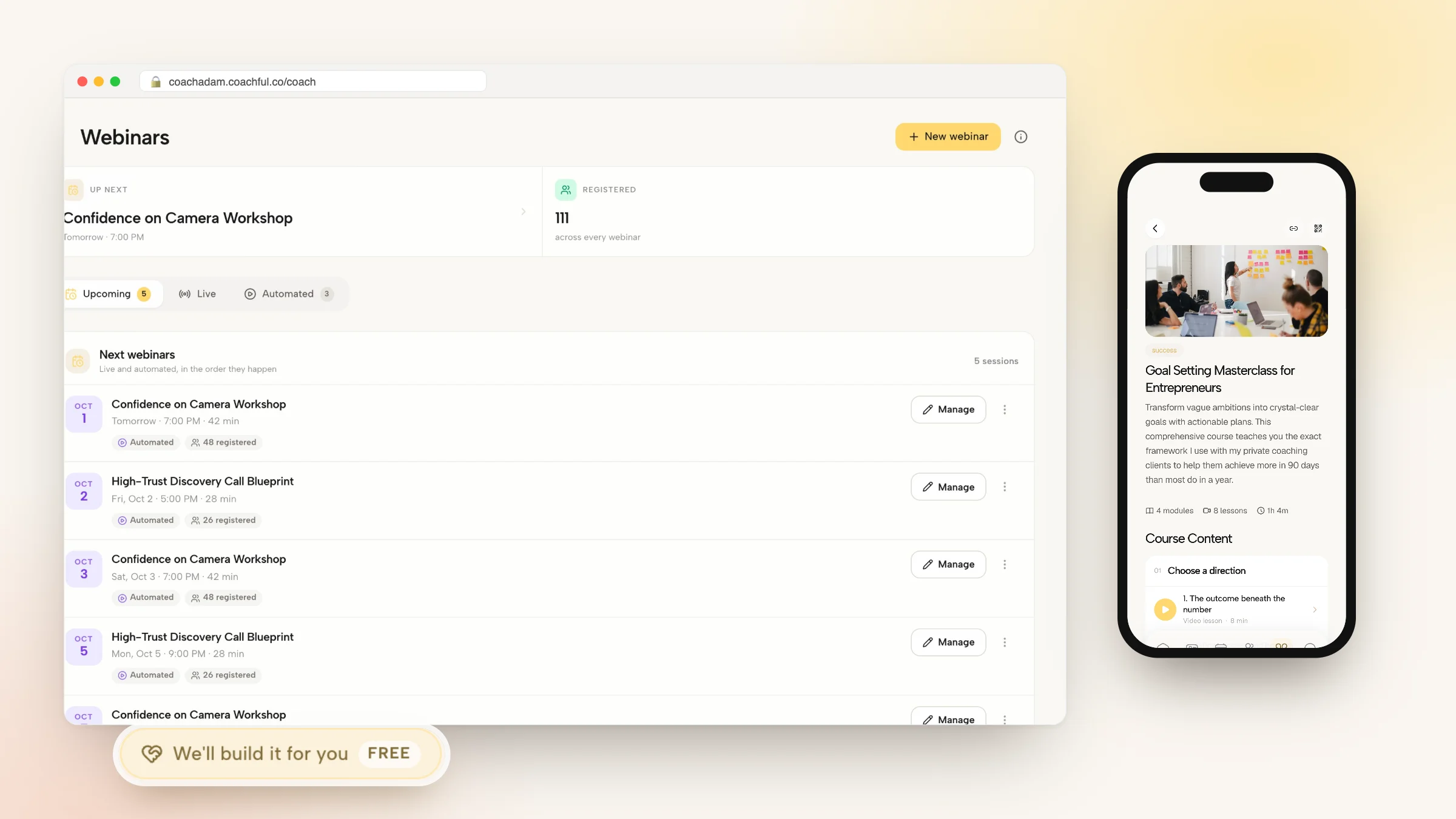
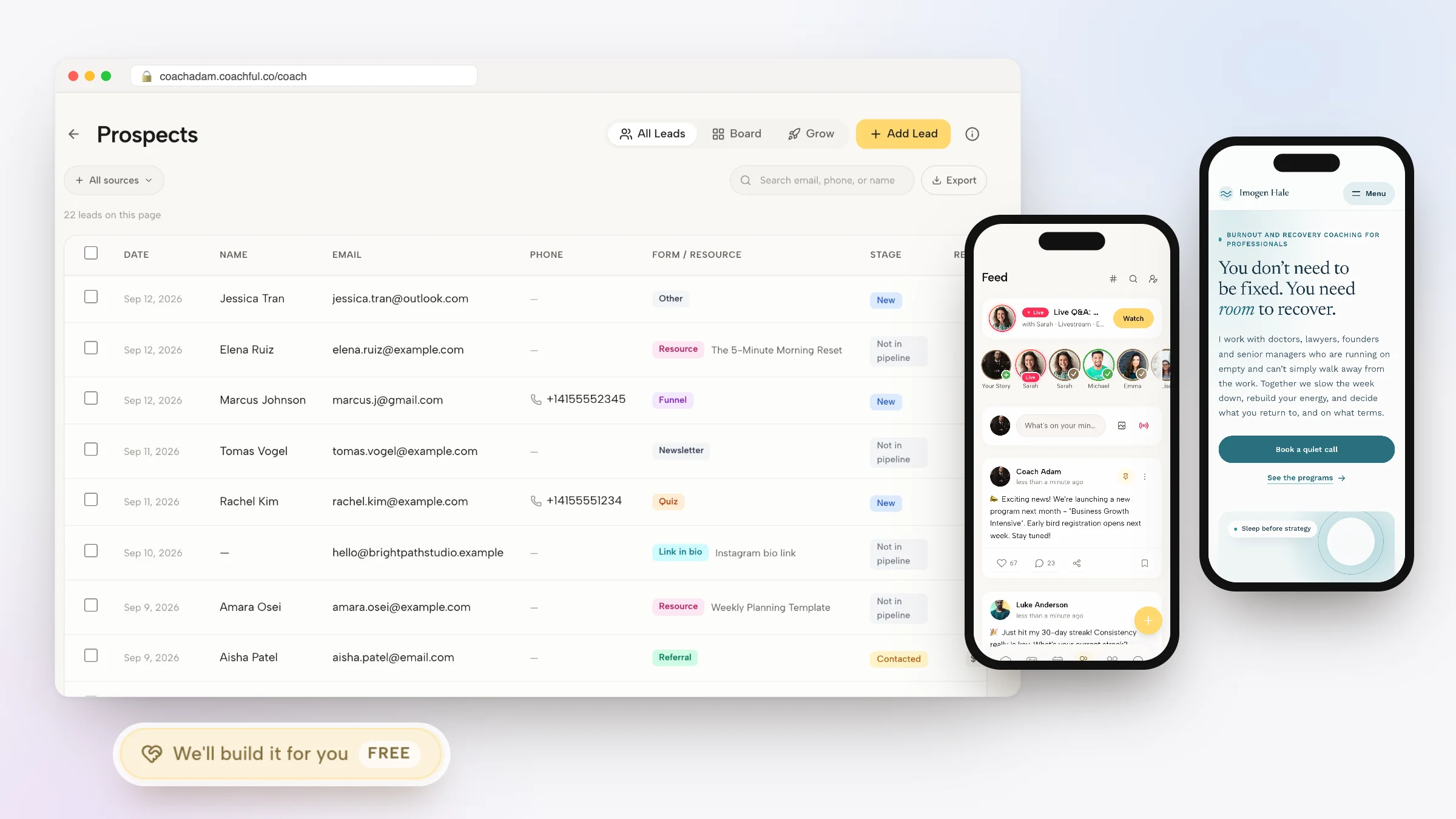
Keep operational records proportionate. Record what you need to handle the enquiry, not a dossier of what someone watched. Coachful's prospect and intake workspaces can support the business-side handoff shown here; these screenshots do not demonstrate Instagram monitoring, automatic messages or social publishing.
Frequently asked questions
How often should a coach post Instagram Stories?
Start with a cadence you can create and respond to responsibly. One useful sequence with a working next step is a better experiment than a daily commitment you cannot maintain. Increase frequency only when the work remains useful and the response handling is manageable.
Should every Story invite a discovery call?
No. Match the invitation to the content and the viewer's likely readiness. A teaching example can offer a related resource; an offer explanation can invite a suitability enquiry. Do not insert a call invitation simply because you have a booking link.
Can I reuse these scripts for different coaching niches?
Yes, but change the actual situation, method, scope and destination, not just the specialty label. A health coach should not adapt an interview-preparation example into medical advice. The sequence structure is reusable; your competence and service boundaries still apply.
Do I need expensive production or automatic DMs?
No. These sequences can be made with a phone, readable text and a prepared destination. Manual delivery is sufficient for a small number of requested resources. Do not promise automatic fulfilment unless you have a working, permitted setup that you have tested.
Build the next step before filming the invitation
Choose one sequence you can use this week. Write its final invitation, prepare the promised resource or enquiry page, then test that route on a phone. Only then record the frames that lead to it.
If you want to see examples of the link, offer and intake surfaces behind that handoff, Try the interactive demo. Use it to inspect the business-side destination, not as a substitute for your own voice or judgement on Instagram.