TikTok for Coaches: 5 Steps to Test Client Demand

Coachful
Editorial Team
Can TikTok bring you coaching clients, or will it just consume the hours you should be spending finding them? Test it as a source of suitable inquiries, not as a race to grow an audience. Choose one buyer question, teach a complete answer, prepare an honest next step, and review the quality of the conversations before increasing production.
A coach does not need to become an entertainer to make that test worthwhile. But a video that gets attention is not evidence that people will buy your coaching. The useful experiment connects a recognizable problem to the work you actually offer, while protecting client privacy and your delivery time.
This guide gives you five steps for a small organic TikTok test, including a worked video script, profile-link limitations, commercial music checks, and a review method. It is for coaches selling their own services, not creators trying to qualify for platform payouts. The examples are hypothetical, not reported customer results.
1. Choose a buyer question, then check how people search for it
Start with a decision your prospective client genuinely needs to make. “Career confidence” is a topic. “Should I tell my manager I want to change roles?” is a question that can support a useful explanation and a relevant career-coaching offer.
Write a small brief before opening the camera:
- Reader: a professional considering an internal move, rather than every unhappy employee.
- Decision: whether to discuss the move with their manager now.
- Useful answer: separate an internal transfer from an external search, then assess the disclosure risk.
- Paid relevance: your coaching helps people prepare career decisions and conversations. It does not guarantee promotion or provide employment-law advice.
This stops the common mismatch where a coach attracts people with broad motivational content, then wonders why nobody wants a specific service. The topic should give a suitable viewer a sample of your judgment, not merely a reason to agree with you.
Use TikTok's search tools without pretending they prove demand
TikTok describes Creator Search Insights as a tool for exploring topics people search for and checking how posts perform in search. Its support instructions say to search “Creator Search Insights” in the app and tap “View” at the top of the results.
Where the tool is available to you, look for questions related to your actual specialty. Compare the wording with TikTok's ordinary search suggestions and the questions people ask under relevant videos. Note a handful of phrases, not a giant spreadsheet of supposed opportunities.
A search topic is not proof that viewers have the money, authority, location, or readiness to buy your service. Read the surrounding results. If the query mostly attracts other coaches discussing training, it may be the wrong audience for your client offer.
Do not turn confidential session notes into a content research database. Use public questions, questions submitted explicitly for content, or your own teaching examples. Repeated themes can inspire a general lesson without quoting a client's distinctive situation.
Decide whether TikTok is the right test at all
TikTok is worth exploring when your prospective clients use it to understand problems you can explain well on video. It is less attractive when the buying decision depends mainly on procurement, professional referrals, or a small network you already know how to reach.
An executive coach selling a company-wide engagement may learn more from conversations with learning-and-development buyers than from another month of short videos. An individual career coach might find the question above worth testing. Neither decision needs a universal claim about which platform “wins.”
2. Film one complete answer instead of a trail of teasers
The first video should help someone even if they never follow you. Withholding the actual answer until a viewer comments a keyword may generate activity, but it does not demonstrate much coaching judgment.
Choose a production setup you can repeat: phone at a comfortable height, stable support, light on your face, and audio that remains clear without headphones. Record a short test and listen to it before filming the batch. Expensive equipment will not repair an answer that rambles.
A worked career-coaching script
The following is original hypothetical teaching copy. Adapt it to your competence, audience, and local context rather than presenting it as personalized advice.
“Should you tell your manager you want to change roles? First separate an internal move from leaving the organization.
For an internal move, a conversation about your development may help you understand the process and identify support. For an external search, disclosure can carry different risks.
Before you decide, ask: what do I need from this conversation, how has this manager handled similar situations, and what policies or obligations should I check?
Write down the outcome you want before choosing the opening sentence. If you want a blank decision worksheet, request it through the route on my profile.”
The video gives a decision structure, a distinction, and a practical prompt. It does not promise safety, diagnose the manager, or pretend every employment situation follows the same rules. When the issue requires legal advice, the coaching boundary belongs in the explanation.
Give the question consistent wording
Say the main question naturally, use an accurate on-screen title, and write a caption that matches the actual answer. For this example, “Should you tell your manager you want to change roles?” is more informative than “Nobody talks about this career secret.”
Check captions manually, especially job titles, technical terms, and names. Keep important text away from interface controls, and preview the finished post on a phone. A visually clever clip that cannot be understood with the sound off excludes people unnecessarily.
Do not infer a guaranteed ranking formula from this advice. Clear wording helps viewers understand the subject; it does not entitle a video to distribution.
Use formats that reveal a decision
Once the first answer is clear, vary the teaching task rather than chasing unrelated trends. Useful follow-ups include a fictional worked example, two reasonable options with different trade-offs, a misconception with a carefully bounded correction, or a question someone explicitly submitted for a public answer.
Avoid responding to a vulnerable personal disclosure as if a comment thread were a private session. You can acknowledge the person and state your scope without assessing their mental health, relationship, employment rights, or suitability for coaching in public.
Check music rights before publishing promotional content
TikTok's commercial music guidance recommends the Commercial Music Library for content promoting a brand, product, or service. It states that licenses for music outside that library do not cover commercial use.
Using an original sound does not automatically resolve rights if it includes someone else's music. Your own spoken explanation without background music is often the simplest production choice. Check applicable music rights and promotional-content disclosure requirements before posting, rather than assuming a trending sound is available for your business.
3. Prepare a next step your account can actually support
Do not film ten videos saying “tap the link in my bio” before checking whether your account has a clickable website link. TikTok's current profile-link guidance says a website link is available with at least 1,000 followers or a Verified Business Account. Check the options and requirements shown in your own account.
A routine account-type switch is not the same claim as verified business eligibility. Do not change account settings solely because someone promises a universal shortcut. Consider the consequences for available features and music use before choosing an account setup.
If you cannot provide the action you planned, change the invitation. You might direct viewers to a clearly identified public resource or invite an appropriate voluntary inquiry where messaging is available. Test the exact route as a visitor and never promise instant delivery you have not arranged.
Match the action to the question
- Early understanding: offer a complete public explanation or an optional worksheet.
- Comparing approaches: point to a page explaining who your coaching is for, what it includes, and what it does not do.
- Ready to discuss working together: offer the relevant inquiry or discovery-call route with clear expectations.
Not every video needs an email address or a call booking. Sometimes “save this prompt for your next planning conversation” is the appropriate action. A less aggressive invitation can also give you a more honest test of whether the teaching itself is useful.

A destination page should repeat the subject that brought the viewer there. In the career example, explain the decision worksheet before presenting unrelated programs. If there is a call, state its purpose and whether it is free or paid. Do not let a vague “clarity session” label conceal a sales conversation.
For the destination structure, use the existing Coachful link-in-bio guide. The TikTok-specific job here is checking that the account supports the route and that the invitation matches what the viewer will find.

If the resource is a course or short lesson, finish it before promoting it. Check access requirements, mobile readability, and whether the promised material appears without an unexpected purchase. A large resource library is not inherently a better next step than one relevant page.
4. Handle responses without turning engagement into permission
A comment means someone commented. It is not permission to add them to marketing email, investigate their circumstances, or send repeated sales messages. A request for the worksheet means you should deliver the worksheet through the agreed route.
When somebody asks about working together, keep the first exchange specific and light. You need enough context to explain the relevant service, not a full intake inside a social app.
“Thanks for asking. I work with professionals preparing career decisions and workplace conversations. Are you looking for the worksheet, or information about individual coaching? Please do not send confidential employer or health information here.”
This wording gives the person a choice and states a useful boundary. If they want coaching information, send the scope, fees or pricing route, and next step. If they only want the resource, do not treat that as an objection you must overcome.
Keep public teaching and private coaching separate
Do not invite viewers to describe traumatic experiences, medical conditions, workplace allegations, or relationship crises in comments to improve engagement. Remove unnecessary identifying details from any example you prepare, but remember that changing a name does not reliably anonymize a distinctive story.
For client stories, obtain specific informed permission for the intended use and consider whether sharing is appropriate even with permission. A fictional scenario clearly labeled as fictional is often enough to teach the point. Never invent a testimonial or portray an illustrative outcome as something a client achieved.
If an inquiry involves urgent risk or needs outside your competence, do not use the conversation as a sales opportunity. State your limits and direct the person toward appropriate qualified or emergency support for their location and circumstances.

If someone deliberately signs up for email, explain what they will receive and respect the permissions that apply. Keep service inquiries distinct from newsletter consent. Coachful's sequence editor can illustrate preparing follow-up, but it is not evidence of a TikTok integration or automatic permission transfer.
Record only the information you need to respond and assess fit. Do not scrape commenter lists or copy vulnerable public disclosures into prospect records. The commercial goal is suitable voluntary inquiries, not possession of a bigger list of strangers.
5. Review a small test before committing to more production
Give the experiment a defined place in your working week. A reasonable starting design is one protected filming block and one review block, repeated for four weeks. This is a workload suggestion, not a claim that four weeks is enough to prove a channel will or will not work.
Choose a production limit you can keep without rushing client preparation. Repeat a small set of relevant questions, rather than changing audience, offer, filming style, and invitation after every quiet post. Otherwise you will not know what you tested.
Keep a small evidence log
For each post, record the question, invitation, date, production time, and the signals available in your account. Separate distribution signals such as views and search performance from business signals such as voluntary inquiries, suitable conversations, attended calls, and paid engagements.
Ask inquirers how they found you when appropriate. Treat that answer as useful self-reported evidence, not perfect attribution. TikTok's search analytics can help you review search performance, but neither a view nor a profile visit tells you that a person is ready to buy.
Hypothetical review: a coach spends four hours on a small batch, receives four voluntary inquiries, has two suitable conversations, and signs no new paid engagement during the review period. Those invented numbers show some fit signal, not proof of profitable client acquisition.

The next decision depends on the actual gap:
- Little relevant attention: revisit the question, wording, and audience fit before building more destinations.
- Attention but no next-step use: check whether the invitation is relevant and the promised route works.
- Many poor-fit inquiries: tighten scope, audience, location, pricing information, or eligibility language.
- Suitable conversations but no buying decision: review timing, offer fit, and the sales conversation without assuming viewers need more pressure.
- Suitable clients but excessive production time: simplify filming and preserve delivery capacity before expanding.

Continue when you have a credible reason to learn more and can afford the time. Change one important element when you can identify the bottleneck. Pause when the audience is wrong, the workload is damaging delivery, or another channel has stronger evidence. None of those decisions requires a viral post.
Frequently asked questions about TikTok for coaches
Do coaches need a large following to get clients?
There is no follower-count threshold for a person deciding to hire you. However, specific platform features can have eligibility requirements, including clickable website links. Distinguish the ability to make a sale from access to a particular feature, and do not treat either as a guarantee of reach.
How often should a coach post on TikTok?
Choose a cadence that lets you teach accurately, respond appropriately, and protect paid delivery. A small repeatable batch is a better starting experiment than a daily commitment you cannot sustain. Evaluate your own evidence instead of treating someone else's posting frequency as a requirement.
Should I share client transformations or live coaching clips?
Not as the default. Client privacy and the coaching relationship matter more than a persuasive clip. Use fictional examples or public educational demonstrations where they teach the same point, and seek appropriate specific permission before considering identifiable client material. Consent does not make misleading outcome claims acceptable.
Does Coachful post to TikTok for me?
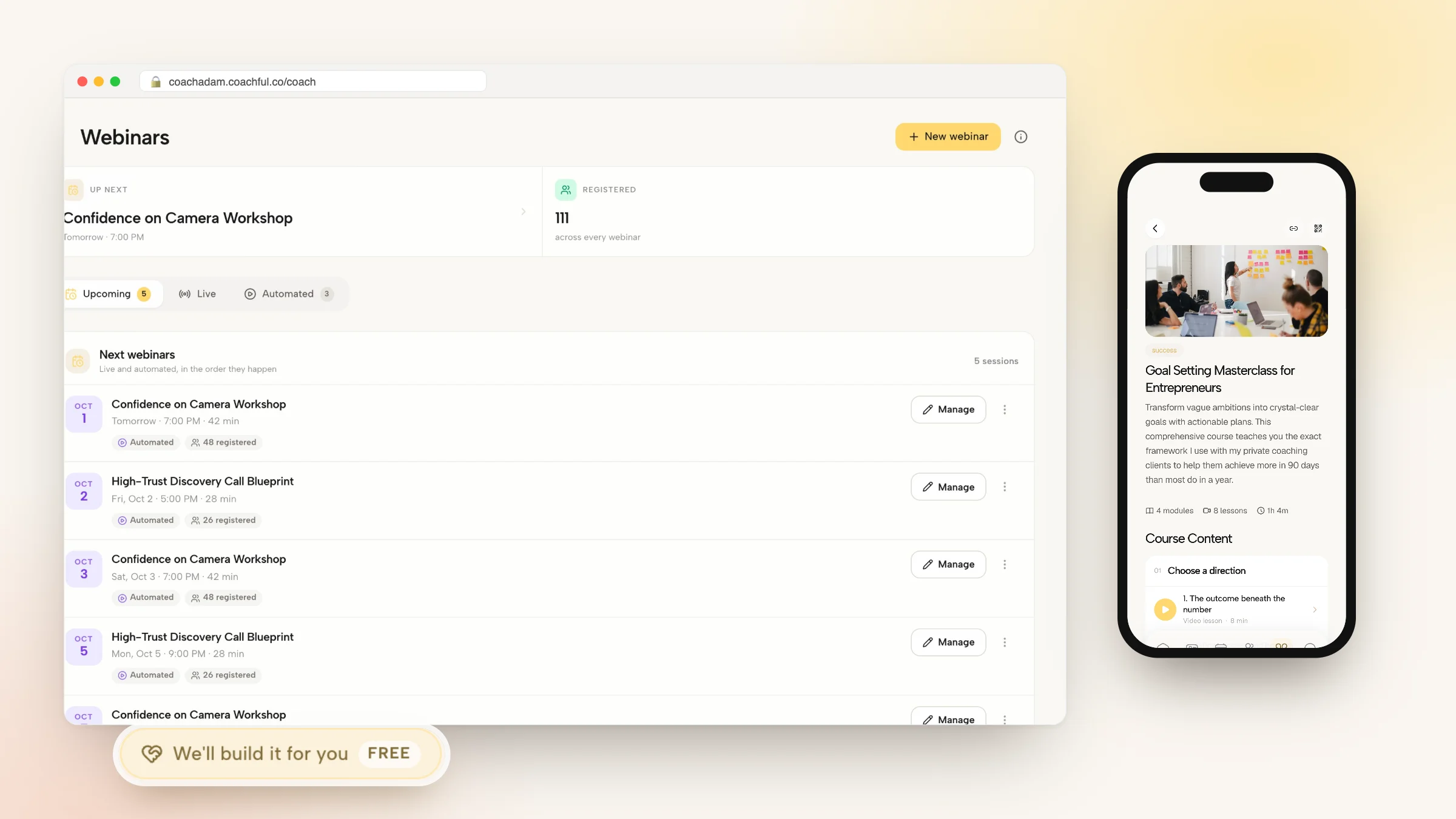
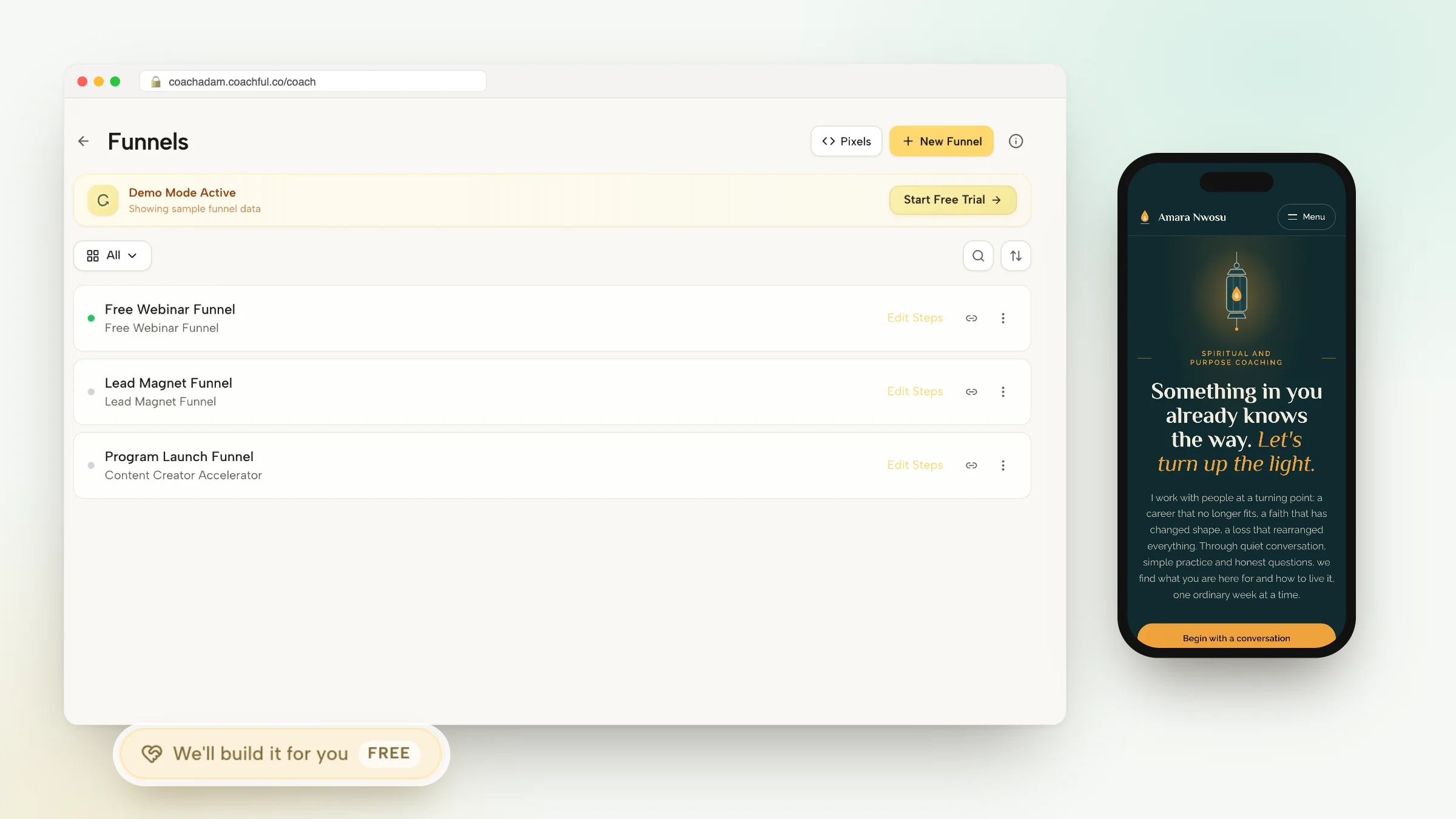
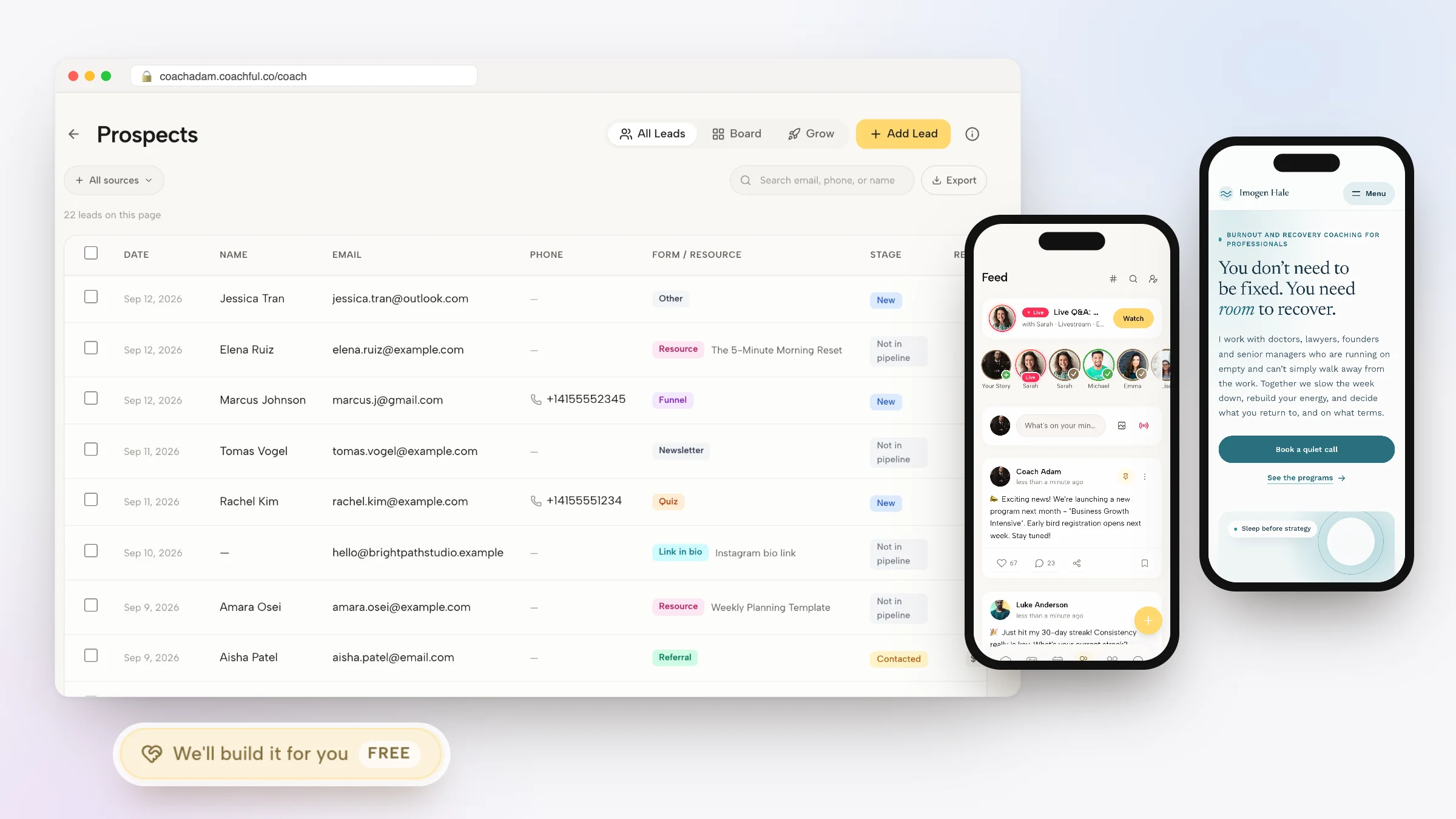
This guide does not claim TikTok posting, account access, automated direct messages, or native TikTok attribution in Coachful. The screenshots demonstrate destination-side work: a website, an educational resource, email preparation, and business review.
Build the route before you increase the reach
The useful next move is not buying equipment or producing a month of videos. Choose one question, prepare one accurate answer, and test the action you will invite a viewer to take. If that route is unclear, more attention will only send more people into the same uncertainty.
If you want to inspect how the website, course, email, and business-review surfaces could support that route in your practice, Try the interactive demo. Explore the relevant destination before making promises about it in a video, and keep TikTok content decisions separate from your client-delivery commitments.