Kajabi vs Circle: A Coach's Decision Guide

Coachful
You're at the laptop late, the second tab is open, and the decision still feels annoyingly expensive. One tab says Kajabi, the other says Circle, and both seem right until you ask the question that matters, which one fits the way your coaching business makes money?
The wrong answer usually doesn't blow up on day one. It shows up later, when your launches flatten, your membership churns, or your community starts feeling bolted on instead of central. For a coach, kajabi vs Circle isn't a software beauty contest. It's a choice between a course-led acquisition engine and a community-led retention engine.
| Decision Point | Kajabi | Circle |
|---|---|---|
| Core strength | All-in-one business stack | Community-first engagement layer |
| Best for | Funnels, email, checkout, courses | Member spaces, discussion, live events |
| Weak spot | Community depth can feel basic | Marketing and commerce need stitching together |
| Best business model | Course-led acquisition | Community-led retention |
| Typical trade-off | More system under one roof | Cleaner member experience, more integrations |
The Real Decision Every Coach Faces
At 11 p.m., most coaches aren't asking for “the better platform.” They're really asking, what will keep my business growing after the launch adrenaline wears off? That's a different question, and it leads to a different answer. If your growth depends on getting strangers into an email list, warming them up, and converting them into buyers, Kajabi's model makes sense. If your growth depends on keeping paying members active, talking, and renewing, Circle's model starts to look smarter.
Two business models, two very different bets
A course-led acquisition engine uses content, funnels, and email to turn cold traffic into buyers. That's where Kajabi's all-in-one setup matters, because it keeps the path from landing page to checkout to course delivery in one system. Kajabi launched in 2010 and, by independent coverage, has since paid out $10B to creators, with payouts rising 25% year over year as of August 2025 (Contrary). That scale tells you exactly what kind of business model it has served for years.
A community-led retention engine works differently. You're not mainly asking, “How do I sell the first time?” You're asking, “How do I keep members inside a high-value experience long enough that renewals, referrals, and higher-ticket offers become natural?” Circle is built around that answer. Its structure is centered on spaces, member profiles, live events, and engagement workflows, not on full-funnel marketing.
Practical rule: if your offer lives or dies on nurture and conversion, start with Kajabi. If your offer lives or dies on belonging and participation, start with Circle.
Where coaches make the wrong call
The mistake I see most often is choosing a platform based on the first sale instead of the 14th month. A coach buys Circle because the community feels alive, then realizes they still need a real email and funnel stack. Another coach buys Kajabi because the launch system is smooth, then realizes the community side feels thin and members stop using it between sessions.
That's why the test is simple. Ask yourself which lever you use to grow:
- Acquisition benefits if you sell through evergreen webinars, lead magnets, or launch sequences.
- Retention benefits if your revenue depends on recurring membership, group accountability, and ongoing participation.
- Delivery benefits if your program needs structured progression, client management, and repeated touchpoints.
If you're still unsure, don't start by comparing menus. Start by naming the business model that pays you over the next 24 months, then judge the software against that motion.
All-In-One Suite or Community-First Platform
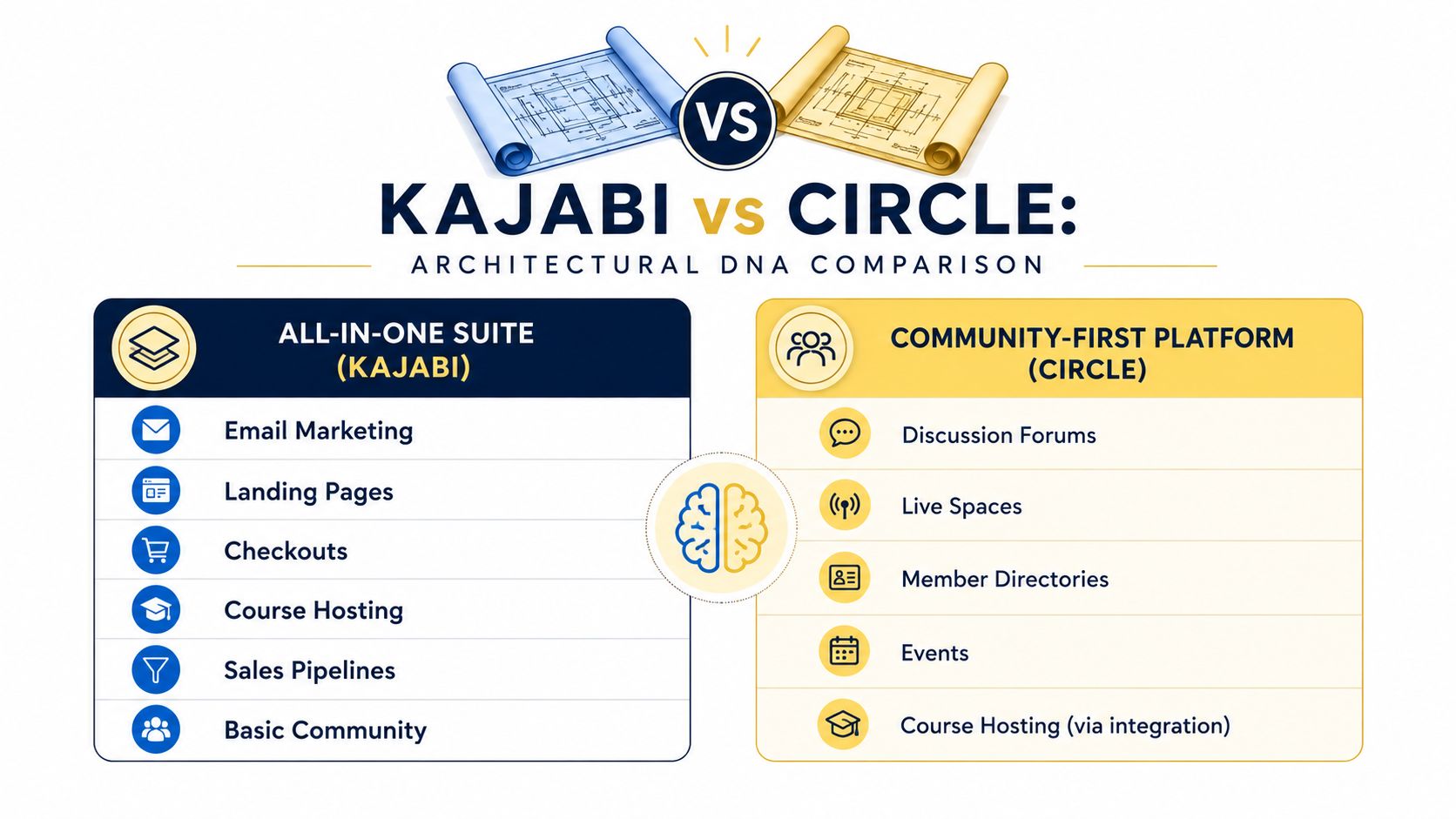
Kajabi and Circle diverge at the level that matters most, their architecture. Kajabi is designed as one connected stack, so a coach can handle website building, email marketing, funnels, checkout, and course hosting under one login. Circle takes the opposite route, it gives you a strong community layer, then expects you to connect the rest with other tools. That difference sounds subtle until you're running the business every week.
What each platform is trying to own
Kajabi tries to own the full customer journey. A visitor lands on your page, joins your list, gets nurtured, buys, and enters the course or membership experience without changing systems. That cohesion reduces friction, especially when you don't want to duct-tape five tools together just to deliver one offer. Circle's design is narrower on purpose. It centers the member experience first, which is why it feels clean for discussion, events, and subgroup activity.
Circle's own comparison page frames it as a community-first product, while Kajabi is the broader all-in-one stack (Circle vs. Kajabi comparison). That distinction is the whole story. If you want one platform to carry acquisition and monetization, Kajabi is the more complete operating system. If you want one platform to make the community feel focused and intentional, Circle is the better social layer.
For buyers comparing the market more broadly, finding the right membership platform usually comes down to this same architectural question, whether you want a bundled stack or a sharper member experience.
The weekly workflow changes more than the feature list
A Kajabi coach spends more time inside the same environment. Build the page, send the sequence, publish the lesson, and check the checkout, all in one place. That matters because fewer seams means fewer things break when a launch gets busy. A Circle coach spends more time curating member activity, moderating spaces, and designing the interactions that keep people showing up.
If you hate app switching, Kajabi will feel calmer. If you hate clunky member experiences, Circle will feel cleaner.
The downside of the all-in-one model is obvious, some parts are broad rather than deep. The downside of the community-first model is just as obvious, you'll stitch together commerce, marketing, and sometimes course delivery with integrations. Neither approach is wrong. They just shift the operational burden to different parts of the business.
That's why all-in-one marketing platforms make sense for coaches who want fewer moving parts, while community-first tools make sense for coaches who care more about the member experience than the full sales stack. The question isn't which platform has “more.” The question is which one lets your actual business breathe.
Features Coaches Actually Use Day to Day
The weekly reality is where the glossy feature list falls apart. A coach doesn't live in abstract “platform capability.” A coach lives in course uploads, member questions, payments, live sessions, and the awkward gap between marketing and delivery. That's why the useful comparison is not feature parity, it's feature depth where your hands go.
Courses, community, and the place members spend time
Kajabi gives you a more complete course environment, including the course structure, completion tracking, quizzes, and a stronger all-in-one delivery path. Circle has course tools too, but they sit inside a community-led product, so the course side tends to feel lighter and more dependent on integrations for advanced drip or assessment logic. That's fine if the course is secondary to the community. It's not fine if the curriculum itself is the value.
Circle is much stronger when the business lives inside discussion, member profiles, subgroups, and live interaction. The member directory and threaded spaces make it easier to create a sense of belonging that doesn't rely on a polished curriculum. Kajabi's community module works, but it usually feels like an add-on inside a broader suite rather than the center of gravity.
Sales, marketing, and checkout where the money actually moves
Kajabi wins when the business depends on pages, pipelines, email broadcasts, and checkout in one place. Circle can gate access, collect payments, and support paid membership flows, but the marketing layer is leaner and more dependent on other tools. If your process includes lead capture, nurture, and launch sequences, Kajabi is built for that motion.
The checkout difference matters because it changes how many systems you need to keep aligned. Kajabi's checkout and offer setup can support the full path from opt-in to sale. Circle often needs a more deliberate stack if you want the same marketing depth. That's why a coach comparing the two should also read the best platforms to sell digital products, because the question is less about a single product and more about the system around it.
Real-world test: if you're constantly asking, “How do I get this lead into the next step?” Kajabi is the cleaner fit. If you're asking, “How do I make members talk, attend, and stay?” Circle is the sharper fit.
Delivery, calls, and resource management
For delivery, both platforms can host the basics, but they behave differently in practice. Kajabi is stronger when the delivery needs to sit alongside marketing and sales. Circle is stronger when the delivery experience is intentionally social, especially for group programs and participation-based work.
That difference shows up in the small stuff. If a coach wants a neat library of resources, a discussion space, and a live event calendar, Circle feels natural. If the coach wants a course plus a funnel plus a sequence that moves people from prospect to buyer to student, Kajabi feels more complete. A community that needs heavy structure will expose Circle's lighter course side. A sales process that needs deep engagement will expose Kajabi's thinner community side.
| Feature Area | Kajabi | Circle |
|---|---|---|
| Course depth | Stronger quizzes, completion tracking, and structured delivery | Lighter course tools, better when course is secondary |
| Community | Basic but usable | Core strength, with threaded discussion and member spaces |
| Sales funnels | Built in | Usually external |
| Email marketing | Built in | Leaner, more dependent on add-ons or integrations |
| Checkout | Built in, conversion-focused | Works, but simpler |
| Live events | Good for integrated delivery | Better fit for community-led events |
| Resource library | Works well inside the suite | Works well inside member spaces |
The practical answer is blunt. Kajabi gives you fewer excuses to leave the platform. Circle gives your members a better reason to come back.
Pricing, Plan Limits, and What You Keep at Scale
Sticker price is the wrong comparison. The comparison is what happens when your list grows, your member count rises, and your admin workload starts compounding. That's where pricing turns from “what can I start with?” into “what does this cost once the business is working?”
Kajabi's cost structure is built around limits
An independent 2026 review lists Kajabi's paid plans as Basic at $179/month, Growth at $249/month, and Pro at $499/month, with annual billing lowering the effective monthly cost to $143, $199, and $399 respectively (Ruzuku). Another independent review shows the hard caps behind those tiers, 5 products and 2,500 contacts on Basic, 50 products and 25,000 contacts on Growth, and unlimited products, 100,000 contacts, 3 websites, and 3 communities on Pro (Art of Her). That means Kajabi is not just a course host, it's a capacity-planned business platform.
Kajabi also charges transaction fees through its payment stack, with its own pricing page showing 2.9% + $0.30 (Mihael Cacic review of Kajabi pricing). That directly affects net revenue on every payment, especially for high-ticket coaching or repeated monthly charges.
Circle starts lower, then the fee structure becomes the real question
Recent comparison pages show Circle's annual plans starting around $89/month, with transaction fees ranging from 0.5% to 2% (Kourses). Independent review data also shows a Professional tier at $89/month billed annually and a Business tier at $199/month billed annually, with the Business tier including 30 spaces, 5 admins, 15 moderators, workflow automations, custom profile fields, API access, and a transaction fee that drops to 1% (Campaign Refinery). Circle looks cheaper at entry, but the fee layer matters once volume grows.
The point isn't which platform is “cheap.” It's which one becomes more expensive as your revenue and community complexity grow. A coach with a small paid community may prefer Circle's lower entry point. A coach with a marketing-heavy funnel and multiple offers may find Kajabi's bundled stack saves money by replacing separate email, funnel, and checkout tools.
What the break-even question really sounds like
If you're under a few hundred members and your model is mainly discussion plus live sessions, Circle can stay financially elegant. If you're building a larger offer suite, or you need products, contacts, and websites to expand without constant retooling, Kajabi's higher monthly cost can still be the better business decision. The answer isn't “which is cheaper.” It's “which set of costs do you want to carry, subscription, transaction fees, or extra tools.”
Margin rule: a platform is only affordable if it protects the revenue motion that pays for it.
If you're comparing this against a more operational coaching stack, Coachful can also replace parts of the admin layer with client onboarding, scheduling, messaging, and progress tracking in one workspace. That doesn't make it a drop-in substitute for either Kajabi or Circle, but it does matter if your real pain is workflow overhead rather than community architecture.
| Member Count | Kajabi Plan Needed | Kajabi Monthly Cost | Circle Plan Needed | Circle Monthly Cost + Fees |
|---|---|---|---|---|
| 100 | Basic | $179/month | Professional | $89/month + fees |
| 500 | Growth or Pro, depending on product and contact volume | $249/month or $499/month | Business | $199/month + fees |
| 1,000 | Growth or Pro, depending on contact load and websites | $249/month or $499/month | Business | $199/month + fees |
Matching the Platform to Your Coaching Model
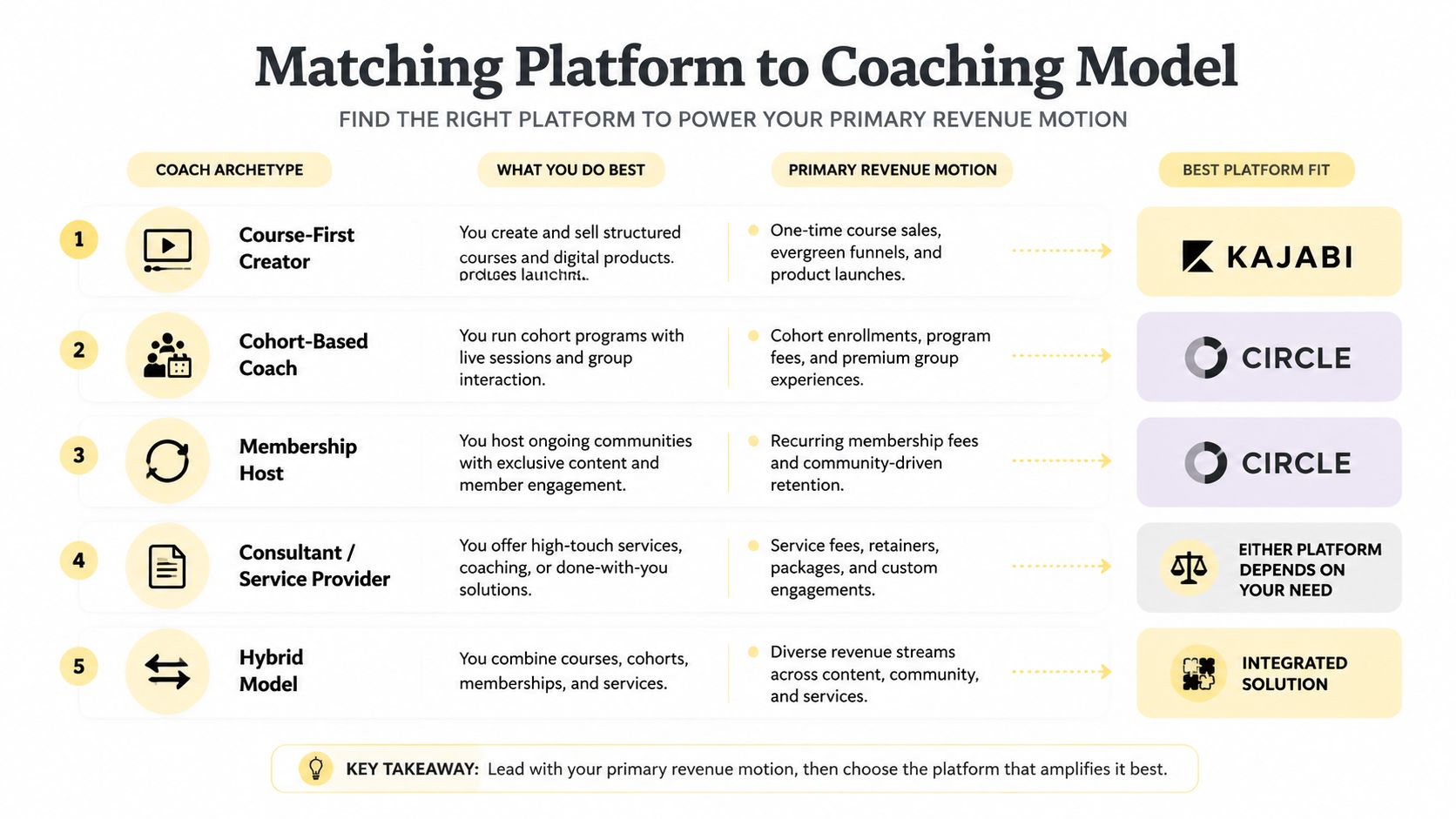
The right answer changes fast once you stop thinking in software categories and start thinking in revenue motions. A platform should fit the way money enters your business, not just the way your content looks on screen. That's why the coach archetype matters more than the feature list.
Five common coaching models and the platform fit
A course-first creator sells evergreen curriculum, then uses traffic and email to push people through a repeatable buying path. Kajabi fits that model because the funnel, checkout, and course delivery are already connected. If your main question is how to turn strangers into self-paced buyers, Kajabi gives you the cleaner machine.
A cohort-based coach runs live groups and wants accountability, interaction, and a strong container for the cohort. Circle often fits better here because the social layer feels more native. The friction shows up if you need advanced marketing automation, but the live experience usually feels more coherent.
A membership host monetizes retention. That's Circle territory. The product is the space, the discussion, the recurring touchpoint, and the reason members renew.
A consultant or service provider can go either way. If the program is really a polished front end for selling packages, Kajabi helps. If the deliverable is mostly relationship management with a lighter content layer, Circle can be enough.
A hybrid operator sells courses plus a paid community. That's where the choice gets messy, because you're trying to maximize both acquisition and retention. In practice, the fit depends on which side of the business is responsible for more revenue.
Quick read on the trade-off
- Kajabi first: if your buyer journey starts with content marketing, lead capture, and a structured offer ladder.
- Circle first: if your revenue depends on member participation, community stickiness, and recurring engagement.
- Both, only if necessary: if you're mature enough to justify a stacked workflow and can manage two systems without losing control.
For coaches who want to compare community-heavy options more broadly, community platform for creators is a useful lens because the central issue is not whether community exists, but whether it drives revenue or just activity.
If your offer needs a “room” more than a “funnel,” Circle usually wins. If it needs a funnel more than a room, Kajabi usually wins.
Integrations, Migration, and Day-Two Realities
Most coaches don't start with a clean slate. They already have a checkout tool, an email list, a scheduler, maybe a course host, and definitely a mess they don't want to make worse. That's why the decision is often not “migrate everything” but “what should stay primary, and what should connect around it?”
Two common setup patterns
The first pattern is Kajabi as the sales engine and Circle as the community layer. That makes sense when Kajabi handles funnels, checkout, and email, while Circle handles the member experience. The second pattern is the reverse, Circle as the engagement hub with a separate checkout or marketing stack. That works when the community is the product and the rest of the stack can stay lightweight.
The integrations usually run through tools like webhook automation or Zapier. That's enough for membership access, tagging, and triggers, but it doesn't magically solve every handoff. Course structure and member lists can move more cleanly than posts, comments, or design elements, which usually need manual cleanup.
What coaches underestimate after launch
The biggest miss is support responsibility. If a member can't access the community, the checkout vendor blames the email tool, the email tool blames the integration, and the coach ends up in the middle. Billing reconciliation becomes another hidden task, especially when one platform handles the sale and another handles the member room. Churn makes this worse, because access can lag if a user leaves one system before the other updates.
If you're adding AI support inside a Kajabi flow, the Kajabi AI chatbot how-to is a useful technical reference for understanding how automation can sit inside the page experience. That kind of add-on solves a narrow problem, but it doesn't remove the broader coordination cost of running two systems.
Use this checklist before you connect anything
- Keep one primary source of truth: decide which platform owns billing, because that's the system you'll defend when access issues appear.
- Map your access rules first: define what happens on purchase, cancellation, upgrade, and refund before you sync a single tag.
- Test the member journey manually: buy the offer as a customer, cancel it, and confirm the access changes work in both directions.
- Do not migrate community history casually: threads, comments, and member behavior rarely transfer cleanly.
- Choose integration over migration when content is the asset: if the old community still has value, keep it alive and connect around it instead of ripping it out.
The clean answer is usually simpler than the ambitious one. If one tool already does the primary money-making job well, integrate around it. If neither tool is the true center of the business, you're probably looking at an unnecessary rebuild.
The Decision Checklist and When Neither Is Right
You do not need to force a binary choice if the business model doesn't deserve one. Some coaches need a platform that does everything. Others need a narrower stack that solves one job cleanly. The smartest move is to score the decision against your actual operating needs instead of buying software that looks impressive in a comparison chart.
A weighted checklist that tells the truth fast
Score each item from low to high based on how central it is to your business.
- Community centrality. If the community is the product, Circle fits harder. If community is a support layer, Kajabi is usually enough.
- Course depth. If you need structured lessons, completion logic, and more refined delivery, Kajabi gets the edge.
- Email automation needs. If your marketing runs on sequences and funnels, Kajabi is the stronger bet.
- Budget and complexity. If you want one subscription and fewer tools, Kajabi simplifies. If you want a lower entry price and can tolerate integrations, Circle can start leaner.
- Technical comfort. If you hate stitching systems together, Kajabi is easier to live with. If you're comfortable managing integrations, Circle is workable.
Three coach personas, three different answers
A solo business coach selling one flagship course and one follow-up package will usually score higher on Kajabi. The reason is simple, the sales motion matters more than the community architecture. That coach needs a funnel that moves people from opt-in to purchase without friction.
A membership-based leadership coach who runs discussions, live rooms, and recurring check-ins will usually score higher on Circle. The coaching itself depends on interaction, not just content consumption. In that case, the community is the retention engine, so the platform should protect that center.
A coaching school or academy with multiple programs, cohorts, and branded delivery often ends up split. If the team wants everything in one place, Kajabi is easier to manage. If the institution's success depends on engaged cohorts and member discussion, Circle plus a separate sales layer may be cleaner.
When neither one is the right answer
Some businesses need something more specific. If your main pain is 1:1 scheduling plus lightweight community, you may want a scheduler plus a focused community tool instead of a broad suite. If you run high-ticket cohorts with deep accountability, a specialized coaching platform may serve the workflow better than either generic stack. If your work relies on native event-hosting or practice-management integrations, neither platform should be forced into that role.
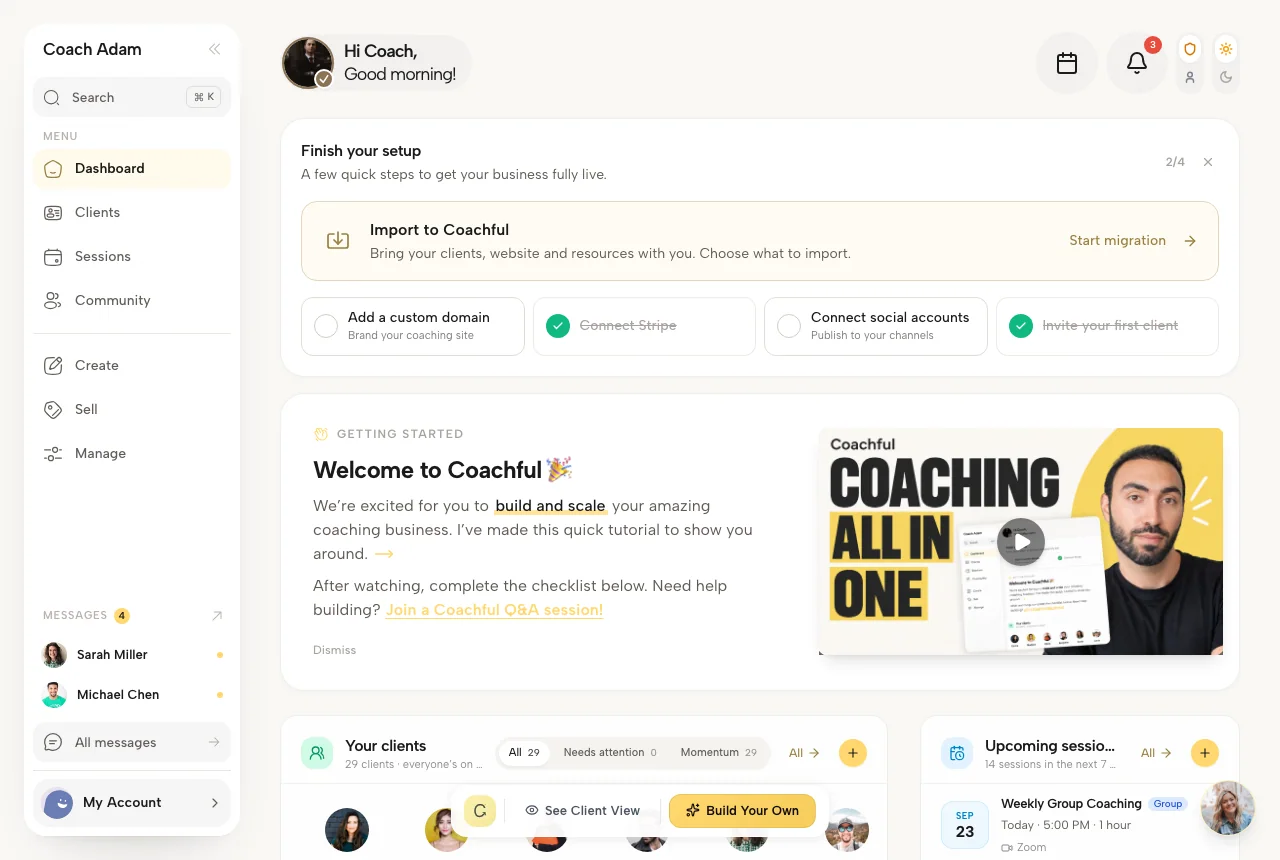
For some coaches, a more operations-focused system like Coachful makes sense because it brings client onboarding, scheduling, secure payments, messaging, progress tracking, and group cohorts into one workspace. That's not a community-first replacement for Circle or a marketing suite like Kajabi, but it can be a better answer when the bottleneck is coaching administration.
A 90-day decision timeline
- Days 1 to 15: audit your current offer, revenue motion, and admin pain.
- Days 16 to 30: trial the platform that matches your primary growth lever.
- Days 31 to 60: test one real offer end to end, from opt-in to payment to delivery.
- Days 61 to 90: migrate only if the new workflow is clearly easier to run weekly.
Choose the platform that makes your next quarter cleaner, not the one that looks best in a comparison screenshot. If your business grows through funnels, Kajabi is the sharper bet. If your business grows through community, Circle is the sharper bet. If your business grows through coaching operations, neither may be the answer.
If you're still torn, stop debating features and map your actual revenue motion on paper. Then test the platform that fits that motion for 30 days inside your real workflow. If you want a coaching platform built around onboarding, scheduling, messaging, progress tracking, and group programs, visit Coachful and see whether a more operations-first stack fits your business better.