Outplacement Coaching Services: 5 Decisions Before You Sell to Employers

Coachful
Editorial Team
Should you sell outplacement coaching if an employer wants help for people it is letting go? Yes, if you can deliver a defined career-transition service, protect the departing employee's choices and information, and support the agreed number of people without promising them jobs. Start with five decisions: scope, activation, confidentiality, capacity and purchasing.
Outplacement is not ordinary executive coaching with a different label. The buyer may be ending someone's employment while paying you to help them move forward. That makes the invitation, the contact details and the reporting boundary part of the service, not paperwork to sort out later.
This guide is for career coaches designing an employer-funded offer. It includes a hypothetical service scope, a worked workload budget and questions to ask HR before accepting a project. It is operational guidance, not employment-law, tax, clinical or data-protection advice.
What are outplacement coaching services?
Outplacement services support people moving out of an organization toward their next career step. The employer commonly funds the support; the departing employee receives it. A service can combine career coaching with practical assistance such as CV review, job-search planning, networking preparation and interview practice.
Mercer's outplacement overview describes employer-provided career-transition support that includes coaching, resume and interview assistance, and learning resources. Randstad RiseSmart's overview similarly combines coaching with other specialist services. Those providers illustrate the category, not a minimum specification every independent coach must copy.
Your offer must distinguish what you personally provide from what requires a partner. Coaching someone to articulate their experience is different from writing their CV for them. Reviewing a search strategy is different from supplying vacancies, making recruiter introductions or acting as an employment agency.
Sell the support you can reliably deliver, not a hiring outcome you cannot control. Employer interest does not establish your competence in every occupation, seniority level, country or employment situation.

1. Decide exactly what the employee will receive
Begin with the participant's practical next steps, not an attractive list of coaching themes. Someone leaving work may need to clarify a target role, describe relevant achievements, organize a search and prepare for interviews. Another person may want a career change rather than a similar role immediately.
Choose a defined audience you can serve well. For example, a career coach experienced with mid-career professional transitions might accept a small project for that population while referring senior executive searches, regulated professions or unfamiliar international markets elsewhere. A narrow and honest scope is stronger than claiming comprehensive coverage.
A hypothetical six-week offer
The example below is a service-design illustration, not a recommended industry standard or a Coachful package:
- Audience: up to ten departing employees whose goals and locations fit the coach's expertise.
- Private support: three 45-minute coaching sessions per activated participant over six weeks.
- Document feedback: two reviews per participant, each capped at 20 minutes, on agreed materials such as a CV section or interview answer.
- Shared learning: two optional workshops, with a stated topic, duration and privacy expectations.
- Participant outputs: a target-role brief, an evidence bank of achievements, a practical search plan and a next-steps handover.
- Exclusions: recruitment representation, job placement, employment-law advice, therapy and unlimited document rewriting.
Define the difference between feedback and production. If you offer comments on one CV draft, do not let the buyer describe the service as professional CV writing. Specify whether participants receive a marked-up draft, a discussion or a rewritten document, and how many revisions are included.

Also define what happens when someone finds work early, pauses for personal reasons or decides not to pursue employment immediately. Completing a useful transition plan can be a legitimate coaching outcome without a signed job offer. The employee's goals should not be overwritten by the employer's preferred completion statistic.
If an employer needs legal guidance on redundancy, severance, notice, benefits or consultation obligations, that belongs with appropriate qualified advisers. Do not imply that purchasing your coaching meets those obligations or makes a dismissal fair.
2. Decide how employees can choose and activate the service
The employer can buy availability without an employee being ready to use it. Build the distinction between eligible, invited, activated and participating into your process. Ten eligible people are not automatically ten coaching clients or ten consenting users of a platform.
Ask HR to explain the benefit accurately, then give the individual a clear route to decide. Where practical, let people initiate contact or use an agreed invitation process rather than importing every detail of an employee roster before anyone has chosen support. Establish the appropriate basis and notices for any personal-data transfer.
What an invitation should explain
- Who provides the service and who pays for it.
- What is included, with the real activation and access dates.
- Whether participation is voluntary and how declining is handled.
- What information is shared with the employer, including any participation administration.
- How to ask a private question before activating.
- Which personal contact details the participant should use.
A departing employee's work email may stop functioning before the first session. Agree a way for them to supply a personal address themselves, verify it and understand where future communications will go. Do not send sensitive coaching information to a mailbox controlled by the former employer merely because that address was on the original roster.

Set an activation window separately from the delivery period. For example, the buyer could fund a defined invitation window followed by six weeks of support from an agreed activation point. Those dates need actual calendar definitions, a late-activation rule and a clear service end. Avoid a benefit that appears available for months but quietly expires days after someone first books.
Offer a short orientation explaining the process without requiring immediate personal disclosure. Someone may be angry with the employer or uncertain about coaching. You are not there to defend the redundancy decision, make them grateful for the benefit or obtain a positive testimonial.

Before launch, test the participant journey from a personal email address on a phone. Can they understand the invitation, access the right materials and book the first appointment? Check the actual permissions as well as the appearance. A polished welcome screen does not prove that records are private.

3. Decide what the employer can and cannot see
Write a reporting agreement before accepting participant information. The employer's payment does not give it unrestricted access to a person's coaching conversations, CV drafts, target companies, interview feedback or personal circumstances.
Separate service administration from coaching content. The sponsor may need an invoice, confirmation of the contracted delivery and a carefully scoped service review. Even named activation or attendance information should be considered explicitly, not treated as automatically harmless or automatically permitted.
A practical reporting boundary
A proposed sponsor report might contain the agreed reporting period, total service units delivered, outstanding administrative issues and feedback that has been assessed for identification risk. It should state what the numbers mean and what population they describe. Report ten invitations and six activations as those two facts, not as ten people receiving coaching.
Keep private coaching material outside that sponsor report. If an individual wants you to share something specific, establish the purpose and appropriate agreement for that disclosure. Do not treat a general consent sentence at signup as permission to share any future detail.

Small groups need particular care. “One senior engineer interviewing with a local competitor” may identify someone even without a name. A percentage can reveal an individual when the employer already knows everyone else in the group. Aggregation is a technique, not a confidentiality guarantee; omit, combine or defer information when necessary.
Use plain language with the participant: “The employer pays for this support. Here is the administration we have agreed to report. Your session notes and job-search materials are not part of that report. We will discuss the applicable confidentiality limits before coaching starts.” Adapt this explanation to the actual agreement, professional obligations and law.
Do not promise absolute secrecy. Establish applicable legal and safety limits, access roles, record retention, deletion and handling of requests. If the buyer insists on individual job-search surveillance or unrestricted notes, do not disguise that conflict with reassuring copy. Renegotiate the service or decline it.
4. Decide your capacity and pricing from actual work
Outplacement can arrive as a sudden batch of people with different needs. A contract for ten participants is not the same as ten ordinary clients joining gradually. Calculate the work before quoting, and distinguish delivery hours from the calendar capacity you must reserve.
Using the hypothetical scope above, the private workload per person is:
- Three sessions at 45 minutes: 135 minutes.
- Two document reviews at 20 minutes: 40 minutes.
- Activation, preparation and closure administration: 15 minutes.
- Total: 190 minutes per person.
For ten activated participants, that is 1,900 minutes, or 31 hours and 40 minutes. If you budget another four hours for workshop preparation and delivery and three hours for sponsor setup and reporting, the project totals 38 hours and 40 minutes before contingency, selling time, specialist costs or extra support. These are illustrative planning assumptions, not typical delivery benchmarks.
Check whether the 15-minute administration allowance is realistic for your process. Rescheduling, accessibility adjustments, a complicated first conversation and document handling can exceed it. Cost those activities honestly rather than calling them incidental and donating the time later.

Choose a commercial model that matches the promise
Reserved-capacity fee: the employer buys a defined amount of availability for a stated population and window. You can protect your calendar, but the buyer needs clear rules for unused places and substitutions.
Activation-based fee: the employer pays when a person activates an agreed package. That can align cost with uptake, but you need a minimum setup fee or another explicit way to cover launch work and reserved availability.
Defined project fee: the buyer purchases the stated project scope with a participant cap. It is administratively simple, but only if extra people, extensions, additional reviews and cancellations have agreed change rules.
None is universally best. Build a quote from delivery cost, preparation, administration, secure tools, any subcontractors, risk and a sustainable margin. Do not borrow a large provider's public performance claims or invent a market rate to justify your own fee.
Check your busiest week, not only the total hours. If everyone wants interview practice at the same time, the project can exceed available appointments while still looking profitable on paper. Set response expectations, review turnaround, a safe caseload and backup arrangements you can actually honor.
5. Decide what must be agreed before the employer buys
The sale should settle both the commercial project and the participant experience. Ask who owns budget approval, who can authorize changes, who coordinates invitations and who handles privacy or supplier checks. A supportive HR conversation is not a substitute for the organization's actual purchasing process.
Use this short buyer brief before producing a final proposal:
- Population: how many people may be eligible, and which locations, languages and career levels must be covered?
- Timing: when can invitations go out, when can employees activate, and when does support end?
- Readiness: what has the employer told employees, and who owns questions about employment or severance?
- Service: which sessions, document reviews and workshops are included, and which specialist services are excluded?
- Information: what data is necessary, how will it be transferred and what administration will be reported?
- Money: what triggers an invoice, what payment terms apply and is a purchase order required?
- Changes: what happens with late activations, extra participants, missed sessions, substitutions and extensions?

For the detailed finance setup, use the separate guide to company-funded coaching billing. Keep those purchasing terms consistent with the service you describe to employees. Procurement should not buy “unlimited coaching” while your participant welcome quietly limits it to three appointments.
A short employer conversation opener
The following is a hypothetical script to adapt, not a message sent to a real buyer:
“I provide a defined career-transition service for [specific population]. It combines [actual coaching and practical support] over [delivery period]. Participants choose whether to use it, and we agree the reporting boundary before invitations go out. Could we discuss the eligible population, timing and support you need before I propose a scope?”
This is more useful than promising to make a difficult redundancy process painless. Ask enough to establish fit, then put the offer, exclusions, reporting, activation rules and fee in writing. Do not use confidential details about a prospective redundancy in marketing or ask the buyer to identify employees before there is a legitimate operational need.
Build a participant journey before expanding the offer
Start with a service you can personally supervise. Rehearse one fictional participant's journey: invitation, private orientation, first appointment, useful action, feedback and closure. Separately rehearse the sponsor journey: signed scope, purchasing requirements, invoice and agreed service report.
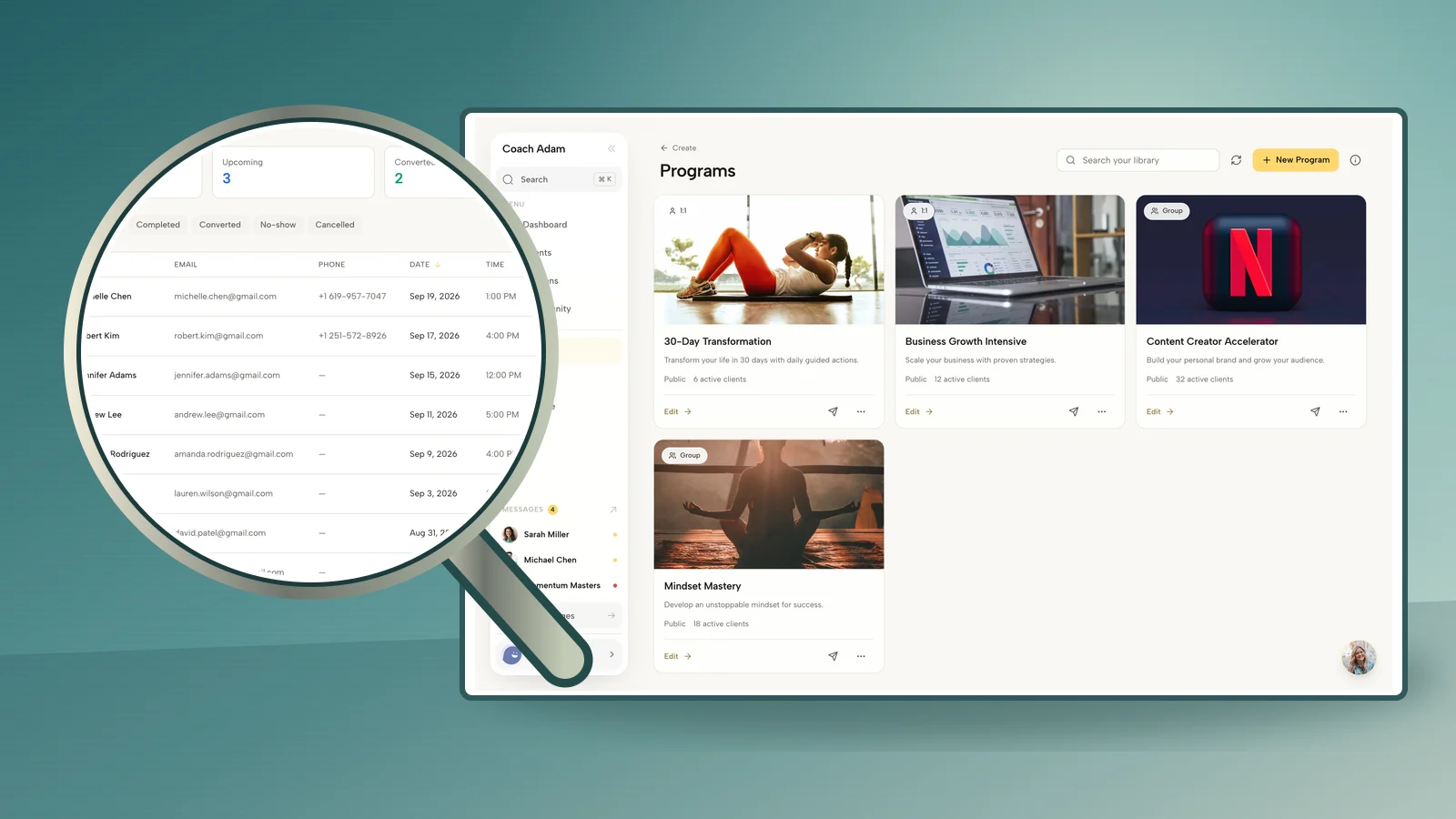
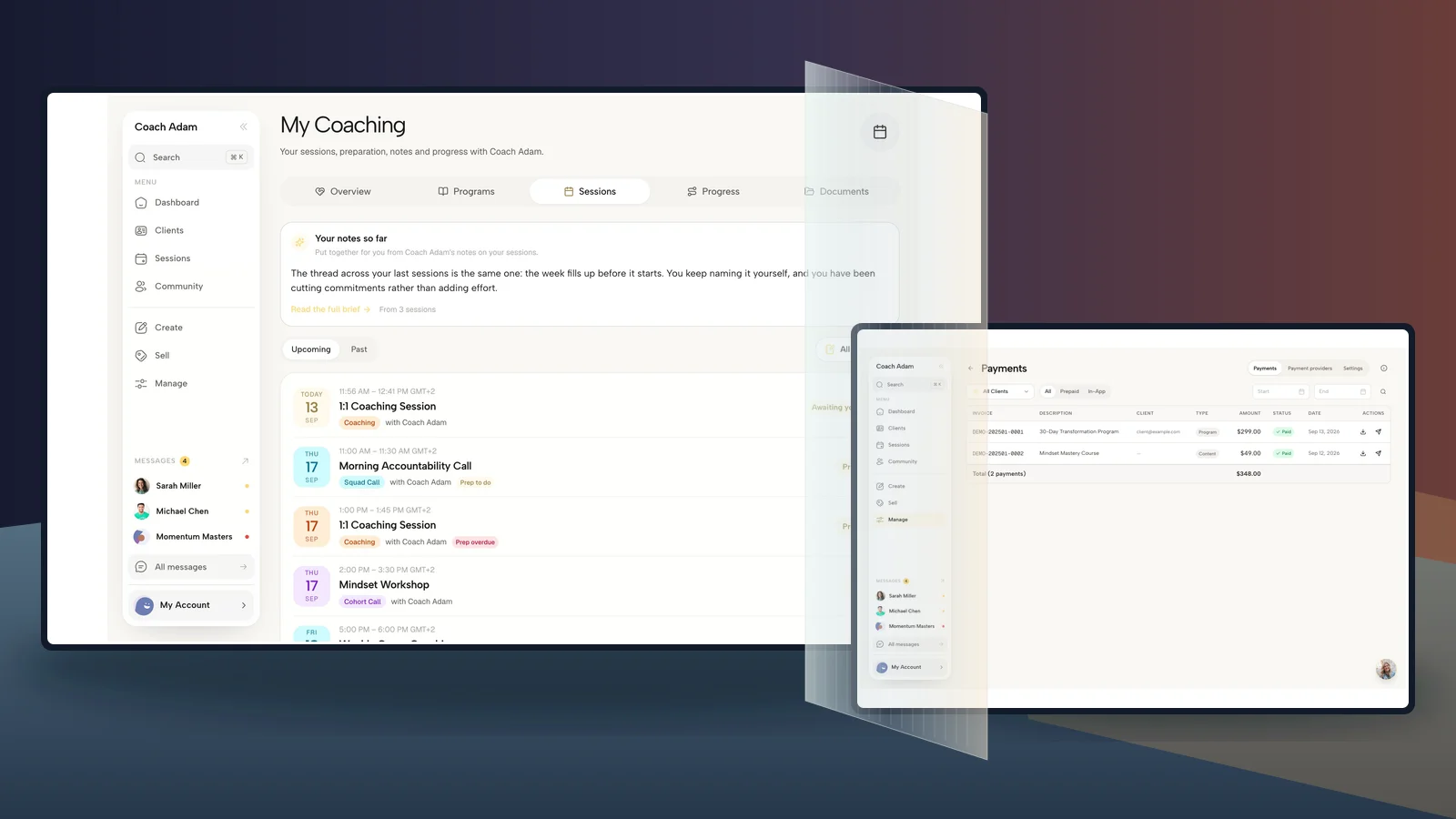
Coachful's demo includes program, session, coaching-flow, branding and invoicing surfaces that can help you assess delivery administration. The screenshots here are general demo examples, not a prebuilt outplacement product, recruitment service or proof of a particular employer-access configuration.
Try the interactive demo to inspect the client session experience alongside the coach's administrative views. The useful next step is to test how you would deliver your stated scope and maintain the reporting boundary, not to assume software will make those decisions for you.
Outplacement coaching FAQs
Is outplacement the same as career coaching?
Career coaching can be part of outplacement. Outplacement describes the employer-supported transition context and may include additional services such as CV writing, job leads or learning resources. State exactly which of those services your practice provides rather than using the category name as a blanket promise.
Can an independent career coach provide outplacement?
An independent coach can offer a defined career-transition service within their competence, capacity and applicable requirements. Large or international projects may need specialist partners, backup coverage and supplier approval. Do not accept a project requiring capabilities you do not have simply because it resembles existing one-to-one coaching.
Should you guarantee that participants will find jobs?
Do not make an unsupported hiring guarantee. You can commit to specific service delivery and participant-owned work, but hiring decisions depend on employers, market conditions, the person's choices and other factors outside your control. Explain any proposed guarantee precisely before agreeing to it.
What should you measure?
Distinguish invitations, activations, sessions delivered, participant feedback and voluntarily supplied career outcomes. Define the denominator and reporting period. A new job reported by one participant is not proof that coaching caused it, and a participant who declines to share an outcome should not be counted as a failure.
What if an employee needs more than career coaching?
Discuss the limit of your role and an appropriate referral. Job loss can raise legal, financial, mental-health or practical support needs that coaching alone cannot address. Maintain a suitable referral process and do not position your offer as a replacement for qualified specialist help.