Pro Bono Coaching Agreement: Template and 7 Decisions

Nour
Founder, Coachful
Do you need a coaching agreement when you are not charging? Yes, use a written agreement to define the donated work, the ending, confidentiality and the client’s choices. Removing the fee does not remove the possibility of misunderstanding. It should also remove any hidden expectation that the client owes you a testimonial, referrals or a paid purchase.
A useful pro bono coaching agreement makes generosity specific: who you will coach, what you will provide, how long it lasts and what happens if either person wants to stop. The seven decisions and original template below are for a coach arranging adult, individual coaching, not for delivering therapy, working with minors or running a complex charity programme.
This is a drafting guide, not legal advice or an ICF-approved contract. Have a qualified adviser check the final wording against your location, insurance, professional obligations and delivery arrangement. A no-fee agreement’s legal effect can depend on local law; do not assume that a template or an electronic signature settles that question.
What makes a pro bono coaching agreement different?
A paid agreement usually explains what the client buys. A donated agreement must be equally clear about what the client receives without payment, and what they do not owe in return. “Free coaching” can otherwise turn into unlimited messages, an indefinite commitment or an awkward request for public praise.
Distinguish the arrangement before drafting:
- Donated coaching: you provide the defined service without a coaching fee or an agreed exchange.
- Reduced-fee coaching: the client still pays something. State that actual fee rather than describing the relationship as entirely free.
- Sponsored coaching: someone else funds the service or organises access. Identify that party and agree information-sharing boundaries.
- Barter: you agree an exchange of value. Describe the exchange honestly instead of hiding it inside a pro bono label.
This article focuses on the first arrangement. If a charity is referring clients, establish whether it is merely making introductions, administering the programme or entering a separate agreement with you. Those roles carry different practical questions about eligibility, complaints, records and reporting.
7 decisions to make before you send the agreement
1. Name the provider, client and any referring organisation
Use the name of the person or business actually providing the coaching and a working professional contact route. Describe your qualifications accurately. If you are still training, say so rather than letting a client infer that a credential has already been awarded.
Explain who the client is and who, if anyone, has another role. A nonprofit introducing someone is not automatically entitled to hear what they say in sessions. If the programme has a coordinator, agree which administrative details they need and tell the client before coaching begins.
For example, a coordinator might need to know whether an appointment was attended to arrange the next booking. That does not mean they need the client’s goals, personal circumstances or session notes. Write the distinction down rather than relying on everybody’s good intentions.
2. Put a boundary around the donated scope
Specify the session count, appointment duration, delivery format and engagement end date. Include preparation or resources only if you will actually provide them. “Support throughout your transition” sounds kind, but it does not explain whether the commitment lasts a month or a year.
Use a concrete description such as: “Four individual video coaching sessions, each up to 45 minutes, to be completed by [date], focused on the client’s chosen work-transition priorities.” This is a hypothetical scope, not a recommended minimum or a promise that four sessions will achieve a particular result.

Define exclusions with the same care. Coaching does not become clinical treatment, legal advice or financial advice because the client cannot afford those services. Explain the limits of your competence, and consider whether a referral or a different support service is more appropriate.
3. State the fee and remove the invisible invoice
Say plainly that no coaching fee is payable for the stated engagement. Identify any genuine third-party costs before the client agrees, or arrange the service without them. Do not advertise free sessions and reveal a compulsory workbook, platform charge or assessment payment afterwards.
Separate generosity from publicity. A client should not discover during the final session that “free” meant writing a review, introducing three friends or becoming your case study. If you want an exchange, discuss that arrangement openly before delivery and obtain appropriate advice about it.
For genuinely donated coaching, use the simpler rule: no required review, referral, recording or paid continuation. You can invite optional feedback separately without making praise the price of participation.
4. Agree booking, rescheduling and contact limits
Reserve realistic appointment capacity before offering it. State how sessions are arranged, how a client can request a change and what happens if an appointment is missed. A donated session can still use a time you cannot offer to somebody else.

Choose a policy you can explain without a threat. One possible approach is to ask for notice where possible, discuss a missed appointment, and agree whether another slot is available before the engagement ends. This is an operational choice, not a universal cancellation standard.
Do not quietly copy a paid late-cancellation fee into a no-fee agreement. If you intend any charge, it needs explicit discussion and appropriate review. For the template below, there is no missed-session invoice; repeated missed appointments prompt a review of whether continuing is practical.

Name the included contact channel and your usual review window. Distinguish a scheduling message from between-session coaching. If you do not provide urgent or crisis support, say so and explain that the client should use appropriate local emergency or specialist services when necessary.
5. Explain confidentiality and keep permissions separate
Describe how you handle coaching information, who can access it, how records are retained and the applicable limits of confidentiality. Use wording that reflects your actual obligations and tools. Do not promise absolute secrecy or imply a legally privileged relationship without advice.
Recording, credential verification, supervision and publicity are different uses of information. A signature accepting coaching is not a blanket permission to upload conversations, disclose identifying details to a training provider or publish a client story.

If you use supervision, explain the arrangement and safeguards accurately. If you want to record a session for assessment, present the exact purpose, audience, storage and retention arrangements separately. A client must understand what they are deciding, including any limits on withdrawal after material has been submitted.
Be particularly careful when a referring organisation serves people in vulnerable circumstances. Do not collect a detailed personal history merely to demonstrate eligibility, and do not send a coordinator sensitive notes just because they introduced the client.
6. Clarify credential records without making an eligibility promise
If you hope to use the experience toward a credential, check the credential body’s current requirements independently. A signed agreement does not itself make a session eligible, and calling an engagement pro bono does not settle its classification.

Explain any verification information you need to retain, why you need it, who might receive it and what choice the client has. Establish this before delivery rather than requesting a broad release months later. Do not claim that a client has authorised disclosure of session content when they have only agreed to verify dates or hours.
Keep your service record distinct from credential administration. Record what was actually delivered; do not count a cancelled appointment as completed coaching. For the separate question of paid and unpaid experience requirements, see Coachful’s guide to pro bono coaching hours and check the current primary requirements before applying.
7. Write the ending before you begin
Specify how either party can end the engagement, what happens to remaining appointments and when access to resources ends. There should be a clear route to raise a concern without having to post a public review or confront the referring organisation.

Do not make donated coaching an automatic subscription. If the client later wants paid support, discuss new scope and fees separately and obtain their affirmative agreement before charging. An invitation can be welcome; a surprise bill is not an invitation.
Plan a final review focused on what the client wants to carry forward. Continuing with you is one option, not the definition of success. They may finish, pause, work independently or seek another kind of support.
Pro bono coaching agreement template to adapt
The following is an original working draft for a straightforward adult, individual engagement with no coaching fee. It is deliberately not a complete legal instrument for every location. Complete every bracket, remove instructions, add locally required provisions and have the final document reviewed before using it.

Pro bono individual coaching: draft agreement
Parties and purpose. This agreement is between [coach’s legal/business name and professional contact details] and [adult client’s name and contact details]. The purpose is individual coaching focused on [client-selected area within the coach’s competence]. [If relevant, name the referring organisation and describe its limited role.]
Nature of the service. Coaching provides a structured opportunity for reflection, goal-setting and client-chosen action. The coach’s relevant training and professional status are [accurate description]. This service does not include [specific excluded activities]. It is not a substitute for medical, psychological, legal, financial or other specialist services. No particular personal, employment or business outcome is guaranteed.
Defined donated scope. The coach will provide [number] individual sessions of up to [duration] through [format/platform or location], between [start date] and [end date]. Included preparation, resources and between-session support are limited to [specific items, or none]. Additional work or an extension requires a separate discussion and written agreement.
No coaching fee. No coaching fee is payable for this defined engagement. [State any agreed third-party costs explicitly, or confirm there are none.] Participation does not require a testimonial, public review, referral, recording or later purchase. Declining optional publicity will not create a charge for these donated sessions.
Appointments and changes. Sessions will be arranged by [method]. The client or coach should request a change through [contact route] with [agreed notice] where possible. If a session is missed, [describe the actual review and rebooking arrangement]. No missed-session fee applies under this draft arrangement. Repeated missed appointments may lead to a discussion about ending or revising the remaining schedule.
Communication. Use [channel] for [permitted purpose]. The coach normally reviews messages during [days/window] and aims to respond within [realistic period]. This is not continuous monitoring or emergency support. For urgent needs, use appropriate local emergency or specialist services rather than waiting for a coaching reply.
Confidentiality and records. The coach will handle coaching information as described in [applicable privacy information and agreed confidentiality terms]. Before signing, both parties will review who can access records, the purposes of use, retention arrangements and legally or professionally required disclosure limits. [Insert reviewed terms appropriate to this engagement. Do not leave a generic promise of absolute confidentiality.]
Third parties and optional uses. Any information shared with [referring organisation, if applicable] is limited to [specific administrative information] for [purpose], under [agreed arrangement]. Recording, identifiable supervision material, credential verification information and public testimonials require their own clear explanation and appropriate permission or other applicable arrangement. No recording or public use is authorised merely by signing this document.
Choice, concerns and ending. The client may decline an exercise or raise a concern through [private professional contact route]. Either party may end coaching by [notice method and arrangement]. On ending, [explain treatment of remaining sessions, resource access and records]. Where another service appears more appropriate, the coach will discuss the boundary and suitable next steps within their competence.
No automatic paid continuation. This engagement ends on [date or agreed completion event]. It does not create a paid renewal, subscription or obligation to buy another service. Any future paid coaching requires separately agreed scope, fees and acceptance before charges arise.
Confirmation and local provisions. The parties confirm they have discussed the scope, contact limits, privacy arrangements and ending. [Add professionally reviewed provisions required for the relevant location and circumstances.] Coach: [name, signature and date]. Client: [name, signature and date]. Each party receives a copy of the final agreed version.
Turn the document into an honest client experience
Read the agreement aloud once as though you were the client. Could you identify your appointment allowance, contact route, end date and choices without asking the coach to translate? Rewrite vague phrases before adding more formal language.
Next, test the actual delivery path. Open the appointment link, inspect the onboarding instructions, check resource access and confirm which notifications the client receives. A document promising no payment should not lead into an unexplained checkout or a message demanding a card.

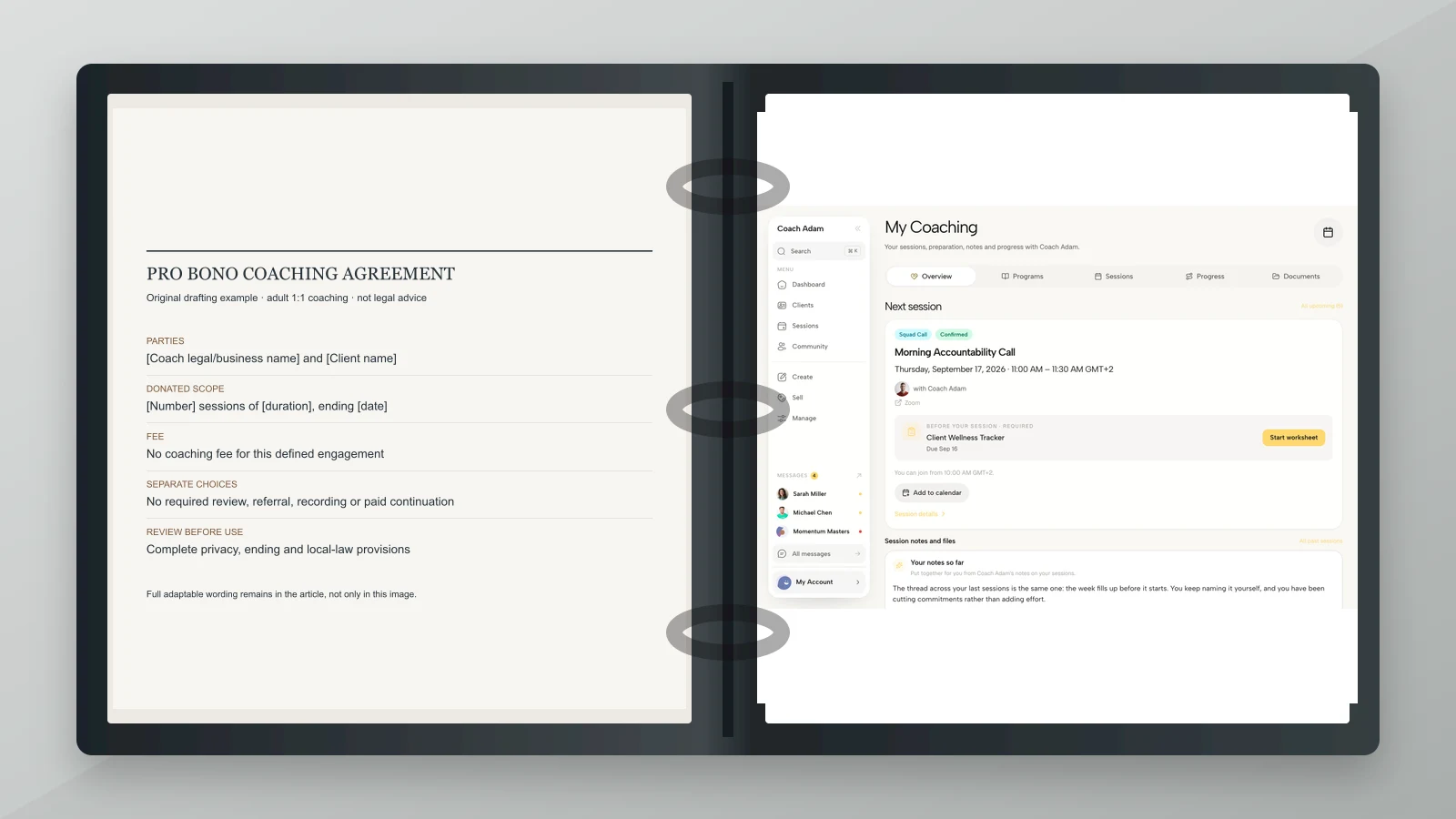
Coachful’s coaching contracts page describes custom agreement templates and downloadable signed PDFs. Those capabilities can support your reviewed wording; they do not provide legal approval or decide whether a no-fee arrangement is appropriate. The screenshots here show genuine general demo workflows, not an existing pro bono contract.
Keep the final agreed version and any later changes identifiable. If you change the service, discuss the change rather than assuming an updated template silently replaces what the client accepted. Give the client a copy they can read and retain.
Frequently asked questions
Can I ask a pro bono client for a testimonial?
You can make a separate, optional request where appropriate, without treating praise as a debt. Explain the proposed wording, attribution and placement and obtain permission before use. If publicity is actually the agreed exchange, do not describe the arrangement as an unconditional donation.
Does a pro bono agreement make coaching hours count for ICF?
No agreement alone establishes eligibility. Review the relevant experience requirements and recording or verification arrangements. Keep accurate records of real coaching delivered, and do not present a software total as an independent credential decision.
What if the client came through a charity?
Clarify the charity’s role before using the template. Referral, funding, coordination and responsibility for the programme are not interchangeable. Agree privacy, reporting, concerns and safeguarding arrangements with the relevant parties; use specialist advice when the situation requires it.
Can I end a free coaching relationship?
Plan a respectful ending route in advance and follow your actual agreement and applicable obligations. If the work is outside your competence or continuing is not practical, discuss the boundary and appropriate next steps. Do not invent a retrospective penalty because the engagement became inconvenient.
Make the donated commitment precise
Before your next pro bono engagement, settle the session allowance, no-fee terms, contact limits, information uses and ending. Then review the wording and test the client’s actual path. The aim is not to make free coaching feel transactional; it is to make the promise dependable.
If you want to examine how that promise could connect to onboarding, scheduling and a client portal, Try the interactive demo. Compare those specific surfaces with your proposed agreement before deciding what to use. Keep the legal and ethical review separate from the software decision.
Source note: The ICF Code of Ethics is a primary professional reference. The ICF Foundation’s Pro Bono Program Toolkit (PDF) addresses the broader task of organising donated coaching. Public examples, including Envision Evolution’s event-specific pro bono agreement, illustrate why the donated service needs defined scope. The wording above is original, not copied from or endorsed by those organisations.