
Progress Note Template for Coaches in 2026

Coachful

If your session note proves that you talked, but can't show what the client chose to change, what exactly are you documenting? After a difficult session, it's easy to worry that a written record will either sound like therapy or reduce meaningful work to a vague summary.
You don't need clinical language to make coaching visible. You need a record that separates what the client reported, what you can substantiate, and what they agreed to do next.
A Coaching Progress Note You Can Fill Today
A coaching progress note is a short record of movement toward a goal the client named. It isn't a diagnosis, a treatment plan, or a SOAP form borrowed from medicine. You can acknowledge uncertainty and emotion without turning either into a clinical assessment.
Use two layers. The client-facing record holds the stated goal, the client's report of change, observable evidence, their chosen action, the owner, deadline, and review date. The restricted practitioner layer holds your interpretation, coaching process, and relevant reflection that doesn't belong in a sponsor, HR, or group update.
Private doesn't mean unrestricted. Record only what helps you coach responsibly, and don't assume that labeling something private gives it special legal protection.
Coaching progress note fields to copy
The examples below describe a hypothetical leadership session. Mark encounter date and time, author, goal link, and follow-up as required; keep narrative boxes short and editable.
| Field | Question it answers | Client can see it | Example |
|---|---|---|---|
| Session header | Who met, when, and why | Yes; sponsor only by agreement | Alex R., 12 Mar 2026, 50 min, goal review |
| Stated goal | What is the client trying to change | Yes; sponsor only by agreement | Give feedback within 48 hours of a missed deadline |
| Client report | What do they say has changed | Yes; sponsor only by agreement | Postponed two conversations last week |
| Observable evidence | What can both of us point to | Yes; sponsor only by agreement | Calendar shows one conversation held |
| Coach interpretation | What does this mean for the goal | No | Delay looks like timing, not a skill gap |
| Coaching move | What did we do in the session | No | Rehearsed the first sentence they will use |
| Agreed action | What, by when, and who owns it | Yes; sponsor only by agreement | Two conversations before Thursday; client owns; coach texts Wednesday |
| Barrier and review | What could stall it and when we look again | Yes; sponsor only by agreement | Travel week; review next Tuesday |
| Private reflection | What only the coach should remember | No | Client flinches if the sponsor is named; keep out of any sponsor update |
Date | Author | Client | Goal link (required) | Stated goal | Client report | Observable evidence | Coach interpretation (private) | Coaching move | Agreed action | Owner | Deadline | Review date (required) | Private reflection (private)
Make Date and Author required too. Put barriers alongside the action or review field if you're using the copy line rather than the table.
Write movement, not a topic
The worry is that a concise note will make the session look superficial. Adding more description won't fix that; connecting the conversation to a commitment will.
Instead of a summary about discussing leadership, write this:
Client will hold two feedback conversations before Thursday and report what happened.
A 2023 meta-analysis of workplace coaching found a medium positive effect across coaching studies and identified goal setting, concrete action planning, and accountability as central coaching mechanics.
For preparation rather than retrospective recording, the Vanta Sports coaching session planning guide offers a useful companion resource. Keep the distinction clear: the plan records your intention; the progress note records what happened.
Paste the blank fields into a document now and fill them from your last session before customizing anything. Keep the blank as a master copy, then create a separate copy for each client and session so the master never carries forward names or previous content.
How to Build and Customize Your Template
The coach's next worry is practical: will this become another form that takes longer than the work it supports? Build the template around the decisions you make, not around every detail you could collect.
A useful design test comes from a 2025 documentation intervention study: a rubric-based lesson and concise EHR template improved all 14 assessed quality items, quality scores correlated with effective provider takeover at r = 0.72, and note length did not increase significantly despite averages moving from 862 to 982 words. Borrow the completeness and handoff principle, not the clinical standard or the word count.
Build the core before adding options
Use this visual as a compact overview of the build.
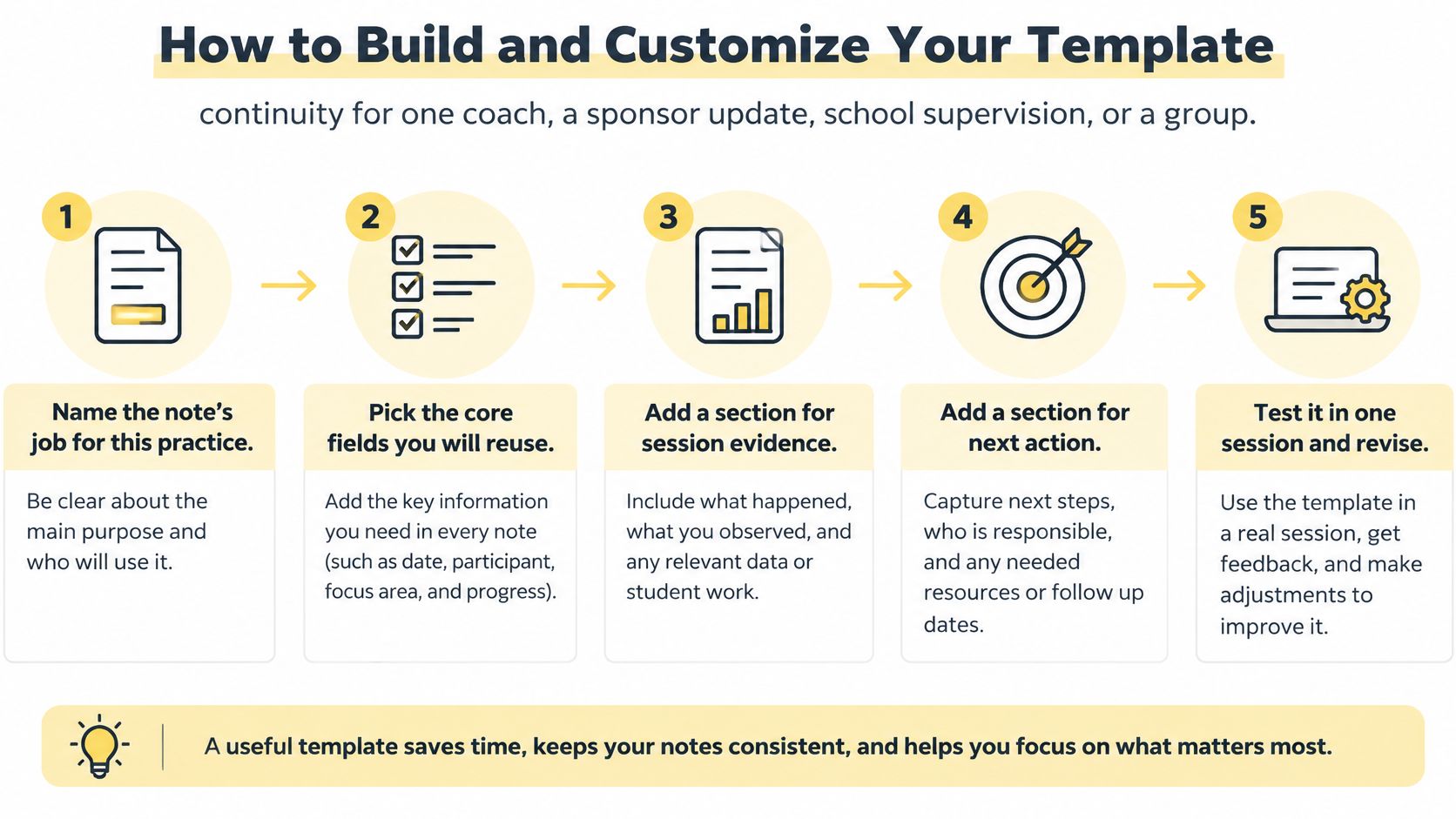
Name the note's job. Choose continuity for your own practice, school supervision, a sponsor update, or a group milestone. Delete fields that don't serve that purpose. A sponsor's desire for detail isn't, by itself, a reason to collect it.
Lock the header. Include client, encounter date and time, author, and purpose so a later reader can identify the session without searching messages. In Word or Google Docs, use a fixed header table rather than scattering these details through the narrative.
Require fresh goal status. Use active, changed, paused, achieved, or dropped, followed by a brief explanation. A hypothetical line might read: Goal paused during relocation; client chose to resume at the next review. Don't make continued pursuit the default.
Separate report from interpretation. Put the client's account in its own box and your tentative explanation in the restricted layer. Client reports difficulty choosing a start time is different from Coach suspects the action is too large. Neither warrants a personality label.
Documentation requirements can also clarify why a template needs an explicit purpose. Hyperbaric Business Solutions' guide to strengthen compliance through wound documentation is a useful contrast from a regulated setting: borrow the discipline of purpose-linked fields, not medical content or billing assumptions.
Finish with an action and a test
Add evidence and a client-owned action. Give each its own line. Include owner, deadline, and review date so you don't mistake a coach suggestion for a client commitment. If no action was agreed, record that plainly and name what will be revisited.
Create a restricted layer and shareable export. Decide who may receive each before entering sensitive content. Separate documents or controlled views are safer than relying on someone to remember to delete private paragraphs before sending.
Add an accuracy gate. Before finalizing, require confirmation of goal status, milestone status, evidence, and follow-up. Block wholesale pasting of the previous narrative. A useful prompt is: Does every statement describe this encounter or clearly identify its earlier source?
Design test: The next session should be able to start from the note without reconstructing the conversation.
- Pilot on three past sessions. Choose an action-heavy session, an emotionally difficult session, and one where the goal changed. Fill separate copies, then cut any field that didn't affect the next conversation. Keep fields that exposed a missing decision, even if completing them felt uncomfortable.
Privacy Sharing and Recordkeeping Rules
Can you delete old session notes when the coaching package ends? There isn't a single retention period you can safely print on every coaching progress note template.
The U.S. Department of Health and Human Services medical-record retention FAQ states that HIPAA's Privacy Rule doesn't itself set medical-record retention periods, which state law generally determines; certain HIPAA-required documentation, such as policies, notices, and complaints, must be retained for six years after the later of creation or last effective date. That documentation rule isn't a universal deletion schedule for coaching notes.
Identify the record before setting the clock
Most independent life, business, and executive coaches are not covered entities just because they coach. Handling protected health information through a covered healthcare relationship can create additional duties, however, so establish your role rather than assuming either automatic coverage or automatic exemption.
Label records according to the service you're providing: ordinary coaching record or regulated health record. If you also hold a clinical role, don't mix service records merely because the same person receives both services. Confirm applicable local law, contractual obligations, and professional-body requirements when setting your written schedule.
Three versions of the same session
| Version | Who sees it | What it holds | Retention |
|---|---|---|---|
| Client version | Client | Goal, evidence, client action, review date | Set by agreement and local law |
| Sponsor or HR version | Sponsor or HR, only as the agreement allows | Themes and milestones only | Set by agreement and local law |
| Private layer | Coach only | Coach interpretation and reflection | Dispose on the written schedule |
| Regulated health record | Only parties the law permits | Health-relevant records only | State law; HIPAA documentation kept six years where it applies |
For the regulated row, apply the legal clock described above to HIPAA-required documentation, not indiscriminately to every health record. For private reflections, the written disposal schedule must still respect applicable obligations and any legal hold.
A sponsor update might say that the client is practicing clearer meeting openings and reviewing completion of agreed actions. It shouldn't explain the client's discomfort with the sponsor. Use Coachful's explanation of who can see coaching data when clarifying access with a client, alongside your sharing agreement.
Leave out details that don't serve the goal
The worry is that omitting sensitive detail will make the note incomplete. Completeness means enough information for the coaching decision, not a transcript of everything disclosed.
- No diagnosis or treatment claims. Keep ordinary coaching records within the service you provide.
- No third-party secrets. Record the client's relevant barrier without preserving someone else's private history.
- No unnecessary health detail. If scheduling is the issue, document the scheduling constraint.
- No other group member's story. Each member's record should describe their own participation.
Copied content also deserves a privacy and accuracy check. A review of clinical progress-note evidence describes substantial copying and importing and links outdated carried-forward content to errors. Carry forward structured baselines only after review, display their last-updated date, and write a fresh current-session progress line instead of automatically pasting an old assessment.
Limit access by role, review permissions when relationships end, and document secure disposal when the applicable retention clock permits it. A forgotten folder isn't a retention policy.
Sample Notes Across Coaching Contexts
A template can feel too flat for a real conversation. These hypothetical notes use the same basic logic without forcing the evidence, action, or private reflection to sound identical.
The cards provide a visual reference for keeping each entry compact.
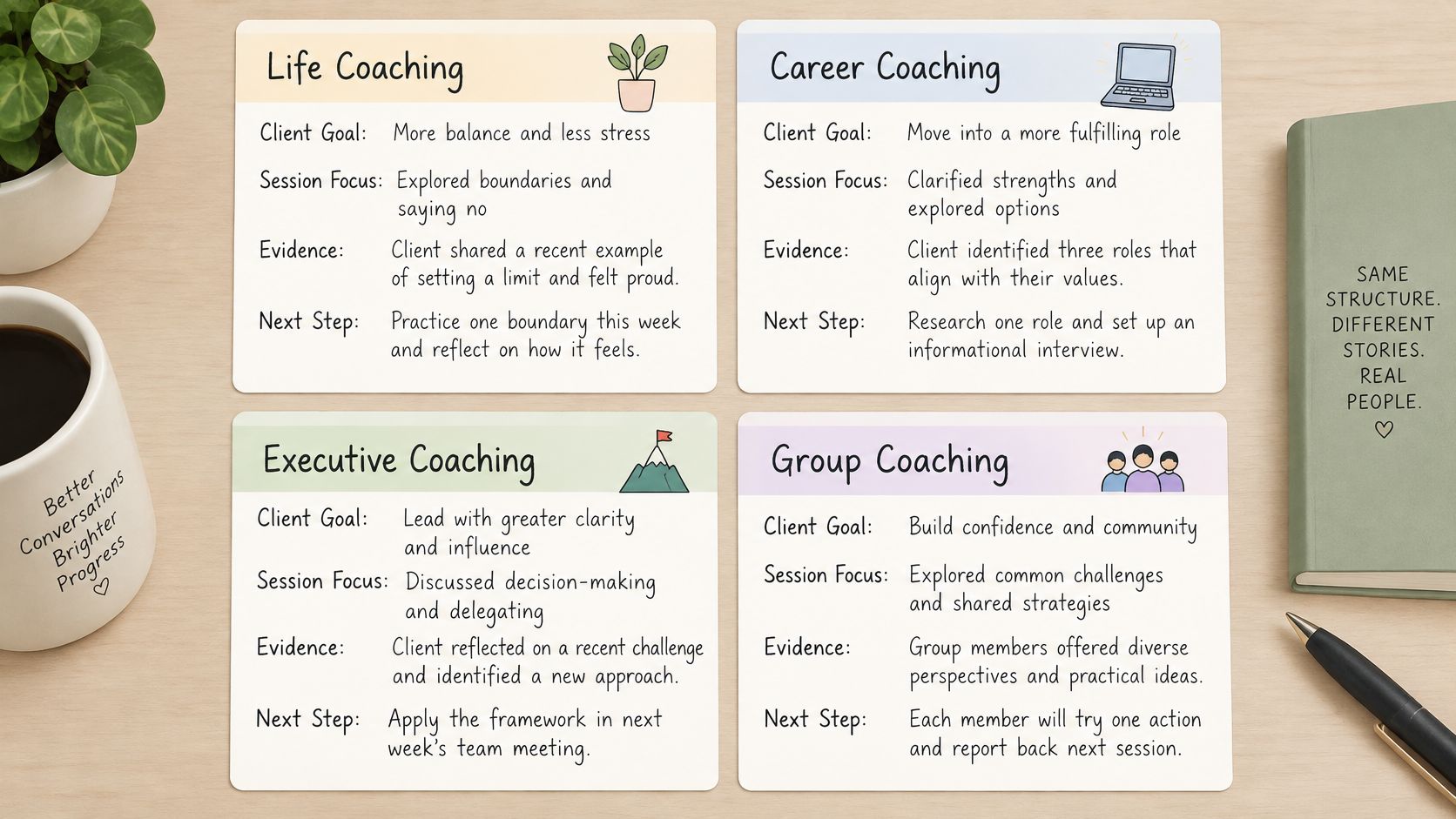
Life coaching and career change
Goal: Three informational conversations this month.
Client report: One invitation sent; two avoided.
Evidence: Client reviewed the sent message during the session.
Coaching move: Practiced a shorter invitation.
Action and review: Client sends two more invitations by Friday; reviews responses next session.
Private: Client reports fear of sounding needy; omit from shared summary.
Business coaching and an offer launch
Goal: Five sales calls from a live offer page.
Client report: Page remains unpublished; no calls logged.
Evidence: Draft page status and current call log.
Coaching move: Separated launch essentials from optional edits.
Action and review: Client publishes the page and logs five calls before the next session.
Private: Explore whether the remaining edits serve buyers or postpone exposure.
Executive coaching with a sponsor
Goal: Make staff-meeting decisions and responsibilities clearer.
Client report: Last meeting ended without named owners.
Evidence: Meeting action list contains tasks but no owners.
Coaching move: Rehearsed opening with the decision required.
Action and review: Client opens the next meeting with the decision and names owners; reviews the action list next session.
Private: Client flinches when sponsor is mentioned; exclude from sponsor update.
Group coaching and a shared milestone
Goal: Complete the cohort's offer-draft milestone.
Client report: Own draft started; audience choice unresolved.
Evidence: Member's draft and their own check-in.
Coaching move: Helped member choose a test audience.
Action and review: Member posts one win and one stuck point before the next call.
Private: Follow up individually on support requested; record no peer disclosures.
The fear beneath accountability is that the client will feel judged. A randomized controlled coaching study summarized in this workplace-coaching paper included 202 clients from 13 organizations and linked effectiveness to supporting goal strategies and actions, providing feedback, and accountability for agreed outcomes. Record what the client selected, not what you wish they'd selected.
Progress note examples by coaching context
| Context | Useful evidence | Leave out | Sample action |
|---|---|---|---|
| Life coaching | A behavior count or a 0-10 confidence rating the client chose | Diagnosis, family medical detail, trauma the client didn't ask to store | Client sends three networking notes by Friday and notes what felt hard |
| Business coaching | A pipeline step, an offer sent, or a revenue action | A customer's private data or unpaid-invoice gossip | Client publishes the offer page and tracks five calls before the next session |
| Executive coaching | A stakeholder theme or a visible meeting behavior | Performance-rating gossip and HR allegations copied verbatim | Client opens the staff meeting with the decision and names owners |
| Group or cohort | A shared milestone plus that member's own check-in | Other members' private stories | Each member posts one win and one stuck point before the next call |
| Career or mentoring | Applications, interviews, and skills actually practiced | Age, health, and protected characteristics | Client completes two informational interviews and logs what they learned |
These are hypothetical action lines, not recommended quotas. Copy the line closest to your context, then replace the target with the client's actual commitment.
For a video companion, use the embedded player below.
A Light Measurement Contract for Real Momentum
Numbers can make coaching mechanical when you use them as grades. But a note with no repeatable indicator can't answer whether anything moved; it can only preserve impressions.
Agree a light measurement contract at onboarding, not as a surprise scorecard later. Choose a primary outcome, observable behaviors, a simple scale, an evidence source, a review cadence, and a rule for changing the metric.
Agree the signal before collecting it
Say a client postponed three difficult conversations last month. Their initial target is to initiate one within seven days, then record the result at the next session. A calendar entry establishes that it was scheduled; the client's report helps establish what happened and what they learned.
The measurement contract below is a worked example, not a clinical assessment.
| Contract element | Worked example |
|---|---|
| Primary outcome | Hold difficult conversations with direct reports instead of postponing them |
| Observable behaviors | Conversations scheduled per week and postponements per week |
| Scale | 0-10 confidence rating, or a milestone of planned, held, reflected |
| Evidence source | Calendar entry plus the client's own report |
| Review cadence | Progress line each session, formal review monthly |
| Change rule | Date any goal change, retire the old metric, and never swap it silently |
Use this checklist visual to keep the agreement light.
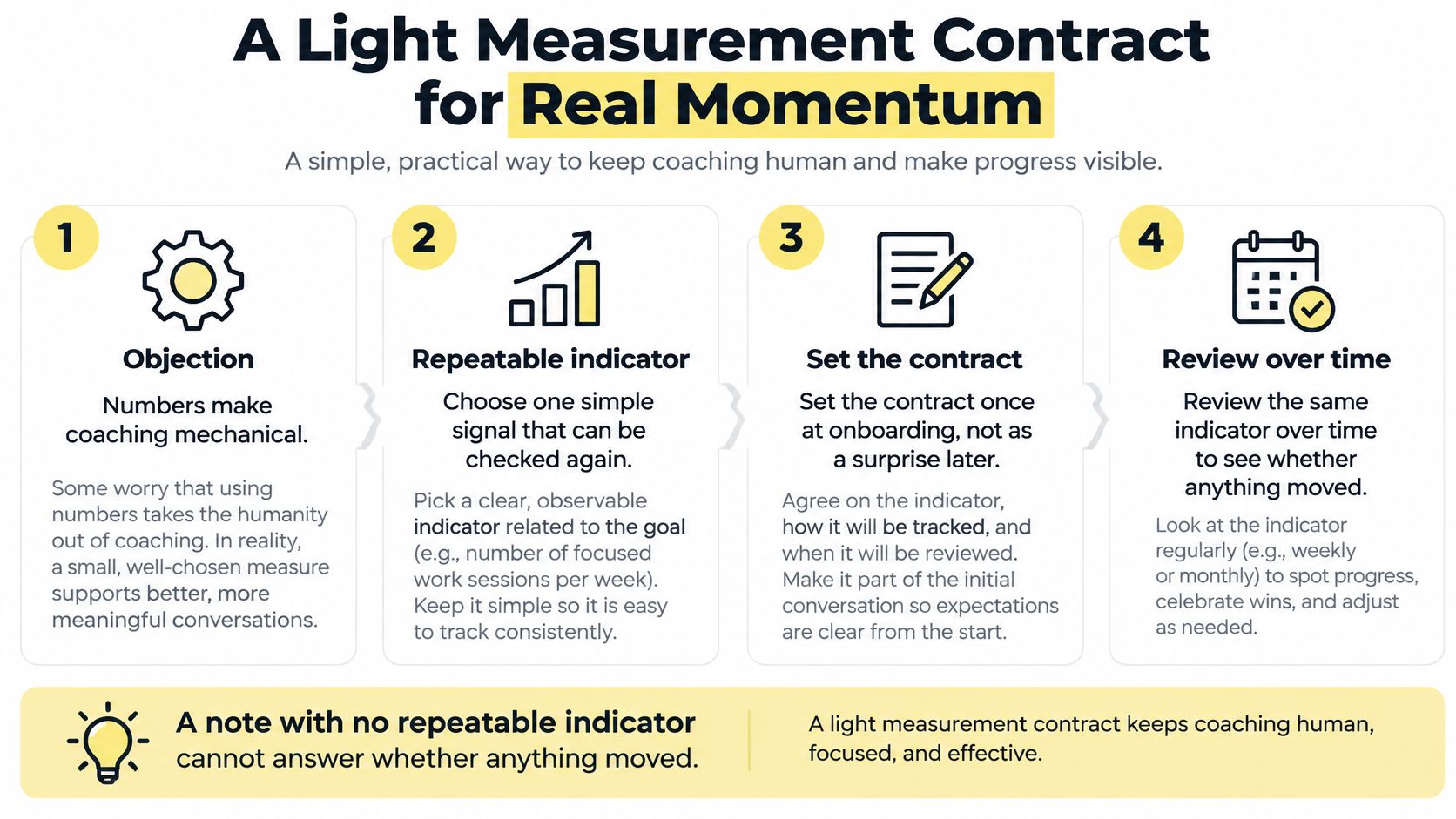
A confidence rating should open a conversation about readiness, not settle it. Ask what makes the chosen rating fit today and what would make the action more workable. Don't compare one client's personal scale with another's as though their anchors were identical.
Preserve setbacks without grading the client
Nonlinear progress: Record that the indicator dipped and the client's explanation. Don't rewrite the baseline to make the trend look smoother. A harder conversation may produce useful learning even when the confidence rating falls.
Missed action: Keep the commitment and outcome visible. Ask whether confidence, competing priorities, or ownership made the action unworkable. Client didn't complete the invitation; chose a shorter message after reviewing the barrier is more useful than a label about poor motivation.
Changed goal: Date the change and retire the old metric. If the client shifts from promotion to career exploration, don't replace leadership behaviors with application counts and present them as one continuous outcome.
Delayed outcome: With an agreed follow-up, add a short close-out line describing the client's reported result after coaching ends. Don't turn that update into a new clinical assessment or imply that coaching alone caused the outcome.
Keep a field only if its answer changes a decision, a question, or an agreed next step.
Burden is a real trade-off: Twofold's 2025 reporting on documentation burden cited 36.1% of 446 clinicians ranking progress tracking as their top burden, with 66.5% of those respondents identifying standardized outcome measures and 25.5% identifying homework or between-session task tracking as contributors. Don't import that burden into coaching by adding measures nobody uses.
For program-level organization, consult how to track client progress through a program. Agree this first-session check with the client:
- Outcome: What change matters to you?
- Behaviors: What observable actions would indicate movement?
- Scale: What simple rating or milestone fits?
- Evidence: What can we check without collecting unnecessary detail?
- Review: When will we examine the pattern?
- Change rule: How will we document a revised goal?
Open the Next Session from Last Week's Note
Pick a current client and write today's note using only the client-facing lines plus a relevant private line. Then stop. Don't polish the summary until it sounds impressive.
The test is whether your next opening question is already available: what happened with the action the client owned? If you can't form that question, either a decision is missing or you've filled the page with description that won't help you coach.
Before you save: Write the question you'll ask when the client returns.
For a specialist context, PreSales Unleashed GmbH's guide to B2B coaching for Solution Engineers offers a useful companion when choosing work-specific actions. Make the commitment something the client can perform, not an aspiration such as becoming more persuasive.
Put the note where you'll use it
Our Coaching CRM connects intake, goals, habits, check-ins, sessions, private notes, tasks, and messages around one client. Recorded calls are summarised with takeaways and action items, and an ICF hours log tracks paid and pro bono coaching hours. Use the guide to saving notes about a coaching client to organize the record, while keeping restricted reflection out of sponsor and group views.
Store the shareable progress line beside the goal it tracks, where the client already checks goals and tasks. Before the next session, write this hypothetical line:
Goal: timely feedback | Evidence: calendar and client report | Client action: hold agreed conversations | Review: next session | Private: explore sponsor-related hesitation separately.
Coachful brings client goals, session notes, tasks, and check-ins into one workspace so you can keep a progress record close to the work it tracks. Visit Coachful to organize your client follow-up and keep private reflections separate from the progress you agree to share.


