
Quantum LEEP Academy: What Coaches & Families Need to Know

Coachful

You're probably here because a family you support is exhausted.
Their child isn't thriving in a standard school setting. The parent is juggling meetings, behavior notes, therapy appointments, and guilt. You're trying to help them think clearly, but you're also asking yourself a very practical question: Is Quantum LEEP Academy an actual fit, or just another program that sounds good on a website?
That's the right question.
As a coach, your job isn't to sell a school. It's to help a family make a decision they can live with. That means understanding what Quantum LEEP Academy appears to offer, where it may fit beautifully, and where you'll need to fill gaps, especially around parent implementation at home.
What Is Quantum LEEP Academy Really
A family calls you after another school meeting goes sideways. The parent is angry, scared, and tired of hearing that the child just needs better behavior, better coping, or one more accommodation. Your job at that point is simple. Figure out whether the problem is skill deficit, placement mismatch, or a support system that keeps breaking at the handoff points.
Quantum LEEP Academy appears to sit in the placement-mismatch category. Based on its public materials, it functions as an independent therapeutic school in Chicago that combines full-day onsite programming with individual therapeutic services and telehealth options. For a coach, that matters because its core offering is not just academics or therapy in isolation. It is a more coordinated setting for children who are not accessing learning well in a standard school structure.

What makes it different from a typical school placement
A therapeutic school changes the daily load on the child and the parent. Support is built into the school day instead of being bolted on before school, after school, or across three separate providers. That alone can reduce the constant reset that drains families.
For coaches, the key question is fit.
If a child is burning energy managing sensory overload, transitions, behavior demands, or repeated misunderstanding, a mainstream setting can keep everyone stuck. The child looks resistant. The parent looks inconsistent. The school keeps adding interventions. Nothing holds because the environment is still asking for skills the child cannot reliably access there.
Quantum LEEP Academy is worth considering when a family does not need a prettier school option. They need a setting organized around regulation, communication, and learning access. If you coach parents through education decisions, the logic is similar to cohort-based learning models that improve consistency and support. Structure shapes participation. Environment changes outcomes.
How a coach should frame this for parents
Keep your explanation plain and disciplined.
- This is a placement decision and a care-coordination decision.
- The question is whether the child can learn in the current environment, not whether they can endure it longer.
- The family should look closely at how school staff, therapists, and parents stay aligned. That parent coaching piece is often where otherwise promising programs fall short.
That last point matters. Many schools can describe services. Fewer can help parents carry the model home in a way that builds confidence instead of dependence. As a referring coach, do not skip that issue. Ask how the academy involves parents, how goals are communicated, and whether families are being taught what to reinforce outside school. If that process is weak, you will need to fill the gap.
Use this rule with families. If the child spends more effort surviving the day than participating in learning, a therapeutic school deserves serious consideration.
If you also advise founders or evaluate whether an education model is being built as a real operating system instead of a loose collection of services, this step-by-step edtech business guide is a useful reference point. It helps you assess whether a program is structured to deliver coordinated support or just market it.
The Multidisciplinary Model Explained
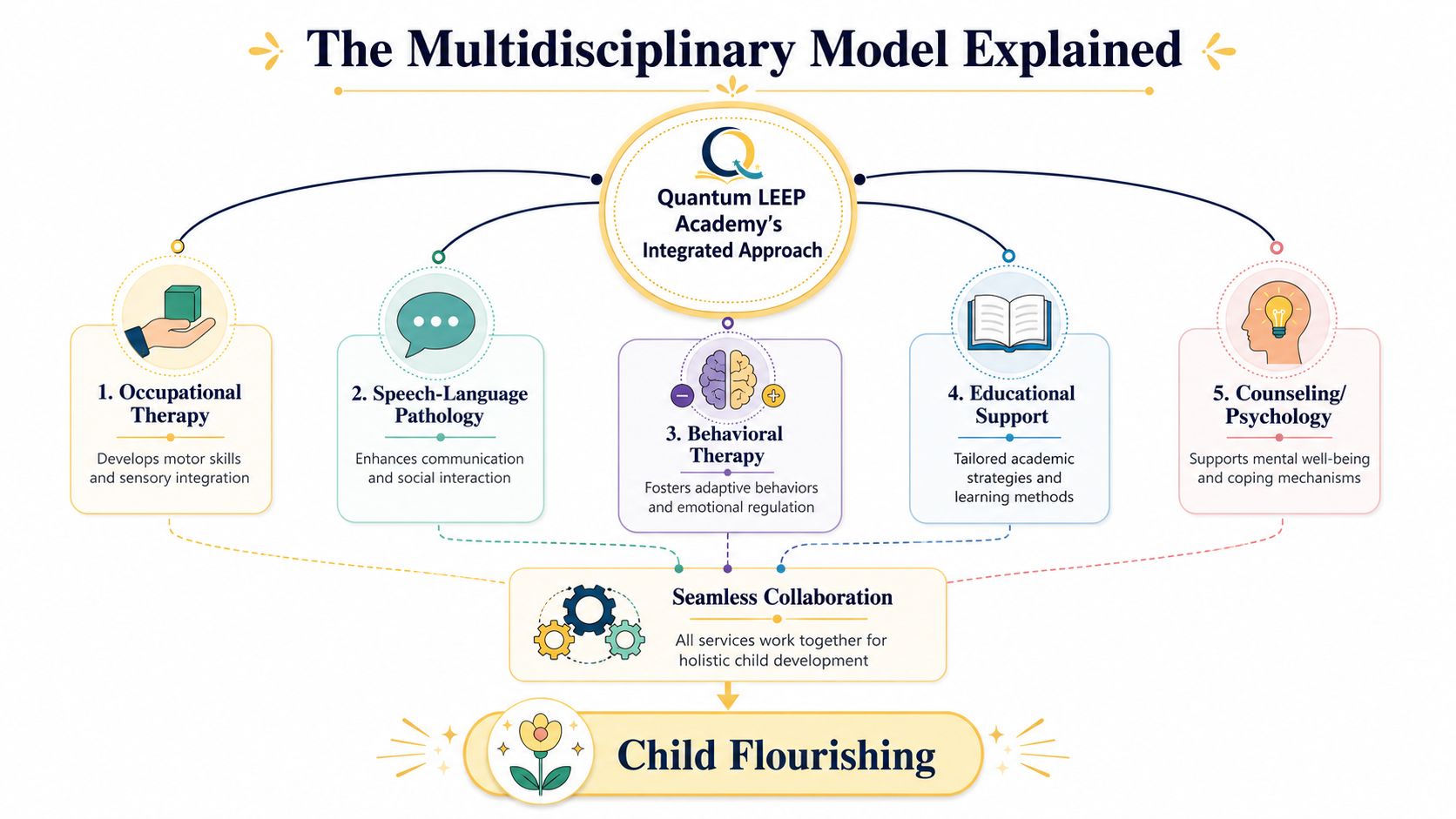
The short version is this. Quantum LEEP Academy appears built around multiple disciplines working together, not around isolated services.
Its admissions materials describe a multidisciplinary approach and list speech therapy, ABA therapy, occupational therapy, parent training, early intervention, school support, and mental health services at the admissions page. That lineup matters less as a checklist and more as a coordination signal.
Think pit crew, not provider list
A lot of parents hear “speech,” “OT,” and “ABA” and assume that means their child will bounce between specialists who barely talk to each other.
That's the wrong mental model.
The better model is a pit crew. The child is not being pulled apart into separate problems. The team is working around one child, one day, one functioning profile.
Here's what that can look like in practice:
| Service | What it may address | Why integration matters |
|---|---|---|
| Occupational therapy | Sensory processing, motor planning, regulation | It can shape what the classroom expects physically and emotionally |
| Speech therapy | Communication, language access, social interaction | It helps teachers and behavior staff respond to what the child is actually trying to express |
| ABA therapy | Behavior support, skill building, routines | It works better when goals reflect sensory and communication realities |
| Mental health support | Emotional regulation, coping, stress | It adds context when behavior is driven by overwhelm, not defiance |
| Parent training | Carryover into home routines | It matters only if families can use it consistently outside sessions |
That's the core coaching point. The value is in the overlap.
What coaches should listen for
When you talk with a family or school representative, don't stop at “Do you offer OT and speech?” Ask smarter questions.
- “How do providers coordinate goals?” If each service has its own lane and no common plan, integration is weak.
- “How do classroom staff use therapy insights during the day?” That's where real carryover happens.
- “How are home strategies chosen?” Families need usable strategies, not clinical jargon.
- “Who helps when one goal conflicts with another?” That's where multidisciplinary teams show their quality.
A concept that often helps coaches explain collaborative learning structures is this piece on mastering cohort-based learning. It isn't about therapeutic schooling specifically, but it does clarify how coordinated group systems outperform siloed interventions.
Later in the conversation, this video can help frame multidisciplinary support in a more accessible way:
When services align around one child's daily reality, families stop feeling like unpaid care coordinators.
A Day in the Life of a Student
A parent gets to 8:15 a.m. already braced for a phone call. Their child barely made it through breakfast, the car ride was rough, and the family is wondering whether school will ask the child to hold it together until they finally fall apart. That is the question underneath, “What does a day look like here?”
As a coach, answer it plainly. The day should be organized around access to learning. Therapy should support the school day, not pull the child out of it so often that academics become symbolic.
A realistic example
Take a student who struggles with transitions, sensory overload, and expressive communication. In a setting like this, the day usually starts with a predictable arrival routine, adult support that is calm and immediate, and a clear path into the first task. That first stretch matters because regulation at the start of the day affects everything that follows.
Then the student moves into academics with support already built in. A writing assignment might be adjusted because motor output is slowing the child down, not because expectations are low. A math lesson might include movement, visuals, or shorter work intervals because attention and regulation need active support.
At some point during the day, the student may also receive individual therapeutic support on site or through a related service model already built into the program. For many families, that changes the whole week. They are no longer trying to stack every intervention into the most depleted hours of the day.
That practical point matters for coaches. If a child can get school and support in one coordinated setting, parents often have more energy left for follow-through at home instead of spending every afternoon transporting, calming, and recovering.
What the day should feel like
The best way to explain it to families is to focus on the student's lived experience.
- Learning time has structure. The child knows what is happening, what support is available, and how to re-engage after a hard moment.
- Therapy connects to real demands. Skills practiced with a provider show up again in class, transitions, peer interaction, and daily routines.
- Adults protect peer access. The child gets help without being isolated from classmates or over-managed.
- Breaks serve regulation. They are planned supports, not rewards handed out after distress.
A strong therapeutic school day gives the child repeated chances to recover, rejoin, and keep learning.
That is also where the parent coaching gap shows up. Families often hear that their child had a "good day" or a "hard transition," but they do not get enough detail to understand what made the difference. Coaches can close that gap by helping parents track patterns in plain language. A simple student progress tracking template helps families record what support was used, where the day broke down, and which questions belong in the next meeting.
What coaches should not promise
Do not sell families a fantasy of calm hallways, perfect transitions, and instant behavior change. That sets everyone up badly.
Give them the sharper frame instead. A school like this can improve consistency because the same environment is handling learning, regulation, communication, and support across the day. The child gets fewer handoff points. The parent gets a clearer picture of what is helping. And you, as the referring coach, get a better chance of supporting the family with information they can use.
Who Is the Ideal Candidate for This Academy
Not every struggling child needs a therapeutic school. And not every family is ready for one.
You'll help your clients most if you get specific. Quantum LEEP Academy looks like the strongest fit for children who need integrated support to access learning, not just occasional intervention layered onto a conventional school day.

The children most likely to benefit
I'd look harder at this option when a child shows patterns like these:
- They need structure to stay regulated. Loose, reactive classrooms usually make things worse.
- Therapy goals and school goals keep colliding. The child may be making gains in one setting and losing them in another.
- Communication, sensory, and behavior needs are intertwined. A single-service solution won't touch the whole picture.
- The current environment is creating repeated distress. Not occasional hard days. Chronic mismatch.
This isn't about labels first. It's about function.
A child may be bright, verbal, funny, and still completely unable to thrive in a setting that treats regulation as a side issue. Another child may look “fine” on paper but unravel every day because the environment asks for capacities they can't yet sustain.
The families most likely to make good use of it
The family fit matters just as much.
A strong match often looks like this:
| Family pattern | Why it matters |
|---|---|
| They want one coordinated setting | They're tired of managing disconnected services |
| They're open to specialized support | They're no longer trying to force a poor-fit placement to work |
| They can engage with recommendations | Carryover at home affects whether progress sticks |
| They want nuance, not blame | Therapeutic schools work best when parents aren't being sold simplistic answers |
Who may not be the best fit
Be honest here. That protects everyone.
This may not be the right recommendation if the child is functioning well in a less intensive environment, if the family wants academic prestige without therapeutic depth, or if the adults involved are looking for the school to “fix” everything without meaningful home follow-through.
The other concern is philosophical. If a parent wants maximum independence and minimal therapeutic involvement, they may experience this kind of model as too intensive. That doesn't make them wrong. It means values and setting need to match.
The Critical Role of Parent and Coach
Here, many conversations go off track.
A family hears that a school offers parent training programs and assumes that means home life will naturally improve too. Not necessarily. Training and coaching are not the same thing.
Quantum LEEP Academy's ecosystem mentions parent-oriented services, but a key unanswered question remains. There is no clear public detail on how parent coaching and family system support are integrated into the daily routine or how parents are coached to sustain progress at home, based on the available reference to Leep Forward's public-facing materials.
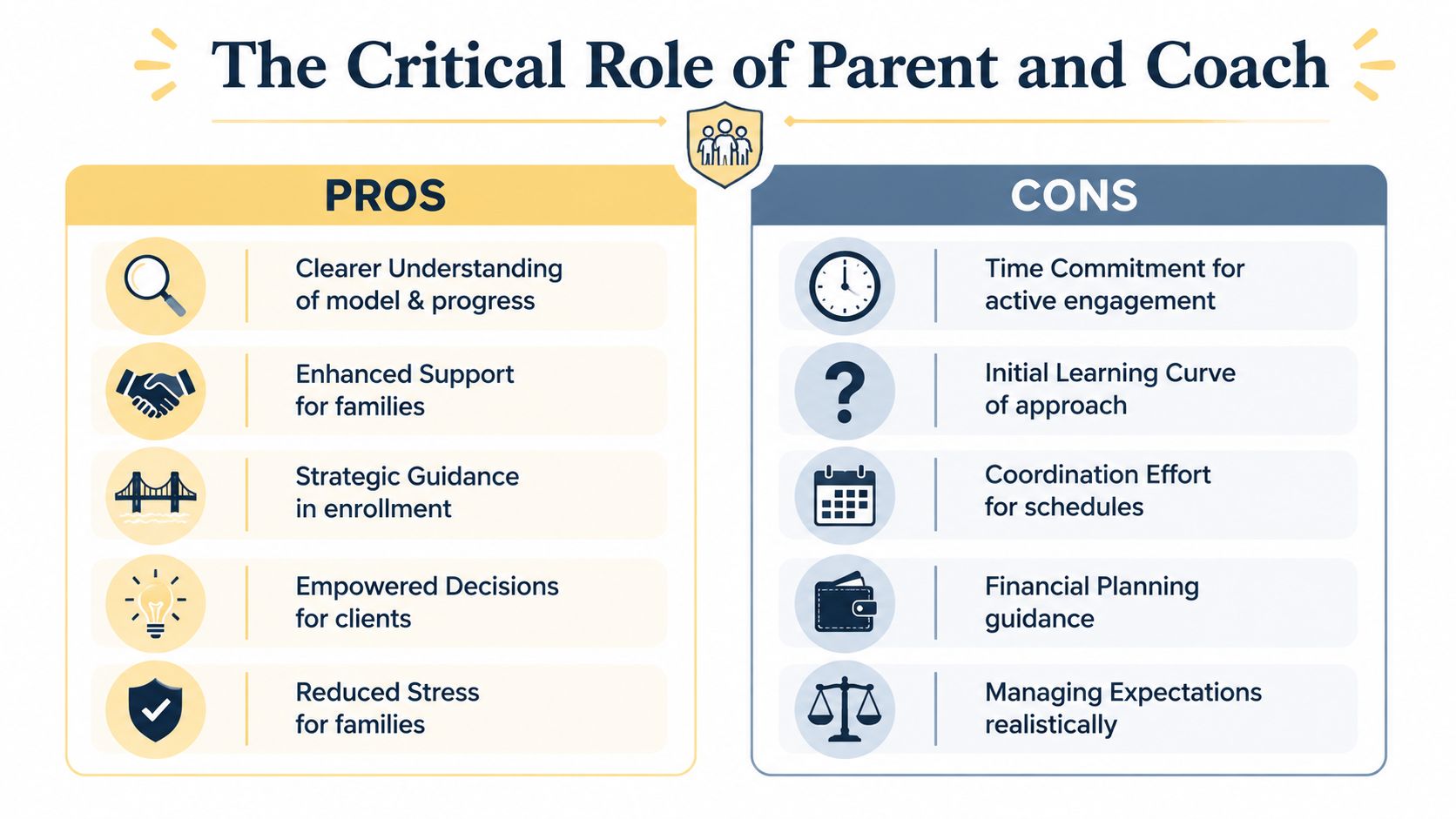
Training gives information. Coaching changes implementation.
This distinction matters a lot.
A parent training session may teach the family what strategy to use. A coaching relationship helps the parent answer harder questions:
- What happens when I know the strategy and still can't do it consistently?
- How do I apply this when mornings are chaos?
- What do I do when my own stress response gets activated?
- How do we stay aligned as co-parents?
- How do I talk to siblings about the different routines in the house?
That is where you, as the coach, still matter enormously.
Coach lens: A therapeutic school can supply interventions. A parent coach helps the family turn interventions into daily habits, emotional resilience, and realistic follow-through.
How to add value without stepping on clinical roles
You do not need to become a therapist or educational consultant to be useful here. You need to occupy your lane clearly.
Your lane may include:
- Decision support when parents feel frozen between options
- Expectation management so they don't interpret every rough week as failure
- Implementation coaching around routines, language, and consistency at home
- Systems support for calendars, documentation, and communication
- Mindset work when guilt and burnout start driving decisions
One useful lens for this kind of work is understanding patterns in how adults respond under pressure. Resources on predicting human behavior for teams can be surprisingly relevant here, because family systems under stress often act like overloaded teams. Different people process change, uncertainty, and responsibility in very different ways.
Questions I'd want answered before making a strong referral
If I were guiding a family, I'd want concrete answers to these:
- How are parents updated on daily or weekly priorities?
- What home recommendations are given, and in what format?
- Who helps parents troubleshoot when a strategy works at school but fails at home?
- Are parent support groups educational, emotional, practical, or all three?
- How does the school respond when family capacity is limited?
A school can be excellent with children and still leave families under-supported in implementation. Don't ignore that.
Navigating Enrollment and Practicalities
Once you think the placement may fit, the next job is helping the family move without panic.
This part gets emotional fast. Parents often feel that pursuing a specialized placement means admitting something painful. They may also be overwhelmed by paperwork, cost questions, and fear of making the wrong decision.
The process I'd coach a family through
Start with a simple sequence.
Inquiry first, not commitment
Encourage the family to make contact and gather baseline information. They don't need to decide on the first call. They need to learn how the academy describes its students, supports, communication style, and admissions flow.
Tour with a coach's eye
If possible, help the parent prepare for a tour with written questions. The point isn't whether the building feels warm. The point is whether the environment appears organized around the child profiles it claims to serve.
Documentation prep
Families should gather evaluations, school records, therapy summaries, behavior notes, and any recent recommendations before they're asked. This reduces scramble and prevents emotional flooding later.
Assessment of fit
A responsible school should assess fit, not just accept interest as readiness. As the coach, remind the family that being evaluated is a good sign. It means the school is trying to place thoughtfully.
Where families often get stuck
These are the common pressure points:
- Money stress: Parents may not know what is school-based, therapeutic, private-pay, or potentially covered through other channels.
- Decision fatigue: By the time they explore a therapeutic school, they're often already depleted.
- Partner alignment: One parent may feel urgency, while the other still hopes the current setting can be salvaged.
- Fear of stigma: Some families still hear “therapeutic school” as a judgment instead of a support structure.
The family rarely needs more information first. They usually need help organizing the information they already have and naming what matters most.
If you support families through educational transitions, you may also appreciate systems thinking from adjacent contexts. This piece on a learning management system for small companies is useful because it highlights how delivery quality depends on process clarity, communication, and follow-through. Those same operational questions matter when evaluating any specialized school.
What I'd tell a parent before they apply
I'd say this plainly. Don't apply because you're desperate. Apply because you can explain why this model matches your child better than the current one.
That one sentence can pull a family out of panic mode and into discernment.
Your Next Steps as a Trusted Advisor
If you're considering Quantum LEEP Academy for a family, keep your focus on three things.
First, this appears to be more than a school placement. It looks like a therapeutic, integrated environment for children who need support woven into the day, not bolted on after the fact.
Second, the best-fit child is not just “struggling in school.” The best-fit child likely needs coordinated support across regulation, communication, behavior, and learning. The best-fit family is willing to partner, ask questions, and stay engaged.
Third, don't gloss over the parent piece. That's where many good placements lose momentum. If the school offers training but the family needs implementation support, that's where your coaching becomes indispensable.
Here are smart conversation starters you can use right away:
- “What parts of your child's day are currently hardest, and what setting factors seem to trigger them?”
- “Does your child need separate services, or do they need one environment where those services work together?”
- “If school strategies helped, what would need to happen at home for those gains to last?”
- “What support would you need as a parent to make a transition like this sustainable?”
- “What would make this option feel like a fit, and what would make it feel wrong?”
A coach who understands resources like Quantum LEEP Academy isn't overstepping. You're doing your real job. You're helping families sort signal from noise, choose based on fit, and build support around the child instead of forcing the child to adapt to a poor system.
If you want a cleaner way to manage client notes, track family goals, organize follow-up after school meetings, and keep coaching support consistent between sessions, Coachful gives you one place to run that work without patching together separate tools.