Quora for Coaches: 5 Answer Examples and a Writing Guide

Nour
Founder, Coachful
Can answering questions on Quora bring suitable coaching inquiries without turning you into the person advertising under every answer? It can create a route to an inquiry, but start with a stricter job: write an answer that resolves the question even if nobody clicks your profile. Choose questions within your competence, explain your reasoning and disclose your commercial interest where relevant.
For a coach, the useful output is not a pile of links. It is a small library of public answers that demonstrates how you think. This guide gives five original answer examples, explains when each belongs and shows how to handle an optional next step without pretending a reader has become a lead.
What Quora actually requires before you write
Quora's Question and Answer Policies say answers should respond to the question asked. Relevant affiliations must be disclosed in the answer or its displayed credential. Affiliate links are not allowed. Self-promotion that is not part of a direct, helpful response is not allowed either.
The same policy says the gist must be understandable without leaving Quora. That is a useful editorial test: remove every external link and read what remains. If the reader is left with a teaser and a booking invitation, you have not finished the answer.
Quora's separate affiliation guidance explains that a brief, clear disclosure can be enough, and that disclosure does not exempt an answer from standards of accuracy and helpfulness. It also distinguishes answers from Spaces content. This guide concerns ordinary answers, not permission to promote inside every Space.

Use the examples below as writing demonstrations, not copy-and-paste campaigns. Each assumes a hypothetical coach with the stated competence. None describes a real client or a result. Your final answer must fit the actual question, current policy and information you can responsibly provide.
1. Answer a career decision with a comparison, not a verdict
Question shape: “How do I choose between two job offers?” This suits a career coach who can explain a decision process. It does not authorize you to tell a stranger which employer to choose from three sentences of context.
Hypothetical answer:
Start by separating what you know from what you are assuming. For each offer, list the actual responsibilities, manager expectations, compensation, working arrangement and opportunities you have verified. Then write the two or three conditions that matter most for this particular move.
If flexibility is essential, a vague promise of a supportive culture is not the same as an agreed working arrangement. Ask the employer a specific question before scoring that condition. Do the same for promotion expectations or travel.
Compare the offers against your conditions rather than trying to make every advantage count equally. You may discover that the decision depends on one unanswered question, not on another evening of pros and cons. I work as a career coach; this is a decision framework, not a recommendation about either employer.
Why it works: the reader gets a method and a concrete distinction between a verified condition and an assumption. The professional disclosure gives context without claiming privileged knowledge of the person's career.
What to leave out: “My clients always negotiate better offers” or a claim that coaching guarantees the right decision. If the question involves contract interpretation, immigration or tax, identify that boundary rather than answering beyond your qualifications.
Before publishing, compare the method with your real offer. If you actually provide recruitment rather than career coaching, describe that accurately. A clear service boundary matters more than choosing the most impressive credential.

2. Answer a leadership question with a small workplace experiment
Question shape: “How do I stop taking back work I have delegated?” A leadership coach can offer an observable experiment without diagnosing the manager or declaring that the team is untrustworthy.
Hypothetical answer:
Before taking the task back, check whether the outcome was clear. Ask the person to describe what a good finished result looks like and where they expect to make their own decisions. A different method is not automatically a failure to understand the assignment.
For the next task, agree three things at the start: the required outcome, the decisions they can make and one checkpoint before the deadline. At that checkpoint, ask them to explain their proposed adjustment before you supply yours.
This will not solve an actual capability gap or an impossible workload. It helps you see whether the problem is unclear delegation, insufficient support or your preference for doing the work yourself. I coach managers, and I would investigate those possibilities before prescribing a single fix.
Why it works: the response makes a distinction the reader can test. It does not require a confidential team story, and it does not reduce every delegation problem to mindset.
What to leave out: a disguised case study with a changed name but a recognizable employer, promotion or conflict. Write a fictional scenario if you need an example. Never use private coaching material merely because it would make a compelling public answer.
A booking link adds little to this answer on its own. If the person later asks how your coaching works, an accurate service page becomes useful. That destination should describe the same management work, not a sprawling promise to transform every part of life.

3. Answer a habit question without drifting into medical advice
Question shape: “How can I be more consistent with exercise when my week keeps changing?” A suitably qualified health or habit coach can discuss planning behavior while recognizing when the question requires clinical advice.
Hypothetical answer:
A changing schedule needs a fallback plan, not just a stronger intention. Choose an activity that is appropriate for you and identify two versions: the normal version and a smaller version for a disrupted day. Decide in advance what event will trigger each one.
For example, someone already comfortable with walking might plan a longer walk on a predictable lunch break and a short walk when that break disappears. The point is to reduce the number of decisions made at the busiest moment, not to make every day identical.
If pain, dizziness, an injury or a medical condition affects exercise, get appropriate professional guidance rather than pushing through to protect a streak. I work on habit planning, not medical diagnosis or an individualized exercise prescription.
Why it works: the answer offers a planning principle while keeping the exercise example conditional. It does not prescribe an intensity, diagnose symptoms or imply that someone should ignore physical limits.
What to leave out: a public request for medications, diagnoses, weight history or other sensitive details. More information is not always the right next move in a public answer. Sometimes the responsible answer is a limit and a referral to an appropriate professional.
Do not turn disclosures of acute distress into acquisition opportunities. A person asking for urgent help is not an unusually motivated prospect. Coaching suitability and immediate safety are different questions.
4. Answer a business question with a bounded decision
Question shape: “How do I decide which service to stop offering?” A business coach can help structure the review without promising profit or pretending a simple matrix settles every commercial obligation.
Hypothetical answer:
Review the service as a commitment, not just a revenue line. Write down what clients pay, the delivery time, the direct costs and the work required between appointments. Then separate existing obligations from decisions about future sales.
A service can bring in money while taking capacity away from work you are better placed to deliver. That does not mean you should abruptly cancel current clients. You might stop accepting new buyers while completing existing commitments, or redesign the scope before the next intake.
Choose one decision you can make now: keep selling unchanged, test a revised version, pause new sales or plan a responsible exit. I coach business owners; accounting, legal and tax consequences need advice appropriate to your situation.
Why it works: it makes the decision smaller and distinguishes future sales from work already owed. It does not manufacture a financial conclusion from missing figures.
What to leave out: invented margins, unnamed “industry averages” or a claim that your preferred offer model is always more profitable. If you introduce arithmetic, show the assumptions and label hypothetical figures rather than making them look like research.
For your own practice, this kind of answer can reveal whether your service explanation is coherent. A reader should be able to understand what you coach, how the engagement works and where the boundaries sit before choosing to contact you.
5. Answer a coach-selection question while declaring your interest
Question shape: “How do I choose a life coach?” This is commercially sensitive for a coach answering publicly. You have a relevant interest, especially if you mention your own service, company or training provider.
Hypothetical answer:
I am a coach, so I have a professional interest in this question. I would compare providers on fit, competence and the clarity of the proposed engagement rather than on the confidence of a sales promise.
Ask what they are trained and experienced to help with, how they describe coaching's limits, what the engagement includes and what you will pay. If a credential matters to you, verify it with its issuing body rather than relying on a logo in a profile.
Use an introductory conversation to understand the process and ask practical questions about confidentiality, cancellations and ending the work. You should not have to commit to a large package simply to discover its terms. Coaching is not a replacement for care or advice that requires a different qualified professional.
Why it works: the disclosure appears before the evaluation advice. The answer gives criteria readers can use with any provider, including a competitor. It does not quietly turn “how to choose” into “why to choose me.”
What to leave out: an affiliate link, fabricated endorsement or a supposedly independent recommendation of a business you own. Quora explicitly disallows affiliate links in answers. A disclosure does not make a prohibited link acceptable.
When should you add a link?
Ask three questions: does the answer stand alone, does the destination add directly relevant help, and is your relationship to that destination clear? If any answer is no, remove the link or finish the writing first. Passing this test is not a promise of moderation approval.

An independent source can support a factual claim. Your own page might supply an optional worksheet or explain a service the question genuinely concerns. Neither should carry the essential answer you withheld from the thread.
Do not add the same booking sentence to every response. Nor is “check my profile” an invisible alternative to a sales link. Evaluate the purpose of the sentence, not just whether it contains a URL.
When you do share a destination, open it on a phone and while logged out of your staff account. Check that the page keeps the promise, identifies you and explains the next action. Avoid making a person choose between six unrelated offers to find the resource you mentioned.

What to do when someone asks about coaching
Distinguish a request for clarification from a commercial inquiry. “Could you explain the second step?” calls for an explanation, not your payment page. “Do you offer individual coaching on this?” permits a clear answer about the service.
A useful manual response is: “Yes, I offer coaching on that kind of decision. I can share the format, fee and limits so you can decide whether a fit conversation would be useful. Please do not post sensitive personal details here.” Adapt it to what you actually provide.
Move to an appropriate private process only when the person chooses that next step. A direct message is not automatically a confidential intake channel. Collect only what you need for the immediate decision, and explain how the person can contact you appropriately.

A minimal prospect record might contain chosen contact details, the broad service requested and an agreed next action. Do not build a file of the person's public history. Record Quora as the source only when that is genuinely known, and preserve uncertainty when a referral or another channel also mattered.
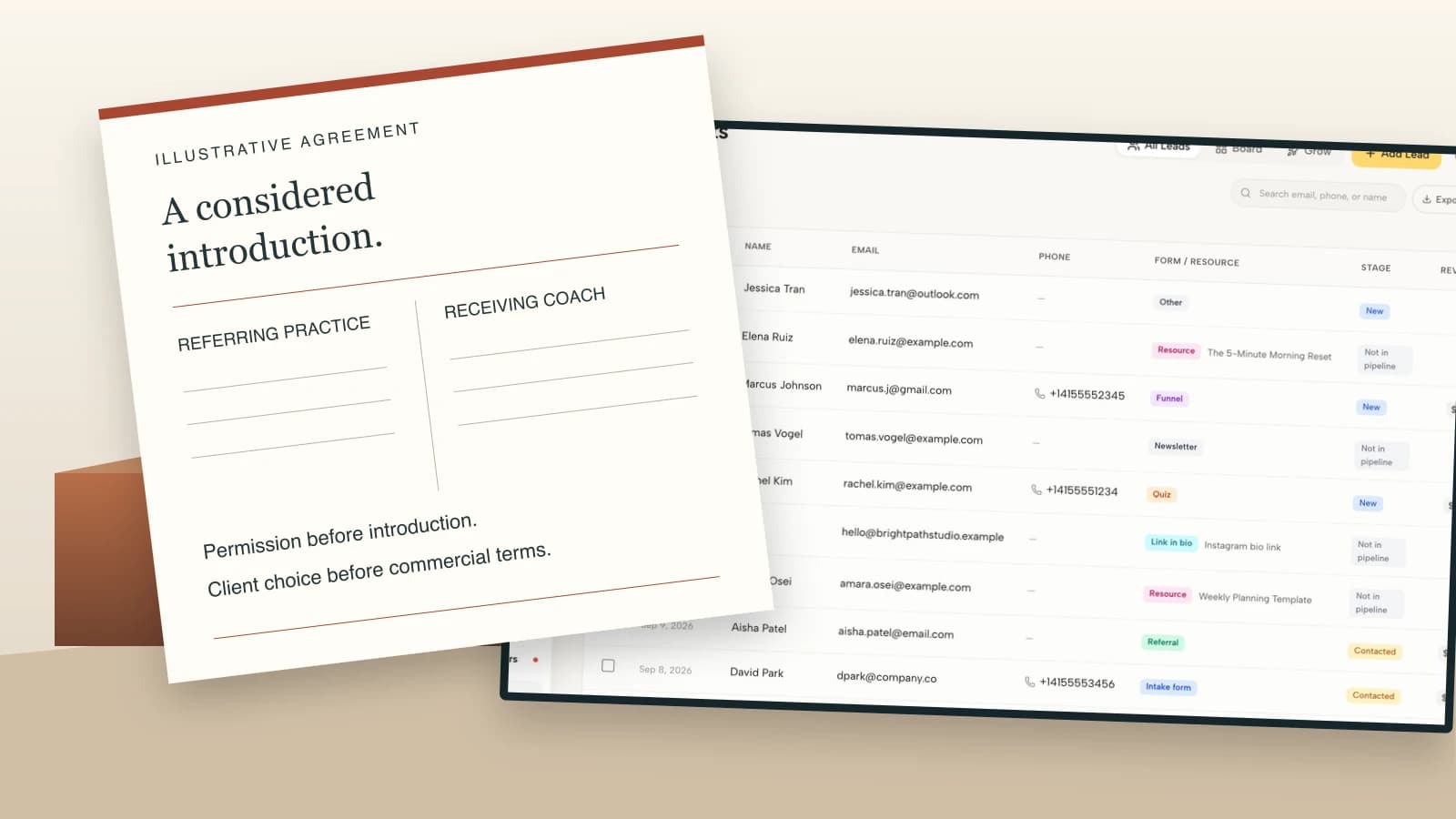
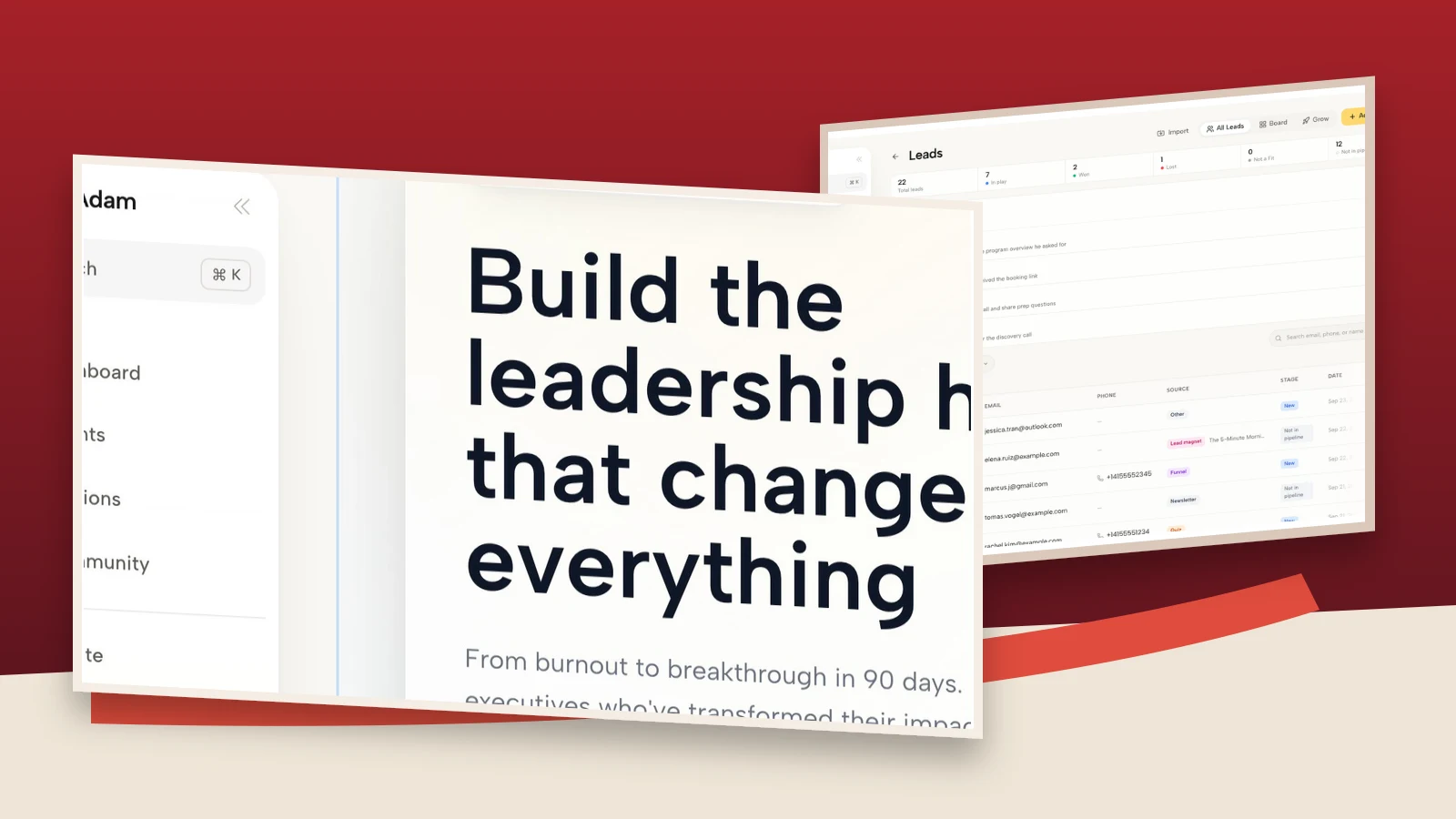
Coachful's screens here illustrate the separate website, offers, mobile destination, leads and intake-call workflow. They do not demonstrate Quora posting, automated outreach, account monitoring or subscriber importing. Nothing in this guide requires connecting or accessing a social account.
Review the work without confusing attention with clients
Set a writing budget that does not crowd out paid delivery. For example, draft a few carefully selected answers, then review their usefulness and the time required before committing to a recurring routine. That is an editorial experiment, not a platform quota.

Keep answer views, visits, inquiries, suitable conversations and agreed engagements separate. Use whatever reliable information is available rather than inventing missing attribution. Ask an interested person what prompted them to contact you instead of assigning an entire sale to the last link.

If you receive relevant questions but no commercial inquiries, the answers may still be useful education. They do not automatically justify more marketing time. If inquiries repeatedly concern work you cannot provide, tighten your scope or select different questions. If writing consumes hours without useful learning, reduce the experiment.
The next improvement is often the destination, not a louder pitch. If your answer explains a decision well but your website cannot explain your coaching, fix that mismatch before sharing more links. To assess that separate handoff, Try the interactive demo and inspect the website and inquiry workspaces with your own offer in mind.
Frequently asked questions
Can a coach promote services in a Quora answer?
Quora prohibits self-promotion that is not part of a direct, helpful answer. Relevant affiliation must be disclosed, and the gist must be understandable without leaving the site. Do not treat those conditions as a blanket invitation to append an advertisement.
Should every answer include a coaching link?
No. A complete answer without a commercial link is often the appropriate contribution. Include a link only when its actual purpose and destination are relevant, with the necessary disclosure and regard for current policy.
Can I reuse the five answers above?
Use their structure to draft your own response to an actual question. Do not claim the hypothetical professional background unless it is true, and do not distribute identical text across unrelated questions. Relevance depends on the question in front of you.
Does answering questions guarantee coaching clients?
No. This guide offers no client count, conversion benchmark or timeline. The defensible goal is useful public writing and a clear, voluntary path for someone who independently wants to explore your service.
Source note: platform rules come from the linked official Quora policies. The five answers, writing framework and review suggestions are original editorial examples, not Quora-endorsed tactics. Coachful images contain demo data, not actual Quora acquisition results.