Secure Instant Payments for Coaching Practices

Coachful
A client finishes a discovery call ready to join your coaching program. They ask if they can pay the program fee today and start tomorrow. You want to say yes. You also know that a payment arriving in seconds can feel reassuring right up until it's sent to the wrong account, or a client says they were tricked into approving it.
That tension isn't a sign that you distrust your clients. It's a business problem: how to make paying easy while keeping the amount, recipient, and next steps clear. Secure instant payments aren't a guarantee that nothing can go wrong. They're a way to pair fast transfers with useful records, warnings, and proportionate checks.
Why Instant Still Feels Risky for Coaches
The client wants to begin tomorrow. You're pleased they're ready, but the money part of the conversation changes the mood. An instant payment sounds modern. It can also sound irreversible.
Maybe you've considered asking for a bank transfer and waiting until it clears before confirming the first session. That feels cautious, but it delays onboarding. A personal payment app might get the money moving quickly, but using it for a high-value program fee can feel informal. You're trying to protect the practice without making a new client feel as if they're being investigated.
Three quiet objections tend to sit underneath that decision:
- “Will the client think I don't trust them if I add checks?” A clear process can feel reassuring, not suspicious. Showing the program name, amount, and intended payee gives both of you a chance to catch an error.
- “If the money arrives in seconds, can I undo a mistake?” Not necessarily. A completed transfer may be difficult to recover, so it's better to check the payment details before authorization than to depend on reversing it afterward.
- “Am I responsible for fraud I can't see?” You can't control every message a client receives or every decision their bank makes. You can make your own payment instructions consistent, limit who can change them, and give clients a clear way to report a problem.
Authentication alone doesn't settle the question of responsibility. A genuine client may be manipulated into approving a transfer, or a fraudster may impersonate your practice. Fast settlement shortens the time available to notice and respond.
The practical standard: Make it easy for the right client to pay the right recipient, and make unusual situations visible before they become hard to fix.
Speed isn't the right test of a payment setup. Ask whether the client knows what they're paying for, whether you can see what happened, and whether your practice has a sensible response when something looks wrong. That's how you keep enrollment moving without treating every payment like cash handed over in a parking lot.
What Secure Instant Payments Actually Do
Start with the client's experience. They choose a coaching package, see the amount and payment recipient, authorize the payment, and receive a confirmation. Depending on the payment method and provider, the funds can move and settle within seconds rather than waiting for an older batch-processing window.
Think of the difference this way. Cash is immediate, but can disappear into a pocket without a useful business record. A paper check leaves a trail, but takes time. An instant electronic payment aims to combine speed with a record of the transaction.
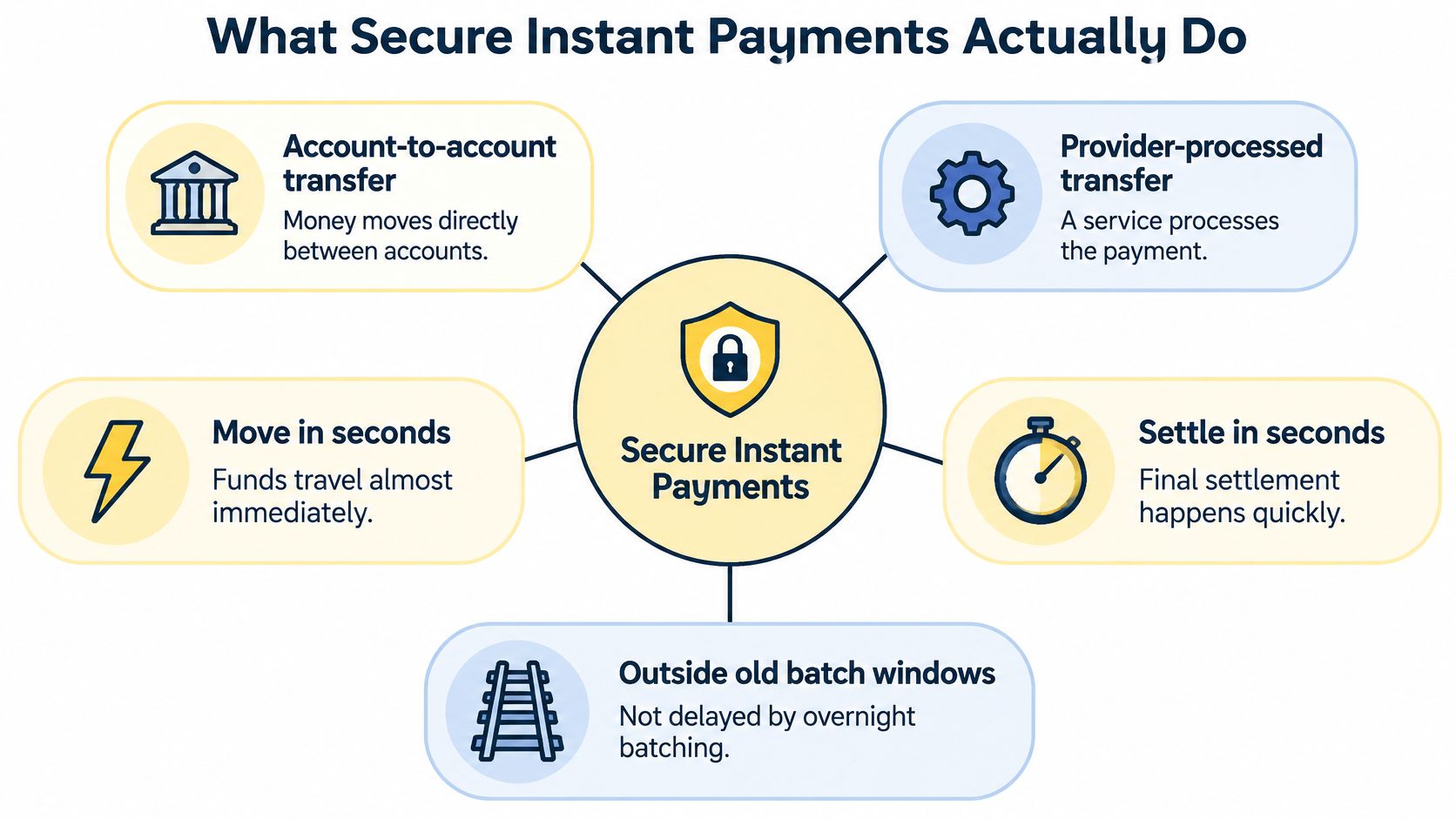
A payment rail is the route the payment and its information follow. It might be a domestic fast-payment system moving money between accounts, or a provider processing a client's payment and settling it to your connected account. You don't need to become an expert in clearing rules to take a payment. You do need to know what the client sees, what confirmation you'll receive, and where to look up the payment status.
For example, a client could pay a deposit for a group cohort from another city, buy a package of sessions, or renew a program without waiting for you to manually confirm a transfer. You see a transaction record and can connect it to the client's enrollment. The client gets a faster path to starting the work.
This is increasingly normal commerce, not a specialist banking trick. The World Bank's Global Payment Systems Survey found that instant or fast-payment systems were operational in 61% of respondent countries, while 27 more countries planned implementation within three years. The BIS reported access to fast payments in more than 100 jurisdictions by 2024. In 2022, India processed 48.6 billion fast-payment transactions, China 16.6 billion, Thailand 9.7 billion, and Brazil 8.7 billion, as described in the World Bank's global payment systems survey.
These systems generally operate continuously and settle transfers within seconds. That can support small-business liquidity and help clients access services without depending on cash or waiting for batch clearing. For a solo coach, a quicker payment can mean confirming a place in a cohort and beginning onboarding while the client is ready, rather than leaving the next step uncertain.
The Controls That Keep Speed from Becoming Exposure
Fast settlement leaves less time to spot a wrong account, fake invoice, or stolen login before money moves. That's a real trade-off, not a reason to panic. The European Banking Authority analyzed data reported by 18 national competent authorities for the first half of 2022 and found that fraud rates by value for instant credit transfers were approximately 10 times higher on average than for conventional credit transfers. Conventional credit-transfer fraud was 0.0008% of transaction value, or about €8 per €1 million transferred; direct-debit fraud was 0.0020%. The EBA's analysis of new payment-fraud types gives a useful reason to take safeguards seriously without treating every instant payment as fraudulent.
Different controls solve different problems
“Encrypted” doesn't mean “the right person is being paid.” Encryption protects information as it travels or is stored. It doesn't confirm that your client intended to pay your practice, or that the payee details are correct.
Keep payment credentials out of email, session notes, and spreadsheets. Let a payment provider handle sensitive card details rather than collecting them yourself. For the same reason, send clients through a consistent, recognizable payment flow rather than asking them to message card or account information.
Recipient verification checks whether the beneficiary name matches the account identifier before the payer authorizes the transfer. Under the EU Instant Payments Regulation, adopted on 26 February 2024, providers must verify that the beneficiary's name matches the supplied IBAN before authorization. A check can return a result such as “match,” “close match,” or “no match.” Treat a mismatch as a reason to pause and confirm, not as a technical detail to wave away.
Staff authentication protects the person who can change payout details, issue refunds, export payment records, or alter recurring billing. NIST says one-time-password authentication isn't phishing-resistant and identifies cryptographic authentication, such as passkeys or FIDO2/WebAuthn security keys, as a basis for phishing resistance. A reminder-sending assistant shouldn't be able to redirect payouts. That's least privilege in ordinary coaching-practice terms: each person gets access needed for their job, not control over every financial setting.
A practical check before sharing a payment link
Look for recipient verification, transaction monitoring, amount alerts, clear warnings, and a way to get help when something doesn't look right. Payee checks complement those controls; they don't replace them. For more on protecting client information across a coaching workflow, see this guide to secure coaching client portal software.
A secure payment link should make the intended recipient and amount clear before a client approves it.
Who Pays When a Client Authorizes a Scam
Here's the objection beneath the controls: if my client taps approve, whose loss is it? A stolen login and an authorized push-payment scam aren't the same problem. In the first, a fraudster may use someone else's account without permission. In the second, the client authorizes the payment, but a scammer has manipulated them with urgency, impersonation, or a fake invoice.
Imagine a client gets a message that looks like it came from your practice. It says the cohort payment link has expired and gives new account details. The client recognizes your program, trusts the message, and approves the transfer. Strong login authentication may not stop the scam because the client is the person authorizing the payment.
Rules differ by country and payment rail, so don't promise clients that every mistaken or manipulated payment will be reimbursed. The United Kingdom offers a defined example: its Faster Payments reimbursement regime took effect on 7 October 2024 and generally covers consumers, micro-enterprises, and charities with annual income below £1 million. Eligible victims can receive up to £85,000 per scam. Providers should usually return the money within five working days, though the process can take up to 35 working days. A provider may apply an excess of up to £100, but the Financial Conduct Authority notes that the first £100 isn't deducted in every case and vulnerable customers receive stronger treatment under the rules. The Financial Ombudsman's explanation of APP fraud reimbursement lays out the limits and eligibility conditions.
Make the payment context hard to spoof
Your practice can reduce confusion without pretending to control a client's bank or messaging apps. Keep payment instructions consistent, include the program name and amount in the invoice, and don't ask clients to use new account details sent casually over chat. If the details must change, confirm through a known channel before asking the client to pay.
Write down what the client should do if they think they paid the wrong recipient. Keep the appropriate payment-provider contact information easy to find, and tell clients how to reach your practice through a channel they've used before. A clear route for raising a concern matters more than a reassuring promise you can't guarantee.
For a practical response process when a client disputes a charge, use this guide to responding to billing disputes and chargebacks. For merchants using Shopify, Shopify chargeback alerts from Disputely can also help them think through how alerts fit into a dispute workflow. Neither resource changes the rules that apply to a particular transfer.
The point isn't to make clients afraid to pay. It's to make legitimate payment instructions recognizable and to give everyone a sensible next step when a message or transaction seems off.
Payment Limits That Fit Real Coaching Invoices
A payment limit answers a practical question: how much should be able to move without another look? A limit doesn't accuse a loyal client of doing anything wrong. It sets a boundary around what your practice treats as routine and what deserves a quick check.
FedNow offers an example of how payment ceilings can work at different levels. The U.S. Federal Reserve's FedNow Service sets a network maximum of $1 million for a credit transfer. Participating financial institutions receive a default transaction limit of $100,000 at the routing-transit-number level; a bank can raise or lower that limit, but can't exceed the network ceiling. FedNow also supports participant-specific negative lists, and payments that fail those checks can be rejected. Those are FedNow rules, not a claim that every coach or payment provider uses FedNow. The FedNow overview of fraud controls and instant payments explains its controls.
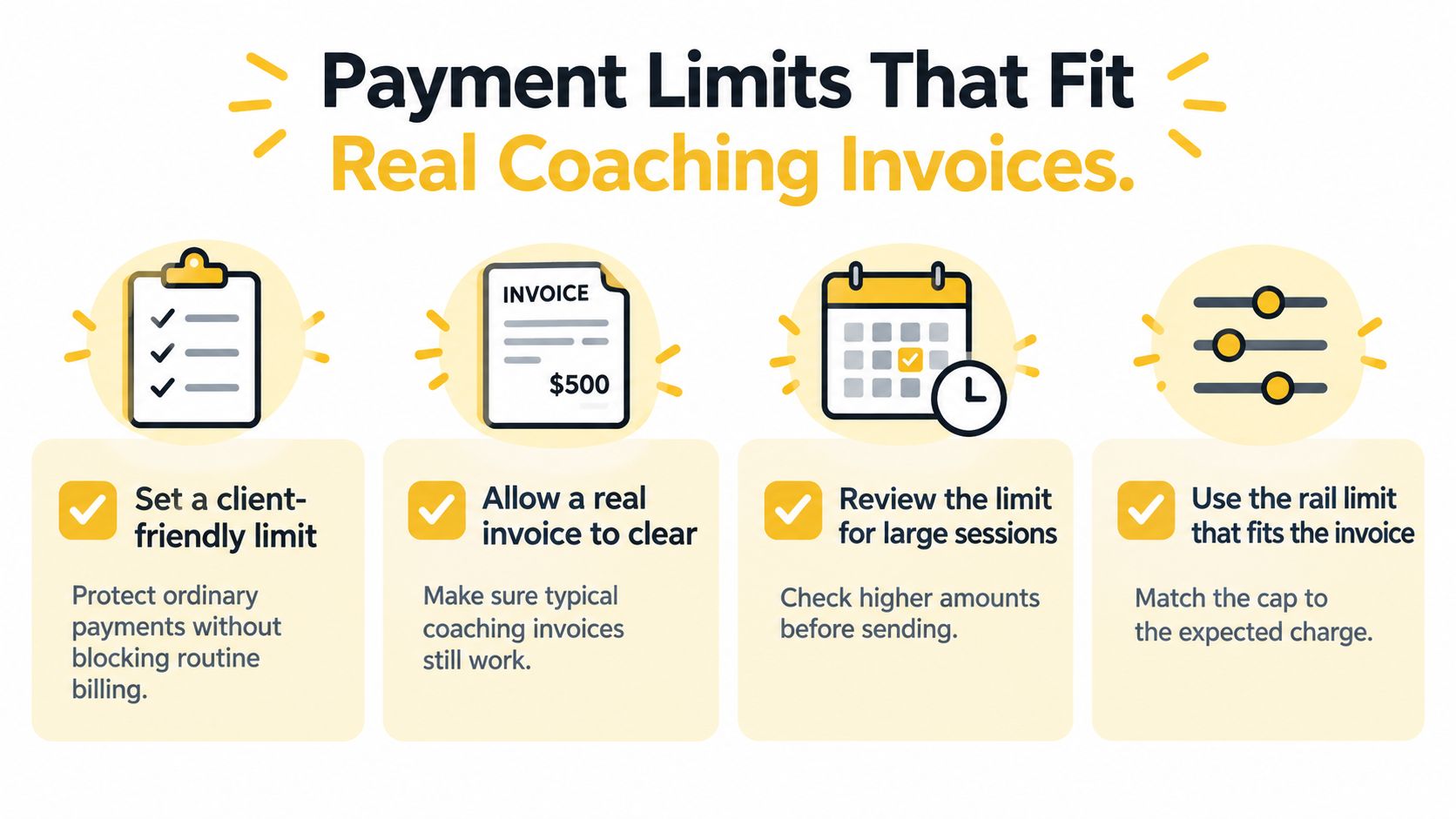
Your own practice can set a more modest internal threshold. A $500 session block or $2,000 coaching package might fit a routine payment path. A corporate invoice above $100,000 could merit a second look, even if the payment rail can carry it. The point is to match your process to the size and context of the invoice, not to copy a network's maximum.
| Coaching Payment Size and Review | ||
|---|---|---|
| Coaching situation | Amount in the example | Sensible response |
| Routine session block | $500 | Automatic, if the client and payment details look consistent |
| Package with a change in context | $2,000 | Step-up confirmation if details are unusual |
| Outsized corporate engagement | Above $100,000 | Hold for review and confirm the payee and invoice |
False positives happen. A returning client may use a new phone, or a corporate sponsor may pay a cohort deposit that doesn't look like a normal individual session payment. If your system flags those cases, give staff a clear route to review the payment quickly instead of leaving the client to wonder whether the checkout has broken.
Explain your limit policy clearly: “Routine payments clear normally, and we'll confirm larger or unusual transfers before processing them.” That's a boundary clients can understand. If a payment request is stuck or an invoice needs to be corrected, a clear process for generating and resending coaching invoices can keep the client from resorting to improvised payment instructions.
How to Choose a Secure Payment Setup
Your payment setup should make three things clear to a client: what they're paying for, who receives the money, and where to go if something looks wrong. It should also keep payment details out of your inbox and avoid giving every team member control over payout settings.
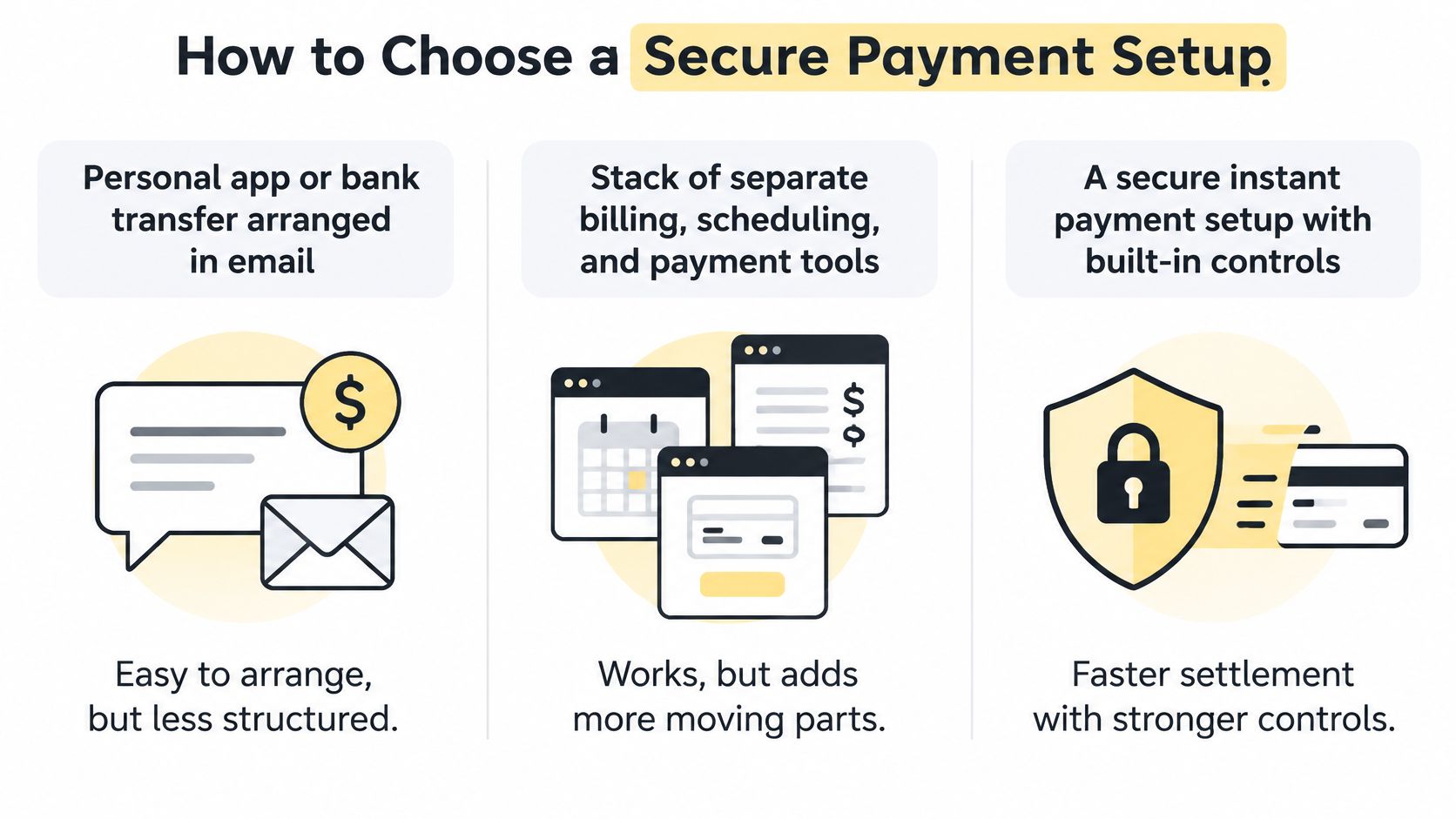
A personal app or bank transfer arranged in email is easy to set up, but relies on you and the client keeping instructions straight. A stack of separate billing, scheduling, and messaging tools can handle more of the work, but adds moving parts. Records can drift: the invoice says paid while the onboarding list still says pending, or a renewal reminder goes out after a client has already paid.
A coaching workspace can bring enrollment, scheduling, messaging, payment status, and permissions together. Coachful is an all-in-one workspace for solo coaches and teams, with client onboarding, scheduling, secure payments, messaging, progress tracking, programs, goals, milestones, session notes, shared resources, reminders, renewals, dashboards, group programs, cohorts, branding, templates, and permissions for protecting sensitive information. Its role is to help organize coaching workflows, not to decide whether a particular transfer is safe.
| Setup | What it can do | What to watch |
|---|---|---|
| Personal app or bank transfer arranged in email | Keep the arrangement simple for a familiar client | Instructions and records may live across messages and accounts |
| Separate billing, scheduling, and payment tools | Give you tools for distinct administrative jobs | More handoffs can mean more chances for records to diverge |
| Coaching workspace with payment workflows | Keep client activity and practice administration in one place | The bank or provider still handles settlement and applies its payment rules |
A workspace doesn't replace your judgment. The bank or payment provider handles settlement and applies the rules of the rail; you still choose prices, decide how to handle refunds, and explain your process to clients. Don't treat “one platform” as a synonym for “fraud-proof.”
The same restraint applies to data. Instant payments are projected to exceed USD 100 trillion globally in 2029, up from USD 60 trillion in 2025, according to Juniper Research's instant-payments outlook. The same source reports that Visa says real-time-payment fraud can be up to 10 times higher than traditional methods, and that more than half of payment fraud in Europe now comes from account-to-account transactions. Those concerns argue for proportionate checks, not collecting every possible detail about clients. Use recipient verification, device and session-risk checks, unusual-amount alerts, step-up confirmation, role-based permissions, audit records, and a clear escalation path while telling clients what information you use and why.
If you're weighing tools for a paid program that includes digital materials, this guide to software for selling digital products can help you compare the broader selling workflow. Judge any setup by the client experience and by the work it still leaves you responsible for.
Your Next Step Toward Safer Client Payments
This week, look at the last five client payments. For each one, note where the request lived: email, text, a personal app, an invoice link, or a platform checkout. You're not auditing your clients. You're finding out whether the amount, program name, and payee were clear in one place before the client approved the payment.
Then choose one path for the next new client or renewal. Make sure the client can see what they're paying for and who receives it, and check that a second person can't change the payout destination just because they can send reminders or manage sessions.
If a client asks why you've added a check, keep the explanation human: “I use this step so a wrong account or fake message can't redirect your program payment. It isn't because I doubt you.” That sentence protects trust while making the reason for the pause plain.
If you're already using several tools, decide which one owns onboarding, scheduling, payment status, and reminders. The specific tools matter less than whether your records agree and your client can find the right payment instructions. You can test the workflow with a single session or a short cohort deposit before moving a flagship program.
You're ready when you can explain, in one sentence, how a client pays, what would trigger a review, and who to contact if a payment looks wrong. Don't wait for a perfect system. Put one clear, tested payment path in place, then improve it as you learn where clients or staff get stuck.
Coachful brings client onboarding, scheduling, secure payments, messaging, and progress tracking into one workspace for coaching practices. Visit Coachful to review how its workflows could support a clearer, more organized payment experience for your clients.