10 Skool Alternatives for Coaches in 2026

Coachful
You're in the middle of a familiar problem. Your Skool community is working, people are paying, and the room has momentum. Then the pressure starts piling up, because you're also running 1:1 calls, cohorts, reminders, payments, content delivery, and client follow-up, and Skool starts to feel like one more place where the business is only partly handled.
The right platform depends on how you coach, not on who has the longest feature page. If you deliver structured programs, sell memberships, run private coaching, or need better branding and automation, the question is simple: what removes the most friction from your actual workflow? Community experience, course and cohort delivery, coaching tools, marketing, payments, automation, pricing signals, scalability, and migration effort all matter, but they matter in different ways depending on your model. A coach running intimate 1:1 work has different needs from a school managing cohorts, and both have different needs from a creator selling courses and a discussion-led membership.
The goal is not to find the platform with the most features, but the one that removes the most friction from the coach's actual business.
The list below moves from the strongest all-in-one coaching fit to more specialized Skool alternatives, so you can match the tool to the way you deliver value. For broader context on customer engagement software, this best customer engagement platforms 2025 guide is a useful adjacent read.
1. Coachful
Coachful is the cleanest fit for coaches who are tired of stitching together scheduling, payments, messaging, community, and content in separate tabs. If you're running a real coaching business, not a hobby community, this matters fast. Every extra login becomes one more place where a client can slip through the cracks, and Coachful is built to reduce that risk.
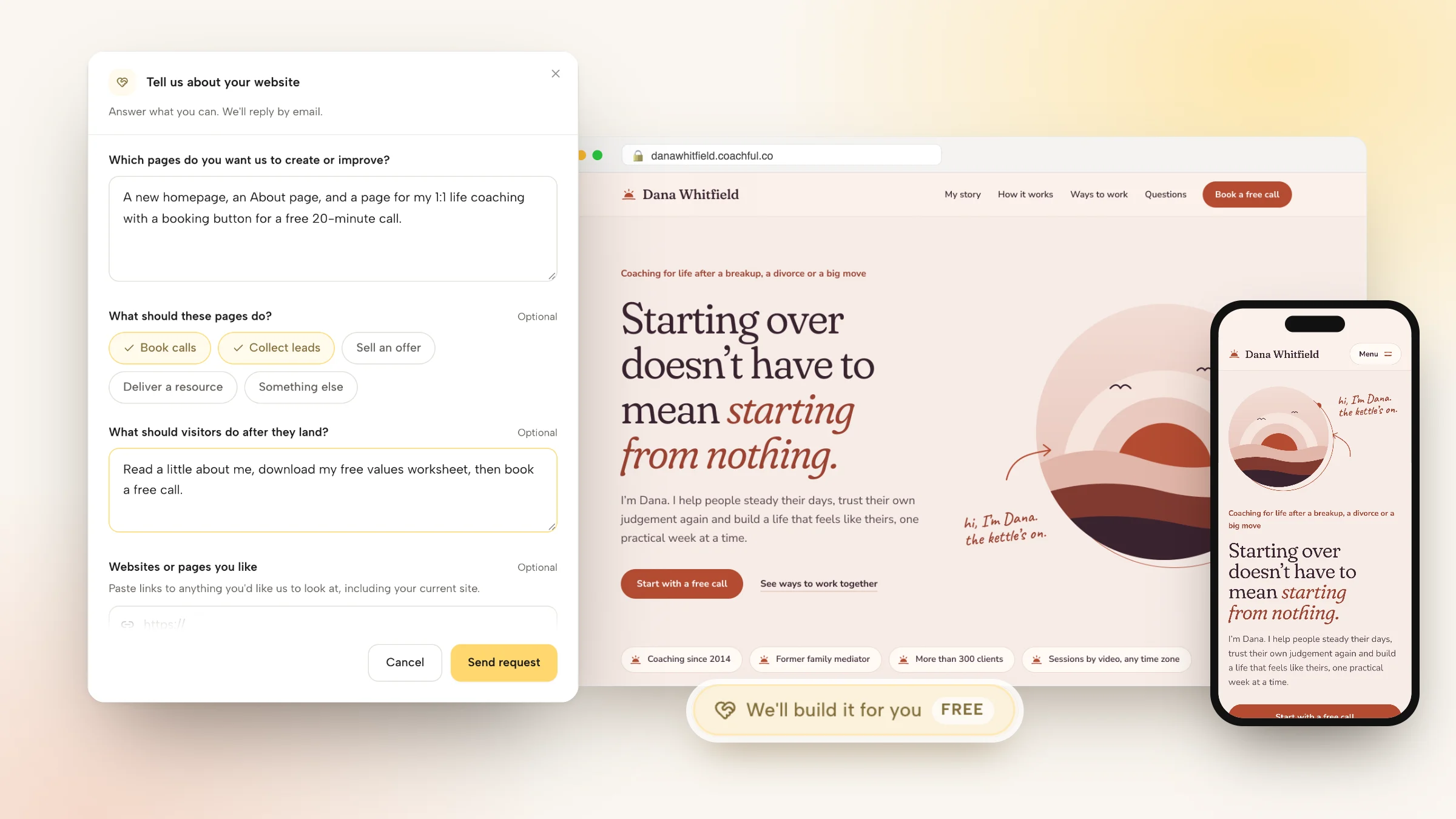
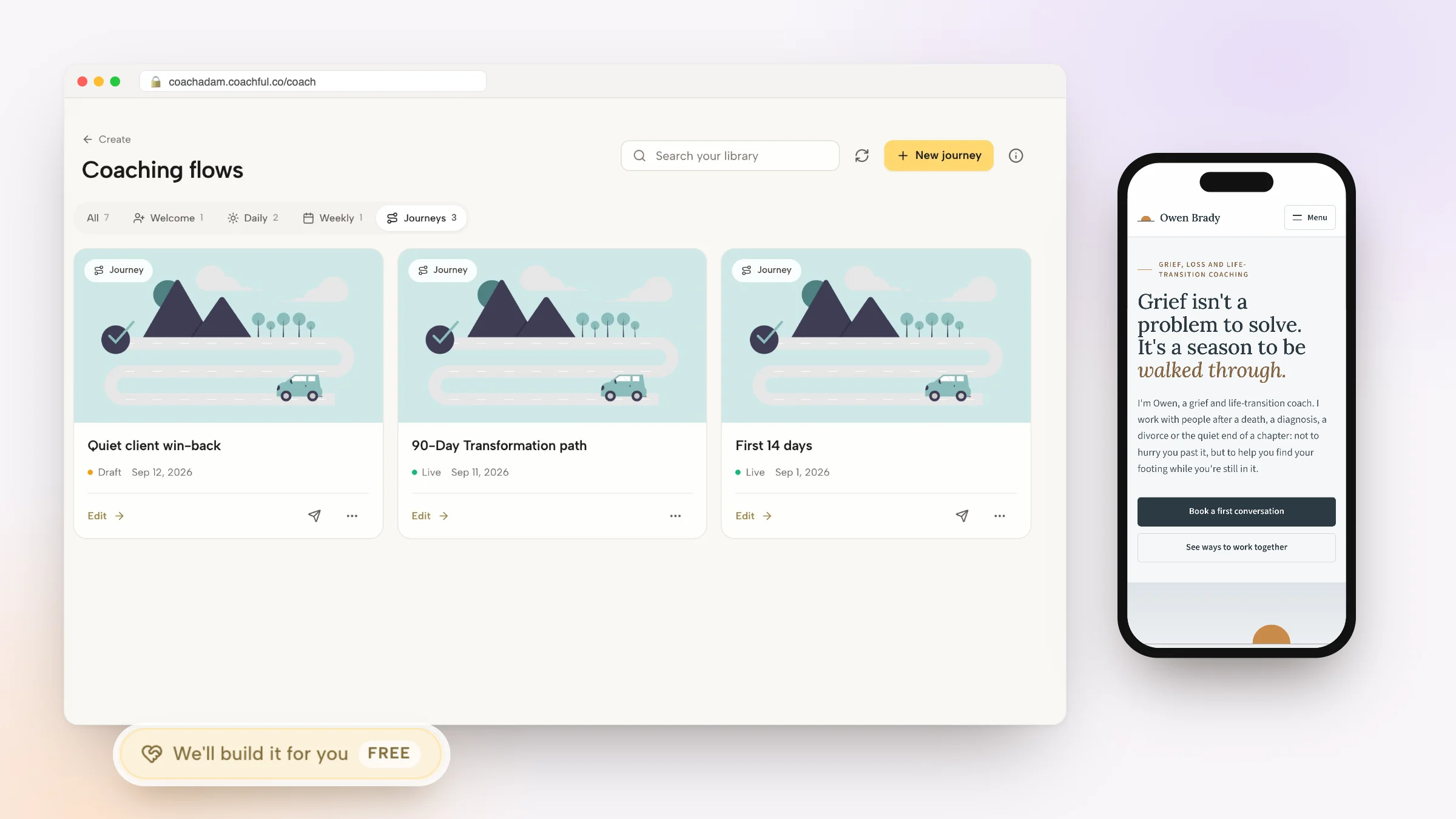
Why Coachful stands out: a free white-glove service. Every plan comes with a team that builds things for you. Send a short request from inside Coachful and they set up your community space, the program behind it and its sales page in your account, usually within about 24 hours, at no extra cost. Switching platforms does not mean rebuilding everything yourself, and for a newer coach it takes the slowest part of starting a coaching business, the setup, off your plate. See what the team will build for you.

What a coach actually gains
Coachful centralizes the work that usually gets scattered across a calendar tool, a video tool, a payment processor, a CRM, and a community app. That means your client onboarding, session scheduling, secure payments, messaging, program delivery, habit tracking, and analytics live in one branded workspace. For a coach, that cuts the most annoying kind of admin, the kind that steals time between calls and makes follow-up inconsistent.
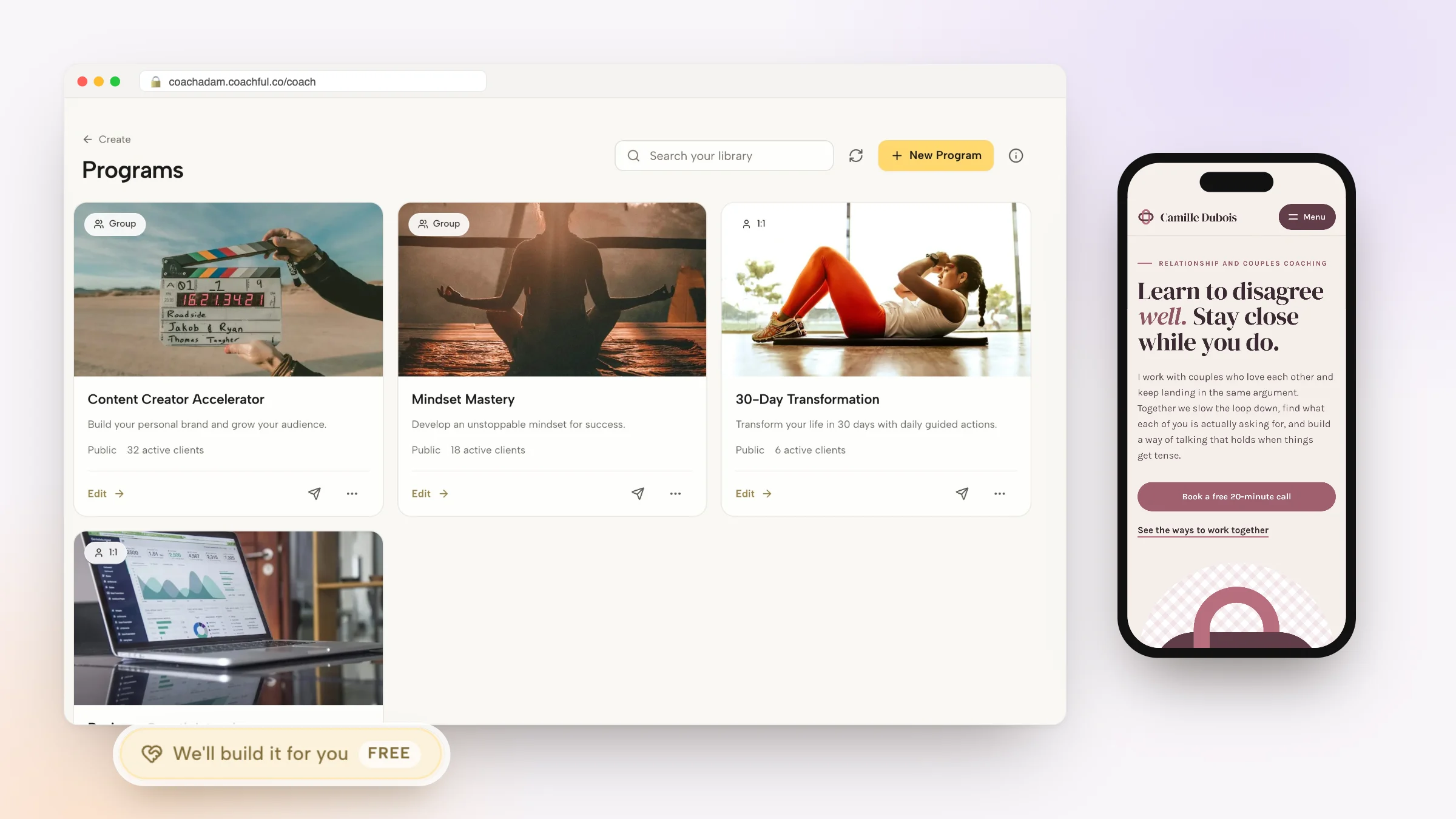
The platform is especially strong if you run 1:1 coaching, cohorts, or recurring programs. Programs can be designed once and delivered automatically, while gated content, assignments, and community touchpoints help keep clients moving instead of drifting. Coachful also supports web, iOS, and Android, and it integrates with calendars plus Zoom and Outlook, so your delivery doesn't depend on a messy workaround.
Why it stands out for daily workflow
Coachful leans hard into automation and AI. Sessions are auto-summarized, follow-up tasks and nudges are generated automatically, and the AI assistant, Michelle, can handle busywork, send nudges, draft content, and even be trained or voice-cloned on your methodology. That's not a gimmick for a coach who has to remember every next step. It means less manual note-taking, fewer missed follow-ups, and more consistency across clients.
Practical rule: If your biggest headache is keeping clients engaged after the call ends, pick the platform that helps you chase less and coach more.
Coachful also gives you flexible branding, with custom domain support, logos, colors, built-in websites, and funnel tools. It accepts payments with no platform fee on client payments, and its pricing is transparent, with Lite starting at $29/month, a fuller Solo/Pro experience from $49/month, and a 7-day free trial. The internal comparison page is also worth a look if you're already weighing this against Skool, here's the direct Coachful vs Skool comparison.
Best for: coaches, coaching schools, and consultants who need one workspace for delivery, accountability, and payments.
Trade-off: if you only need a bare-bones community, Coachful may feel deeper than you need at first.
2. Circle
Circle is the polished choice for coaches who want a premium community experience without losing structure. It works well when your membership, cohort, or program needs clearer organization than Skool typically gives you, plus a more branded feel for serious clients. If your offer is partly community, partly learning, and partly live interaction, Circle sits in a strong middle ground.

What Circle does well
Circle is built around unlimited members, courses, discussions, and events, with live video and rooms baked into the experience. That matters when your coaching business uses calls, workshops, and discussion spaces together, because you don't have to force everything into one generic feed. Higher tiers add workflows, automations, and advanced APIs, which gives bigger coaching teams more room to grow.
The brand presentation is one of Circle's biggest strengths. Custom domains, white-labeling, and branded mobile apps via Circle Plus give your program a more finished look than a plain community app. For a coach selling premium access, presentation affects trust before a client ever joins a call.
Where the trade-offs hit
Circle charges transaction fees, and the tiered structure means the cost is tied to how much capability you want. Circle's own 2026 comparison lists starting points like $89/mo, with higher levels for more advanced capabilities, and examples like transaction fees of 2%, 1%, and 0.5% depending on tier, plus paid add-ons such as Email Hub. That means Circle can stay elegant, but it isn't the cheapest place to run payments-heavy coaching offers.
Circle is strongest when your business needs a branded community with enough structure to support paid programs, not just chat.
If you want to compare it directly against a coaching-first alternative, the Coachful vs Circle breakdown is a smart next step. Circle makes sense when you're building a refined member experience and don't mind paying for the polish.
Best for: community-led coaching businesses, memberships, and cohort programs that need a premium face.
Trade-off: fees and add-ons can stack up faster than a coach expects.
3. Mighty Networks
Mighty Networks fits coaches who care about mobile engagement, live interaction, and cohort energy. It's a good choice when your clients will spend a lot of time inside the app, not just in occasional course modules. If your group thrives on check-ins, challenges, and momentum, Mighty has the right shape.

Built for movement, not just storage
Mighty combines communities, courses, events, memberships, bundles, and an AI setup assistant called Mighty Co-Host. That is useful when you want to launch a paid challenge or a recurring cohort quickly and don't want to build from scratch. The templates can shorten setup time, and the platform supports payments in many currencies, which helps if your audience isn't limited to one market.
The mature mobile experience is a real advantage for coaches managing high-touch groups. If members need reminders, event access, or easy participation from their phones, Mighty makes engagement less dependent on desktop discipline. Its optional branded app program, Mighty Pro, also gives established businesses a path to a more premium client experience.
Where it works and where it doesn't
Mighty is strong for coaching communities that need rhythm. It's not the best fit if your business depends on very detailed backend control, because some advanced capabilities and services are gated to higher levels, and the public pricing experience can be less straightforward. That makes it better for coaches who value speed and engagement over total transparency in feature packaging.
The practical reason to choose Mighty is simple. If your coaching style depends on members showing up, posting, and participating regularly, the platform supports that habit better than a plain course host. If your style depends on detailed automation and a deep operational backend, you may still feel friction.
The Mighty Networks alternative comparison is useful if you're deciding between community energy and coaching workflow depth.
Best for: cohort programs, paid challenges, and membership communities with heavy mobile use.
Trade-off: some advanced functions sit behind higher tiers, so the base experience can feel lighter than your business eventually needs.
4. Kajabi
Kajabi is the better choice when your coaching business is really a marketing machine with coaching attached. If you sell courses, memberships, and coaching through funnels and email, Kajabi replaces a lot of separate tools. It's not just a community platform, it's a business system.

The right fit for sales-heavy coaching
Kajabi brings together courses, coaching, memberships, communities, funnels, email, pages, and payments through Kajabi Payments. That makes it strong for coaches who spend as much time selling as delivering. If your sales process includes lead magnets, nurture emails, and checkout pages, you can keep the stack much tighter than with Skool plus separate marketing tools.
The upside is obvious for a coach with multiple offers. You can sell a flagship program, a membership, and a coaching upsell without pushing people through disconnected systems. The downside is equally obvious. Kajabi is deeper than many coaches need, and depth comes with complexity.
Who feels the pain
A coach who only needs community discussion and simple delivery can overbuy here. Kajabi's capacity-based model, with products, contacts, and admins tied to plan limits, means scaling requires attention. That's not a flaw, but it is a business constraint you have to respect, especially if your list or offer catalog keeps expanding.
Kajabi still makes sense when revenue depends on converting traffic, not just serving an existing audience. If you need your platform to handle the landing page, the email sequence, the checkout, and the delivery path, Kajabi gives you more control over the full buyer journey than a community-first tool.
Best for: expert businesses with strong marketing, funnels, and multiple digital offers.
Trade-off: expensive, powerful, and easy to overbuild if your coaching model is simple.
5. Thinkific
Thinkific is the right move when your business is course-first and the coaching layer comes second. Training providers, academies, and structured educators tend to do well here because the platform is built around delivery discipline. If your clients need progression, assessments, and certificates, Thinkific is a serious option.

Why structured delivery matters
Thinkific is strong on curricula, assessments, certificates, and student management. That matters for a coach or academy leader who wants learners to move through content in a controlled way, not just browse it. It also has communities and memberships, so you're not trapped in a course-only setup.
The platform's app store and documentation give you room to extend it, which is useful if your business grows into a more operational training system. For teams that want a mature course engine and predictable student flows, Thinkific keeps the learning experience organized.
Where coaches feel the gap
Thinkific is not the most automation-heavy option. If your business needs marketing depth or intricate lifecycle workflows, you may still end up connecting outside tools. That's the trade-off for its cleaner course-first focus. It handles education well, but it doesn't try to be your entire growth stack.
Thinkific fits a coach who cares about curriculum quality and student outcomes more than social buzz. If you're teaching a method, a certification, or a multi-step curriculum, the platform's structure helps you look organized from day one. If your offer depends on lively member interaction, you may want a more community-forward platform.
Best for: academies, certification programs, and coaches with serious curriculum design.
Trade-off: you'll likely stitch in extra tools for marketing and automation.
6. Teachable
Teachable is the straightforward option for coaches who want to launch a course or coaching offer without wrestling the platform. It's easier to get moving than a heavier all-in-one system, and that matters when your real job is selling and delivering, not configuring software. If you want low-friction setup, Teachable deserves attention.

Why simple can be smart
Teachable gives you a course and coaching product builder, upsells, an affiliate program, and mobile learning apps for students. That combination is strong for a coach who wants to test offers quickly, bundle products, and avoid a messy technical launch. It's especially practical if your audience just wants clear access and a smooth checkout.
The platform also has a clear path to reducing platform fees as you move up plans. That matters because many coaches start with a simple offer and only later realize the platform is taking too much off the top. Teachable lets you start lean and decide whether the business justifies a bigger plan.
Where it falls short
Teachable's starter plan includes a 7.5% transaction fee, and that alone tells you who it's for. It's a launch tool, not a forever home for every business model. Its community features are also basic compared with the stronger community-first options in this list.
If you're mostly selling education and coaching content, Teachable can keep your process clean. If you want a well-developed member environment with discussion depth, accountability, and daily engagement, it won't carry the whole load. You'll need to decide whether community is a side feature or a core part of the business.
Best for: coaches testing offers, selling simple courses, and keeping setup light.
Trade-off: basic community depth and a starter fee that makes scale matter quickly.
7. Podia
Podia is for the coach who wants one simple place to sell a few different things without building a software stack. Courses, digital downloads, coaching, community, events, website, and checkout all live together, which is exactly what lean operators want. It's a practical tool when you're trying to stay focused on delivery, not systems.
Simple packaging, fewer moving parts
Podia is easy to understand because the offer structure is easy to understand. If you sell a course, a coaching package, and a community membership, you don't need a different platform for each one. That reduces decision fatigue for you and checkout friction for clients.
Its built-in checkout, multi-currency support, sales tax handling, integrations library, and migration help make it appealing for solopreneurs. The higher tiers remove Podia transaction fees, which helps once your business starts generating predictable revenue. The platform feels designed for people who want practical simplicity, not a giant operations suite.
Where the limits show up
Podia's entry-level Mover plan includes a 5% fee and a low email subscriber cap, so you need to watch the economics before you settle in. Its advanced automations and analytics are lighter than the larger suites, which means you may eventually outgrow it if your coaching business gets more complex.
Pick Podia when you want to sell multiple products cleanly, and you don't want the platform itself to become another project.
It's a strong fit for a coach who wants clarity. If you know you need course delivery, coaching, and a simple store without extensive engineering, Podia can keep the business tidy.
Best for: solopreneurs and lean coaching businesses selling several product types.
Trade-off: lighter automation and a starter fee that matters if margins are tight.
8. Heartbeat
Heartbeat works best when your coaching business depends on social energy. It blends chat-style spaces, forums, courses, events, payments, and light automations, which gives it a more conversational feel than classic course software. If your clients stay engaged by talking, reacting, and checking in often, this can work well.
A fit for cohorts and masterminds
Heartbeat is a natural fit for masterminds, group programs, and paid communities. The thread, chat, DM, and member directory structure makes it easy for members to feel present with each other. That social layer can be a real advantage when your coaching outcome depends on accountability and peer momentum.
It also supports membership tiers, one-time and subscription payments, and in-community upsells. That gives you practical ways to package a coaching offer without sending clients through a dozen separate tools. Its automations, weekly digests, and Zoom, Calendar, and Zapier integrations keep the platform usable without turning it into a technical headache.
The business side
Heartbeat is not the cheapest route once transaction fees are included. The platform fee stacks on top of Stripe fees, which means your real cost depends on your tier and payment volume. It also treats the branded app as a separate, higher-tier offering, so the best experience costs more than the entry point suggests.
That said, the platform makes sense if your coaching style is community-led and interactive. If your business is built around relationships, live participation, and ongoing discussion, Heartbeat feels more natural than a course host pretending to be a community.
Best for: cohorts, masterminds, and social coaching spaces.
Trade-off: fees and higher-tier app access can raise the total cost of ownership.
9. Bettermode
Bettermode is the serious branding choice for coaches and organizations that want a fully integrated community hub. It's better suited to a polished, embedded experience than a casual creator setup. If your community needs to look like it belongs to your brand, not a third-party forum, Bettermode deserves a hard look.
Branding and control come first
Bettermode gives you a white-label design studio, custom content models, API access, webhooks, a sandbox environment, and SSO, JWT, and SAML options on the higher end. That is a lot of control for a coach, but it's the right kind of control if your community has to sit neatly inside a broader client experience. It also has advanced search and AI features on Growth+ and enterprise compliance options.
This is the platform for people who care about ownership, layout, and enterprise readiness. If your members need to find content later, search quality matters. If your business works with bigger clients or stricter standards, compliance and uptime expectations matter too.
The cost of that control
Bettermode's starting price is higher than creator tools, and it isn't positioned as a casual launchpad. That's fine if you're running an established coaching brand, a client portal, or a branded customer community. It's not ideal if you just want to put a cohort online by Friday.
Use Bettermode when community is part of your company's infrastructure. If your daily workflow includes support, resources, searchable knowledge, and a polished client experience, the platform earns its keep. If you need a fast, low-friction coaching launch, it's probably too much platform too early.
Best for: branded communities, client hubs, and larger organizations.
Trade-off: higher starting cost and more platform than a simple coaching business needs.
10. Discourse
Discourse is the right answer when the community itself is the asset, especially if you care about durable, searchable discussion. It's not trying to be a full coaching suite. It's trying to keep conversation organized, ownable, and easy to revisit later.
Built for depth, not hype
Discourse uses a category and topic model, powerful moderation, and trust levels to keep discussion usable as the community grows. That is a big deal when your clients ask repeated questions or when you want resources to stay findable months later. Higher tiers support custom themes, domain support, API, webhooks, and SSO.
For coaches, that structure helps when the community acts like a knowledge base. If your members need to search for a thread about onboarding, lesson feedback, or a past coaching framework, Discourse is much better than a fast-moving feed that buries everything. Its hosted plans also include a Free plan, which makes it easier to get started if discussion quality matters more than fancy presentation.
What it doesn't do
Discourse is not a courses-and-funnels suite. You usually pair it with other tools for payment handling, structured delivery, and marketing. That's the whole trade-off, and it's why Discourse works best for coaches who already have a separate sales and delivery stack.
Use it when your priority is long-term discussion ownership. If your clients value depth, archives, and moderation, Discourse is stronger than a trendy feed. If your coaching business depends on all-in-one convenience, you'll need to bolt on more systems.
Best for: searchable communities, knowledge bases, and durable member discussions.
Trade-off: you'll need separate tools for course delivery and monetization.
Top 10 Skool Alternatives: Features & Pricing
| Product | Core features | Unique selling points | UX / Quality | Value & Pricing | Target audience |
|---|---|---|---|---|---|
| Coachful 🏆 | Scheduling, payments, messaging, programs, analytics, AI assistant ✨ | ✨ AI-driven automation (auto-summaries, trainable assistant), single branded workspace 🏆 | ★★★★ | 💰 $29–$49+/mo; 7‑day trial; no platform fee on client payments | 👥 Solo & team coaches, coaching schools, cohort program owners |
| Circle | Communities, courses, events, native live video | ✨ Strong white‑labeling, APIs, branded mobile apps | ★★★★ | 💰 Tiered plans; transaction fees (2%/1%/0.5%); Email Hub add‑on | 👥 Creators & community managers scaling branded hubs |
| Mighty Networks | Communities, courses, memberships, AI setup | ✨ Cohort-focused UX, AI Co‑Host, branded app option | ★★★★ | 💰 Variable pricing; tiered transaction fees; Pro/Scale add‑ons | 👥 Creators running cohorts, paid challenges, memberships |
| Kajabi | Courses, funnels, email, pages, payments, coaching | ✨ Deep marketing automation; capacity‑based plans for scaling | ★★★★ | 💰 Higher entry price; clear plan/product/contact limits | 👥 Experts & businesses needing full marketing stack |
| Thinkific | Courses, curricula, assessments, certificates | ✨ Robust LMS features, strong student management & integrations | ★★★★ | 💰 Mid‑range; transparent plans (recent price changes) | 👥 Training providers, academies, structured course creators |
| Teachable | Course & coaching builder, mobile apps, commerce | ✨ Low‑friction course builder, affiliate tools | ★★★ | 💰 Starter plan 7.5% fee; upgrade reduces platform fees | 👥 Creators testing offers, solo course sellers |
| Podia | Courses, downloads, coaching, community, checkout | ✨ Simple packaging, multi‑product selling, easy launch | ★★★★ | 💰 Mover (5% fee) → higher tiers no transaction fee; clear tiers | 👥 Solopreneurs, lean creators selling varied products |
| Heartbeat | Threads/chat, courses, events, payments, automations | ✨ Social, lightweight cohort UX; in‑community upsells | ★★★ | 💰 Tiered; platform fees (5%/2.5%/1.25%) + Stripe | 👥 Cohorts, masterminds, group program facilitators |
| Bettermode | White‑label embeddable community, APIs, SSO | ✨ Deep branding & design control; enterprise compliance & search | ★★★★ | 💰 Higher starting price; enterprise pricing options | 👥 Enterprises & teams needing embedded/custom hubs |
| Discourse (hosted) | Forum categories, moderation, trust levels, exportable data | ✨ Best‑in‑class long‑form discussions, ownable data model | ★★★★ | 💰 Hosted Free → Pro/Enterprise plans; OSS core | 👥 Communities prioritizing searchable, durable discussions |
Choose the Workflow You Want to Own
The best skool alternatives are not the ones with the flashiest interface. They're the ones that match how you coach, how you sell, and how much admin you can tolerate before it starts eating into delivery. If you run 1:1 coaching, group programs, cohorts, memberships, scheduling, payments, messaging, and accountability in one place, Coachful is the strongest fit because it was built to remove exactly that kind of friction. If your business is more community-led, Circle and Mighty Networks are the better choices, because they give you branded member spaces and recurring engagement without forcing you into a course-only box.
If your real engine is marketing, Kajabi makes sense because it bundles funnels, email, pages, courses, memberships, and communities into one system. If your business is course-first, Thinkific and Teachable are the cleaner plays, with Thinkific better for structured curricula and Teachable better for low-friction launches. If you're lean and want to sell multiple product types without carrying a big stack, Podia is the practical option. If the emotional center of your offer is live social interaction, Heartbeat fits better. If branding and ownership are the priority, Bettermode is the serious choice. If discussion longevity matters most, Discourse is the strongest home for searchable, durable conversation.
Migration deserves respect. Export your member and customer data first. Inventory every course, discussion space, offer, and payment flow. Preserve important links and resources, communicate the move early, run a pilot cohort before the full switch, and keep the old platform live until access and delivery are verified. Coaches get burned when they move too fast and discover that the platform looked cleaner than the transition really was.
The smartest choice is the one that reduces your highest-cost operational friction without forcing you to manage a second stack. That is the lens to use when you compare any Skool alternative, because your business doesn't pay you for software preferences, it pays you for clear delivery, client retention, and a calm operating system.
If you want the coaching stack to feel simpler, Coachful brings scheduling, payments, messaging, program delivery, community, and automation into one workspace. It's built for coaches who want fewer tools, better follow-through, and a more professional client experience. Visit Coachful if you're ready to replace platform sprawl with a system that supports the way you coach.