Udemy for Coaches: 5 Checks Before Publishing a Course

Nour
Founder, Coachful
Should you put your coaching course on Udemy, or keep it inside your own practice? Use Udemy when you want to sell a self-contained educational course and are comfortable with marketplace pricing, revenue sharing and student-relationship rules. Keep an independently delivered coaching offer separate when it depends on private client information, individual support or terms you need to agree directly.
The expensive mistake is recording your entire signature program, uploading it and assuming the students will become coaching clients. A learner may simply want the lesson they bought. That is a perfectly good purchase, not an incomplete relationship you need to fix with a sales pitch.
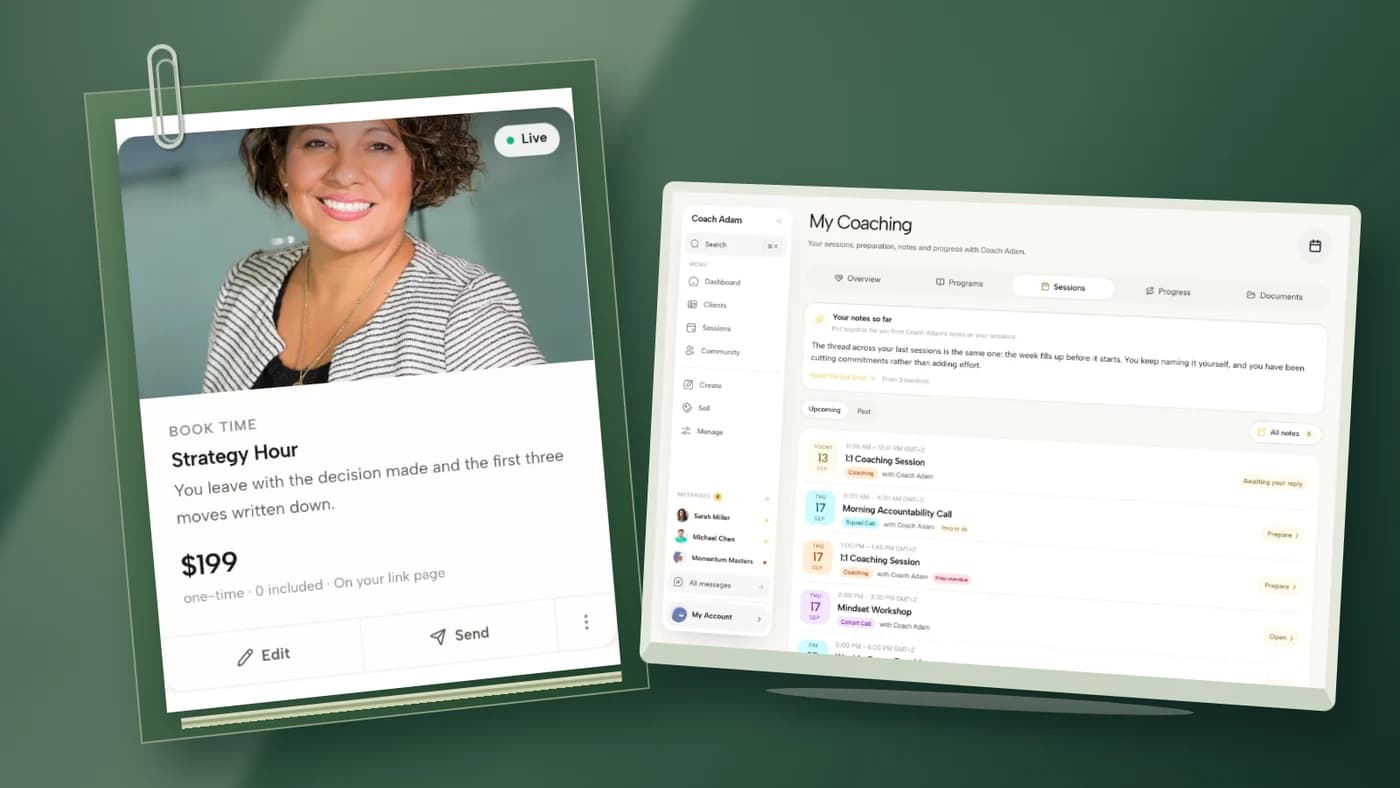
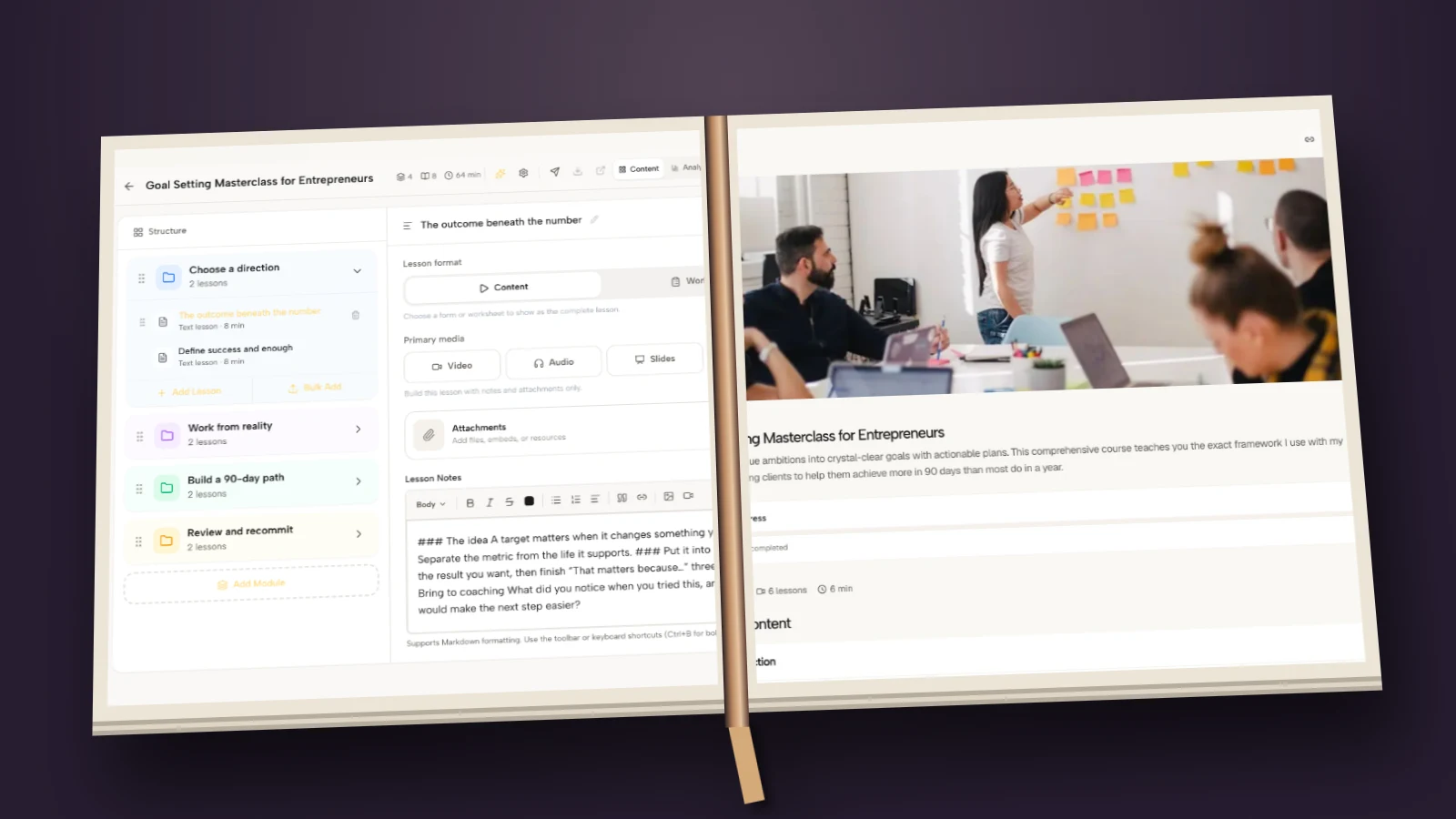
These five checks help you decide whether Udemy deserves a small test. They cover course scope, economics, content rights, promotion and ongoing delivery. All course examples and financial assumptions below are hypothetical. Coachful screenshots illustrate independent course delivery, not Udemy screens, a Udemy integration or automatic student transfers.
1. Choose a course that works without private coaching
A suitable first course teaches a bounded skill a learner can practise independently. A leadership coach might teach someone to prepare a useful agenda for their first manager one-to-one. A career coach might teach a method for comparing job descriptions. Neither promise requires the instructor to review the learner's confidential situation.
Write down three things before you record: who the course serves, what the learner will produce, and what is not included. “Become a confident leader” is too broad to guide production. “Draft an agenda and opening questions for your first team one-to-one” gives you a concrete educational job.

Do not confuse teaching a coaching-related skill with delivering a professional coaching engagement. Your course should not imply that buying videos establishes a confidential individual service, gives access to unlimited personal advice or qualifies someone for a credential it does not actually award.
A fictional five-part course outline
- Choose the meeting purpose. The learner writes one objective for an ordinary workplace conversation.
- Build a short agenda. They select three discussion points rather than copying a sprawling template.
- Practise an opening. They draft a respectful first sentence and notice where it becomes leading.
- Respond to a worked example. They revise a question using a fictional scenario supplied in the course.
- Plan the follow-through. They create a simple note and next-action format.

The paid value is in the instruction, demonstrations and practice, not in access to you afterward. Do not make the useful worksheet available only after someone joins your mailing list or buys a coaching package. The learner should receive the course they were promised within the agreed learning experience.
Udemy's minimum course checklist currently requires at least five lectures and 30 minutes of video, alongside educational, audiovisual and landing-page standards. Those are publication minimums, not evidence that a particular length will sell or teach well. Build enough instruction to support the skill, not filler to make the runtime look impressive.

Important exception: Udemy's current Instructor Terms also describe live Coaching Services. They explicitly say availability may be limited to certain instructors and subject to platform limits. Do not assume your account can offer these sessions, or apply recorded-course revenue shares to them. This article focuses on the standalone course decision.
2. Calculate the economics from the Net Amount, not the headline price
Udemy's course revenue-share guidance distinguishes sales using your instructor coupon or course referral link from sales without one. It lists 97% for the former and 37% for the latter. These percentages apply to the Net Amount, not automatically to the advertised price or everything the student pays.
The Instructor Terms define deductions that can include transaction taxes, mobile-platform fees and service or processing fees. Refunds and any co-instructor allocation can further change what reaches you. Subscription programs and live coaching sessions have different arrangements, so keep them out of a simple transactional-course forecast unless you model them separately.

Here is a deliberately simplified example. Assume the Net Amount for a sale is USD 20 after applicable deductions. At a 37% course share, the instructor's share is USD 7.40. At 97%, it is USD 19.40. Those are arithmetic examples, not claims about Udemy's normal sale price, your likely channel mix or your take-home profit.
Now suppose you set a fictional production budget of USD 600. Recovering that budget alone would require 82 non-refunded sales at USD 7.40 each, or 31 at USD 19.40 each, rounded up. This excludes ongoing support, income taxes, future updates and other costs. A real forecast needs those too.
Make the distribution decision explicit
- If you need Udemy to bring the learners: model the share for sales without your coupon or referral link. Do not budget as though every purchase earns the instructor-promoted share.
- If you bring the audience yourself: compare the marketplace route with an independent checkout and delivery route, including your actual software, payment, tax and support costs.
- If you join promotional programs: read the pricing permissions before assuming your selected base price is the price students will pay.
- If the course supports another business: decide whether the course can justify itself without speculative future coaching sales.
The current Instructor Terms distinguish a base price from the discounted or list prices that can apply through promotional programs. A coach protecting a premium offer should consider what a different marketplace price communicates, but the answer is not automatically “never discount.” It is to distinguish the products honestly.

A self-paced introduction and a private coaching package can have different prices because their scope and support differ. Spell out those differences. Do not use an artificially inflated coaching value to make an ordinary video course look like a bargain, and do not promise personal feedback you have not costed.
Decision rule: choose Udemy for a credible distribution experiment, not merely because course hosting has no upfront fee. Production time, maintenance and the share you retain still matter.
3. Check the rights in every file and the license you grant
Before uploading, separate your original teaching material from material you have permission to use privately with clients. Owning your slides does not necessarily mean you can distribute the assessment inside them. A training-school handout, licensed questionnaire, stock photograph, music track or client screenshot may have its own restrictions.
Udemy's Instructor Terms require the rights, licenses, permissions and qualifications needed for the content and services you offer. They also grant Udemy rights to offer, market and sublicense submitted content. Read that license as a business decision, not as a checkbox you can delegate to your video editor.
Particularly for coaches, review anything that came out of a real engagement. A name removed from a recording may not make the person unrecognizable. Their employer, voice, distinctive situation or worksheet answers can still identify them. The safer production choice is often a fictional scenario written for public teaching rather than a recycled client moment.

Run a practical pre-upload rights review
- Teaching framework: identify what is yours and what requires attribution or a distribution license.
- Examples: use clearly fictional cases unless you have an appropriate, specific basis for public use.
- Media: keep records of permitted commercial uses for images, music, clips and other assets.
- Credential wording: distinguish your qualifications from any certificate the learner receives.
- Third-party tools: check whether demonstrations or included downloads comply with their terms.
- Platform license: understand what remains available to existing students if you later remove the course.
The current terms also discuss AI-related uses. They describe core-platform uses and a separate Instructor Generative AI Program, including an opt-out process with designated periods. Review the linked policy and your actual participation status if reuse of your material matters to your practice. Do not assume deleting a course simply reverses every permission already granted.
This is a rights-screening process, not legal advice. If the course depends on proprietary assessments, sensitive recordings or an employer's intellectual property, obtain qualified advice before publishing rather than hoping a disclaimer will repair an unsuitable license.
4. Respect the difference between a student and your marketing list
Udemy is not a permission slip to move student details into your practice. Section 3.3 of its Instructor Terms restricts the use of student data to delivering services on Udemy and says instructors must not solicit additional personal data or store students' personal data outside the platform.
That changes the common “cheap course as a funnel” plan. Do not export names into a coaching CRM, add students to a newsletter, send unsolicited coaching pitches or require an off-platform intake merely because they enrolled. Treat student support and promotion as different activities governed by the platform's rules.
Udemy's Bonus Lecture guidance permits a specific marketing space for other courses, products and services. It limits that space to one final bonus lecture and sets rules about its title, references elsewhere and preview availability. Permission for that space is not permission to insert a coaching advertisement throughout the course.
Its course-material rules further distinguish educational material from promotional links. Review the current rules for each placement before linking to a paid offer or a destination requesting personal information. When the boundary is unclear, ask Udemy support rather than improvising a workaround.

If you also operate an independent coaching practice, keep that offer and its records distinct. Someone independently choosing to enquire about coaching needs accurate scope, privacy information and a direct agreement for that service. A permitted promotional reference does not erase the platform's student-data restrictions or automatically establish an outside coaching relationship.
For example, do not write “Complete this client history form so I can personalize your Udemy course” when no such personal service was included. Keep the course exercise inside the learning experience where possible. Any future coaching decision should be genuinely separate, voluntary and compliant with the relevant platform rules.
The sharp opinion here is simple: a course that only works by extracting a lead is not a strong standalone course. Design the education to stand on its own. That is better for the learner and gives you a cleaner way to judge the commercial experiment.
5. Budget for support and define the first review
Recorded does not mean maintenance-free. A learner can struggle with your instructions, a link can break and a lesson can become outdated. Before publishing, decide who reviews questions, how often you check the course, and how you distinguish a content clarification from a request for private coaching.
A useful response boundary sounds like this: “I can clarify the method taught in this lesson and explain the fictional example. I cannot assess your confidential workplace case through the course discussion.” Adapt that wording to the actual course and platform tools rather than promising a response time you cannot sustain.
Give yourself a written experiment brief. Name one audience and one skill, cap the production effort, record your actual costs and choose a review date. A review date is a management checkpoint, not proof that the test has accumulated enough evidence to succeed or fail.

Review the course as a product, not a popularity contest
- Revenue: what did you retain after deductions and refunds, compared with the time and money invested?
- Channel: which sales came through your promotion and which did not?
- Learning friction: which instructions generate repeated clarification requests?
- Support: are you answering course questions or unintentionally supplying unpriced individual coaching?
- Maintenance: what must change for the material to stay accurate and usable?
Use information actually available in your instructor account. Do not assume Coachful's demo analytics are Udemy reporting fields, or that a completion indicator proves a learner has changed their behavior. Use feedback to revise an explanation, not to manufacture an outcome claim.
At review, choose a specific next move: improve one weak lesson, adjust the course description to match the real audience, continue the bounded test, or stop investing in additional production. Avoid solving disappointing sales by immediately recording another ten hours.
When independent course delivery is the better fit
If your main promise is a directly agreed coaching relationship with lessons supporting it, an independent delivery route may fit better. You still need to attract the right people, handle your obligations and explain the offer clearly. Owning the delivery decision does not generate demand by itself.
Coachful's course platform supports modules and lessons with video, text and attachments, plus progress tracking at course, module and lesson level. That is useful when content belongs alongside the coaching you already deliver. It is not a Udemy distribution channel and does not give you permission to import Udemy student data.
Before committing to either route, inspect the learner experience you intend to sell. Try the interactive demo to explore independent course delivery, then compare it with the marketplace obligations above. Choose on the basis of your actual product and acquisition plan, not the number of features on a comparison page.
Frequently asked questions
Is Udemy free for coaches to publish on?
Udemy's revenue-share guidance says there is no fee to create and host courses. That does not make production free or mean you retain the entire sale. Model the relevant revenue share, applicable deductions, refunds, support effort and maintenance before deciding whether a course is financially worthwhile.
Can I sell live coaching on Udemy?
The current Instructor Terms describe Coaching Services, but say they may not be available to all instructors and may be subject to limits. Check your account eligibility and the current session terms. Do not assume a standard recorded-course account includes a general-purpose private coaching checkout.
Can I move Udemy students into Coachful?
Do not treat enrollment as authorization to transfer personal data or create an independent client record. Udemy's terms restrict student-data use and outside storage. Review those obligations and any separately initiated relationship carefully; there is no automatic student-transfer workflow demonstrated in this article.
Should I put my entire signature coaching program on Udemy?
Only if it genuinely works as the educational product you are offering under those terms. If its value depends on confidential casework, personal feedback or a separately agreed coaching relationship, start with a self-contained course instead. Keep the higher-support offer accurately scoped and commercially distinct.
Policy references checked on 18 October 2026. Platform terms, eligibility and revenue arrangements can change. This is a practice-management guide, not legal, tax or income advice.