What Emulsifies Fat: A Practical Guide to the Process

Coachful
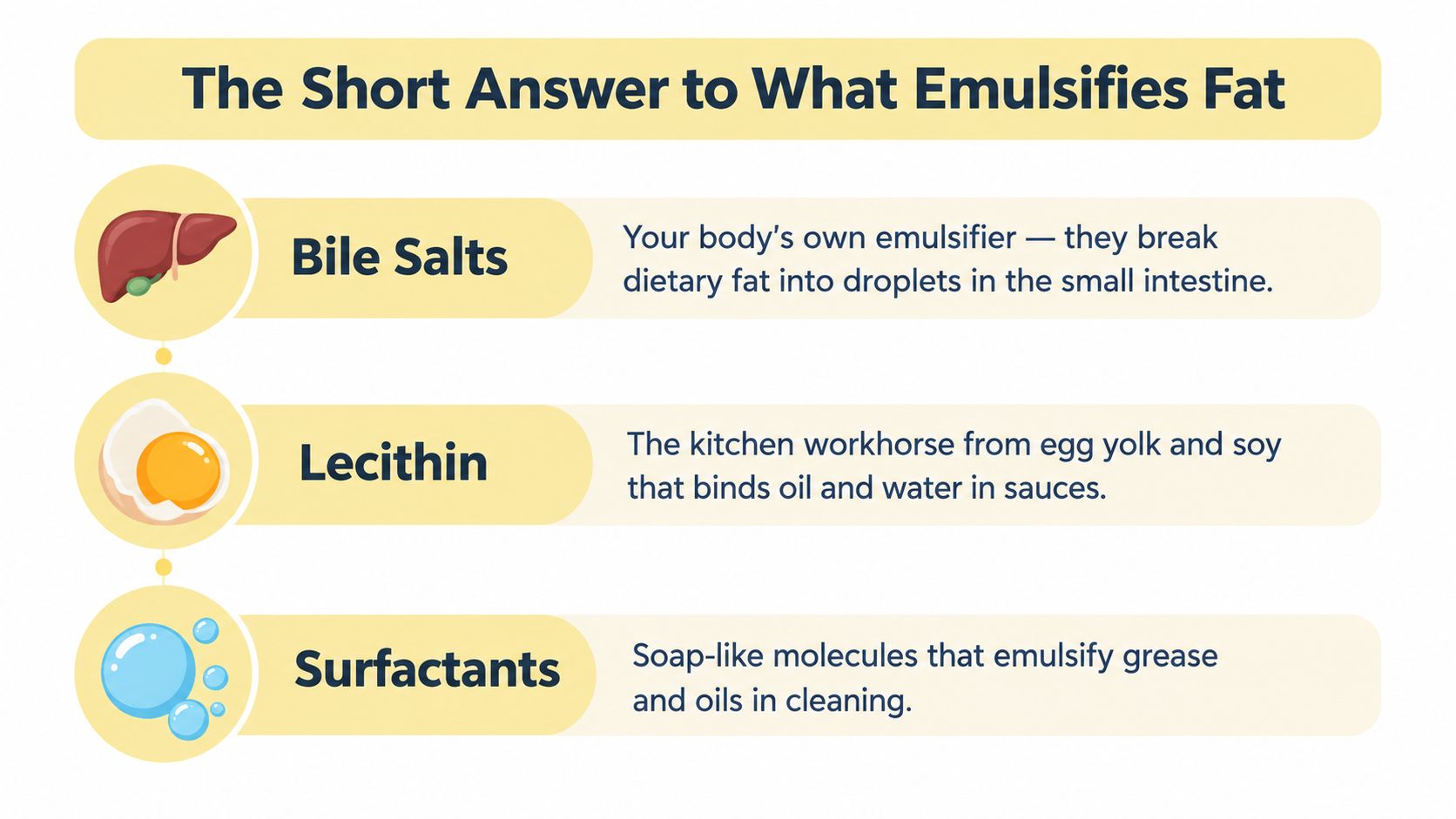
Bile salts are the main natural emulsifiers of dietary fat in the human body, with lecithin assisting in the small intestine. In food and cleaning, lecithin from egg yolk or soy and soap-like surfactants emulsify fat by using one part that interacts with water and another that grips oil.
Why does salad dressing separate, while mayonnaise stays creamy and dish soap lifts grease from a pan? The answer isn't “because an emulsifier is present.” Emulsification works because certain molecules can stand at the boundary between water and fat, reduce the tension holding oil droplets together, and help keep those droplets dispersed.
That same chemistry appears in your duodenum, your saucepan, and your kitchen sink. Once you understand the two-sided design of an emulsifier, “what emulsifies fat” stops being a memorization question and becomes something you can reason through.
The Short Answer to What Emulsifies Fat
In the human body, bile salts emulsify dietary fat. The liver makes bile, the gallbladder stores it, and the small intestine receives it when fat arrives. Lecithin and other phospholipids in bile support the process. Bile salts don't chemically digest triglycerides, but they disperse large fat globules so digestive enzymes can reach them more effectively. Bile salts are described as the main emulsifying agents in lipid digestion because their amphipathic structure interacts with both fat and water.
In cooking, lecithin is a familiar emulsifier. Egg yolk and soy are practical sources, which is why egg yolk helps mayonnaise hold oil and water together. Mustard can also help stabilize a vinaigrette, especially when whisking breaks the oil into small droplets. In cleaning, soap and detergents perform a related job. Their molecules surround greasy material and help carry it into water.
Think of an emulsifier as a molecular interpreter. One end is comfortable in water, while another end prefers oil. That arrangement lets the molecule settle at the oil-water boundary instead of choosing only one liquid.
The practical rule: Fat doesn't become water-soluble. An emulsifier helps break it into droplets small enough to remain dispersed.
A simple vinaigrette demonstrates the problem. Vinegar and oil naturally separate because their molecules prefer different surroundings. Whisking creates temporary droplets, while mustard or another emulsifying ingredient helps those droplets stay apart. The rest of this guide explains why that happens, how your body uses the same principle, and how to repair an emulsified sauce when the balance fails.
How Emulsifiers Actually Work at the Molecular Level
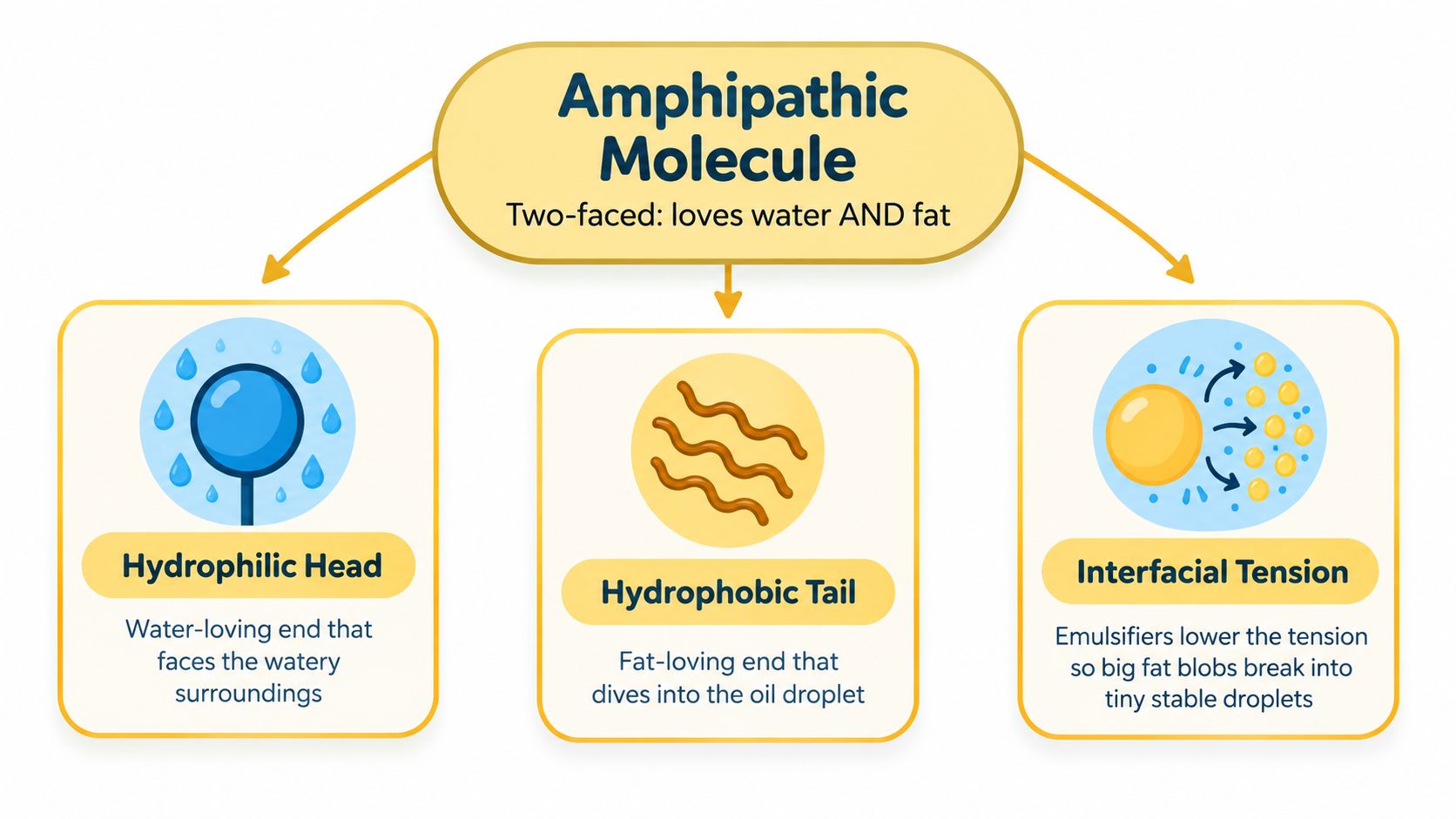
An emulsifier works because it is amphipathic, meaning it has two contrasting chemical preferences. The word sounds technical, but the idea is simple: one part likes water, and another part likes fat.
The two ends of the bridge
The water-friendly portion is called the hydrophilic head. It can interact with surrounding water. The fat-friendly portion is the hydrophobic tail, which avoids water and associates with oil or grease.
Put one of these molecules beside an oil droplet in water. The tail points into the oil, while the head faces outward toward the watery environment. A whole layer of molecules can form around the droplet, creating a bridge between liquids that normally pull away from each other.
Why the boundary matters
Oil and water have an oil-water interface, the boundary where the two liquids meet. Interfacial tension makes that boundary energetically uncomfortable, so oil tends to gather into larger, rounded globules. Mechanical mixing can split a large globule, but without an emulsifier, the new droplets often collide and merge again.
An amphipathic layer makes merging harder. Bile salts and other emulsifiers adsorb at the interface, and mixed bile-salt micelles help pancreatic lipase and colipase access triglycerides within the droplets. This molecular framework is described in the physiology and food-science literature on bile salts, micelles, and lipid digestion.
From droplets to micelles
A micelle is a small structure in which amphipathic molecules organize around lipid material. The exact structure varies with the surroundings, but the essential outcome is the same. Fat becomes packaged into a form that can remain associated with the watery contents of the intestine.
This is why the most useful prediction is not “Does this ingredient contain fat?” but “Does this molecule have a water-compatible part and an oil-compatible part?” If it has only one preference, it won't act as an effective bridge. If it can occupy the boundary and mechanical energy is available, it may help create a more stable dispersion.
For hands-on kitchen experimentation, a Just Cook It kitchen toolkit can make this chemistry easier to observe through controlled mixing and texture experiments.
Bile Salts and the Body's Own Fat Emulsifier
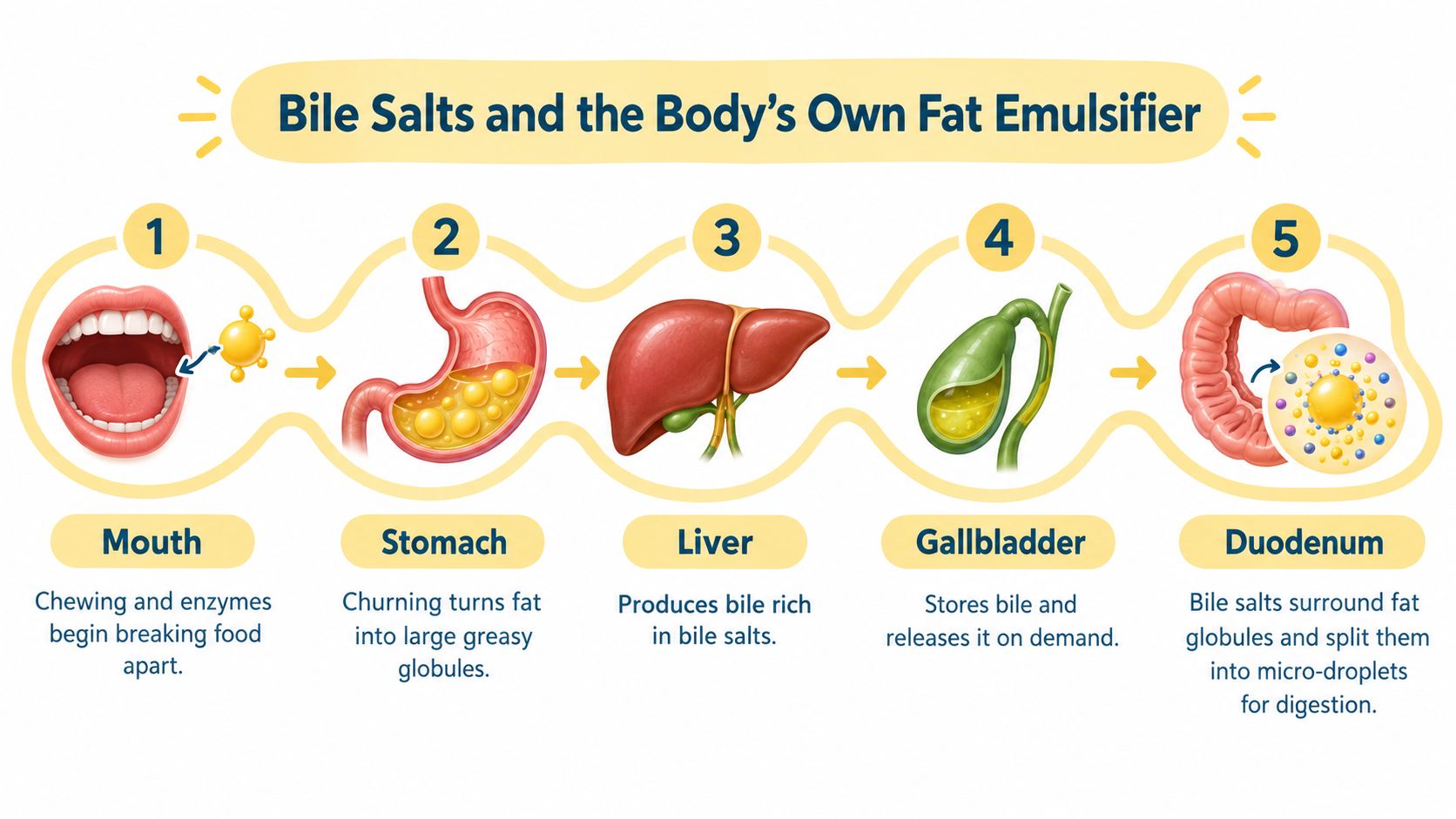
Follow a bite of oily food through digestion. Chewing breaks the food into smaller pieces, and the stomach churns it into a mixture containing large greasy globules. The stomach can begin lipid digestion, but the major emulsification stage happens later, when the mixture enters the duodenum.
The liver produces bile, while the gallbladder stores and releases it into the small intestine. Bile salts are the active amphipathic ingredients. Their water-compatible side faces the intestinal fluid, while their fat-compatible side associates with the lipid surface. Lecithin and related phospholipids assist at that same boundary.
What happens in the duodenum
The duodenum supplies the watery setting in which fat must be dispersed. Bile salts lower the effective surface tension around fat globules and help split larger masses into smaller droplets. That creates more oil-water interface, which gives pancreatic lipase more access to triglycerides.
One educational physiology description states that emulsification can increase lipid surface area by more than 1,000-fold in the small intestine. The important lesson isn't the number alone. It's that physical size and surface area determine how easily enzymes can reach the fat.
The digestive sequence has distinct jobs:
- Bile salts disperse the fat.
- Pancreatic lipase hydrolyzes triglycerides.
- Monoglycerides and free fatty acids become available for absorption.
- Bile salts help form micelles that transport lipid products toward the intestinal brush border.
A common student mistake is to treat emulsification as digestion. It isn't. Emulsification is preparation, similar to chopping a large vegetable before cooking. The chopping doesn't cook the vegetable, but it changes the pieces so heat can act more efficiently.
The same distinction appears in this explanation of lipid digestion and absorption. Bile makes fat accessible; lipase performs the chemical breakdown. If either stage is misunderstood, the whole process seems mysterious.
Lecithin, Egg Yolk, and the Chemistry of the Kitchen
Egg yolk is a classic kitchen emulsifier because it contains lecithin, a phospholipid with a water-friendly region and fat-friendly regions. That molecular design lets lecithin gather at the boundary between oil and water, much as bile salts do in digestion.
Mayonnaise makes the mechanism visible. Start with an aqueous phase, such as egg yolk, vinegar, or lemon juice, then introduce oil gradually while whisking. The whisk supplies mechanical force, breaking the oil into droplets. Lecithin coats those droplets, reducing their tendency to join into one oily layer.
Three sauces, one principle
A vinaigrette is usually a temporary or semi-permanent emulsion. Whisking makes it look unified, but the phases may separate during standing. Mustard helps because its components support droplet dispersion and add a flavor bridge between sharp acid and rich oil.
Mayonnaise is more persistent because the egg yolk provides a strong emulsifying system and the oil is incorporated gradually. The final texture changes from thin and separated to thick, glossy, and cohesive. That visible thickening is evidence that many small droplets now occupy the mixture instead of one continuous oil phase.
Hollandaise adds heat and another challenge. Egg yolk helps bind the butter and watery ingredients, but excessive heat can make the proteins seize. Gentle temperature control matters because emulsification depends on both molecular ingredients and physical handling.
| Sauce | Main watery phase | Fat phase | Helpful action |
|---|---|---|---|
| Vinaigrette | Vinegar or citrus juice | Oil | Whisk slowly and use mustard |
| Mayonnaise | Egg yolk and acid | Oil | Add oil gradually |
| Hollandaise | Egg yolk and acid | Butter | Whisk with controlled heat |
The kitchen lesson is straightforward. An emulsifier can't rescue careless mixing indefinitely. Even a good emulsifier has limited capacity, so droplet size, addition speed, temperature, and agitation all influence the result.
For a closer look at temperature control and how to avoid curdling ice cream custard, use the same mental model. Egg proteins and lecithin perform different jobs, and a successful sauce depends on respecting both.
How to Emulsify a Sauce and Fix a Broken One
A reliable emulsion begins with order. Put the water-based ingredients in the bowl first, add the emulsifier, and then introduce the oil slowly while whisking or blending. Each new oil droplet needs time to meet the emulsifier and become coated before more oil crowds the mixture.
The basic method
- Build the water phase. Combine vinegar, lemon juice, water, or another watery ingredient with seasoning.
- Add the stabilizer. Use mustard for a vinaigrette or egg yolk for mayonnaise.
- Create movement. Whisk continuously, or use a blender for stronger shear.
- Drizzle the oil. Add it in a thin stream rather than dumping it in.
- Watch the texture. The mixture should become thicker, smoother, and more uniform as droplets multiply.
Oil added too quickly can overwhelm the emulsifier. The available lecithin or mustard compounds can't coat enough new droplets, so the droplets collide and coalesce. Once that happens, the sauce develops a slick surface or separates into visible layers.
Practical diagnosis: If you can see a distinct oil layer, the continuous phase has regained control. Rebuild the emulsion instead of simply whisking harder.
Two rescue methods
For a broken vinaigrette, place a fresh teaspoon of mustard in a clean bowl and whisk the broken dressing into it gradually. The new mustard gives the droplets a better starting environment.
For broken mayonnaise, start with a new egg yolk in a clean bowl. Slowly whisk the broken mayonnaise into the yolk, treating the broken sauce as though it were the oil you should have added in a controlled stream.
Use ingredients close to room temperature rather than combining very cold components. Temperature differences can make the mixture harder to blend smoothly, particularly in egg-based sauces.
Before trying again, check this short list:
- Too much oil too soon: Add the fat more slowly.
- Insufficient movement: Whisk continuously or use a blender.
- Not enough emulsifier: Start with a fresh mustard or yolk base.
- Cold ingredients: Let them approach the same moderate temperature.
- Overheating: Protect egg-based sauces from excessive heat.
Soaps, Detergents, and Modern Food Additive Emulsifiers
Dish soap applies the same principle with a different molecular design. A soap molecule typically has a charged carboxylate head and a hydrocarbon tail. The tail associates with grease, while the charged head interacts with water.
When you wash a greasy pan, agitation loosens the fat from the surface. Soap molecules surround the grease, with their tails facing inward and their charged heads facing outward. The resulting structures can remain dispersed in rinse water instead of returning to the pan as a continuous oily film.
Detergents use related surfactant chemistry. Their molecules are designed to reduce interfacial tension and help lift oily material from surfaces. The chemistry may be stronger or more specialized than that of a food emulsifier, but the underlying pattern remains recognizable.
Food manufacturers also use purified emulsifiers for predictable texture and stability. Examples include mono- and diglycerides, polysorbates, and sodium stearoyl lactylate. These ingredients can support products such as baked goods, ice cream, and sauces by managing interfaces during mixing, storage, and use.
The safety question needs more care than a simple “natural is good” or “synthetic is bad.” A review notes that concern has focused on a limited group of additives, including carrageenan, polysorbate 80, and carboxymethylcellulose, while the effects of many other emulsifying agents remain less understood in the available evidence.
That doesn't prove that all emulsifiers are harmful, nor does it make every additive irrelevant. Effects may depend on the compound, amount, food matrix, and individual context. The sensible question is more precise: which emulsifier, used how, and for whom?
Common Misconceptions Worth Clearing Up
Misconception one: emulsifiers digest fat. They don't. Bile salts and lecithin prepare fat by dispersing it, while pancreatic lipase carries out the chemical hydrolysis. A useful comparison is a tool organizer. It puts materials where the worker can reach them, but it doesn't perform the work.
Misconception two: every emulsifier is unhealthy. The body depends on bile salts, and lecithin occurs naturally in foods and tissues. Food additives require separate evaluation because their structures, exposures, and uses differ. The evidence around some additives raises questions, but it doesn't justify treating every emulsifier as equivalent.
Misconception three: natural automatically means safer. Egg yolk is a natural emulsifying ingredient, but it can create problems for someone with an egg allergy. “Natural” describes an origin, not a complete safety profile.
Misconception four: synthetic automatically means dangerous. A manufactured emulsifier can be tested for a defined use, while a natural ingredient can vary in composition or trigger sensitivities. Safety depends on chemistry, dose, exposure, and the person consuming it.
Misconception five: more emulsifier always improves the sauce. A stable emulsion needs balance. Too little support allows droplets to merge, but excessive or poorly matched emulsifier can change flavor, mouthfeel, viscosity, or the structure of the sauce.
A better question than “Is this natural?” is “What does this molecule do in this mixture, at this amount, and under these conditions?”
One Principle Across Body, Kitchen, and Lab
The portable mental model is one molecule with two preferences. Its water-loving side faces the watery environment, its fat-loving side associates with oil, and mechanical energy breaks large masses into droplets.
In the duodenum, bile salts package dietary fat into dispersed structures that enzymes can access. In a vinaigrette, mustard and lecithin help keep oil droplets distributed through an acidic water phase. In the sink, soap surrounds grease and helps move it into rinse water.
The ingredients differ, and the available mixing force differs, but the physics stays connected. Change the emulsifier, droplet size, temperature, or shear, and the result changes without changing the underlying principle.
When you meet a new emulsion, ask three questions:
- Which molecule bridges oil and water?
- What force creates smaller droplets?
- What keeps those droplets from merging again?
Answer those questions and you can understand digestion, repair a broken sauce, assess a cleaning product, or interpret a food label with far more confidence.
Coachful gives coaches one workspace for client onboarding, scheduling, secure payments, messaging, progress tracking, and structured programs. If you want to turn complex ideas into clear learning journeys, organized milestones, and consistent client follow-through, visit Coachful and explore how it can support your coaching practice.