
What is performance coaching: Unlock Your Full Potential

Coachful

Let's be clear: performance coaching isn't about giving advice or telling people what to do. It’s a powerful partnership designed to help someone tap into their existing abilities and maximize their own performance. The process empowers people to discover their own solutions, build genuine confidence, and achieve real, measurable results.
What Is Performance Coaching Really
You've definitely heard the term, but a question might be lingering in your head: 'Isn't this just a fancy new name for management? Or is it therapy? Where does this fit in?' It's a valid thought, especially with so many industry buzzwords flying around. Let's cut through that noise and get to what performance coaching actually is—and what it isn't.
The best way to think about it is like being a personal trainer for someone's career. A trainer doesn't lift the weights for their client. They provide a proven framework, correct form to avoid setbacks, and supply the motivation needed to push past those invisible walls we all build for ourselves. Performance coaching works exactly the same way.
A performance coach isn't the expert with all the answers. They are a catalyst, helping the client realize they are the expert on themselves. Your role shifts from "problem-solver" to "potential-unlocker."
This change in mindset is everything. It's the difference between dictating a solution and guiding someone to figure out how to solve problems effectively on their own, time and time again.
From Knowing to Doing
Most professionals already know what they should be doing. The real hurdle is almost always in the execution. This is where a performance coach bridges the gap between knowing and doing.
You've seen it a hundred times. A client might be held back by a limiting belief, like, "I'm just not experienced enough for that promotion." A manager might just say, "Yes, you are!" As a coach, however, you learn to ask powerful questions that help the person dismantle that belief themselves:
- "What specific evidence makes you feel you're not ready?"
- "If you did feel ready, what would look different?"
- "What's one small step you could take this week to build a skill you feel is missing?"
This line of questioning helps people break down their own mental barriers and build a concrete, actionable plan. It’s all about turning passive knowledge into active, consistent performance.
A Rapidly Growing Field
This focus on unlocking human capability is exactly why performance coaching is exploding in popularity. The global coaching industry is on track to hit $5.34 billion USD in revenue by 2026, with an incredible 62% growth in the number of active coaches since 2019.
This isn't just a fleeting trend. This massive growth shows just how much businesses and individuals value developing peak performance. You can dig deeper into data on coaching industry trends to see how the field is evolving. It's a proven method for driving real improvement and has become a fundamental part of modern professional development.
It happens all the time. A prospective client calls and says, “We need you to mentor our new sales manager.” But as you listen, you quickly realize they’re actually describing a need for performance coaching.
This kind of mix-up is incredibly common. Learning how to gently untangle these terms isn’t just about being precise—it’s a core skill that immediately establishes your expertise. It’s your first opportunity to shift from simply taking an order to guiding the client toward a solution that will create real, lasting change.
A Quick Mental Model for Clarifying Your Role
When a client uses "mentoring" or "training" interchangeably with "coaching," it helps to have a simple, practical way to explain the difference.
Picture a manager who's struggling to get their team to hit their goals. Here’s how each discipline would tackle the problem:
Training is Directive: A trainer comes in with a set curriculum. They’re there to transfer knowledge. Their conversation sounds like this: "Here is our five-step framework for effective weekly check-ins. Let's practice it." The goal is to teach a specific, repeatable skill.
Mentoring is Experiential: A mentor shares wisdom from their own career. They offer guidance based on what worked for them. You'd hear them say: "I ran into this same issue when I was a new manager. Here’s how I handled that difficult conversation." The goal is to provide advice from personal experience.
Coaching is Exploratory: As a performance coach, you don't provide the answers. Instead, you help them find their own. Your dialogue is about unlocking their resourcefulness: "What are three different approaches you could take to boost team engagement? What’s one small step you can commit to this week?"
This exploratory, question-based method is the very essence of performance coaching. It operates on the belief that the client already has the capacity to solve their own problems. Your job isn't to give them the answers but to help them discover and sharpen their own best approach.
The entire relationship is built on partnership.
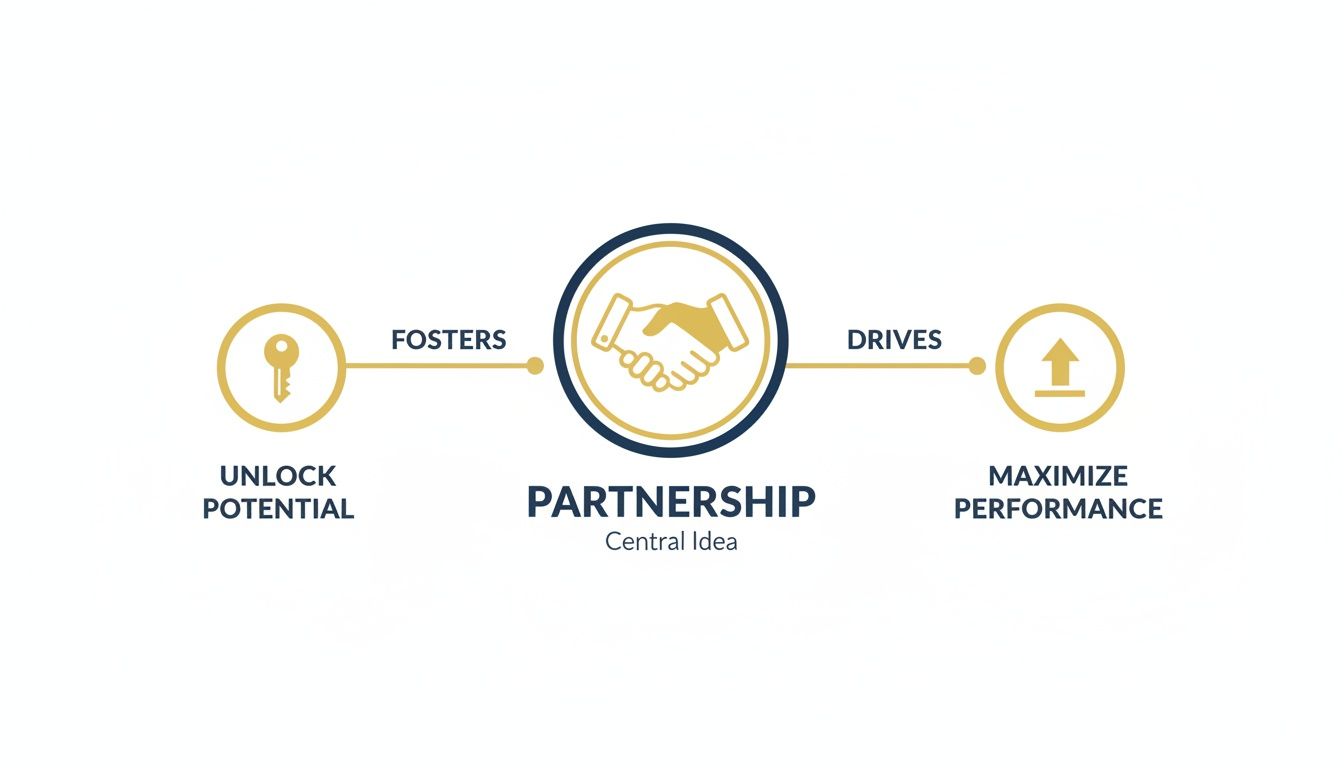
As you can see, the coach and client work together to unlock the client's own potential, which is what ultimately drives them to maximize their performance.
How to Articulate Your Unique Value
Knowing these distinctions helps you confidently navigate those initial client conversations. To help you clearly articulate your value, here's a simple table that breaks down the key differences between coaching and related fields, including consulting.
Coaching vs. Mentoring vs. Training vs. Consulting
| Discipline | Primary Focus | Goal | Driving Question |
|---|---|---|---|
| Performance Coaching | The individual's potential | Self-discovery and performance improvement | "What do you think is the best path forward?" |
| Mentoring | The individual's career path | Guidance and wisdom sharing | "Have you considered what I did in a similar situation?" |
| Training | A specific skill or process | Knowledge transfer and skill acquisition | "Do you know how to execute this process correctly?" |
| Consulting | The business problem or system | Providing expert solutions and recommendations | "What is the most effective solution for this problem?" |
This framework allows you to pivot the conversation with confidence. When a client mislabels their need, you can respond with something like:
"That's a fantastic goal. From what you're describing, it sounds like you're looking for a partner to help your manager develop their own unique leadership style, not just someone to tell them what to do. Is that a fair assessment?"
This simple reframe does two powerful things. First, it shows you're listening intently. Second, it elevates the conversation from a one-off task to a strategic partnership focused on building long-term capability.
The client starts to understand that they aren’t just buying your time; they're investing in their team's ability to solve problems and drive results on their own. That's a far more valuable proposition.
Core Frameworks Every Performance Coach Should Master
If you’re a coach, the idea of using a "framework" might make you cringe. Your strength lies in human connection and intuition, not following a script. You might be thinking, 'A framework sounds too rigid. It's going to make me sound like a robot.'
Think of these models less as rigid cages and more as the reliable scaffolding that gives your intuition a place to climb. They provide a dependable structure for any coaching conversation, ensuring you're always moving the client forward. Instead of starting from scratch every single session, you can lean on a proven roadmap. This frees up your mental energy to focus on what really matters: deep listening, asking powerful questions, and creating those "aha" moments.
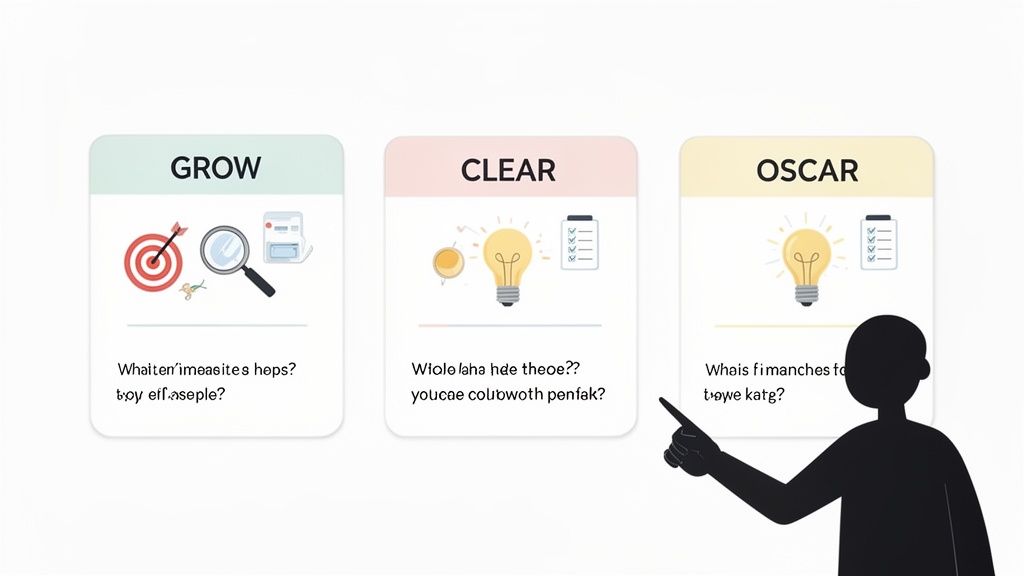
The GROW Model: A Foundation for Goal Achievement
The GROW model is the bread and butter of performance coaching for a reason. It’s simple, powerful, and incredibly versatile. It carves a clear path from a vague aspiration to a concrete action plan by moving through four distinct stages.
Let's walk through what this actually sounds like in a session, focusing on questions that get under the surface.
G – Goal (What do you want?) This is about painting a vivid picture of the destination.
- Standard Question: "What's your goal?"
- Deeper Question: "Let's jump forward six months. We're celebrating your success. Describe to me, in detail, what you've accomplished."
R – Reality (Where are you now?) Here, you need an honest assessment of the starting point.
- Standard Question: "What's the current situation?"
- Deeper Question: "Tell me what you've already tried. What worked, what didn't, and what did you learn from those attempts?"
O – Options (What could you do?) This is the brainstorming phase, where you create a safe space for all ideas.
- Standard Question: "What are your options?"
- Deeper Question: "If time, money, and fear weren't factors, what would you try? Who do you know that has crushed a similar challenge, and what can we borrow from their playbook?"
W – Will (What will you do?) This is the most critical step: turning talk into action and securing commitment.
- Standard Question: "What will you do next?"
- Deeper Question: "On a scale of 1-10, how committed are you to that first step? What's the one obstacle that could derail you, and what's your plan to handle it before it happens?"
The GROW model is a coaching staple because it puts the client firmly in the driver's seat. A huge part of this is setting clear objectives, and you can sharpen this skill by diving into effective coaching goal-setting strategies.
The CLEAR Model: Adding a Holistic Perspective
While GROW is fantastic for tangible goals, you'll sometimes sense a deeper issue. The client talks about a goal, but their body language screams that something else is going on. This is where the CLEAR model shines. It places a stronger emphasis on the emotional landscape and your partnership.
- C - Contract: This is more than a goal. It's defining the rules for the session. 'How will we know this was a good use of time?'
- L - Listen: This is active listening. You help the client hear their own story and identify the hidden beliefs shaping their reality.
- E - Explore: You guide the client to re-frame their situation, focusing on the personal impact of a change, not just a list of pros and cons.
- A - Action: Actions here are designed to align with the client’s newly explored perspective and emotional state.
- R - Review: This creates a powerful feedback loop. You regularly review progress, learnings, and the results of actions, fostering a cycle of continuous improvement.
The OSCAR Model: Focusing on Solutions
For professional settings where measurable progress is king, the OSCAR model is a game-changer. It’s perfect for clients who get stuck in problem-analysis and need a forward-looking, solution-oriented push. You've had those clients who can describe their problem in exquisite detail but can't see a way out.
The OSCAR model fundamentally shifts the conversation from "What's wrong?" to "What does 'right' look like, and what's one step we can take to get closer?" It’s an inherently optimistic and action-focused approach.
Here’s the breakdown:
- Outcome: Start with the end in mind. "What's the ideal future you want to create?"
- Situation: Look at the present, but only in relation to that desired outcome. "Where are we now compared to where we want to be?"
- Choices/Consequences: Brainstorm paths forward and—this is key—analyze the likely ripple effects of each choice.
- Actions: Define and prioritize the specific actions that will bridge the gap between situation and outcome.
- Review: Establish a clear system for reviewing progress. This builds accountability and allows for course corrections.
Ultimately, these frameworks aren't meant to handcuff your natural coaching style. They are proven tools to bring structure to your sessions, depth to your questions, and certainty that every conversation helps unlock your client’s true potential.
The Measurable Impact Of Performance Coaching
Let's be honest. In every initial conversation with a potential client, there's an unspoken question hanging in the air: "This sounds great, but how do I justify the investment?" Whether they need to convince their boss, their team, or just themselves, answering this question is what separates a good coach from an indispensable one.
Your job is to get past fuzzy goals like “improved morale” and connect your coaching directly to tangible business results. This is how you prove your ROI and start selling concrete outcomes, not just coaching hours.
From Vague Hopes to Concrete KPIs
The secret is to define what success looks like with your client, right from the beginning. This isn't about you showing up with a list of metrics. It's a collaborative effort that creates buy-in and makes you both accountable for the results.
It all starts by asking one powerful question early in the engagement:
"Six months from now, if our coaching partnership is a huge success, what specific, measurable change will we see in your business outcomes?"
This single question changes the entire dynamic. You’re no longer just a "coach"; you’re a strategic partner invested in their most critical goals. Their answers become the very KPIs you'll use to track your impact.
Here’s what that looks like in the real world:
- For a Sales Leader: The goal might be a 15% increase in the team's closed deals or shrinking the average sales cycle by 10%.
- For an Executive: The metric could be carving out 5 hours per week for high-value strategic work by cutting down time spent in unproductive meetings.
- For a Tech Team Lead: Success might mean delivering projects 20% faster or seeing a measurable drop in bugs after a product launch.
Quantifying the Qualitative Wins
But what about the so-called "soft skills"? A client might be thinking, "A sales number is easy, but how do we measure something like better decision-making?" This is where a great coach shines—by connecting those qualitative improvements to quantitative results.
Think of it this way: soft skills are the engine, and business metrics are the speedometer. One clearly drives the other.
For instance, if you're helping an executive become more decisive, you don't just aim for "better decisions." You identify the business problem their indecisiveness is causing. If it’s delaying projects, then the metric becomes a reduction in the time it takes to kick off a new project.
The proof is in the data. Studies consistently show that performance coaching delivers a massive ROI. Executives who receive coaching report a 70% improvement in key areas like productivity and goal attainment. It doesn't stop there—81% of clients gain more self-confidence, and 73% see their work performance improve. For companies, this often translates to a 5.7x return on their initial investment. You can explore more coaching statistics and their impact to see just how powerful this can be.
Building Your Impact Tracking System
Tracking progress doesn’t need to be complicated. With the right approach and a few simple tools, you can create a clear and effective system.
- Establish Baselines: Before you start, you have to know where you're starting from. Document the current state of the KPIs you've agreed upon. What's the sales cycle length today? How many hours are currently lost to wasteful meetings?
- Set Milestones: Break that big, six-month goal into smaller, achievable steps. This builds momentum and gives you both regular opportunities to check in, adjust, and celebrate small wins along the way.
- Use a Shared Dashboard: Transparency is key. A shared space where both you and the client can see progress keeps the goals top-of-mind and reinforces that sense of shared accountability.
When you meticulously track outcomes, you're building a powerful story of transformation backed by hard data. At renewal time, you won't be talking about the "feeling" of progress—you'll be presenting a clear, compelling report on the value you delivered. For coaches who want to make this even easier, a dedicated student progress tracking template can give you a great framework for showing your measurable impact.
How to Manage Your Coaching Practice Seamlessly
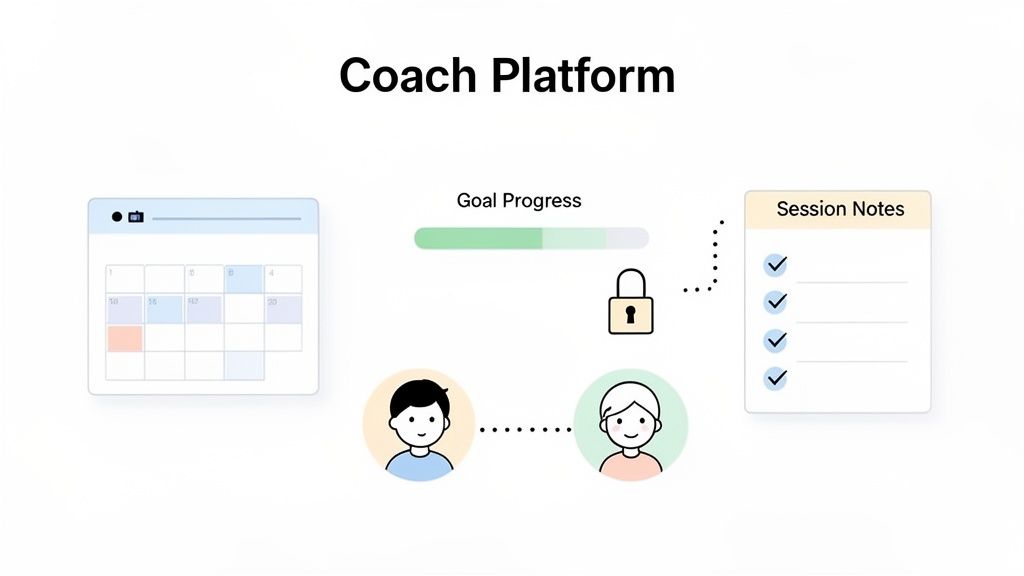
You can see the incredible potential of performance coaching, but a familiar question probably just popped into your head: 'This all sounds great, but how on earth do I manage it all?' It's a valid concern. Trying to juggle client goals, session notes, progress tracking, and communication can quickly spiral into chaos.
If you’re currently trying to patch together a system with spreadsheets, scattered email chains, and a separate scheduling app, you already know the grind. Every hour you spend on administrative work is an hour you’re not spending on high-impact coaching. This is where a dedicated coaching platform stops being a "nice-to-have" and becomes absolutely essential.
The real cost of disorganization isn't just your own lost time; it's a fractured client experience. When a client feels like they are part of a smooth, professional system, their trust and commitment deepen.
Let's look at how a system designed specifically for coaches solves these frustrations, making your practice more efficient while seriously upgrading the client journey.
From Frameworks to Workflows
Think about bringing those powerful coaching frameworks we talked about to life. A platform like Coachful doesn't just store your data; it builds an interactive workflow right around your chosen coaching model.
Take the GROW model, for instance:
- Goal: You can set a clear, top-level 'Goal' right inside the platform. It’s not just a note in a document—it’s the central objective that every other activity and session links back to.
- Reality: All your 'Reality' discussions are captured in secure, organized session notes. Instead of getting buried in a random folder, they’re tied directly to the client and that specific session, making it a breeze to review their starting point.
- Options: Brainstorming 'Options' can happen in a shared resource hub. You can drop in articles, videos, and worksheets that clients can access whenever they need a spark of inspiration.
- Will: This is where accountability gets real. The 'Will' phase becomes a system of action items you can assign directly to the client, complete with automated reminders to ensure things actually get done.
Suddenly, a theoretical framework becomes a dynamic, living process. For any coach building their own business, learning to manage the practice well from day one is a huge advantage. That means understanding business basics, much like learning how to start an event business requires finding a niche and getting clients.
Making Your Impact Visible and Undeniable
Remember those KPIs for proving your ROI? A good coaching platform takes them from abstract numbers in a spreadsheet and turns them into clean, visual dashboards. The system can automatically track progress toward milestones, saving you hours of manual updates.
This makes demonstrating your value incredibly straightforward. You can pull professional-looking reports in minutes to show a client—or their boss—exactly how far they've come. The conversation shifts from, "I feel like I'm making progress," to, "Here is the data showing a 15% improvement in my team's output."
This isn't just an efficiency hack; it solidifies your reputation as a results-driven professional. It provides the hard evidence you need to retain clients and confidently justify your fees.
Elevating the Entire Client Experience
What happens behind the scenes directly impacts what the client sees and feels. A seamless backend operation creates a premium front-end experience, and a dedicated platform pulls every touchpoint into one central hub.
Put yourself in your client's shoes for a moment:
- Onboarding: They get a professional welcome sequence with every form and agreement they need, all in one place.
- Scheduling: Booking a session is as simple as clicking a link in their portal—no more back-and-forth emails trying to find a time.
- Communication: All messages are kept in a secure, dedicated space, not lost in the noise of a crowded inbox.
- Progress: They get a personal dashboard where they can see their goals, check off action items, and access shared resources 24/7.
This kind of polish shows you’re a serious coach who respects their time and their investment. It frees you from administrative burnout and lets you pour all that energy into what you do best—coaching. If you want to nail this first impression, learning how client onboarding automation can set the tone for the entire engagement is a great next step.
Common Questions About Performance Coaching
Even with a solid grasp of the basics, some questions are bound to pop up. As a coach, I hear these all the time on discovery calls and from leaders trying to understand if this is the right fit. Having clear, confident answers ready doesn't just make you look like an expert—it proves you are one.
Here’s a quick rundown of the most common questions I get, along with the straightforward answers I give.
How Long Does a Typical Performance Coaching Engagement Last?
This is often the first thing people ask. They’re thinking, "Is this a forever commitment? I need a solution, not a permanent crutch." It’s a fair question, and my first job is to set the expectation that coaching is about empowerment, not dependency.
While every situation is unique, a typical performance coaching engagement runs between three and six months. That’s usually the sweet spot for digging into the real challenges, building new skills and habits, and starting to see tangible results you can actually measure.
For instance, three months might be perfect for a newly promoted manager who needs to get great at delegating. On the other hand, a senior leader looking to overhaul their entire leadership approach might need the full six months. The point is, good coaching has a clear beginning, middle, and end. My goal is always to work myself out of a job for that specific challenge.
Can Performance Coaching Be Used for an Entire Team?
Yes, and it’s one of the most powerful ways to use it. A leader will often say, "I get how this helps one person, but my whole team's dynamic is off. Can you fix that?"
This is where team performance coaching shines. Instead of focusing on an individual, the work targets the group's collective goals and behaviors. The coach isn't there to take sides or assign blame; they act as a neutral facilitator who guides the team to solve its own problems.
This usually involves things like:
- Improving Communication: Guiding a team away from tense, blame-filled meetings toward open, constructive dialogue about what’s really blocking progress.
- Clarifying Roles and Responsibilities: Helping a team where tasks are constantly dropped or duplicated create a clear map of who owns what—and getting everyone to agree to it.
- Resolving Group Conflicts: Creating a safe process for a team with competing factions to find common ground and move forward together.
The coach essentially creates the space for the team to unlock its own combined potential.
What’s the Difference Between a Life Coach and a Performance Coach?
This is easily one of the most common points of confusion. I’ll have potential clients say, "I’m trying to decide between you and a life coach. What’s the real difference?" Being able to explain this clearly is vital for attracting the right people.
While both roles use similar skills, the main distinction comes down to focus and measurement.
A performance coach zeros in on improving performance within a specific context—usually professional or skill-based—and ties the work directly to measurable outcomes. A life coach tends to take a broader, more holistic view, addressing a wider range of life areas like well-being, relationships, and personal fulfillment.
Think of it this way: a life coach might help a client discover their passion. A performance coach helps that same client build a concrete plan to turn that passion into a successful business, tracking metrics like revenue growth and customer acquisition along the way. Both are incredibly valuable, but the scope is different.
Is Performance Coaching Only for Executives or Underperformers?
Absolutely not, and this is a huge myth I’m always happy to bust. So many people operate under the assumption that "Coaching is for the C-suite or for people on a PIP. I’m a solid mid-level contributor, so it’s not for me."
Nothing could be further from the truth. Performance coaching is for anyone looking to close the gap between where they are and where they could be. It's about the leap from good to great.
This includes:
- High-potential employees being groomed for their next big role.
- Solid, dependable team members who feel like they've hit a plateau and are hungry for the next level.
- Entire teams that are doing fine but want to become truly exceptional.
The best athletes in the world have coaches. They don't hire them because they're failing; they hire them because they are relentlessly committed to being the best. Performance coaching in business works on that exact same principle.
Ready to stop juggling spreadsheets and start delivering a world-class coaching experience? Coachful brings your scheduling, client management, goal tracking, and communication into one seamless platform, so you can focus on what you do best. See how Coachful can transform your practice.