
What is Transformational Coaching & Why It Creates Change That Lasts

Coachful
You've mastered the skills. You've helped clients hit their targets. But a part of you knows there's a deeper game to be played. Transformational coaching isn't just about tweaking a client's actions; it's about fundamentally rewiring how they see themselves and their world. It goes beyond surface-level goals to unearth and reshape the core beliefs, values, and perspectives that define a person's reality. The result is deep, lasting change that starts from the inside out.
What Is Transformational Coaching Really About
As a coach, a question probably just popped into your head: "Isn't all coaching about change? How is this any different?" You're right, it is. But transformational coaching is playing a completely different ballgame. Where many coaching models focus on sharpening skills or hitting specific targets, this approach digs much, much deeper.
Think of it this way: a performance coach is like an expert gardener helping a plant grow bigger and stronger in its current pot. They might provide better fertilizer (new skills) or a more effective watering schedule (new strategies). A transformational coach, on the other hand, is like a landscape architect. They're there to help the client question the entire garden.
"What if this pot is too small? What if this soil isn't right for you? What if you were never meant to be this kind of plant at all?"
That’s the core of it. Transformational coaching is a holistic partnership where you help clients explore their inner world. Instead of just setting goals, you guide them to understand why they have those goals to begin with and what hidden beliefs are driving their ambitions.
Shifting from Doing to Being
The crucial shift here is from "doing" to "being." A client might come to you wanting to do something, like get a promotion. A traditional coach would likely help them build a strategy to achieve it. A transformational coach helps them explore the being behind that goal.
As you listen to them, you're not just thinking about action steps. Your inner dialogue sounds more like this: “Okay, they want the promotion. But what do they believe that promotion will give them access to? A feeling of worthiness? Security? Respect? The real work isn't getting the job; it's helping them access that feeling without needing external validation.”
You’d be asking questions like:
- Who do you need to become to step into that role effortlessly?
- What belief about your own worth is tangled up in this promotion?
- If you got it tomorrow, what would genuinely change about how you see yourself?
This reframes the entire conversation from external actions to internal identity. The diagram below shows where transformational coaching sits in relation to other common coaching styles.
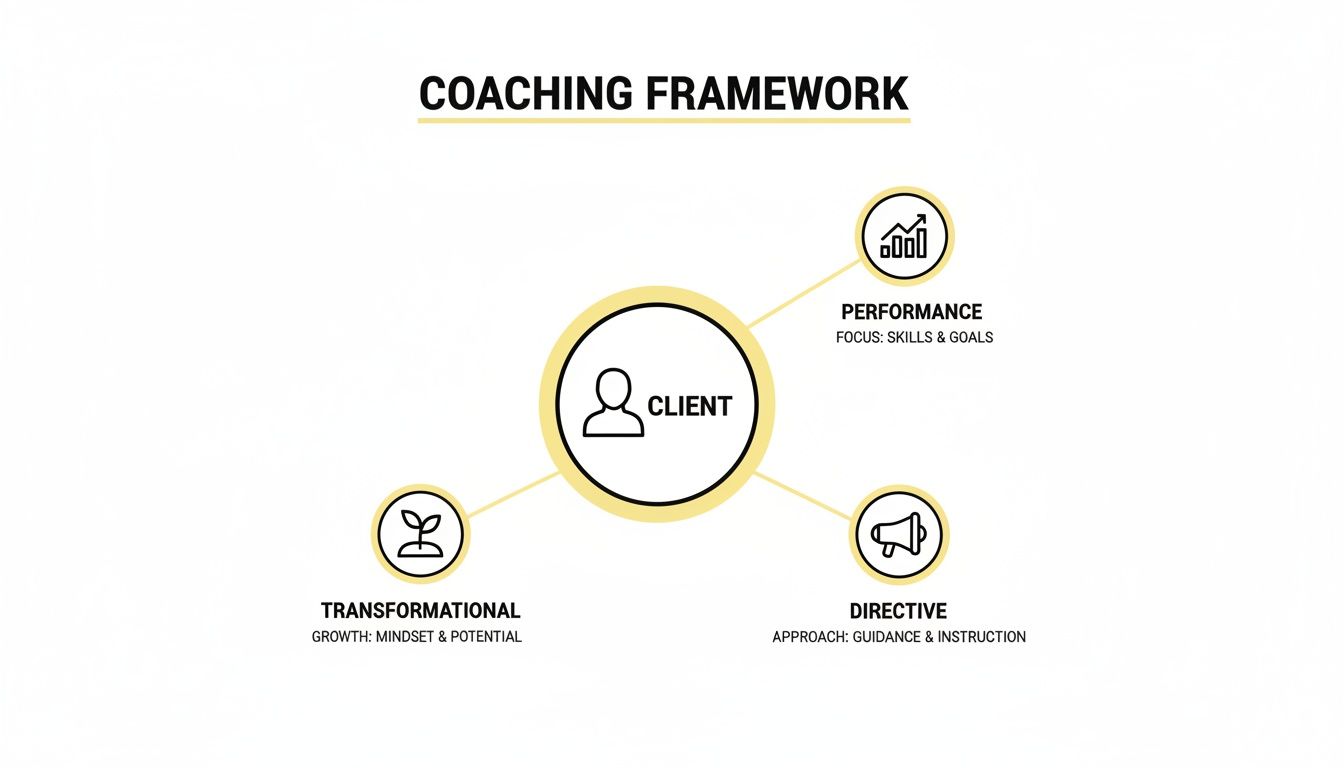
As you can see, while performance and directive coaching focus on the client's external behaviors, transformational coaching gets right to the core of their identity—the very seed from which all their actions grow. It's about nurturing that seed so the client can blossom into a completely new version of themselves.
How Coaching Models Compare At a Glance
To make these distinctions even clearer, it helps to see the models side-by-side. Each serves a different purpose, and knowing which one to use is key to effective coaching.
| Coaching Model | Primary Focus | Typical Timeline | Key Outcome |
|---|---|---|---|
| Transformational | Changing mindset, beliefs, and identity ("Being") | 6-12+ months | A fundamental shift in perspective and self-awareness |
| Performance | Improving skills and achieving specific goals ("Doing") | 3-6 months | Measurable improvement in a specific area (e.g., sales) |
| Directive | Providing advice and a clear path forward ("Telling") | Short-term, project-based | Quick resolution to a specific, defined problem |
This table highlights the fundamental differences in approach. While directive and performance coaching are about fixing or improving something external, transformational coaching is about fostering a deep internal evolution.
The Core Principles That Drive Lasting Change
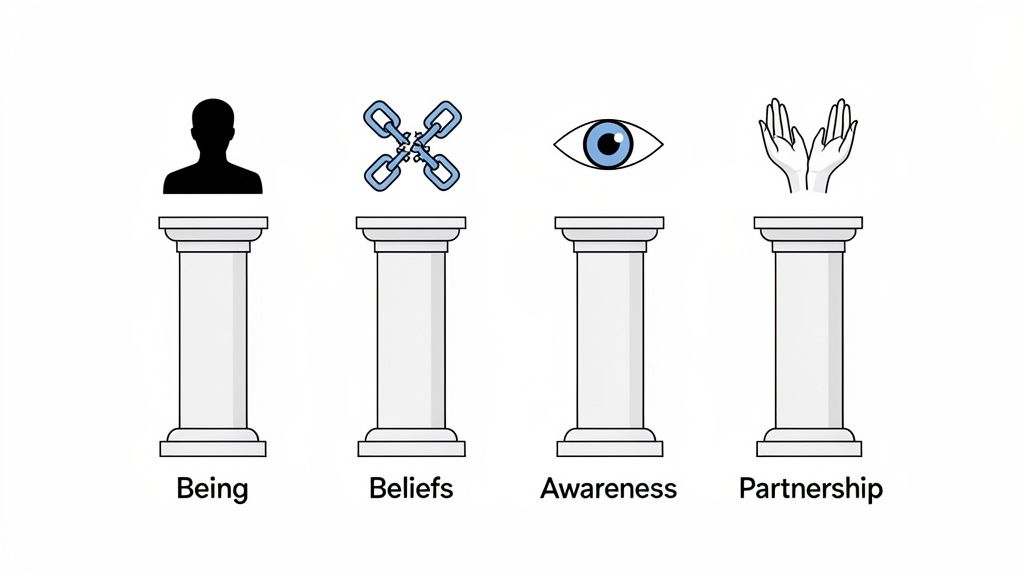
So you get the general idea, but you're probably wondering, “What does this actually look like in a session? How do I facilitate this kind of change without just... talking?” It really comes down to four powerful pillars that set transformational coaching apart. These principles are the bedrock for deep, sustainable client growth, moving way beyond temporary fixes to foster a genuine evolution.
This profound approach is exactly why the coaching industry is booming. Valued at USD 4.67 billion in 2022, the global life coaching market is on track to hit USD 7.44 billion by 2030. This surge is largely driven by increasing workplace stress and the undeniable return on investment companies see when they coach their leaders effectively. You can dig deeper into the market dynamics and coaching's impact in recent industry analyses.
Shifting Focus from Doing to Being
At its heart, transformational coaching is more interested in who a client is becoming than what they are simply doing. Goals are still important, of course, but we see them as vehicles for identity-level change, not just items to tick off a to-do list.
Instead of asking a client, “What steps will you take this week?” a transformational coach might ask:
- “Who do you need to be to make those steps feel natural and easy?”
- “What qualities does the version of you who has already achieved this embody?”
This subtle but powerful shift guides clients away from merely changing their actions to fundamentally evolving their sense of self.
Uncovering Limiting Beliefs
The second pillar is all about diving deep into the subconscious stories that hold clients back. These limiting beliefs often run the show from just beneath the surface, sabotaging progress without the client even realizing why. Your job as a coach is to help bring these hidden narratives into the light.
You aren’t just a cheerleader; you're a mirror, reflecting back the hidden assumptions that keep them stuck. You help them see the invisible walls they’ve built around themselves.
Powerful questions are your best tool here. For instance, if a client insists, "I'm not ready to launch my business," you could ask, “If you let go of the belief that you’re not ready, who would you become?” Or if they say, “I always mess up relationships,” you might gently inquire, “What does that belief protect you from having to do?”
Cultivating Deep Self-Awareness
Awareness is the spark that ignites all change. This third principle is about helping clients develop a profound understanding of their own thoughts, emotions, and behavioral patterns. Through deep listening and insightful questioning, you create a space for them to see their world—and themselves—in a completely new way. It’s not about giving advice; it’s about empowering them to uncover their own answers.
For example, a client might vent about their micromanaging boss. Instead of offering solutions, you might ask, "What does that level of control remind you of?" The goal is to connect their present-day reactions to deeper patterns, creating an awareness they can act upon.
Building a Co-Creative Partnership
Finally, what is transformational coaching if not a true partnership? This isn't a top-down, expert-to-student relationship. You are a guide, a thinking partner, and a co-creator walking alongside the client on their journey. The entire process is built on the belief that the client is inherently creative, resourceful, and whole. Your job is simply to facilitate their discovery, not hand them a map.
How This Approach Differs From Other Coaching Styles
It’s a fair question for any coach to ask: "Isn't this just a fancier term for life or performance coaching? Am I just overcomplicating things?" While all coaching aims to create positive change, the how and the why are worlds apart. Understanding these differences is key to choosing the right approach for your clients and clarifying your own coaching identity.
Imagine a client, Sarah, comes to you wanting a promotion. It’s a common goal, but how you approach it reveals everything about your coaching style. Each method looks at the same goal through a completely different lens, leading to vastly different conversations and outcomes.
Let's break down how four distinct coaching styles would tackle Sarah's ambition.
Performance Coaching: The Skill-Builder
A performance coach’s mind immediately jumps to strategy and execution. They’re thinking, “What specific skills does Sarah need to sharpen to become the undeniable candidate for this role?”
Their approach is tactical and results-oriented. The conversation would likely sound like this:
- “Let's identify the key performance indicators (KPIs) for the next level.”
- “Which of your current skills need improvement to meet those expectations?”
- “How can we create a 90-day plan to hit your project targets and demonstrate leadership?”
This is all about improving the "doing." It's incredibly effective for targeted skill development but doesn't really question the underlying drive for the promotion itself.
Directive Coaching: The Advisor
The directive coach, often an expert in a specific field, operates from a place of experience. Their internal question is, “Based on what I’ve seen work, what is the most efficient path for Sarah to get this promotion?”
They essentially provide a roadmap, acting more like a mentor or consultant. You'd hear them say things like:
- “You should volunteer for the upcoming high-visibility project.”
- “Here's how you need to structure your next presentation to the board.”
- “I recommend you network with these three specific department heads.”
This style provides clear, actionable steps but puts the coach in the expert seat, which can sometimes limit the client's own problem-solving growth. For a deeper look at this model in a professional context, you might be interested in our guide on what is business coaching.
Solution-Focused Coaching: The Quick-Action Strategist
A solution-focused coach is all about forward momentum. Their mind is on immediate progress, asking, “What's one small, achievable step Sarah can take right now to move closer to her goal?”
The focus here is on finding quick wins to build confidence and get the ball rolling. The conversation is geared toward immediate action:
"What is one thing you can do this week to increase your visibility? Let's brainstorm some options and pick one to commit to before our next session."
This approach is fantastic for overcoming inertia but may not address the root causes of why the client felt stuck in the first place.
Transformational Coaching: The Identity-Explorer
Finally, we arrive at transformational coaching. The coach's internal dialogue is completely different. They are wondering, “What does this promotion truly represent for Sarah? What deep-seated need or value does she believe it will fulfill?”
This approach shifts the entire focus from the "what" (the promotion) to the "who" (Sarah's core identity). The questions go much deeper:
- “If you got the promotion tomorrow, who would you become?”
- “What belief about your own worth is tied to achieving this title?”
- “Imagine you decided not to pursue it. What would you fear losing?”
This is the key distinction. Transformational coaching explores the “why” behind the goal to uncover the client's core beliefs and values. The promotion isn't the end goal; it's a vehicle for a profound shift in self-perception.
Bringing Transformation to Life With Real Scenarios
It’s one thing to talk about theories and principles, but to really get transformational coaching, you have to see it in action. You need to imagine yourself in the room, listening to the conversation unfold.
So, what does this actually look like in a real session? Let's step away from the abstract and dive into two common scenarios. You'll see how a client’s presenting problem is almost always just a symptom of a much deeper belief they’re holding onto. The real work isn't about treating the symptom; it's about helping the client uncover—and ultimately rewrite—the story running the show.

Scenario 1: The Overwhelmed Executive
Meet Alex. He’s a high-achieving director who comes to you with a problem you’ve heard a hundred times: "I have no time. I'm drowning in work and constantly teetering on the edge of burnout."
A performance coach might immediately pull out their time management toolkit. But as a transformational coach, your curiosity points you in a different direction. You're thinking, "What is this 'no time' issue really about for Alex? What part of his identity is he protecting by being constantly indispensable?"
Your questions are designed to gently peel back the layers.
- Coach: "Imagine you suddenly had an extra 10 hours a week. What's your biggest fear about what would happen?"
- Alex: "I... honestly don't know. I suppose I’d worry my team wouldn't need me as much."
- Coach: "And if they didn't need you as much, what would that mean to you?"
- Alex: "That I'm not adding enough value... that I'm not that important."
And there it is. The surface-level problem of time management was just a cover for a deep-seated belief: "My worth is tied to being indispensable." The breakthrough won't come from a new calendar app. It will come from helping Alex forge a new identity where his value is inherent, not something he has to earn through exhaustion.
Scenario 2: The Unfulfilled Entrepreneur
Next, let's meet Maya. She’s a successful founder whose business is crushing all its revenue targets. The problem? She confides in you, "I feel completely empty. I know I should be happy, but I'm not."
Her stated goal is to find a new marketing strategy to "reignite her passion." But your coach's intuition is telling you this isn't about strategy. It's about the destination.
Your job is to help Maya read the map of her own values. The goal isn’t to find a faster route, but to question if she’s even heading toward the right mountain.
You steer the conversation back to her core motivations.
- Coach: "Let's put the revenue goals on the shelf for a moment. When you first started this business, what was the dream? What impact did you want to make?"
- Maya: "I wanted to build a real community and create something that genuinely helped people connect."
- Coach: "On a scale of 1 to 10, how aligned is your day-to-day work with that original dream?"
- Maya: "...Maybe a 3. I spend all my time looking at financial forecasts and managing investor relations."
The transformation sparks the moment Maya realizes she's been chasing a version of success that directly clashes with her core values. From there, the coaching shifts to focus on realigning her business model—and her role in it—to honor that original vision. It's about moving from chasing hollow metrics to building a legacy of genuine impact.
This is why the data is so compelling. Studies show that coached leaders can improve their performance by 70% and report satisfaction rates over 80%. If you're curious, you can explore more coaching statistics and their impact on leadership to see the numbers behind these powerful outcomes.
Structuring Your First Transformational Program
This is where the theory gets real. Your mind is probably buzzing with questions like, "This all sounds amazing, but how do I actually build a program around something so personal and measure its success?" It's a valid concern. You're not just selling time slots; you're creating a space for a profound journey to unfold.
A solid program structure acts as the container for that journey. It provides a sense of safety and direction, preventing deep, powerful conversations from becoming aimless. Without a framework, both you and your client can end up feeling lost, wondering if any real progress is happening.
The Three-Act Structure of Transformation
A great way to think about a transformational program is like a three-act story. Each phase serves a unique purpose, building on the last to guide your client through a complete and meaningful arc of change.
The Discovery Session (Act 1): This is all about laying the foundation. It’s a deep, immersive session, often 90-120 minutes long, dedicated to unearthing core values, clarifying their true vision, and identifying the deep-rooted beliefs that have been holding them back. The goal isn't to solve problems yet; it's to collaboratively draw the map for the journey ahead.
Ongoing Sessions (Act 2): This is the heart of the work, the long middle where the real change happens. This phase typically spans 3-6 months with bi-weekly sessions. Here, you'll gently challenge limiting beliefs, introduce new perspectives, and hold the space for powerful insights to bubble up. Each conversation builds on the previous one, creating momentum as your client starts experimenting with new ways of thinking and being.
The Integration Session (Act 3): The final session is about making the change stick. It's where you help your client look back on their journey, honor how far they’ve come, and create a concrete plan to carry their new awareness and sense of self forward, long after your official time together ends.
Tools and Measurement in Your Program
I can almost hear your inner pragmatist screaming, "But how do I track progress when it's all so internal? How do I prove ROI?" It's a great question. While you won't be tracking traditional KPIs, you can absolutely facilitate and measure growth using the right tools.
The goal isn't to measure tasks completed but to witness shifts in perspective. You're tracking the evolution of your client’s inner world, which inevitably changes their outer world.
Here are a couple of practical tools you can weave into your program:
- The Wheel of Life: This is a fantastic tool for the Discovery Session. It creates a visual snapshot of a client's current satisfaction in key life areas (career, health, relationships, etc.). Revisiting it at the halfway point and again at the end gives both of you a tangible, visual representation of their progress.
- Powerful Journaling Prompts: Encourage reflection between sessions with prompts like, "What old story am I ready to let go of this week?" or "If I fully trusted myself, what would I do next?" This work deepens their self-awareness and brings rich material into your coaching calls.
Measuring transformation is more qualitative than quantitative. You'll listen for shifts in their language—from "I can't" to "What if I could?" You'll notice changes in their confidence and their decision-making. These are the real markers that deep, lasting change is taking root. To learn more about setting up these systems, check out our guide on how to start a coaching business online.
Got Questions About Transformational Coaching? Let's Talk.
If you're thinking about adding this approach to your toolkit, you probably have a few questions bubbling up. That's a good thing. Great coaches are always thoughtful about the methods they use. Let's tackle some of the most common concerns to help you get clear and confident.
How Long Does This Actually Take?
A little voice in your head might be asking, "This sounds deep. Will my clients get impatient waiting for results?"
It's a fair question. Unlike performance coaching where you might see a quick win on a specific task, transformational coaching is more of a journey. Clients often have those "aha!" moments and feel shifts in their perspective pretty early on, but the really sticky, lasting change—the kind that truly reshapes their world—usually unfolds over 3-6 months.
Remember, the goal isn't just to check a few boxes. It's to fundamentally change how your client sees and moves through their life. We're talking about rewiring old beliefs, not just tweaking a habit.
Wait, Isn't This Just Therapy?
This is a big one. Your inner critic might be whispering, "Am I really qualified for this? Am I stepping over a professional line?"
Here’s the crucial difference: Coaching is always forward-looking and action-oriented. We work with functional people who want to build a better, more meaningful future. Therapy, on the other hand, is primarily about healing past trauma and treating clinical mental health conditions.
As a transformational coach, your professional boundaries are everything. A huge part of your job is knowing when a client's struggles are outside your expertise and having the integrity to refer them to a qualified therapist.
Your role is to help clients build their future, not excavate their past. Knowing the difference is the hallmark of a responsible and ethical coach.
Attracting clients who are actually ready for this kind of deep work is a skill in itself. Our guide on how to get coaching clients can show you how to find people who are a perfect match for this profound approach.
Can I Use This Approach With Every Single Client?
It’s easy to get excited about a new method and wonder, "Is this my new go-to for everyone?"
The short answer is no. Not every client needs or is even ready for transformational coaching. If someone comes to you with a very tactical goal, like nailing a single presentation next week, they'll likely get more from straightforward, skills-based coaching.
This deeper work is best suited for clients who feel stuck, unfulfilled, or know they need a major life change but have no idea how to start. The most important ingredient? The client has to be genuinely willing to look inward and do the work.
How Do I Get Certified and Build Credibility?
And finally, the practical question: "How do I actually get good at this and show clients I know what I'm doing?"
Look for training programs accredited by reputable bodies like the International Coaching Federation (ICF). The best ones don't just teach you a script; they focus on mastering core competencies like deep listening, asking powerful questions, and creating genuine awareness in your clients.
Think of certification as more than just a piece of paper. It’s your commitment to learning how to guide people through massive change safely, ethically, and effectively.
Ready to run your transformational coaching programs like a pro? Coachful is the all-in-one platform that handles everything from client onboarding and goal tracking to scheduling and curriculum management. Stop juggling a dozen different tools and focus on what you love—guiding your clients through life-changing breakthroughs. Discover how Coachful can support your practice today.