5 Abandoned Checkout Email Templates for Coaching Offers

Coachful
Editorial Team
What should you email a prospective coaching client who starts checkout but does not pay? Send a short, relevant message that helps them finish an informed decision, only when you are entitled to contact them. Confirm that they have not purchased, offer a working next step, and avoid pretending you know why they stopped.
An unfinished checkout is not an unpaid invoice. The person may have changed their mind, opened the page to compare dates, encountered a technical problem, or decided the offer was unsuitable. Your copy should leave room for all four possibilities.
These five abandoned checkout email templates for coaches are alternatives for different situations, not five messages everyone should receive. They cover a simple reminder, a reported technical problem, a practical fit question, a genuine enrollment deadline and a final close-the-loop note. Each includes a subject, preview and adaptable body.
Before choosing a template, establish these facts
Start with the record, not the copy. A page view, a submitted email address, an attempted payment and a completed purchase are different events. Your system must distinguish them before you attach a message to any of them.
- The correct person and offer: can you reliably connect the unfinished checkout to the contact and the actual coaching package?
- Permission and purpose: do applicable marketing rules and the person's stated preferences allow this message?
- Current payment status: has a purchase completed elsewhere, is payment pending, or is the status uncertain?
- Existing conversation: has the person already asked a question or declined?
- The destination: does your link open the current, suitable offer rather than an expired session or somebody else's checkout?
- Availability: can you still deliver the dates, format and terms you describe?
If you cannot establish the identity or current payment status, investigate first. Do not turn uncertain data into a confident “you forgot to pay” message. An ordinary sales-page visitor is not a debtor and has not necessarily asked for a personal follow-up.

A checkout email address is not blanket marketing permission
Rules depend on jurisdiction, recipient and message purpose. The FTC's CAN-SPAM guidance explains US requirements for commercial email, including accurate sender information, non-deceptive subjects, a valid postal address and an effective opt-out. A message does not escape those requirements merely because you send it individually.
For UK recipients, the ICO's electronic mail marketing guidance describes consent and the conditions for the limited soft opt-in exception. Do not assume typing an address into an unfinished form satisfies those conditions. Other jurisdictions have their own rules, and the ICO notes that its guidance is under review.
This is operational guidance, not legal advice. Keep evidence of the applicable basis and preferences, and obtain qualified advice where necessary. The templates below deliberately separate useful copy from the compliance footer you must configure correctly.

1. The simple reminder: return the useful details
Use when: you have a properly identified, eligible contact, no completed purchase and no open question requiring a personal answer. You do not know why the checkout stopped.
Keep the first message modest. You are reopening access to the decision, not announcing that someone has failed to honor a commitment. Avoid “your place is waiting” unless a place really is held under stated terms.
Subject: The details for [program name]
Preview: The scope, schedule and next step, if you are still considering it.Hi [first name],
If you are still considering [program name], here are the details: [verified offer page link].
The page explains [coaching focus], [session format and dates] and [total investment and payment terms]. You can review those before deciding whether to continue.
If something on the page was unclear, reply with your question. There is no need to continue if the offer is not right for you.
[Coach name]
[Required sender details, postal address and working marketing opt-out]
Adapt it: use an offer-details page if you cannot safely create a fresh checkout link. Say “review the details,” not “resume exactly where you left off,” unless you have tested that the link genuinely preserves the correct state.
Do not invent a saved cart, reserved session time or locked price. If the page includes a payment plan, confirm that its installment total, currency and any relevant charges agree with the email. A tidy reminder cannot repair contradictory terms.

2. The technical-help email: respond to a reported problem
Use when: the prospect has actually reported a checkout problem, or you have a verified issue relevant to their attempt. Do not infer “your card was declined” from an incomplete purchase.
A requested support reply and a promotional recovery email can have different purposes and requirements. Keep a support response focused on the reported issue. Do not use that conversation as permission to add unrelated sales messages.
Subject: Help with the [program name] checkout
Preview: A safe next step for the issue you reported.Hi [first name],
Thanks for telling me that [accurate description of the issue you reported].
[State what you have verified, or explain that you are still checking.] Before trying again, please check whether your bank or payment account shows a completed or pending charge.
If there is no completed or pending payment, use [verified secure payment route] to try again. If there is a charge, reply to let me know and I will reconcile the status before asking you to make another attempt.
Please do not email card numbers, security codes, passwords or banking screenshots containing sensitive details.
[Coach name]
[Appropriate sender and contact details]
Adapt it: do not say a problem is fixed until you have verified the relevant path. If you need a screenshot, request only a redacted error message, not a full financial record. Use the payment provider's secure support route for payment credentials.
When a payment is pending, another purchase invitation can create a duplicate-payment problem. Resolve the status with the provider before deciding whether the person should retry. For an already-agreed payment that failed, use a payment-resolution process rather than this optional purchase reminder.

3. The practical-question email: clarify one real constraint
Use when: you have a genuine question from the prospect, or a specific participation condition worth clarifying to eligible contacts. Examples include the live schedule, preparation required, access arrangements or the difference between a group program and private coaching.
Do not diagnose a stranger's “money block.” Someone who leaves checkout may be making a sensible decision about time or affordability. Useful information beats a lecture about investing in themselves.
Subject: A practical detail about [program name]
Preview: Check [specific requirement] before deciding.Hi [first name],
Before you decide about [program name], one practical detail is worth checking: [actual requirement or accurately stated question].
The arrangement is [specific factual answer]. Participation involves [real time commitment, access condition or delivery requirement], and it does not include [important limit].
If that works for your situation, you can review the current offer here: [verified details link]. If it does not, there is no need to force the timing.
You are welcome to reply if you need clarification before making a decision.
[Coach name]
[Required sender details, postal address and working marketing opt-out]
Adapt it: distinguish an observed question from a guessed objection. “A detail worth checking” is honest when you do not know the person's concern. “I know you are worried about the price” is not.
For a career-coaching group, you might clarify that live sessions occur during a particular timezone's working day. For an executive engagement, you might explain whether employer approval is required before purchase. Keep those examples hypothetical unless they describe your actual offer.

4. The real-deadline email: explain what actually closes
Use when: a real deadline changes what the person can buy or apply for. This could be a dated cohort's enrollment cutoff, an application deadline or a genuinely ending introductory price. An evergreen offer does not acquire a deadline because an email template needs one.
State the date, time and timezone. Explain the consequence precisely. If applications close tonight but accepted applicants pay later, do not tell everyone that checkout must be completed tonight.
Subject: [Program name]: [enrollment/applications] closes [day]
Preview: The cutoff is [time and timezone], with the next step below.Hi [first name],
A reminder that [specific enrollment or application window] for [program name] closes [date, time and timezone].
[State the real operational reason, if useful.] To join this round, you need to complete [precise required action] before that cutoff.
You can review the scope, dates and investment here: [verified current offer link]. [Explain whether acceptance is required or whether completing payment confirms enrollment.]
After the cutoff, [accurate consequence]. If this round does not fit, please leave it rather than rush the decision.
[Coach name]
[Required sender details, postal address and working marketing opt-out]
Adapt it: remove any unverified seat count. Do not claim “one place left” because only one person has paid recently. Capacity must reflect your actual delivery arrangements and current accepted enrollments.
A deadline message should stop once the deadline passes or the person becomes ineligible. If someone enters a relative-delay sequence late, a beautifully written email can still arrive after the offer closes. Check calendar conditions, not just the order of boxes in an editor.

5. The final note: close the loop without manufacturing pressure
Use when: you have already made an appropriate contact, the person has not replied or bought, and one final relevant message is justified. This is not a reason to keep sending until somebody responds.
Final means final for this recovery follow-up. It does not mean secretly moving the same person into another sales sequence with a different label. Respect their preferences and the scope of any separate subscription.
Subject: Closing the loop on [program name]
Preview: The details are here if you need them; no response required.Hi [first name],
This is my final follow-up about the unfinished [program name] enrollment.
If you still want to consider it, the current details are here: [verified offer link]. [Include a real availability limit only if one exists.]
If your plans have changed, no response is needed. I will not send further checkout reminders for this attempt.
If you have an unresolved question, you can reply and I will answer it personally.
[Coach name]
[Required sender details, postal address and working marketing opt-out]
Adapt it: only use “unfinished enrollment” if the event record supports that description. Otherwise choose neutral wording such as “following up on [program name].” Do not imply surveillance, personal disappointment or an obligation to explain.
You do not need a discount to make this message useful. An automatic discount can contradict a published price or disadvantage someone who just paid. If you choose an incentive, check eligibility, margin, actual expiry and how you will treat recent purchasers before offering it.

Test the recovery path before using any template
Use test contacts and a non-charging test environment where available. Do not create a real customer payment or email a live audience to discover whether an exclusion works. If your system cannot safely test a required behavior, keep the process manual until you can verify it.
- Eligible and unpaid: the correct contact can receive the appropriate message, with the correct offer destination.
- Purchased: a completed purchase for the same offer prevents subsequent recovery messages, including messages already queued.
- Opted out: marketing recovery does not reach someone who has withdrawn the relevant permission or objected.
- Replied: an open conversation is handled personally rather than interrupted by the next sales reminder.
- Pending or uncertain payment: the record is investigated before another payment invitation is sent.
Also test the link on a phone and outside your logged-in coach session. A link that works for the owner can fail for a prospect. Check the sender identity, reply destination, footer, timezone, personalisation fallback and expired-offer behavior.

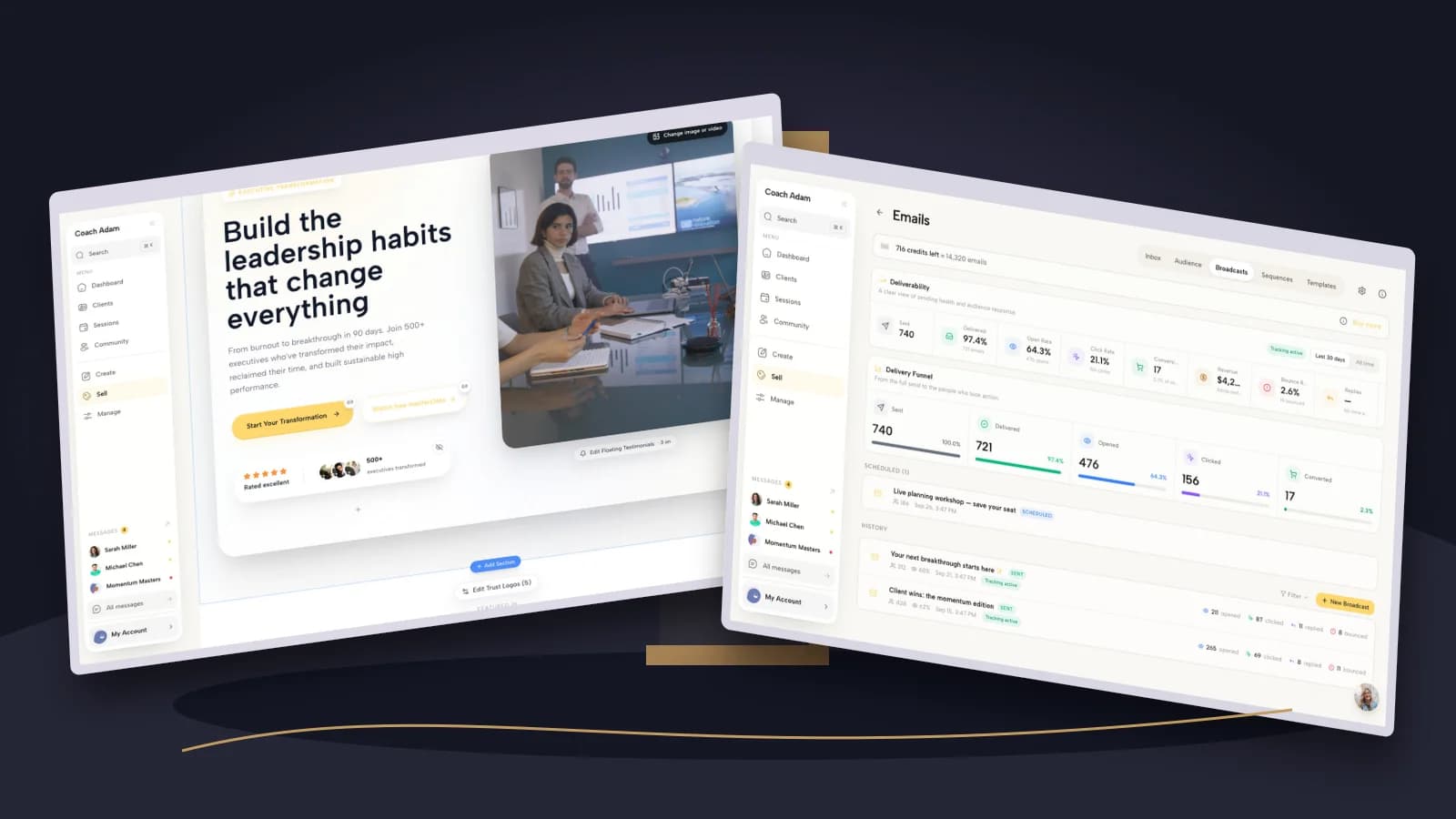
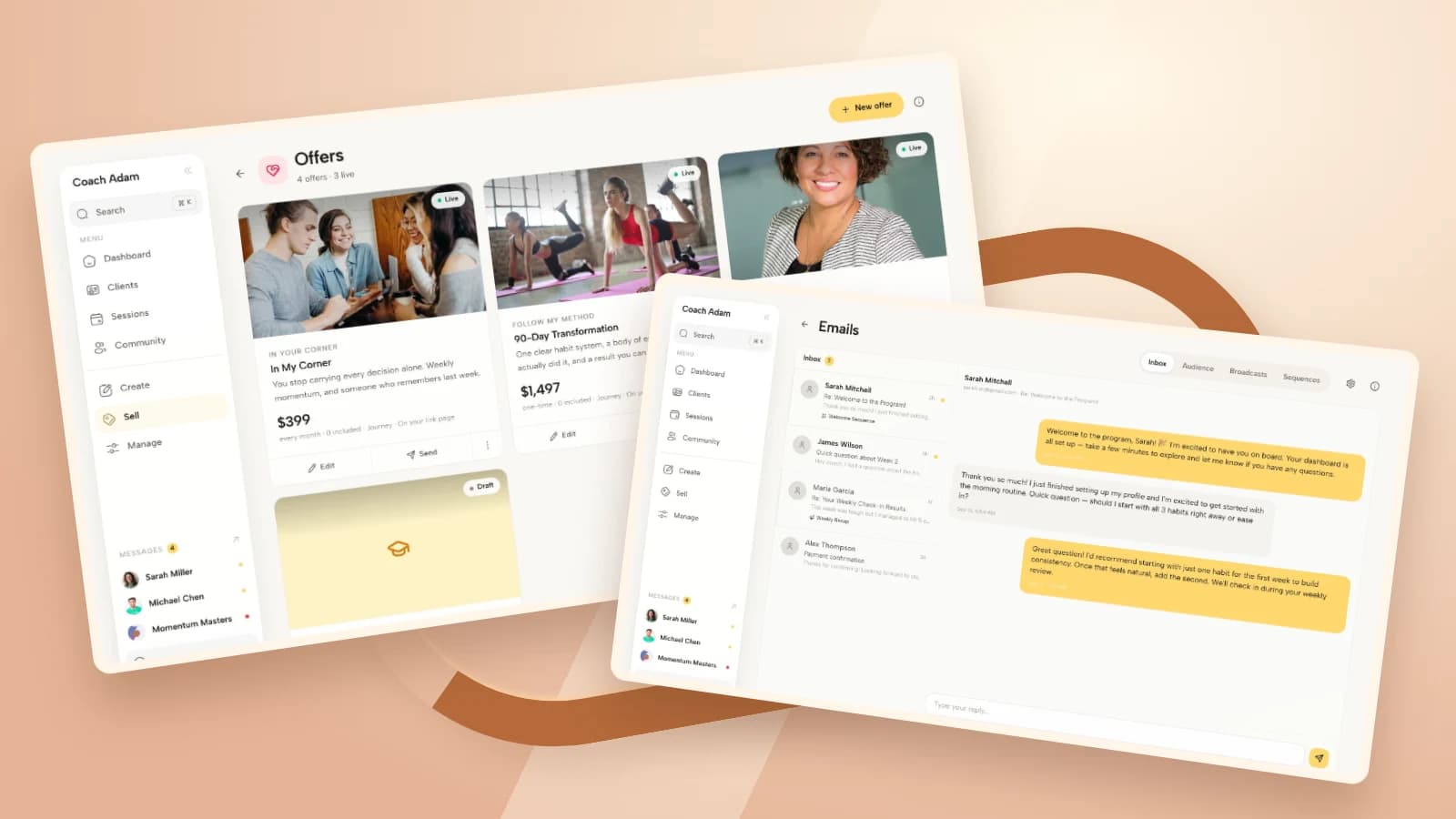
Coachful's real demo surfaces show offers, funnels, prospects, email sequences, conversations and payment records. They are useful places to evaluate this handoff. The screenshots in this article do not establish that your account has a configured recovery trigger, the correct consent basis or a fully tested purchase-suppression rule.
If you are choosing how to connect those steps, Try the interactive demo and trace one offer through its next step, then inspect the email and payment surfaces. Use the five-state test above to decide what you would need to verify before enabling any live follow-up.
What to measure, and what not to claim
Record eligible unfinished checkouts, messages actually delivered, relevant replies and confirmed purchases for the same offer within a defined observation window. Keep purchases already in progress separate where possible. A click is not a purchase, and an open is not reliable proof of buying intent.
Do not call every later purchase “recovered revenue.” Some people would have returned without an email. Where volume and permissions support a meaningful comparison, a properly designed holdout can help distinguish association from incremental effect. Otherwise describe attributed purchases honestly and avoid causal claims.
Abandoned checkout email FAQs for coaches
How many recovery emails should I send?
Use the fewest justified by the offer, expectations and response. These are five situation-based alternatives, not a mandatory five-email sequence. Stop when someone buys, opts out, replies with a question or becomes ineligible. A personal sale may need one relevant message rather than an automated series.
When should the first email go out?
There is no universally verified best delay for every coaching practice. Allow enough time to distinguish a genuinely unfinished checkout from someone still paying, and account for delayed payment confirmation. Choose a reasonable starting policy, test safely and review actual complaints, replies and purchases rather than borrowing a promised conversion benchmark.
Can I send this to everyone who visits my pricing page?
No. A visit alone does not identify an eligible recipient or establish permission for a marketing email. Do not infer an address, buy a visitor list or use an unrelated signup as a shortcut. Establish the identity, applicable basis and preferences first.
Is this the same as a failed-payment email?
No. A recovery message invites someone to complete an optional purchase. A failed-payment message addresses an attempted or agreed payment that did not succeed. Reconcile the record first, then use the appropriate communication. Never turn an unfinished checkout into a claim that money is owed.
The rule worth keeping
Make the decision easier, not the pressure louder. The best starting point is an accurate record, a relevant answer and a trustworthy next step. If any of those is missing, fix it before polishing the subject line.