5 Coaching Program Launch Email Templates for Enrollment Week

Nour
Founder, Coachful
What should you email when coaching enrollment opens, without turning into a countdown machine? Send a clear invitation, show how the program works, answer the decision that is holding people back, explain genuine fit, and finish with one honest deadline reminder. Each email should make the buying decision easier, not merely louder.
The five coaching program launch email templates below are for a defined enrollment window: a cohort, a dated group program, or an intake with a real closing date. They are not a sequence for people waiting indefinitely for a private-coaching opening. For that situation, use the coaching waitlist guide.
You do not need to send all five. If an email adds no new decision-making information, leave it out. A small launch with personal conversations may need fewer messages than an established program with a longer enrollment period.
Before you copy a template, settle these six facts
Launch copy exposes unresolved offer decisions. If you cannot state the dates or explain what support includes, the problem is not the subject line.
- Who it serves: the person and situation your coaching is designed for.
- What participation requires: duration, live session dates, timezone, preparation and between-session work.
- What support includes: coaching sessions, feedback, resources and access boundaries.
- The actual investment: total cost, payment terms and any applicable extra charges.
- The next step: direct enrollment, an application, or a fit conversation.
- The real deadline: what closes, at what time and in which timezone, and why.
Choose one primary route. An application button, a checkout button and a discovery-call button competing inside the same email make the reader decide how your sales process works before deciding whether they want coaching.

A suggested five-email launch sequence
This is an editorial starting point, not a proven conversion formula. Adjust the spacing to the window you actually offer and the expectations people agreed to when subscribing.
- Enrollment opens: name the offer, essential logistics and next action.
- Show the work: explain a representative activity and the support around it.
- Answer the hardest practical question: address time, money, access or delivery honestly.
- Clarify fit: help suitable people decide and unsuitable people opt out.
- Close the window: state the real cutoff and the consequence of missing it.

For an illustrative seven-day window, you might send on opening day, then days three, four and six, with a final note on day seven. That is a sample schedule, not a requirement. Do not compress five messages into a day just because the templates are available.
Send promotional emails only to people you have a valid basis to contact, respecting the purpose of their signup and applicable rules. A past client, a workshop attendee and a newsletter subscriber have not automatically asked for every launch announcement.
1. Enrollment-open email: make the offer concrete
Use when: people can genuinely take the next step. Your page works, the terms are settled and you can support the enrollment route you describe.
The first email should answer the obvious questions without making people click to discover whether the dates, format or investment are even plausible. If you promised an advance invitation to a particular group, deliver that promise before calling it public enrollment.
Subject: [Program name] enrollment is open
Preview: The dates, format and next step for this round.
Hi [first name],
If you are [specific audience] trying to [specific decision or change], enrollment for [program name] is now open.
Over [duration], we will work on [bounded coaching focus] through [live format and frequency]. You will also have [accurate support and resources].
The program starts [date]. Live sessions run [days, times and timezone], and the investment is [total price and payment terms].
You can review the scope, schedule and terms here: [program details link]. If those fit, the next step is [one application, booking or enrollment action].
Enrollment closes [date, time and timezone] because [real operational reason]. Joining the interest list did not reserve a place.
[Coach name]
Adapt it: replace a broad outcome such as “transform your life” with the work your program actually supports. For a career program, “test two career directions and build a decision plan” is clearer than promising everyone a new job.
If a payment plan is available, state the total as well as the installments. If the next step is an application, say that applying does not guarantee acceptance. Never make an application link sound like a reserved seat.

2. Show-the-work email: let people evaluate your method
Use when: subscribers understand the offer but cannot picture participating. Explain one real exercise, coaching interaction or week of delivery.
You do not need a dramatic client transformation to make your method credible. A concrete account of what people do, what support they receive and what remains their responsibility is often more useful than a glossy success story.
Subject: What we actually do in [program name]
Preview: One example of the work, not another list of promises.
Hi [first name],
“What would I actually be doing?” is a fair question before joining a coaching program.
In [specific session or week], we use [real exercise or process] to examine [specific challenge]. You bring [input], and we work through [what happens in the coaching].
For example, a participant might [clearly hypothetical situation]. The task would be to [realistic action], then review [observable evidence or learning]. That example illustrates the process, not a guaranteed result.
Between sessions, [accurate activity or support boundary]. You will not be expected to [only include a genuine exclusion].
If that approach fits how you want to work, review this round's dates and details: [program details link].
[Coach name]
Adapt it: describe a representative activity, not an unusually intensive exception you cannot offer everyone. If you say every participant receives written feedback, confirm how much and on what timeline.
Use client material only with appropriate permission and disclosures. Removing a name does not necessarily make an identifiable story safe to publish. You can demonstrate a coaching approach with a clearly labeled hypothetical example instead.

3. Practical-question email: answer the real hesitation
Use when: an actual question is stopping people from deciding. Choose the question you have heard, not a made-up objection that lets you repeat the sales pitch.
A person asking about recordings may be checking whether they can participate from another timezone. “You need to invest in yourself” does not answer that. Give them the conditions they need to make a responsible decision.
Subject: Can [program name] work if [practical constraint]?
Preview: Here is the actual arrangement, including the limits.
Hi [first name],
A question about this round is [accurate question, or describe it as a question people may reasonably have].
The arrangement is [specific factual answer]. That means [practical consequence], but it does not include [important limit].
If [condition that makes participation workable], the format may suit you. If [condition that makes it unsuitable], I would suggest waiting or considering [appropriate alternative].
You can review [relevant schedule, access or terms] here: [program details link].
Before you commit, check [one concrete thing they need to verify]. I would rather you decide with that information now than discover a mismatch after enrollment.
[Coach name]
Adapt it: for time concerns, specify the live commitment and preparation rather than saying “it fits a busy schedule.” For investment concerns, state the available terms without assuming someone can afford them or encouraging debt.
If you offer recordings, explain what they cover, when they are available and any confidentiality restrictions. Do not imply that recordings replace live coaching when the program depends on participation.

4. Fit-check email: give the wrong person a useful no
Use when: the offer attracts interest from people with different goals, support needs or readiness. This is not a reverse-psychology trick. It is a genuine boundary.
Good fit criteria describe needs and conditions, not whether someone is “serious enough.” Someone can be motivated and still need a different format, a licensed professional, or support you are not qualified to provide.
Subject: Who [program name] is, and is not, for
Preview: Three checks before you choose this round.
Hi [first name],
Before you decide about [program name], check these three things.
This round is designed for [specific audience and current situation]. We focus on [scope], and participation involves [real commitment].
It may be a good fit if you want [relevant process or support] and can [practical requirement].
It is not the right offer if you need [out-of-scope service], expect [unsupported guarantee], or cannot participate in [essential element].
If the fit looks right, the next step is [single next step] here: [working application or enrollment link]. [State whether review or acceptance is required.]
If it is not right, there is no need to force it because enrollment is closing.
[Coach name]
Adapt it: a group program might require comfort working alongside peers, while a high-touch offer might require an initial conversation. State the requirement and explain why it matters. Do not present coaching as a substitute for clinical, legal or other regulated support.
If applications close before enrollment does, give both dates precisely. A coach who still needs to review applications and hold calls cannot reasonably invite a new application five minutes before a payment deadline.

5. Closing email: use the deadline, not pressure
Use when: something specific genuinely closes. That could be an application window, a cohort intake or a clearly defined price. Name which one.
The deadline's job is to make the timeline clear. It is not evidence that a person should buy. Do not invent seat counts, claim a place is held when it is not, or restart a countdown when the page is refreshed.
Subject: [Program name]: enrollment closes [day]
Preview: The cutoff is [time and timezone]. Here is what happens next.
Hi [first name],
A final reminder that [enrollment or applications] for [program name] closes [date, time and timezone].
This round starts [date] and includes [brief accurate format and support]. The investment is [actual total and terms].
If you have reviewed the fit and want to take the next step, use this link: [working next-step link]. [State what must be completed before the cutoff.]
After the deadline, [accurate consequence]. The next round is [confirmed date, or say it is not confirmed].
If this is not your round, that is fine. Thank you for considering the work.
[Coach name]
Adapt it: use “application closes” when a review is still required. Use “introductory price ends” when enrollment remains open at a different price. “Last chance ever” is false if you already plan to reopen the same offer.
Remove people who have enrolled, declined launch messages, unsubscribed or become ineligible from remaining promotional sends, as appropriate. Review any pending applications separately rather than asking those people to apply again.

Make the emails work as one enrollment process
Before launch, read the five messages consecutively. The promised program, investment, dates and links should agree. Each message should add something a reader can use to decide.
Then test the path as a prospect. Open the link on a phone, check that the page describes the current round, and confirm that the application or booking step does not contradict the email. Test links without making a real purchase or sending a campaign to your audience.
Keep fixed launch dates separate from subscriber-relative delays. An email sent “three days after signup” can arrive after enrollment closes if someone subscribes late. Use the controls your system actually provides, and review dates and audience exclusions before every send. Do not assume a visible automation canvas handles those conditions.

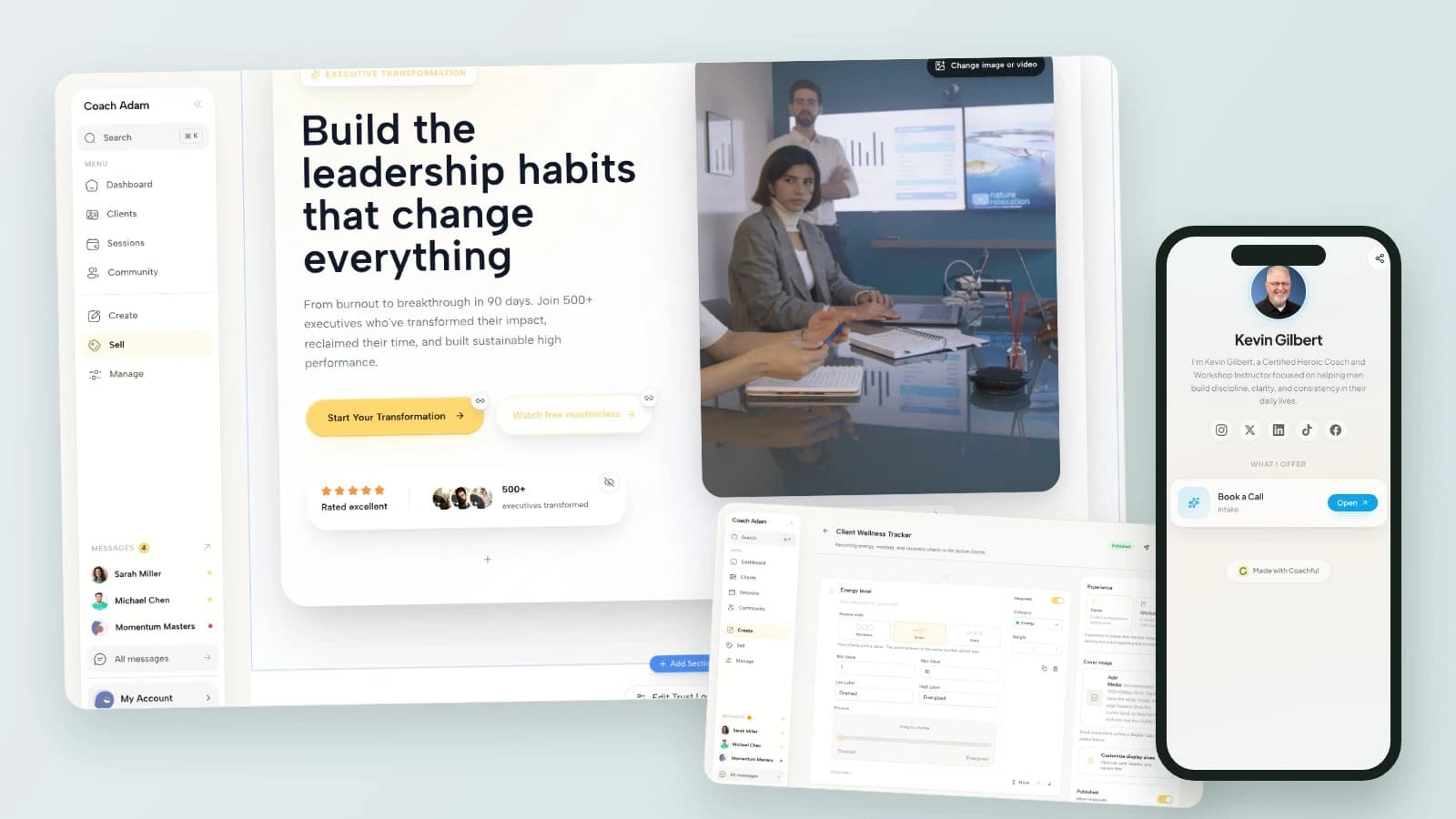
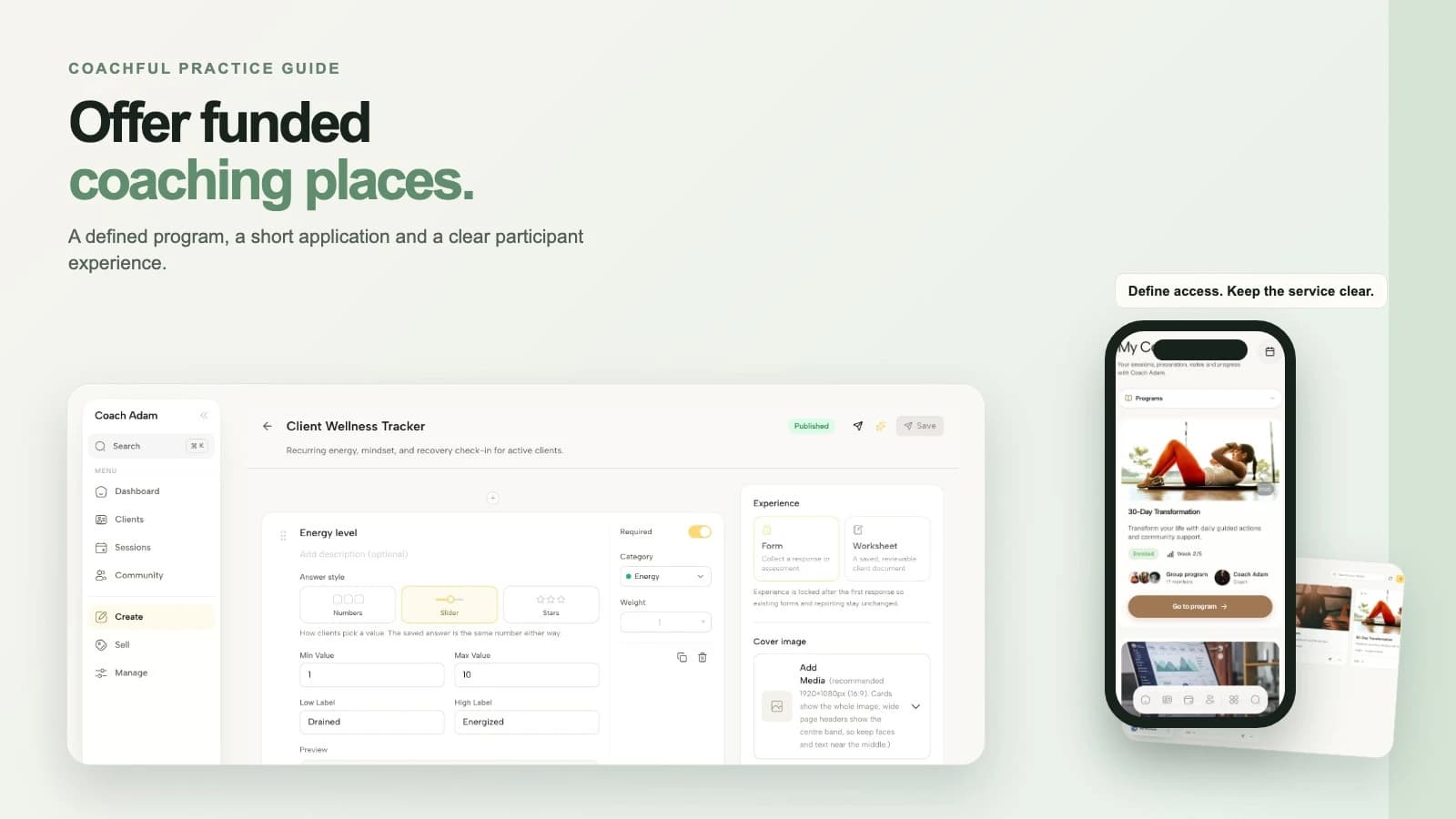
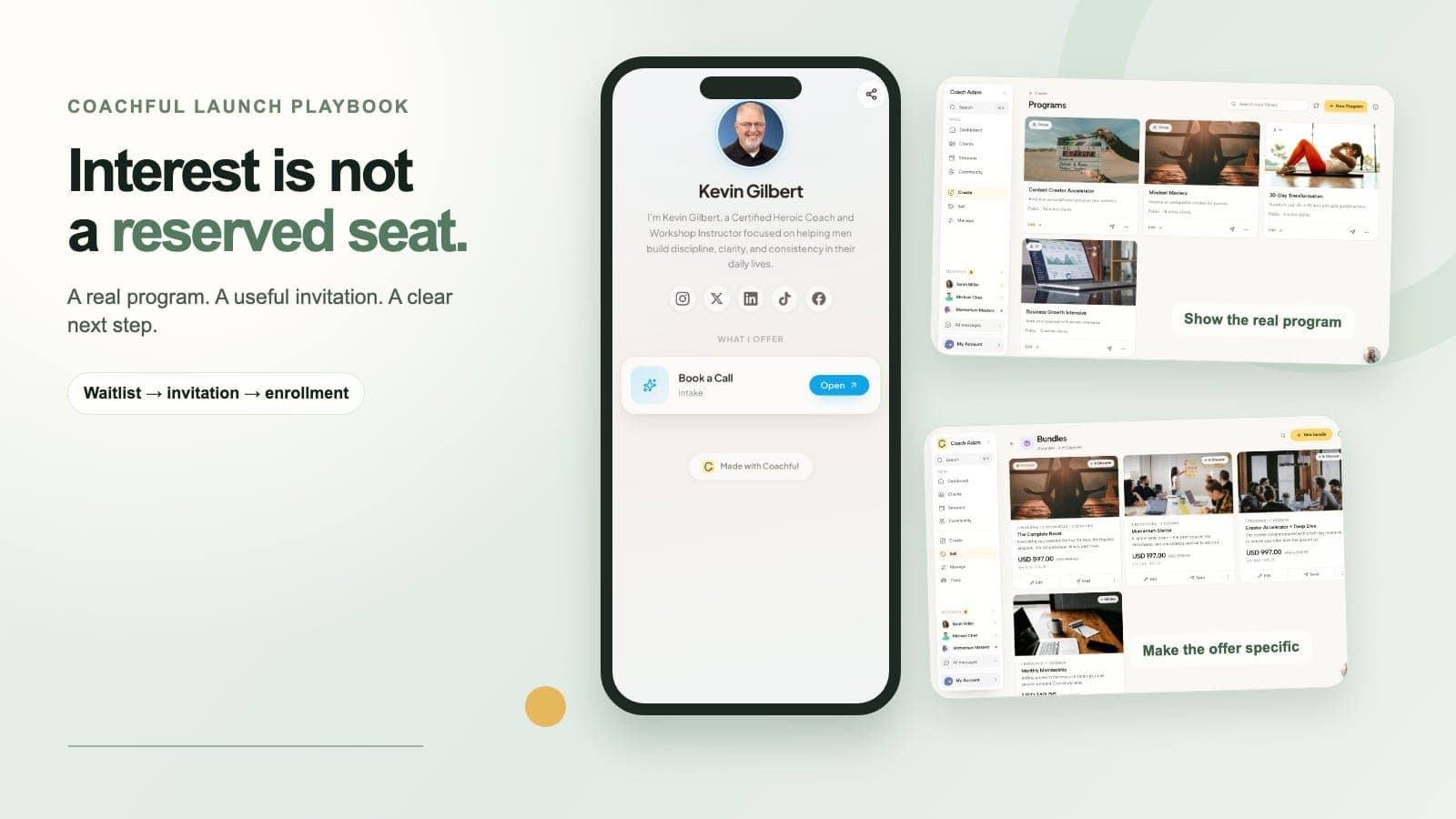
Coachful's demo shows programs, bundles, email and intake-booking surfaces you can evaluate together. Those screens illustrate parts of the enrollment journey; they do not establish that your account has a ready-made five-email launch automation or that every exclusion happens automatically.
If you are preparing a launch, try the interactive demo and follow the path from the offer to the next conversation. Assess whether the screens support your actual enrollment process before building campaigns around them.
What to measure after the launch
Record the number of eligible people invited, applications received, relevant calls held and enrollments completed. Keep the definitions consistent between launches. A downloaded resource and a completed application are not the same signal.
Read replies for concrete friction: impossible session times, unclear investment, uncertainty about group participation or a confusing application. Fix the offer or process before concluding that a punchier subject line would have solved it.
Do not use opens alone to decide someone is ready to buy. Privacy features and automated scanning can affect email engagement signals. A direct question, an application and an actual enrollment tell you different, more specific things about the decision.
Launch email FAQs for coaches
How many emails should a coaching program launch have?
Use enough to cover the real decision without repeating yourself. These five templates cover different jobs, not a mandatory quota. For a short, relationship-led intake, a clear opening invitation, personal answers and one closing reminder may be sufficient.
Should I send launch emails to my whole list?
Not automatically. Check the purpose and scope of the person's signup, their current relationship with you and applicable requirements. A topic-specific interest list is not permission to promote unrelated offers indefinitely.
Do I need an early-bird discount?
No. A specific offer with a suitable format and honest deadline does not require a discount. If you use one, explain the actual price, who qualifies and when it ends. Do not manufacture a reference price to make the saving look bigger.
What if I have no testimonials?
Show the real method, accurate credentials, delivery details and clearly labeled examples. You can also be transparent that this is a first round. Never invent client results or imply a hypothetical example is evidence of an outcome.
Can I reuse these emails for private coaching?
Yes, if there is a genuinely defined intake and the copy matches your process. For an ongoing service with capacity-based openings, use individual availability updates instead. Do not manufacture an enrollment week for a service that remains continuously available.
The useful rule
Every launch email should remove one uncertainty the right person needs to resolve. If the message only repeats that time is running out, it probably needs a better reason to exist.
For the broader sequence of positioning, pages and onboarding, see the 30-day coaching program launch plan. This article's job is narrower: give you usable enrollment-week copy, and the judgment to know when not to send it.