How to Offer Coaching Scholarships: 7 Practical Steps

Nour
Founder, Coachful
Can you offer coaching scholarships without making your practice responsible for support it cannot afford? Yes: fund a defined number of client places, protect the delivery hours, publish clear access criteria and let recipients accept the same bounded service you promised. Decide the limits before inviting applications, not after a moving story reaches your inbox.
This guide is for coaches offering fully or partly funded coaching to clients. It is not about scholarships to train as a coach, and it does not describe a Coachful scholarship scheme. You are designing an access policy for your own practice.
A scholarship should reduce a financial barrier, not create a second-class client experience. The seven steps below help you choose a model, budget the commitment, write a short application and make decisions consistently.
1. Define the service before naming the scholarship
Start with what someone will actually receive: the coaching focus, number and length of sessions, delivery period, between-session contact and any group or course access. A funded place in an existing program is easier to explain and deliver than “support for as long as you need it.”
Choose a service you are qualified and able to provide. Financial need does not make coaching appropriate for every situation. Keep your normal scope checks, referral boundaries and arrangements for needs outside your competence.
A practical description might be: “A partly funded place in my four-session career-decision package, delivered online over an agreed period, with the same preparation resources and contact boundaries as the standard package.” This is sample wording, not an offer currently available from Coachful.
Be precise about what is not included. A short coaching package is not ongoing crisis support, recruitment, therapy or a guarantee of employment. Clear boundaries protect an applicant who might otherwise assume a scholarship buys more than the service normally provides.

2. Set two budgets: money and delivery time
A reduced fee and an affordable commitment are not the same thing. You may have room to waive a fee but no room for additional sessions. Alternatively, you may have available hours but need participant contributions to cover direct costs.
Write down the maximum number of places, session hours, preparation and follow-up time, software or venue costs that increase with participation, and any outside funding you can actually rely on. Include application review and onboarding in the work you need to accommodate.
Illustrative capacity calculation: four funded places, each needing four session hours and one support hour, require twenty delivery hours. That excludes application administration. The calculation does not assume those hours are spare or that the program will pay for itself later.

Keep fee reductions separate from accounting costs. The difference between your normal price and the recipient's contribution describes the price concession; it is not automatically a tax-deductible donation or the amount of cash the practice spends. Ask a qualified adviser how to record the arrangement in your circumstances.
Set a review point before renewing the scheme. For example, you could test one intake and decide whether another is feasible after delivery. That is a planning choice, not evidence that a particular scholarship quota is sustainable for every coach.
3. Choose a funding model and eligibility criteria
Three common models create different commitments. Choose the one you can explain without a complicated exception policy.
- Fully funded place: the participant pays no coaching fee for the defined service. State any genuine additional costs rather than surprising them later.
- Partly funded place: you agree a specific participant contribution and what it covers. Someone who cannot afford that amount should not discover the minimum only after applying.
- Externally funded place: another person or organization contributes. Clarify funding, confidentiality and any reporting before offering places.
A scholarship is not necessarily the right solution for everyone who needs flexibility. If you want a continuing choice of fees with a simpler entry route, compare the approach with our guide to sliding-scale coaching rates. This article addresses a finite allocation of funded places, with applications and selection.

Write criteria that connect the purpose of the funding with the service. For a career-transition package, that might mean adults facing a relevant career decision who cannot currently access the standard fee, within the locations and delivery conditions you can support.
Decide what information is genuinely necessary to apply those criteria. Do not request bank statements, diagnoses, immigration records or a detailed account of hardship merely because a longer form feels more rigorous. Any sensitive eligibility requirement needs a clear purpose, appropriate handling and suitable advice.
Avoid moral tests disguised as financial criteria. You do not need to inspect whether someone bought a coffee to decide whether your service fits. If you use self-declaration, say so. If a funder requires verification, explain the requirement before collecting information and keep access limited.
Check relevant legal requirements, including privacy, equality and consumer rules where they apply. A private access initiative does not become exempt from those obligations because it has generous intentions. Do not promise charitable status, a tax benefit or universal eligibility.
4. Build a short, proportionate application
Your application should answer the decisions you actually need to make. It should not be an audition for the most compelling personal story. A clear written form can work; an accessible alternative may be appropriate where the format itself would exclude someone.
Use these questions as a starting template, then remove any that do not serve your policy:
- What would you like coaching to help you think through or work on?
- How does the published package fit that goal?
- Do you meet the stated access criteria? Give a brief explanation if needed, without unnecessary sensitive detail.
- For a partly funded place, is the stated participant contribution manageable?
- Can you participate within the published delivery format and period? What practical access needs should we discuss?
- What is the best way to contact you about this application?

Explain who reviews the answers, why you collect them, how you protect them and how long you plan to retain them, subject to applicable requirements. Do not promise “complete anonymity” if you need a name and contact details to make and communicate a decision.
Keep marketing permission separate from applying. Someone asking for financial access has not necessarily asked for your newsletter. Likewise, do not require a public testimonial, social post, referral quota or permission to use their story as the price of receiving coaching.
Publish the timeline: when applications close if there is a window, when people should expect a response, and whether a fit conversation is part of the process. If you accept rolling applications, explain how capacity is allocated and when submissions stop being considered for the current period.
5. Use a consistent review process
Before opening applications, decide how you will choose among people who meet the criteria. You might prioritize a stated group within a defined access purpose, review in published rounds, or use another appropriate method. The important thing is that the method is defensible, lawful and described accurately.
Separate four decisions: whether the service fits, whether the access criteria apply, whether a funded place is available, and whether the applicant chooses to accept. A person can meet the criteria and still be outside your coaching scope. They can also be suitable when no place remains.

Use a short private review note: criterion considered, relevant information, decision and next action. Do not turn the note into a speculative personality assessment. When several reviewers are involved, agree the criteria and confidentiality arrangements before sharing applications.
Do not quietly reward polished writing, professional connections or willingness to disclose more distress than another person. If your process needs a conversation to clarify fit, keep its purpose clear. It should not become a high-pressure sales call for applicants who cannot afford the standard service.
Communicate decisions without judgments about someone's worthiness. For an unsuccessful application, a suitable note might be: “Thank you for applying. We are not able to offer a funded place in this round. This decision is about the published criteria and available places, not an assessment of how deserving you are of support.” Adapt the reason to the actual decision.
If the service is not suitable, say that respectfully rather than hiding behind capacity. Offer relevant alternative routes only when you can do so responsibly. Do not imply an external service will accept the applicant or that a future scholarship is reserved.
6. Confirm the award, contribution and coaching agreement
An acceptance message should make the commitment easy to understand. State the exact service, the amount the participant pays if any, the delivery period, how to accept, any genuine acceptance deadline, and what happens next.
Adaptable acceptance wording: “We can offer you a [fully/partly] funded place in [exact package]. It includes [sessions, resources and contact boundaries], delivered during [agreed period]. Your total contribution is [amount and payment terms, or no coaching fee]. Please review [terms link] and tell us by [real date] whether you would like to accept. We will confirm the agreement and booking arrangements before coaching begins.”
Do not begin with an invoice that leaves the applicant guessing whether they have been selected. Equally, do not mark a place accepted simply because you sent an email. Record the person's actual decision and clarify questions before starting delivery.

The coaching agreement still matters. Explain cancellations, missed sessions, confidentiality, contact boundaries, early endings and any participant payment obligations. Check how your normal terms should apply to a funded place instead of copying clauses that assume the full price was paid.
If an outside sponsor pays, document the commercial arrangement separately from the participant's coaching consent. Funding does not automatically entitle a sponsor to private session information, application answers or progress reports. Agree any appropriate reporting explicitly with the relevant parties before coaching begins.
Never make a surprise future purchase a condition of the award. If a later paid service is optional, keep it genuinely optional. A scholarship recipient should not have to sit through an upsell to receive the coaching already offered.

7. Deliver the promised experience and review the scheme
Once the place is accepted, the participant should know where to go, how to prepare and how to ask practical questions. Review their actual access to sessions, materials and support. A generous announcement cannot compensate for an enrollment process that nobody tested.

Do not publicly label recipients inside a shared program. Other participants usually do not need to know who pays what. In a team practice, limit funding information to people who need it for their role, while ensuring the delivering coach understands the agreed service.
At the end of the funded period, offer the same thoughtful closing process you would use for the service generally. Discuss what the participant wants to take forward without assuming they can, or should, move into a paid package. Their choice not to purchase more does not make the scholarship a failure.
Review the scheme using the measures that match its purpose: places offered and accepted, delivery completed, administration time, capacity used, participant feedback and money committed. Keep impact reports proportionate and aggregated where appropriate. Do not turn private financial information into a marketing asset.
If the commitment exceeded your capacity, change the next round before announcing it. You might reduce the number of places, simplify review, adjust the package or find reliable funding. Do not respond by quietly reducing support for people whose places you have already agreed.
A concise scholarship announcement template
Use the following after the service, budget and application process are ready. Brackets identify details you need to replace, not promises you should copy without checking.
Applications are open for [number] [fully/partly] funded places in [program/package] for [defined audience and situation].
The service includes [scope] over [period]. The participant contribution is [total and terms, or no coaching fee].
Eligibility and selection: [short criteria and process]. Applying does not guarantee a place, and coaching suitability is checked separately.
Apply at [application link] by [real deadline, if applicable]. We expect to respond by [date or stated timeframe]. For an accessible application route or practical questions, contact [method].
Your application is used for [purpose]. Marketing updates are optional, and a testimonial or public story is not required.
Frequently asked questions
How many scholarship places should a coach offer?
There is no universal percentage. Work from the cash and delivery capacity you can commit without undermining existing obligations. One carefully delivered place can be more responsible than a larger public promise that relies on future sales.
Should coaching scholarship applicants prove their income?
Not automatically. Choose information proportionate to your published policy and any legitimate funding requirements. Self-declaration may suit some small initiatives. Where verification is genuinely required, explain why, protect the information and obtain suitable advice on your responsibilities.
Can a partly funded place still be called a scholarship?
Use language that makes the arrangement unmistakable. “Partly funded place with a total participant contribution of [amount]” is clearer than a scholarship headline that reveals a fee later. Check any specific legal or funding conditions that apply to your use of the term.
Can recipients provide testimonials afterward?
They may choose to offer feedback, but do not make a testimonial a condition of access. Any later public endorsement needs appropriate permission, truthful claims and any required disclosure of the funding relationship. Private program feedback and public marketing permission are different decisions.
Start with the service you can genuinely fund
Write the package, capacity limit and access criteria first. Then test one complete journey: application, review, decision, agreement, payment if relevant, and participant access. That test is more useful than polishing an announcement while the obligations remain vague.
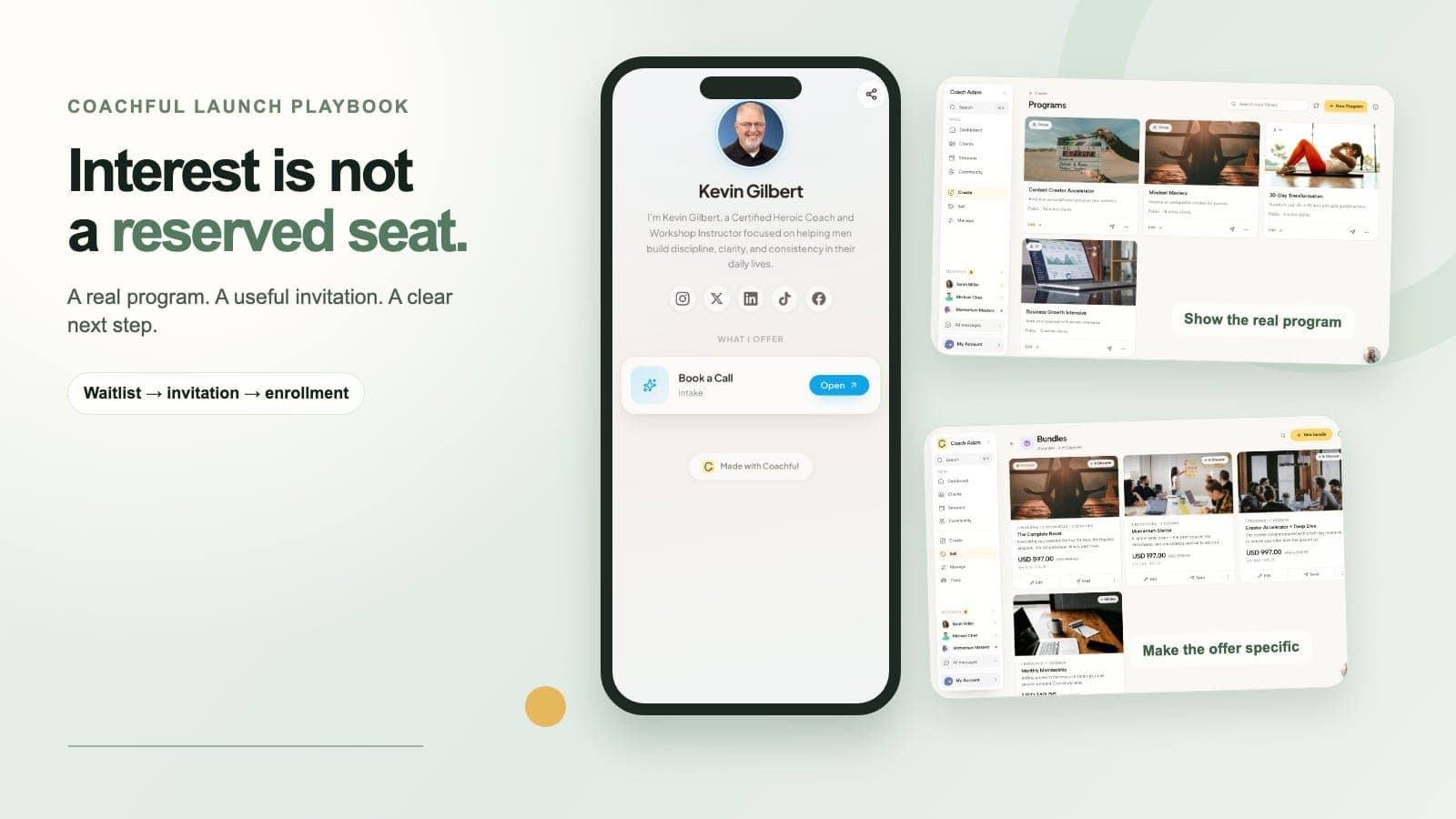
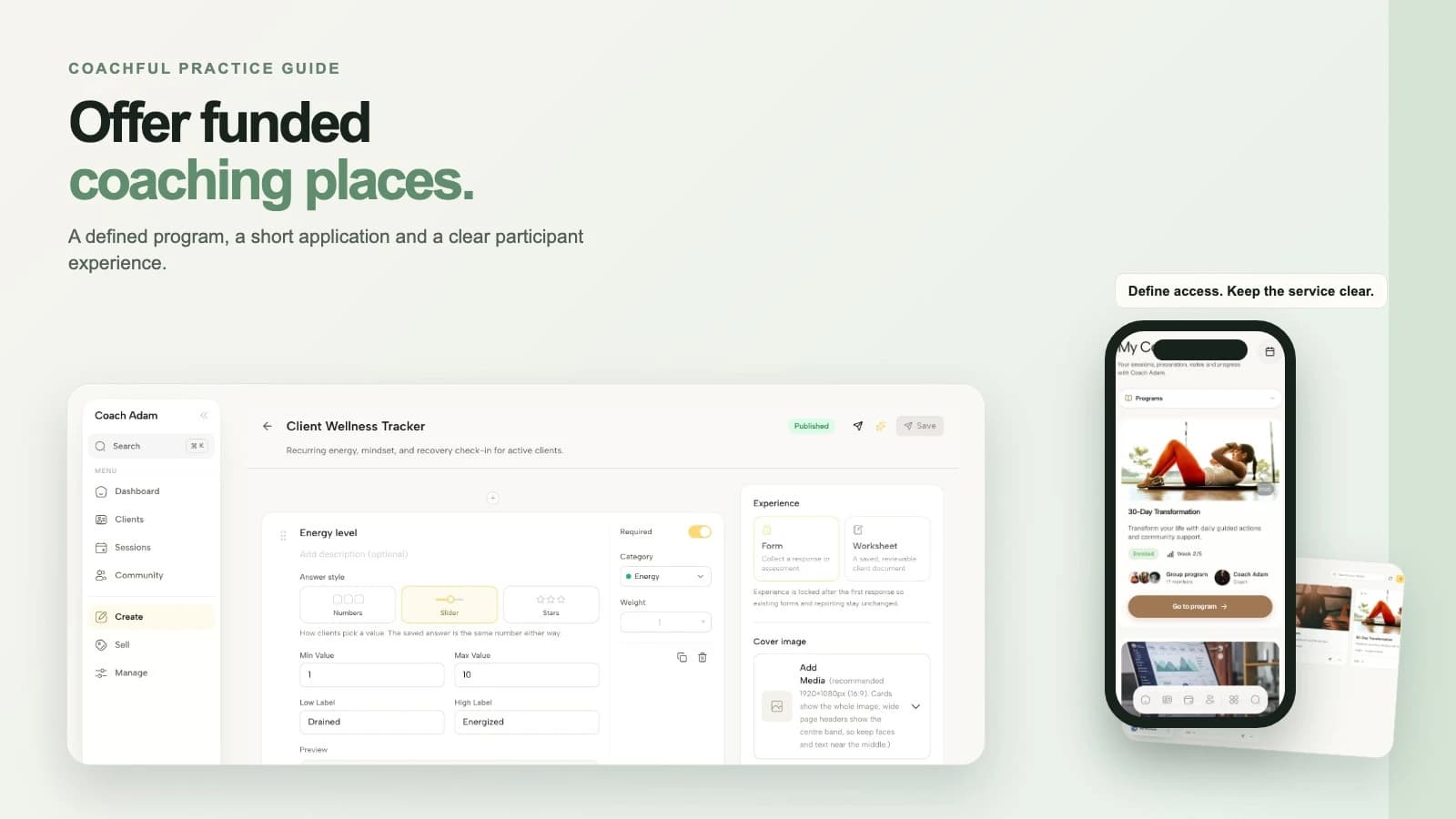
If you want to examine the practical setup, Try the interactive demo and review the Programs, Forms, Invoicing and onboarding screens illustrated here. Coachful can be part of the administration you evaluate; these screenshots do not establish a dedicated scholarship application, selection, funding or accounting system.
Sources and limits: Public examples from Rawz Coaching and The Courage Practice show that client-coaching scholarships can have defined services, eligibility and application processes. They are examples, not policies to copy or evidence of current availability. The planning steps and templates above are original editorial guidance, not legal, tax or financial advice. All product images show demo data; the two diagrams are teaching aids, not measured outcomes.