5 Corporate Coaching Email Templates for HR Introductions

Coachful
Coachful Editorial

What should you write to an HR contact when you want to offer coaching, but nobody has asked for a proposal? Send a short introduction that establishes why you are contacting this person, names a relevant coaching focus and asks for one proportionate next step. Do not attach a deck and hope they invent a reason to read it.
The first email should earn the right conversation, not try to close a corporate coaching contract. That means different messages for an introduction, an event follow-up, a public business development, a requested summary and a final follow-up.
Below are five corporate coaching email templates for those situations. They are original examples to adapt, not messages sent to real companies or evidence of response rates. This guide covers the introduction email, not designing the engagement: use our employer-paid coaching pilot guide for that separate decision.
Choose the email that matches the relationship
The selection rule is simple: use the strongest relationship you can truthfully name. An agreed introduction is stronger than a claim that you have been “following the company” when you discovered it this morning.
- Someone has agreed to introduce you: use template 1 and confirm what the introducer has permission to share.
- You spoke at an event: use template 2, referring to the actual conversation rather than merely attending the same venue.
- You have no prior relationship: consider template 3 only after checking the contact route and applicable marketing rules.
- The buyer requested information: use template 4 and send what they requested, not your entire service library.
- An earlier introduction received no answer: use template 5 if a follow-up is appropriate, then close the loop.
None of these routes justifies adding the person to a newsletter. A business card, a public email address and a polite reply are not interchangeable with permission for recurring marketing.

Before writing: separate evidence from inference
A useful opener connects to something you actually know: an introduction the recipient accepted, a question they asked or a public announcement relevant to your work. It does not diagnose the company's workforce from a LinkedIn post.
For example, “I saw your announcement about a new manager development programme” is an observation if you read the announcement. “Your managers must be overwhelmed and disengaged” is an assumption. The second sentence can make a coach sound perceptive to themselves and presumptuous to the buyer.
Write down the source, what it actually says and the question it leaves open. Then draft the message. If you cannot identify an honest connection between that information and your competence, choose a different organization rather than manufacturing urgency.

1. The agreed introduction email
Use when: a mutual contact has checked that the recipient welcomes an introduction. This is not permission to mention somebody's confidential coaching engagement.
Subject: Introduction via [mutual contact]: [coaching focus]
Hi [First name],
[Mutual contact] suggested we speak and confirmed you were happy to be introduced.
I coach [specific professional audience] on [specific work-related focus]. [Mutual contact] mentioned that you oversee [relevant responsibility], so I wanted to ask whether this sits within your remit.
If useful, I can send a short outline of my approach for you to assess before deciding whether a conversation would help.
Would that be relevant, or is there a better route for supplier enquiries?
[Name]
[Role and business]
[Applicable business details and marketing footer]
Why this version works: the recipient can see who connected you and what you are asking. They do not have to infer whether “introduction” means a private session, a sales call or a partnership.
Change before sending: verify the mutual contact's exact permission. If the contact is a current or former coaching client, do not disclose that relationship or use their workplace difficulties as your opening. Ask for an introduction that stands on its own.

2. The genuine event follow-up
Use when: you actually spoke with the recipient at an event and the follow-up is consistent with that exchange. Sharing a room is not the same as having a conversation.
Subject: Following our conversation at [event]
Hi [First name],
We spoke at [event] about [specific non-confidential topic]. You mentioned [the detail they agreed you could follow up on].
My coaching work focuses on [audience and practical focus]. As promised, here is [the resource or information requested]: [relevant link].
If you are exploring support in this area, would a brief conversation about the audience and your priorities be useful?
No problem if you were only looking for the resource.
[Name]
[Role and business]
[Applicable business details and marketing footer]
Why this version works: it fulfils the original promise before asking for anything else. The final sentence lets the recipient distinguish interest in a resource from interest in buying coaching.
Change before sending: remove “as promised” if no promise was made. If the person never requested a resource, do not invent one to create the appearance of an existing commercial relationship. Use a truthful reference to your conversation and a small, relevant question instead.
A resource link should open without a surprise opt-in or a demand for employee information. If you said you would send a worksheet, send the worksheet, not a sales page that merely mentions it.

3. The public-context introduction
Use when: there is a genuine professional fit, you have verified a relevant public fact and contacting the recipient is lawful. If the organization publishes a supplier route, use it rather than circumventing it.
Subject: Coaching enquiry: [specific audience or initiative]
Hi [First name],
I read [specific public announcement or page] about [verified initiative]. I am contacting you with a commercial enquiry about coaching support.
I work with [professional audience] on [specific coaching focus]. I do not know whether external coaching forms part of your plans, so I wanted to check the appropriate route before sending information.
Do you handle enquiries in this area, or does your organization use a supplier application process?
If this is not relevant, please let me know and I will not follow up.
[Name]
[Role and business]
[Applicable business details and marketing footer]
Why this version works: it states the commercial purpose and acknowledges what you do not know. It asks about a process rather than asserting that the company has a problem only you can fix.
Change before sending: check the initiative is current, the audience matches your real experience and the recipient's role plausibly relates to it. Do not infer individual employees' mental health, performance problems or private circumstances from public information.
This is not a recommendation to scrape contacts or launch a sequence. One-to-one messages can still be regulated marketing. If you cannot establish a lawful route, do not send this version; seek a permission-based introduction or a published supplier opportunity instead.

4. The requested-information email
Use when: the contact has asked what you offer. This is a response to that request, not a reason to send a full proposal before you understand the brief.
Subject: Requested outline: [coaching focus]
Hi [First name],
Thanks for asking for details. Here is the short outline of my work with [audience] on [focus]: [relevant service-page or accessible document link].
The outline explains [approach and typical format]. It is background information, not a proposed scope or a commitment about outcomes.
Before recommending an engagement, I would want to understand the intended participants, the business context, timing and purchasing process.
Would you prefer to share a brief by email or arrange a short scoping conversation?
[Name]
[Role and business]
[Applicable business details and marketing footer]
Why this version works: it separates explaining your service from recommending a solution. A buyer asking for information has not necessarily approved a budget, selected participants or agreed that coaching is the right intervention.
Change before sending: make the outline genuinely short and relevant. Include only qualifications, experience, references and examples you can substantiate and have permission to use. A fictional case should never appear among real client evidence without an explicit label.
If the contact wants a call, give a real duration and confirm time zones. Offer a simple scheduling route, but do not make them complete a personal coaching intake to discuss an organizational brief.

5. The close-the-loop follow-up
Use when: one earlier relevant message has received no answer and a further contact is appropriate. Do not use it after an objection, opt-out or request to stop.
Subject: Following up: [original topic]
Hi [First name],
I am following up on my note about [specific topic]. I realize it may not be a current priority.
If you would like the short outline, I can send it. If another route is appropriate, I am happy to follow your supplier process.
If I do not hear back, I will close this enquiry rather than keep chasing. Please let me know if you would prefer no further marketing contact.
[Name]
[Role and business]
[Applicable business details and marketing footer]
Why this version works: it offers an answerable next step and makes stopping explicit. It does not punish silence with “I guess developing your people isn't a priority.”
Change before sending: check whether the recipient has already replied elsewhere, whether your original information is still current and whether you have a legitimate reason to follow up. If they gave a future date, respect it. An agreed date beats an arbitrary automation delay.
Treat this as a conservative editorial approach, not a scientifically optimal cadence. There is no verified reply-rate promise here, and silence is not permission to approach the person's colleagues repeatedly.
What each message needs before it is safe to send
The templates above show the message body. Replace every placeholder and add the identification, transparency and opt-out information required for your situation. A short email is not exempt from marketing rules because it looks personal.
The FTC's CAN-SPAM guidance says the US rules cover commercial email, including business-to-business messages, not just bulk campaigns. Its requirements include accurate headers, non-deceptive subjects, clear identification of advertising, a valid physical postal address and an easy way to opt out. Follow its current guidance on processing opt-outs as well.
The UK ICO's business-to-business guidance distinguishes corporate subscribers from sole traders and certain partnerships. It also explains that UK GDPR can apply when you process a named business contact's personal data. The ICO notes that this guidance is under review following legislative changes.
Check the rules that apply to you and the recipient, including other jurisdictions. This article is not legal advice. “They work in HR” and “their email is public” are not legal analyses.
- Use your genuine identity, role and business contact details.
- Keep the subject consistent with the body; never fake an existing reply thread.
- Explain the commercial purpose where required and do not hide a pitch as research.
- Use a valid postal address and required privacy information.
- Provide an accessible opt-out and maintain a record that prevents recontact.
- Never subscribe the recipient to a newsletter simply because they answered.
When HR replies: ask for a brief, not employee secrets
A positive reply is the beginning of qualification. Ask who the support is for, what prompted the enquiry, who owns the decision, the intended timing and what purchasing requirements apply. Keep a record of the next action you actually agreed.
You do not need employee diagnoses, private performance files or session notes to decide whether to have a scoping conversation. Ask for organizational context and an appropriate level of detail. If sensitive material arrives unexpectedly, stop and agree a suitable handling process rather than copying it into a sales record.

A brief form can reduce repetitive questions, but it must be appropriate to the buyer. Start with organization, audience, contact, timing, practical focus and procurement requirements. Make clear that employees' confidential information should not be submitted.
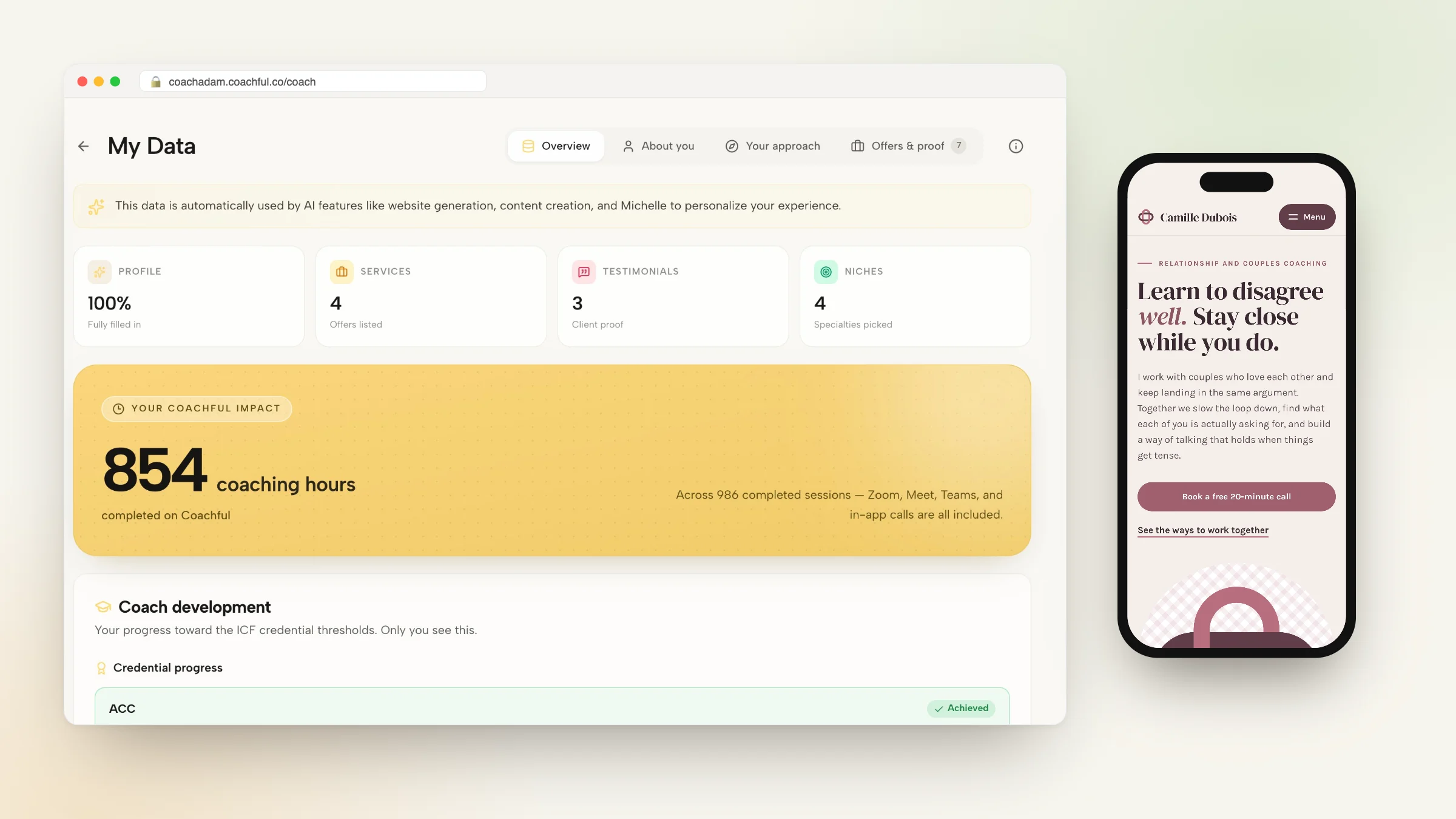
Coachful's reviewed demo includes a form builder, a website editor, leads, email, scheduling and offers workspaces. The screenshots here illustrate those surfaces, not a claim that Coachful finds HR buyers, supplies compliant cold-contact lists or approves an organization's data requirements.
Keep the introduction separate from the proposal
Once you understand the buyer's needs, decide whether you are competent to help and whether coaching is appropriate. Only then propose a defined engagement. Scope, confidentiality, sponsor reporting, fees and purchasing terms need their own considered discussion.
For the later document, see our coaching proposal examples. Do not paste a proposal's confidentiality clause into the first email and assume that makes a sponsored relationship properly contracted.

If your next challenge is managing the move from a welcome enquiry to an agreed conversation, Try the interactive demo. Inspect leads, scheduling and the website editor with that specific handoff in mind. An attractive system cannot rescue an irrelevant introduction, but a useful reply deserves a reliable next step.
Frequently asked questions
Should I attach a coaching proposal to my first HR email?
Usually not unless the buyer or supplier process requests it. An introduction establishes relevance and the appropriate next step. A proposal recommends scope and commercial terms after you understand the brief.
Should the first email include my fees?
Include accurate fees when the buyer asks or a supplier process requires them. Otherwise, do not invent a quote before knowing the audience and scope. If you publish a genuine starting fee or standard offer, label its inclusions and limits clearly.
Can I mention a client who works at the company?
Only with appropriate permission to disclose the relationship and the specific information involved. A mutual introduction can often be made without saying the person is your coaching client. Never use their confidential concerns as sales evidence.
What if I have no corporate case study?
Be honest. Describe relevant experience, your actual qualifications and how you would establish whether the work fits. You may offer a clearly labeled sample approach, but do not invent employers, testimonials or results.
What is the most important editing test?
Ask whether the recipient can answer without doing your thinking for you. “Would you like to explore synergies?” is work. “Do you handle coaching supplier enquiries, or is there an application route?” is a concrete question. Earn that answer before asking for a contract.