
How to Build an Academy for Men That Actually Works

Coachful

You're probably sitting on a half-built men's program right now, with a name, a landing page, a few module titles, and that nagging sense that the whole thing still sounds generic. That is the core problem. Most academy for men offers do not fail because the coach cannot market. They fail because the design does not answer a man's actual objections, habits, and follow-through patterns.
If you want this to work, stop treating it like a course with a nicer font. Build it like an institution with a clear purpose, a clear participant profile, a curriculum that produces visible progress, and a delivery system that does not burn you out. Men are looking for order, accountability, and proof that the group will not drift into vague motivation talk. The best historical examples prove the point. West Point started as a small engineering school and became a leadership institution as its mission, standards, and curriculum sharpened over time (Britannica). The lesson is simple, structure comes first, hype comes later.
Why Most Men's Academies Stall Before They Start
A coach launches the first version, posts a few polished graphics, and waits for men to sign up. The silence feels personal. It is structural.
A common mistake coaches make is building around what they want to teach instead of what the participant needs to solve. Men do not buy “transformation” in the abstract. They buy relief from a specific mess, a new identity they can picture, or a path out of a pattern they are tired of repeating. If you are asking yourself, “Am I qualified to lead men?”, the better question is whether you have designed a container that makes progress visible. Qualification matters, but structure matters more.
Structure beats slogans every time
The oldest service academies understood this instinctively. West Point began as a tiny engineering school, then matured into a leadership institution as its mission, standards, and curriculum became clearer over time (Britannica). That is the model most coaches miss. They try to launch with branding and a mission statement, but the men who enroll are scanning for order, accountability, and proof that the group will not drift into vague motivation talk.
Eagle Academy for Young Men is another useful example. It was created in 2004 by One Hundred Black Men of America and operates as a system of six schools serving grades six through 12 (CBS News). That kind of institutional design tells families and students what to expect before the first class starts.
Practical rule: if your offer cannot be explained as a sequence of decisions, milestones, and accountability, it is not an academy yet. It is a workshop with ambition.
The inner objection most coaches ignore is simple, “Will they show up?” Men show up when the program has a clear cadence, a visible standard, and a social reason to stay engaged. They disappear when the container feels loose, vague, or emotionally noisy. Do not blame marketing until you have fixed the design.
A better starting point is a program outline that makes the path obvious from the first touchpoint. A clear program outline builder forces you to define the sequence, the checkpoints, and the outcomes before you start polishing the front end.
Mental health also gets ignored too early. A men's academy does not need to become a therapy group, but it does need language for stress, shame, isolation, and relapse when those issues affect participation. Leave that out, and you build a room full of men who look fine on paper and vanish when the work gets real.
Retention starts before the first session. If men do not know how they are being measured, how progress is recognized, and what happens when they miss a week, they will treat the academy like another good intention. Build the rules, the feedback loop, and the support path first, then worry about the polish.
Defining Your Audience and Designing the Curriculum
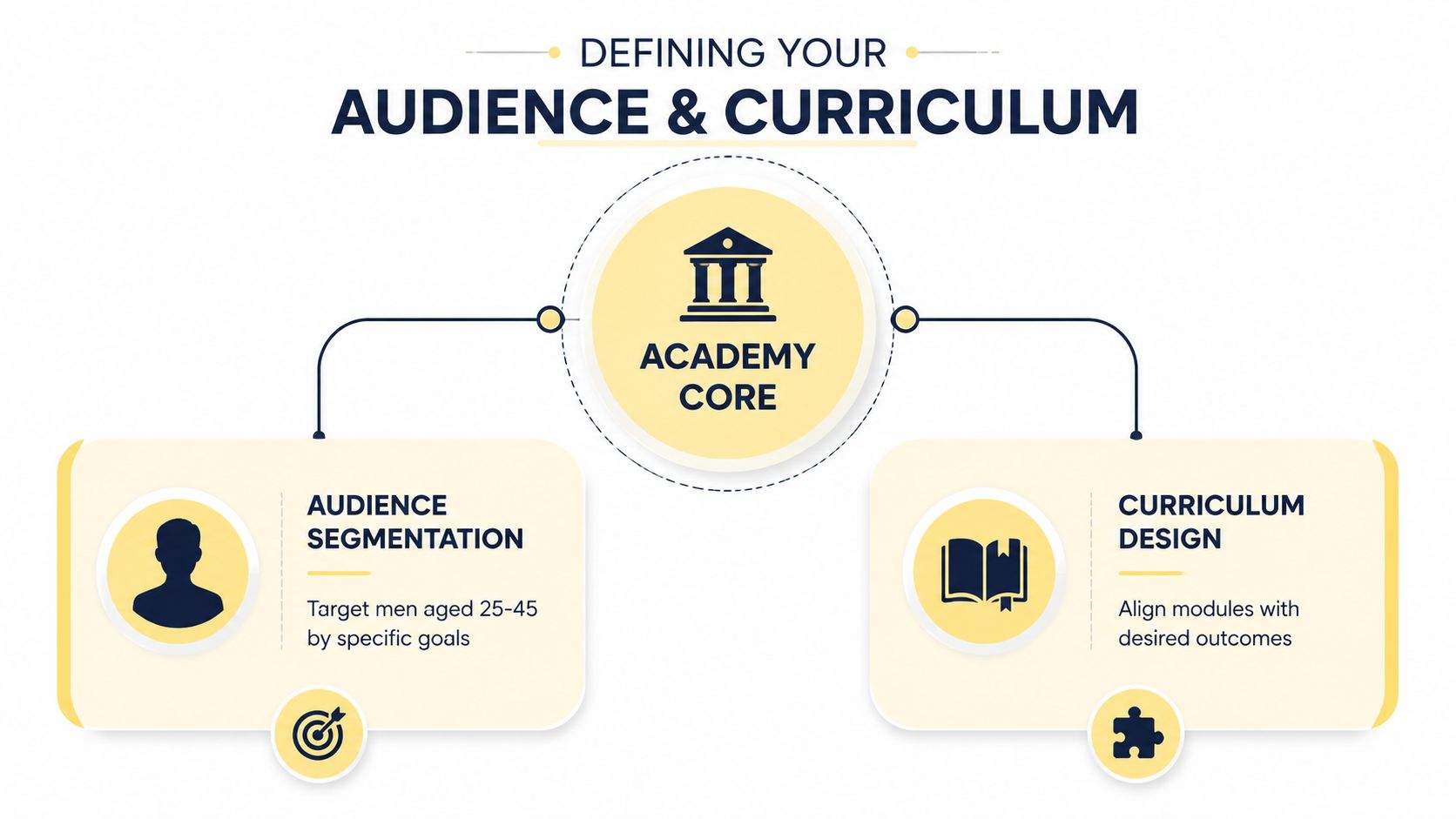
Start with a narrower man, not a broader one. “Men aged 25 to 45 who want to be better” is not a market, it's a wish. You need a psychographic profile you can feel in your bones, something like new fathers rebuilding identity, executives managing burnout, or men coming out of a career break and trying to recover direction.
That level of specificity changes everything. It sharpens the promise, it shapes the examples you use, and it stops your messaging from sounding like it was written for everyone and no one. The men who are most likely to enroll are the ones who read your description and think, “He gets exactly what I'm dealing with.”
Build the curriculum around transformation milestones
The curriculum has to move men from point A to point B in a way they can recognize week by week. The Manhood Academy is a useful example because it uses the elements earth, water, fire, and air as a thematic framework for teaching positive masculinity, leadership, and responsibility (Huck). The value of that model is not the poetry, it's the coherence. Men can track where they are in the process because the framework gives the journey shape.
Use that same principle in your own academy. Don't pile on modules because you have a lot to say. Sequence the work so each step builds on the last. If a man can't tell what changed between week one and week four, your curriculum is too fuzzy.
A good stress test is brutally practical. Ask whether your ideal participant would still buy if he were tired, skeptical, and half-convinced this is just another self-improvement brand. If the answer is no, you haven't defined the pain point sharply enough. That's where a planning tool can help, and a clean way to sketch the offer is through a structured outline like program outline builder.
Use this quick filter on every module:
- Specific problem solved: Name the exact frustration, not a broad theme.
- Observable shift: State what the participant should do differently afterward.
- Proof of progress: Decide how you'll know he's changing.
- Language test: Read the sales page out loud. If it sounds like therapy wallpaper, rewrite it.
A strong academy curriculum doesn't just sound meaningful. It produces moments where a man thinks, “I'm not the same guy I was two weeks ago.” That's what you're building.
Choosing the Right Delivery Format and Cohort Structure
The format you pick will decide how much energy you spend, how much support the men get, and how often the whole thing slips into chaos. Most coaches want the flexibility of evergreen delivery with the accountability of a live cohort. That's not how reality works. You have to choose what you're optimizing for.
Compare the formats against your actual capacity
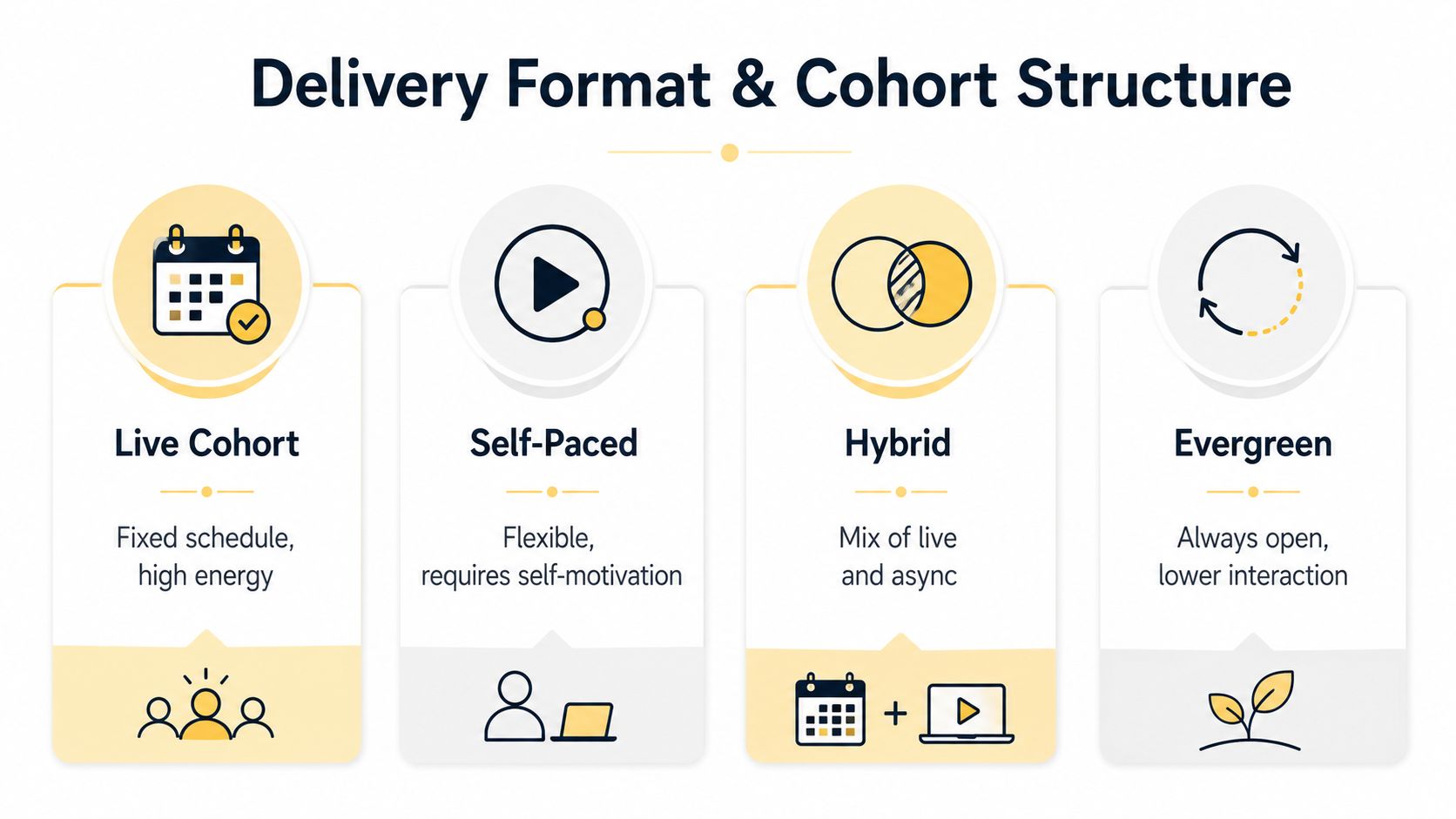
Live cohorts are the easiest to make feel alive. They also demand the most from you because every session has to land in real time, and if you overbuild them, you'll end up exhausted. Self-paced programs are easier to scale, but they're weak on peer pressure and easy to abandon when life gets busy. Hybrid models are often the smartest middle ground because they combine structure with breathing room. Evergreen is the least demanding operationally, but it usually needs stronger onboarding and stronger reminders to avoid dropout.
Men stay with programs that feel socially real. They drift from programs that feel like content libraries.
The bigger issue is how you deliver the learning itself. In a three-country study of academy training, the dominant pattern was large-block, siloed training rather than integrated practice, and the average North American academy spent 78 hours on arrest-and-control techniques (Force Science). The implication for your academy is obvious. Don't dump everything into giant sessions and assume repetition happened. Small, repeated, integrated sessions make it easier to verify transfer, especially when the work mixes communication, behavior, and physical discipline.
Build the cohort around peer accountability, not performance theater
You don't need to be on camera all day to create a strong cohort. You need rhythm. One live session, one check-in prompt, one peer accountability assignment, one clear deadline. That's enough to keep momentum if the men know the group is watching.
The right cohort size is the one you can coach consistently. If it gets too large, men hide. If it's too small, the energy collapses. The sweet spot is usually the point where every participant can speak, be remembered, and still feel some social pressure to follow through.
The structure should also respect your own bandwidth. If you can't sustain the delivery cadence without resenting the program, the format is wrong. Pick a model that lets you keep showing up with precision, not one that turns you into a full-time host.
Building Your Tech Stack and Automation Engine
If your academy is held together by scattered calendars, manual reminders, and five different login systems, you're not running a business. You're running a maintenance project. That's why the cleanest setup is usually one all-in-one workspace for onboarding, scheduling, payments, messaging, progress tracking, and cohort management.
Use automation to remove the tasks that should never require your brain. Enrollment sequences should confirm the purchase, deliver the next step, and set expectations. Session reminders should go out without you remembering to nudge anyone. Renewal triggers should activate before the program becomes a memory. Progress check-ins should surface when engagement drops, not after someone has already gone quiet.
Protect the relationship by reducing admin noise
The more manual your operation is, the more likely you are to forget something that matters to the participant experience. That includes resource delivery, session notes, and private disclosures. A proper system gives you permissions, templates, and dashboards so sensitive information stays controlled while the client experience stays polished.
If you want a practical comparison of how well-organized coaching systems can reduce friction, the broader category of software for personal trainers is worth studying because the same operational problem shows up there, client management gets messy fast when everything lives in separate tabs. The specific lesson isn't the niche, it's the discipline. Single-workspace systems reduce admin drag and keep participants from slipping through cracks.
Use the workflow templates in n-8-n workflow templates as a model for thinking about sequence, even if your tools differ. The point is to map every recurring action once, then stop paying the mental tax over and over.
Here's the stack logic in plain English:
- One place for onboarding: Collect forms, payment, and consent before the first live interaction.
- One place for communication: Keep group updates, reminders, and direct messages visible.
- One place for progress: Track milestones, notes, and check-ins without digging through spreadsheets.
- One place for renewal: Trigger follow-up before the participant disappears.
You don't need fancy automation. You need boring reliability. The best system is the one that lets you coach without constantly asking yourself, “Did I forget to send that?”
Pricing Strategy and Enrollment Funnels That Convert
Most coaches underprice men's academies because they're scared of sounding too serious. Then they attract people who treat the program like an optional experiment. Cheap pricing doesn't create trust. It often creates doubt.
Price for commitment, not volume
Men evaluate a program partly by how it handles commitment. If the price is too low, the offer can feel disposable. If the application is too loose, you invite curiosity shoppers. A stronger funnel uses a clear sequence, awareness, consideration, then decision, so the prospect understands what the academy is, why it exists, and what changes if he joins.
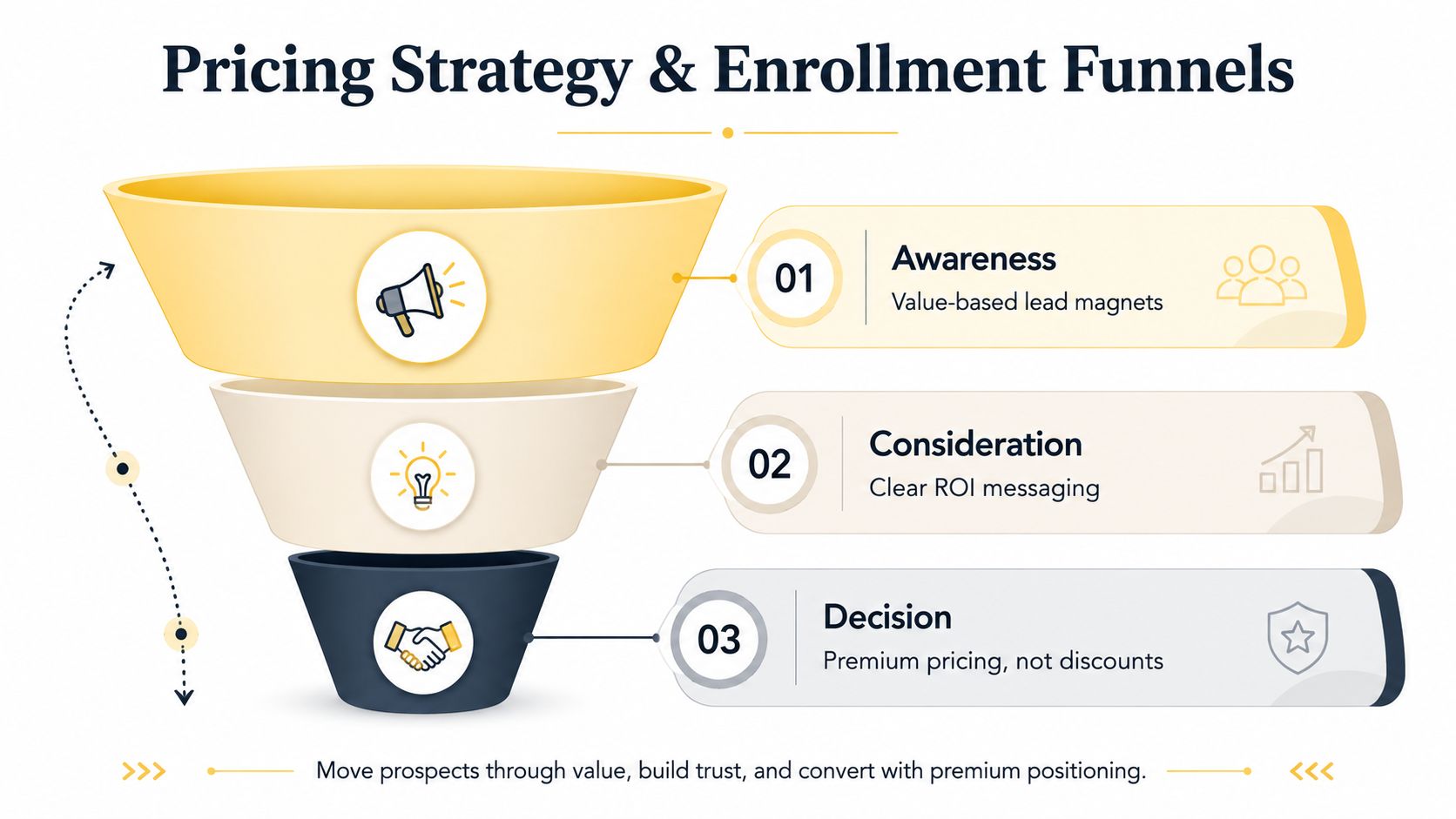
The objections are predictable. “Is this worth it?” “What if I don't get results?” “Can I just watch the recordings?” Your funnel should answer those before the sales conversation starts. That means case-specific messaging, clear outcomes, and an application process that filters for seriousness.
A franchise-style lead system can help you think about quality over raw volume, and the logic behind lead generation for franchises is useful here because it emphasizes fit and intent, not just clicks. That's exactly how men's academies should think. You want fewer leads who are more likely to complete, not a bloated pipeline full of dabblers.
Use the application to raise commitment
The application should feel like a decision, not a formality. Ask about the problem he wants solved, the cost of staying stuck, and the action he's willing to take. If a man can't slow down long enough to answer thoughtfully, he probably isn't ready to enter a serious cohort.
Payment plans can reduce friction, but they shouldn't cheapen the container. Use them to make the decision workable, not to pretend the program is low stakes. The strongest academies usually position price as part of the signal. This is not a commodity purchase. It's an environment built to demand follow-through.
The inner voice you're dealing with is often, “I don't want to scare people off.” You should scare off the wrong people. That's not harsh, it's operational hygiene.
Community Building and Retention Tactics That Stick
Enrollment is vanity. Retention is sanity. If men do not stay engaged between sessions, the academy turns into a calendar event instead of a real developmental container.
The gap most programs miss is emotional and social, not just instructional. Men show up carrying loneliness, weak friendships, anxiety, and a shortage of trustworthy male models. Some programs are honest about that pain, then stop at inspiration. They tell men to level up, lead better, or become more disciplined, but they do not build the social architecture that keeps change alive. Building that social architecture is a discipline in itself, and you can explore more strategies for forming a community that lasts.
Make connection regular, not forced
The best community touchpoints are simple and repeatable. A weekly check-in. A peer pair. A short accountability prompt. A celebration ritual when someone completes a hard task. None of that requires emotional oversharing, and that matters. Not every man wants a vulnerability marathon. He wants a place where showing up is normal and being honest does not make him feel exposed.
St. Emma Military Academy gives a useful historical reminder about why belonging matters. It operated from 1895 until 1972, and the source describes it as the nation's only military academy dedicated exclusively to educating young Black men for decades, with thousands of young African-American men attending over that span (Virginia Historical Society video). The scale and duration matter because they show what happens when a men-centered institution becomes part of identity, not just instruction.
Practical rule: if your participants only connect with you and never with each other, your retention system is too fragile.
A real retention system also needs a clear pathway when mental health is part of the picture. Some men need coaching. Some need peer support. Some need referral to a licensed professional. If you blur those lines, you create risk for participants and confusion for yourself. Build the referral pathway before you need it, and define who handles what before someone is in distress.
The right community metrics are simple enough to review every week. Track attendance consistency, check-in completion, peer interaction, and who goes silent after a strong start. If someone drops off, that is a signal, not a mystery. Reach out early, and treat disappearance like a process problem before it turns into a relationship problem.
Measuring Outcomes and Scaling with Evidence
If you can't say what changed, you don't have an academy, you have a vibe. That's fine for social media, but it's weak business design. Funders, partners, and serious participants want to know whether the work moves anything.
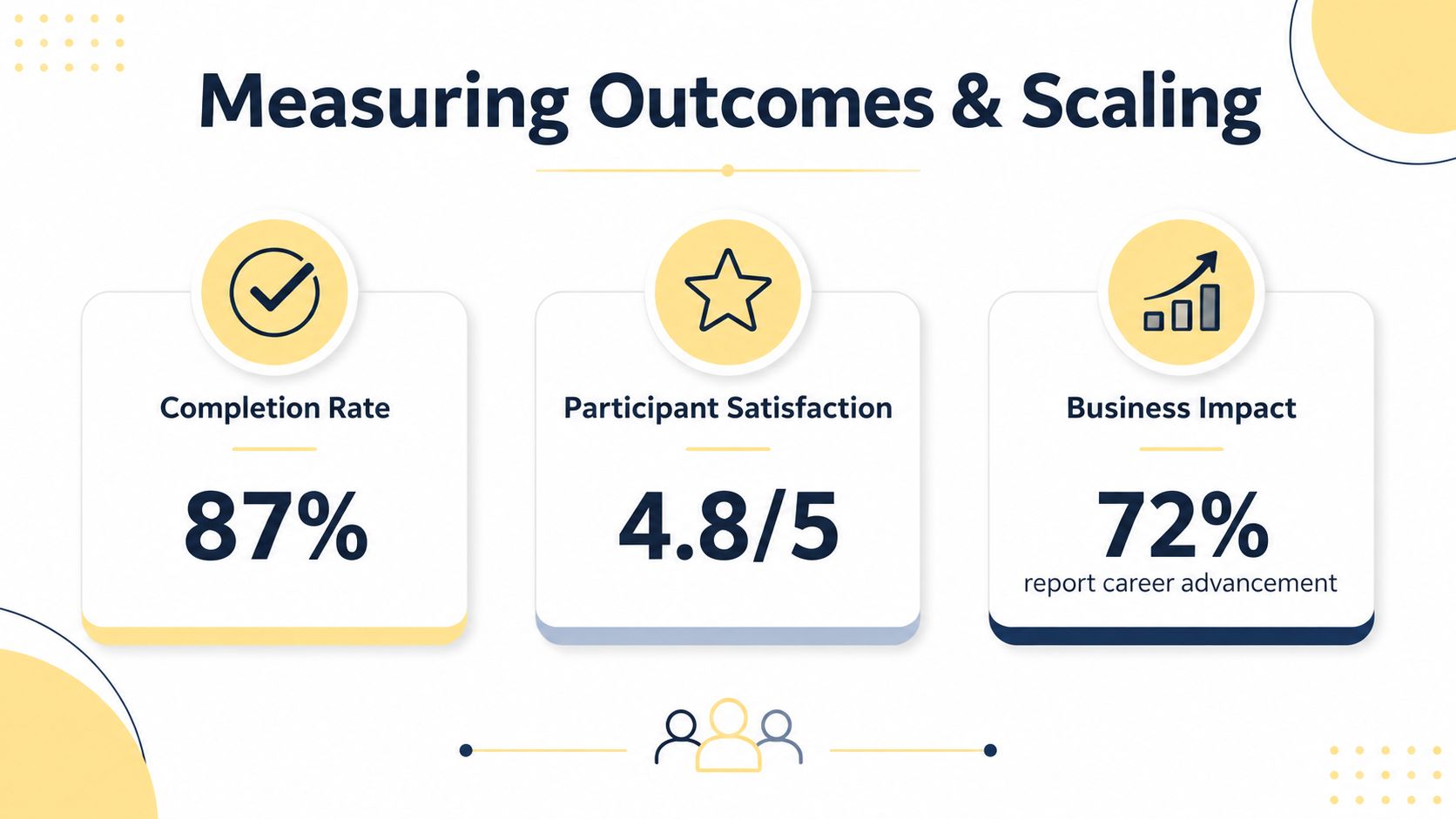
The data you track should go beyond attendance. Measure behavioral shifts at 30, 60, and 90 days, referral behavior, re-enrollment into advanced cohorts, and self-reported confidence or relationship improvements. You're looking for evidence that the participant's real life is changing, not just that he liked the sessions.
Use measurement to improve, not impress
The point of outcomes tracking is decision-making. If men are dropping after week three, fix the sequence. If the curriculum creates enthusiasm but no behavior change, tighten the assignments. If one cohort format produces better continuity, keep that one and drop the rest.
The police-academy study is useful here because it showed that higher push-up counts and faster 1.5-mile run times at entry predicted graduation, and the overall graduation rate in one prospective study was 91%, with academy-to-academy graduation rates ranging from 79% to 100% (PMC). The practical lesson is blunt, measure what predicts success early, not just what looks good at the finish line. The same study also noted that when missing low-fitness scores were imputed, estimated failure rates rose to 40% for women and 49% for men, which is a strong warning against pretending incomplete data is harmless.
A serious academy also knows when to bring in licensed professionals and when not to overreach. If the issues are clinical, refer out. If the issue is accountability, coach it. If the issue is community belonging, design for it directly. That clarity protects participants and keeps the brand credible.
Scale only after the first cohort has a dependable rhythm. Add another cohort, then another program layer, then a specialized track. Don't scale confusion. Scale what already works.
If you want a cleaner way to run cohorts, track progress, manage renewals, and keep your participant experience consistent, build it on Coachful. It gives you the operating system to deliver a serious academy for men without drowning in admin, and you can see how it fits your model by visiting Coachful.