Backwards Planning Lesson Plans for Results-Driven Coaching

Coachful
Backwards planning is a framework for designing coaching programs, but it’s really more of a mindset shift. You start with the desired client outcome, figure out how you'll measure success, and only then do you plan the sessions to get there. This flips the traditional approach on its head, ensuring every part of your coaching has a clear, measurable purpose.
Why Your Current Coaching Plans Fall Flat
Have you ever finished a coaching engagement and had that quiet, nagging thought: ‘Did that actually change anything?’ You poured hours into prep, found great resources, and led what felt like insightful sessions. And yet, the client’s progress feels… fuzzy. Vague. Disconnected from all your hard work.
If that sounds familiar, you're not alone. It’s a frustratingly common feeling for even the most dedicated coaches.
Our instinct is to start by thinking, “What activities should we do this week?” or “What’s a good worksheet for this problem?” We’ve all been taught to plan forward like this. The problem is, this approach often creates a collection of well-intentioned but disconnected coaching moments, not a clear path to real transformation.
The Activity-First Trap
When we put activities first, we stumble right into the “Activity-First Trap.” This is a sneaky cycle where the process of coaching—the calls, the tools, the discussions—unintentionally becomes the goal, rather than the client’s actual outcome.
This leads to a few problems that might hit close to home:
- Fuzzy Results: The client seems to make a little progress here and there, but there’s no significant, lasting change. The sessions feel more like a series of interesting conversations than a focused journey toward a specific goal.
- Confused Clients: Your clients might enjoy the sessions, but they struggle to connect the dots between your work and their original objective. They can’t really explain how what they're doing is getting them closer to the finish line.
- Wasted Effort: You spend valuable time creating and finding resources that, while great on their own, don’t directly serve the ultimate goal. Your effort just doesn't translate into proportional impact.
The real issue is a misalignment between your effort and the evidence of progress. When you plan activities before defining the destination, you're basically packing for a trip without knowing if you're headed to the beach or the mountains. You might have a suitcase full of great stuff, but you probably won't have what you actually need.
A Mindset Shift from Activities to Outcomes
This is where building your programs with backwards planning changes everything. It forces you to stop asking, “What will we do?” and instead start with the most critical question of all: “What will my client be able to do, know, or feel at the end of our time together that they can’t do now?”
Let’s say a client wants to “be a better leader.” A traditional, activity-first plan might involve reading articles on leadership and talking about their challenges.
A backwards plan, on the other hand, starts by defining what “better” actually looks like in practice. For instance: “The client will confidently delegate a major project from start to finish and lead their weekly check-ins without micromanaging.”
See the difference? The target is suddenly crystal clear. This simple shift in perspective reframes your entire approach. Every tool you choose, every question you ask, and every single session you design now serves one explicit purpose: getting the client to that specific, measurable outcome.
It’s no longer about just doing coaching; it’s about intentionally designing transformation.
How Backwards Planning Works: The 3 Core Steps
So, what does this mindset shift actually look like when you're in the trenches, planning a coaching engagement? It’s not some academic theory you need a Ph.D. to understand. It's a surprisingly simple, logical framework that any coach can use to design sessions with intention and, ultimately, deliver a real impact.
I like to think of it like this: you wouldn't start buying furniture for a new house without looking at the blueprint first. It’s the same with coaching. You can’t just jump into activities and hope they lead somewhere meaningful.
This approach isn't new. It’s a coaching-centric take on the "backward design" model introduced by Grant Wiggins and Jay McTighe in their 1998 book, Understanding by Design. Instead of starting with activities and hoping they hit the mark, you flip the script. You start with the end goal, figure out how you'll know it's been achieved, and then you design the experiences to get there. The results speak for themselves; one 2019 study found that using backward design increased student performance on related activities by 25% and improved faculty collaboration by 40%.
The entire process boils down to three core steps. Getting this sequence right is what makes your coaching targeted, effective, and results-driven every single time.
Let's take a look at how this compares to the way many people instinctively plan.
Traditional Planning vs Backwards Planning
| Phase | Traditional Forward Planning (Activities First) | Backwards Planning (Outcomes First) |
|---|---|---|
| Starting Point | "What activities will we do?" Focus is on the doing. | "What result are we trying to achieve?" Focus is on the outcome. |
| Middle Stage | Hope the activities lead to the desired (often vague) goal. | "What evidence will prove we've reached the goal?" Focus is on measurement. |
| Final Stage | The goal is an afterthought; success is hard to define. | "What experiences will produce that evidence?" Focus is on purposeful action. |
| Common Result | "Good conversations" but unclear progress. Client feels busy, not transformed. | A clear, direct line from start to finish. Client sees and feels tangible progress. |
As you can see, backwards planning isn't just a different order—it's a fundamental shift in focus from activity to impact.
Step 1: Identify the Desired Outcome
This is your compass. Before you plan a single session or draft a single question, you and your client need to get crystal clear on what success actually looks like in concrete, measurable terms.
This is often the trickiest part, especially when clients come to you with vague desires like, "I just want to be a better leader." That's a feeling, not a destination.
Your job as a coach is to gently push for clarity. You're not putting words in their mouth; you're helping them articulate what they truly want. You can do this by asking better questions:
- "If you were a 'better leader' three months from now, what would you be doing differently day-to-day?"
- "What's one specific action that would prove to your team that you've grown?"
- "Let's imagine we're celebrating your success in six months. What exact achievement are we celebrating?"
Through this kind of dialogue, "be a better leader" can transform into something tangible, like, "Confidently delegate a major project from start to finish and lead weekly check-ins without micromanaging." Now that's a target you can both aim for. For more on getting this crucial first step right, our guide on powerful coaching goal setting is a great resource.
Step 2: Define the Evidence of Success
Once you know the destination, the next question is obvious: how will we know when we’ve arrived? This step is all about co-creating the proof of transformation with your client.
I know what some of you might be thinking: "I'm a coach, not a teacher. I don't want to test my clients!" That's a common reaction, but it helps to reframe what "evidence" means here. It isn't a pass/fail exam. It’s a collection of success markers that make their progress visible and incredibly motivating.
The evidence must directly link back to the outcome you defined. For our leader who wants to delegate better, that evidence could look like:
- A completed project plan that they successfully delegated to their team.
- A self-assessment score showing their confidence in delegation has jumped from a 3/10 to an 8/10.
- Anonymous feedback from team members noting a real improvement in their autonomy and ownership.
Think of it this way: You’re not grading them. You’re helping them build a portfolio of their own success. This evidence gives you both the data to celebrate wins and solidifies the real-world value of your coaching.
This is the key difference between planning with a purpose and just hoping for the best.
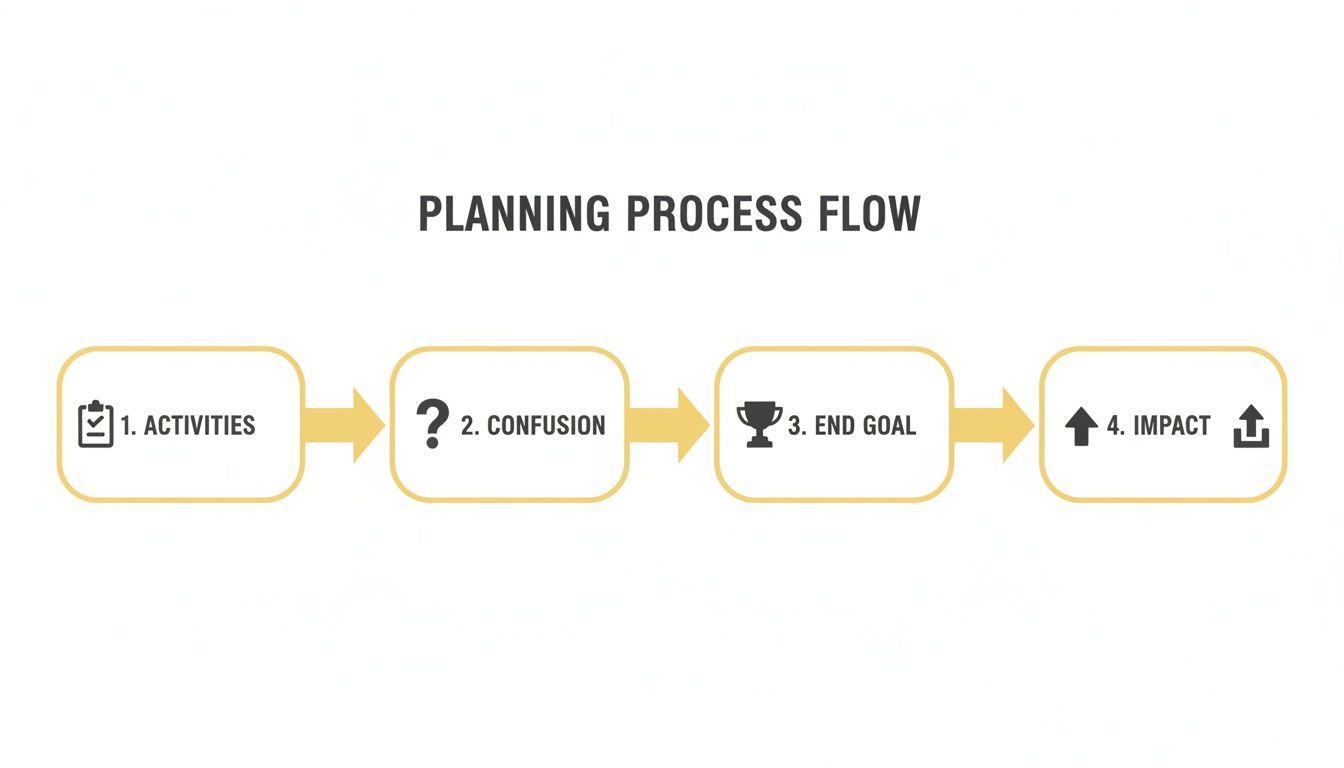
As the diagram shows, starting with activities often leads to confusion. When you start with the end goal, you create a clear path straight to impact.
Step 3: Plan the Learning Experiences and Activities
Only now—with a clear destination and defined signposts—do you start planning the journey itself. This is the final step, where you actually design the coaching sessions, create exercises, and pull together resources.
Here's the magic: every single element you plan must serve as a direct stepping stone toward producing the evidence you just defined.
For our client who's learning to delegate, your session plan might include things like:
- A session focused on identifying and overcoming mindset blocks around control and perfectionism.
- An activity where they practice using clear language to set expectations for a delegated task.
- A few rounds of role-playing difficult feedback conversations for when they conduct project check-ins.
This sequence guarantees that every minute of your coaching is purposeful. You're no longer just having "good conversations" and hoping for the best. You are intentionally architecting a specific, measurable transformation for your client.
Designing Your Client's Victory Lap First
Alright, enough with the theory. Let's get our hands dirty and talk about how this actually works in a real coaching session. This is the part that feels like magic to your clients but is pure, intentional strategy on your part.
One of the first hurdles every coach faces is the "fuzzy goal." Clients often come to us with big, beautiful, but vague dreams. How can you possibly start with a concrete outcome when they can't articulate one? That's where your real coaching skill comes into play—your job is to guide them from a feeling to a finish line.
The entire idea behind backwards planning is to start by defining that finish line. Just like you can't create a social media strategy that works without clear objectives, you can't build an effective coaching plan without first designing your client's "victory lap."
First, Pinpoint the Finish Line
Forget goals like "I want more work-life balance." As a coach, you know that's not a goal; it's a wish. Your first job is to help the client translate that wish into something tangible they can actually achieve.
Let's stick with that "work-life balance" example. Through some targeted questioning, you can help them reframe it into something like this: "Leave the office by 5:30 PM four days a week for the next four weeks, and don't check work email after 7 PM."
See the difference? Suddenly, you have a destination. It's specific, measurable, achievable, relevant, and time-bound (SMART). The client can now see exactly what success looks like, which is often half the battle. That clarity alone is a huge win.
Next, Define What Success Looks Like
Okay, so you've set the goal. But how do you know the change is real and not just a good intention? This is where you determine the "acceptable evidence." This isn't about giving your client a test; it's about co-creating milestones that make their progress undeniable.
This evidence is the proof that the transformation is happening. For our work-life balance client, that proof might include:
- A shared log of departure times: Something as simple as a shared note or spreadsheet where they track when they leave the office.
- Screenshots of their empty inbox at 7 PM: A quick visual confirmation that they're sticking to their new boundary.
- A weekly "win journal" entry: A short reflection on how leaving on time that week impacted their personal life.
These aren't meant to be punitive. They're powerful tools for accountability and motivation. When a client sees a chart showing they’ve left on time for three straight weeks, the momentum becomes an unstoppable force. You’re making an invisible internal shift into a visible, external reality.
Think of the evidence as the collection of photos from a successful trip. The outcome was the destination, but the evidence is the proof you actually went there and had an amazing time. It solidifies the memory and the achievement.
Finally, Map Out the Journey
Only after you have the crystal-clear outcome and the defined evidence do you begin brainstorming the actual coaching sessions. This is the fun part. You’re no longer just pulling random activities out of your hat; you're building a custom-paved road that leads directly to your client's victory lap.
A common concern I hear is, "But isn't this too rigid? What if the client needs something different one week?" That’s a fair question. This plan isn't a rigid script; it's a strategic framework.
For the client seeking work-life balance, your session topics suddenly have a laser focus. You might design a sequence of sessions around:
- Boundary-Setting Language: Role-playing how to say "no" to last-minute requests.
- Time-Blocking and Prioritization: A deep dive into their calendar to protect that 5:30 PM departure time.
- Delegation Strategies: Identifying tasks they can offload to create more breathing room.
- Mindset and Guilt: A session on overcoming that nagging feeling of "slacking off" when they disconnect.
Each session directly builds a skill needed to produce the evidence (leaving on time, empty inbox) that proves they’re reaching the outcome (better work-life balance). It creates a focused, powerful coaching curriculum. If you want to explore this part of the process more, our article on how to write a comprehensive curriculum is a great resource.
And this method works. A 2020 analysis found that high school teachers using backward design saw 35% higher student mastery on final assessments. Another review in 2022 showed it boosted student independence by 28%, which led to 40% fewer late submissions. For coaches, this translates directly to more tangible client wins and a more efficient practice—some platforms even report that automating plan-aligned reminders can cut client no-shows by 22%.
Backwards Planning in the Real World
It's one thing to talk about a methodology, but it’s another thing entirely to see it in the wild. This is where backwards planning really comes to life. When I talk with experienced coaches, they don't see this as just another planning tool; they see it as co-designing a client’s victory from the very start.
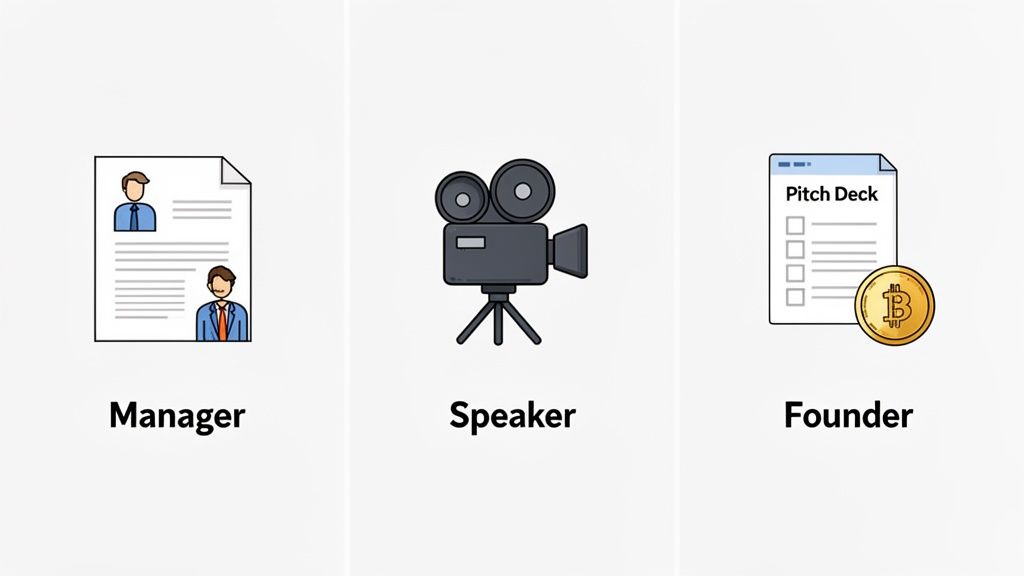
Let’s look at how three different coaches might put this into practice.
Scenario 1: The Executive Coach and the New Manager
Imagine an executive coach, Sarah, meeting her new client. David just got promoted to manager, and he's drowning. His goal is simply to "not fail"—a common but unhelpful starting point. Sarah’s job is to find a concrete anchor for their work.
Instead of suggesting leadership articles, her first question is, "What's the first big, high-stakes event on your calendar where your leadership will be on full display?" David thinks for a moment and lands on the quarterly strategy meeting he has to lead in two months.
Now Sarah has a destination. Forget the vague idea of "not failing"—let's focus on absolutely nailing that meeting. That’s a tangible win.
This is how she reverse-engineers the plan:
- The Big Win: David will confidently facilitate his first quarterly strategy meeting, producing a clear, documented action plan for the team.
- Proof of Success: How will they know he nailed it? They’ll have a finalized strategy doc, positive feedback from at least two senior colleagues, and David’s own self-reported confidence in facilitation will jump from a 3/10 to at least a 7/10.
- The Coaching Sessions: With the end in sight, Sarah designs the sessions as direct building blocks.
- Weeks 1–2: They'll focus on crafting the agenda and conducting pre-meeting stakeholder interviews.
- Weeks 3–4: Time for role-playing. They'll simulate managing difficult personalities and navigating tough group dynamics.
- Weeks 5–6: Sessions will shift to presenting data clearly and guiding a group toward consensus without railroading them.
- Week 7: A full dry-run of the meeting presentation and facilitation, putting all the pieces together.
Every step is designed to generate the evidence that proves the outcome. David isn't just "learning leadership"; he's gaining the precise skills for a specific, career-defining moment.
Scenario 2: The Life Coach and the Anxious Speaker
Next up is a life coach, Alex. His client, Maria, has crippling anxiety about public speaking. The problem? Her sister's wedding is in three months, and she's been asked to give the Maid of Honor toast. The thought alone is giving her sleepless nights.
A less experienced coach might jump right into breathwork or practice drills. But Alex starts at the end. He’s thinking, the toast is the entire goal. She doesn't need to become a TED speaker; she just needs to deliver five heartfelt minutes with confidence. How do we make that single moment a success?
Here's his backwards plan in action:
- The Big Win: Maria will warmly and confidently deliver her wedding toast.
- Proof of Success: They'll define success with three key metrics: a friend will record the toast so they can review it, Maria's post-toast confidence will hit at least an 8/10, and she’ll be able to relax and enjoy the rest of the reception.
- The Coaching Sessions: The plan becomes a gradual process of building skills and desensitizing the fear.
- Month 1: They'll focus entirely on mindset, reframing anxious thoughts and separating her self-worth from this one performance.
- Month 2: They'll introduce the tools—practicing grounding techniques, then actually writing and polishing the toast itself.
- Month 3: It's all about practice. She'll start by delivering the toast to Alex, then to a trusted friend, and finally to a small group of friends.
The goal isn’t to eliminate the fear but to build the confidence to a point where the fear no longer has control. The plan creates a safe, scaffolded path to that exact moment.
Scenario 3: The Business Coach and the Founder
Finally, let’s look at Maya, a business coach. She’s working with a founder, Ben, who is tackling his first pre-seed funding round. His goal is to "raise money," which Maya immediately recognizes is far too broad to be actionable.
Her first thought is, raising capital isn't a single action. It’s the final outcome of a dozen smaller wins. We need to define what a successful round looks like and identify the milestones that prove he's on the right track.
The backwards plan becomes a strategic roadmap to the fundraise:
- The Big Win: Ben will successfully close a $500k pre-seed funding round.
- Proof of Success: This is a multi-part metric. Success means having a finalized, compelling pitch deck; a target list of 50 qualified investors; at least 10 investor meetings scheduled; and ultimately, one signed term sheet.
- The Coaching Sessions: Maya structures their coaching work around producing this evidence.
- Phase 1 (Deck & Narrative): Intense sessions focused on storytelling, financial projections, and visual design for the pitch deck.
- Phase 2 (Investor Targeting): Workshopping the ideal investor profile and using networking strategies to build that target list of 50.
- Phase 3 (The Pitch): Mock pitch sessions with pointed feedback, specifically preparing him for the toughest questions investors will ask.
In the real world of coaching, applying backwards planning means your lesson plans become more than just a list of activities—they become a series of strategic steps toward a clear, meaningful client victory. These principles are fundamental to making a lesson plan that works. When you're ready to scale this thinking to an entire program, you might also want to explore how to create an outline of a course.
Common Mistakes and How to Sidestep Them
Let's be honest—adopting any new method, especially one that flips your process on its head, is going to feel a bit strange at first. That little voice of doubt might start whispering some very convincing reasons to stick with what you know.
I've been there, and I’ve coached hundreds of others through it. Let's talk through the most common hang-ups I hear so you can push past that initial awkwardness with confidence.
"This Feels Like Teaching, Not Coaching"
One of the first things coaches tell me is, “I’m a coach, not a teacher. This feels like I’m building a syllabus instead of holding space for my client to explore.”
This is a totally valid point, but it stems from a slight misunderstanding of how the plan works. The backward plan is your behind-the-scenes blueprint, not a script you read from.
The “learning activities” aren’t lectures. They are the same powerful, open-ended coaching questions and client-led discovery exercises you’re already using. The only real difference is that now, those questions are strategically aimed at a specific target. You’re still facilitating discovery; you’re just making sure that discovery leads somewhere meaningful.
The plan is your guardrail, not a script. It ensures that even the most organic, in-the-moment coaching conversations are still moving the client down the field toward their goal.
This kind of structured approach has proven its worth time and again, even in highly regulated environments. By 2023, 82% of US K-12 districts had adopted backward design, and the results were striking: test scores jumped by 16-22%.
A 2024 analysis also found 91% of teachers agree it boosts engagement, with lesson effectiveness ratings climbing from 6.2/10 to 8.7/10 after they made the switch. If it works that well in rigid school systems, just imagine the impact it can have in the flexible world of coaching. You can explore more on how backward design is being implemented in education to see the data for yourself.
"But My Clients' Needs Change All the Time!"
This is the big one. “My coaching is fluid! My client could have a breakthrough tomorrow that changes everything. This feels way too rigid.”
I hear you. The last thing you want is a plan that traps you.
But a backward plan isn't a concrete cage; it's more like a GPS. You plug in a clear destination (the outcome), but if you hit a surprise roadblock or decide to take a scenic detour (a client pivot), the system can instantly find a new path. The structure gives you the freedom to adapt with purpose instead of just wandering aimlessly.
"I Don't Know How to Write 'Learning Objectives'"
Finally, there’s the jargon hurdle. Many coaches feel intimidated by academic-sounding terms and think, “I can’t write ‘learning objectives’ and ‘acceptable evidence.’ That’s not what I do.”
Forget the fancy terminology. We’re not writing a formal curriculum for a university.
All you're doing is getting clear on the goal. You can make this feel completely natural by using simple, collaborative sentence starters with your client.
- For the Outcome: "By the end of our work together, what’s the one thing you want to be able to do?"
- For the Evidence: "How will we know for sure that you've got this? What would that look like?"
Here’s a real-world example of how that conversation might go:
- "By the end of these three months, you'll be able to confidently lead your weekly team meeting from start to finish."
- "And we'll know you've nailed it when you can show me your meeting agenda and share a recording of the session for us to review together."
See? It’s just a clear agreement. By simplifying the language, you turn a stuffy academic exercise into an empowering conversation that gets you and your client on the same page from day one.
Answering the Tough Questions About Backwards Planning
I get it. Even after seeing the power of this approach, it’s natural to have some lingering "what ifs." You’re probably wondering how this clean, structured method holds up in the messy reality of a coaching relationship.
That's a good thing—it means you're thinking like a pro. Let's tackle the most common questions and hesitations that come up when coaches first start using backwards planning.
What if My Client’s Goals Change?
This is usually the first question I hear: "This all sounds great, but my clients have breakthroughs all the time. What happens when the goal we set in session one is totally irrelevant by session four?"
That's not a problem; that's the whole point of great coaching!
Think of your backwards plan as a GPS route, not as a concrete slab. If you decide you want to go to a different city halfway through a road trip, you don't throw your phone out the window. You just punch in the new destination. Your backwards plan gives you the framework to pivot just as intentionally.
When a goal shifts, you simply walk through the process again:
- Get crystal clear on the new outcome.
- Define what success now looks like.
- Rework your upcoming sessions to build toward that new target.
This actually makes your pivots more powerful because they are just as focused and purpose-driven as your original plan.
Isn't This Too Structured for Coaching?
Another common feeling is that this might be too rigid. Coaches often tell me, "I value the organic, intuitive flow of a session. I don't want to follow a script."
I completely agree. The last thing you want is a coaching session that feels robotic.
The key is to understand that the structure is for you, the coach. It’s not a script for the client. It provides the guardrails for the journey, ensuring every session, every question, and every activity is building toward something meaningful.
The plan gives you focus, not a script. Within that structure, your coaching can be as organic and client-led as ever. It's the difference between a focused exploration and just wandering aimlessly.
This framework is your secret weapon. It ensures your powerful questions and explorations are always moving the client forward, connecting each "aha!" moment to a bigger, tangible result they can see and feel.
How Much Time Should This Take?
Finally, there’s the practical question of time. "This sounds like a lot of upfront work. How much time will I really spend on this?"
For a typical three-month engagement, you can expect to spend about 60 to 90 minutes mapping out your initial plan. That’s it.
The return on that initial investment is huge. You immediately save hours of "what should we work on this week?" prep time down the road. More importantly, your client feels the intention and clarity from day one, which dramatically increases the value of your coaching in their eyes.
For group programs, the ROI is even better. You build the plan once and can use it to deliver a high-impact experience again and again. It quickly becomes one of the most efficient and effective tools in your arsenal.
Ready to stop wasting time on scattered plans and start designing real transformation? Coachful provides the all-in-one platform to build, manage, and scale your backwards planning lesson plans. Set clear outcomes, track evidence of success, and deliver purposeful coaching that gets results. See how Coachful works.