
Best Client Onboarding Process: 8 Steps That Work in 2026

Coachful

She pays on Tuesday afternoon, still buzzing from your discovery call. Your system sends a receipt and a vague line, something like "Welcome aboard, we'll be in touch." Then nothing. No intake link. No date for session one. No explanation of what she should prepare, or even where to show up.
By Friday she's not angry. She's wondering if she made a mistake. By session two she's polite, late with her homework, and already half gone. You never get a complaint. You just get a client who stops replying.
That silent gap is where most practices lose people, and it's why the best client onboarding process isn't about paperwork. It's a commercial, relationship-building sequence. Bain & Company research popularized by Frederick Reichheld found that a 5% increase in customer retention can generate more than a 25% increase in profit in financial services, according to the customer onboarding statistics summary. Coaching lives on renewals, referrals, and completion, so that early experience carries the same weight.
The eight steps below turn that uncertain first week into momentum. Each step starts when your client takes a specific, verifiable action, signing, paying, booking, submitting. The journey moves on evidence, not hope, and every step answers the doubt you're probably having at exactly that moment.
1. Pre-Onboarding Inquiry and Fit Qualification
Your inner voice at this stage says, "If I ask too many questions, I'll scare off a paying client." The opposite is true. A short qualification step makes you look selective and competent, and it protects you from the client who drains three months and then blames your method.
Keep it to one page and three questions. Say you're an executive coach. Your form asks, "What outcome do you need in 90 days?", "Who else must agree to the change?", and "What have you tried already?" A prospect who can't name a specific outcome isn't rejected cold. You invite her to a free group workshop instead, where she can clarify what she wants without either of you committing to the wrong container.
Say you're a life coach working with burnout. You add one line about current medical or therapy support. Someone describing symptoms that need clinical care gets a kind referral, not a coaching package. That's not a lost sale. That's you doing your job properly.
The Script That Ends Every Discovery Call
Don't finish with "Let me know what you think." Finish with a named next step. Try, "Based on what you've told me, this is a fit because we can work on X in 90 days. The next step is the agreement, I'll send it today. If you don't want that pace, tell me now and I'll point you somewhere better."
- Write your fit criteria down: Goals, timeline, budget, and readiness, checked on every call
- Ask the money question: "What would make this worth your investment?" surfaces the decision driver
- Close the loop: Agreement, referral, or waitlist, never a vague maybe
2. Coaching Agreement and Scope Definition
Now she's said yes, and your doubt flips. "Won't a contract kill the warm feeling we just built?" Clients don't mind clear terms. They mind discovering the terms later, usually during a disagreement about texts at 10 p.m. or a session they thought was free.
Walk through the agreement live, in plain sentences she could explain to a friend. Here's a worked example you can copy: six 60-minute sessions over three months, two async voice-note check-ins per month, 48 hours' notice to reschedule, and 30 days' written notice to end the engagement. Say each line out loud and ask, "Does that match what you expected?" She signs a decision she understands, not a document she skimmed.
Privacy belongs here, and it needs to be specific. Under GDPR, consent must be freely given, specific, informed, and unambiguous, expressed through a clear affirmative action, as the Your Europe GDPR guidance sets out. So use separate checkboxes for session notes, progress tracking, and optional marketing, not one pre-ticked box. If you need wording to model, start from our coaching contracts resource and adapt it to your jurisdiction.
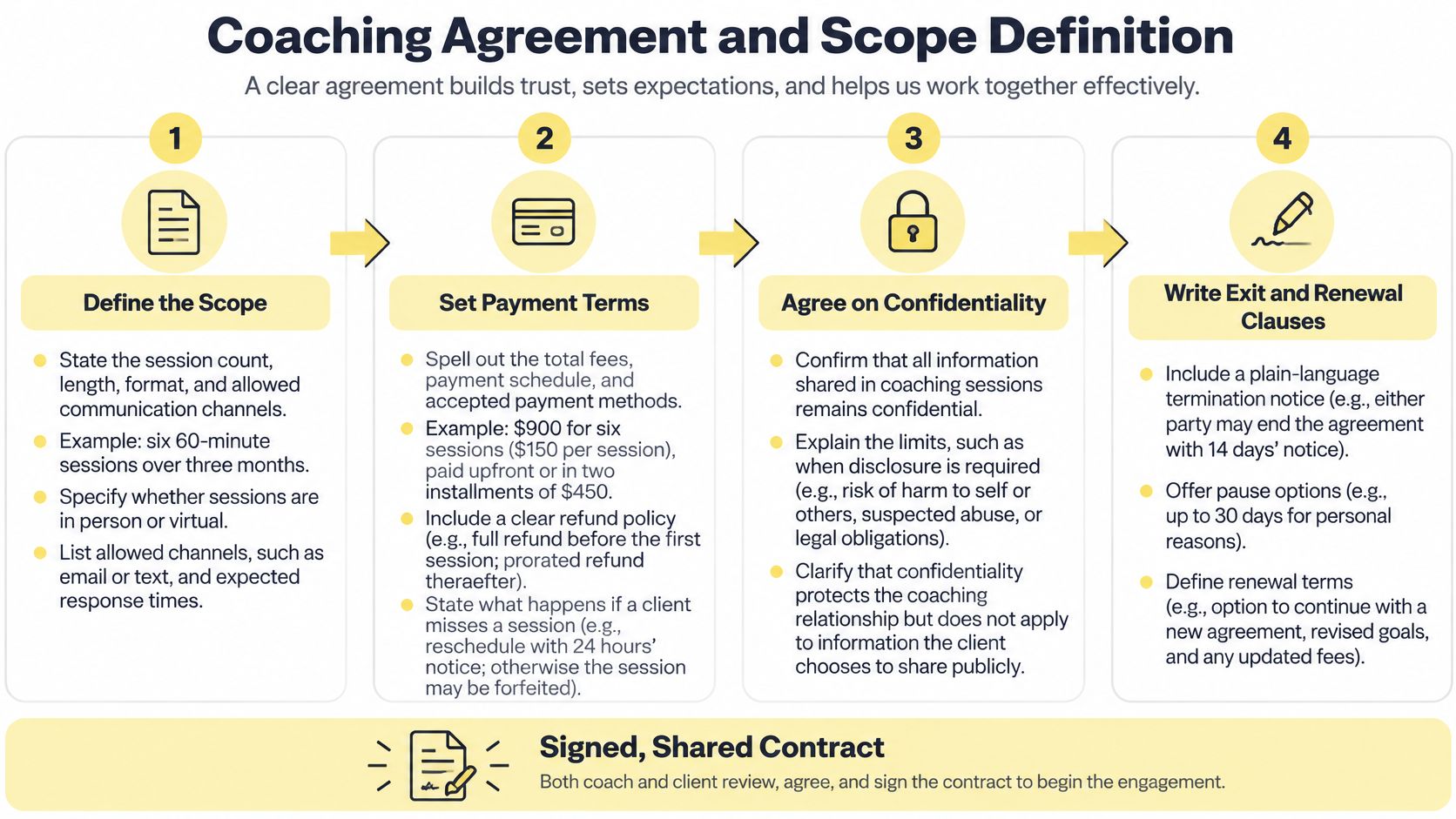
Add a pause clause if your clients live volatile lives. A leadership coach who lets a client freeze for up to 30 days during a crisis keeps clients a rigid policy would lose. Keep a version history, too. When terms change next year, you'll need to show which version applied to whom.
3. Secure Payment Setup and Billing Transparency
Your worry here is, "Talking about money makes me sound salesy." What makes clients uneasy is a surprise. A charge they didn't expect, on a date nobody mentioned, with no receipt. Transparency is the least salesy thing you can do.
State the total price and the schedule before you ask for card details. Say your program is $2,400 billed as three monthly payments of $800. Your checkout says exactly that, sends an automated receipt after each charge, and a reminder five days before each renewal. She never has to email you asking what just hit her card.
On our side, we built this so a client journey starts on purchase. An offer holds the price or payment plan, the calls, private chat, and the program, and onboarding begins when the client pays. Complete Stripe onboarding under Coach, Settings, Billing first, it takes about five minutes, because a transaction fails if a client reaches checkout before your Stripe account is fully verified. Our secure payment link guidance covers the setup details.
Practical rule: Test your own checkout on your phone before you send it to anyone. If you hesitate anywhere, your client will abandon there.
Handle failure before it happens. Set one line, "If a card fails, we'll retry in two days and email you first," and apply it to everyone. A health coach who sends a portal reminder two days before a retry recovers most failed payments without a single awkward chase email. Offer a pay-in-full incentive if cash flow matters, and thank people personally when they take it.
4. Intake Questionnaire and Baseline Assessment
Your doubt now runs, "I need her full history or I'll look unprepared." She sees a 40-question packet and thinks, "I don't have an evening for this." Friction at this exact point empties pipelines.
Visa Consulting & Analytics found the average customer abandons a digital application after 14 minutes and 20 seconds, and 55% leave once a process exceeds that duration, in its digital onboarding experience report. That's financial account opening, not coaching, but the design lesson transfers. Every duplicate field costs you completions.
So collect only what you'll use in the first three sessions. Say you're a career coach. Send 12 questions max. Rate current job satisfaction from 1 to 10. List three recurring frustrations. Describe a typical workday. That's enough to open session one with direction instead of spending it on biography.
Make the Baseline Do Double Duty
A life coach asks clients to rate five areas of life balance, then opens the first call with the two lowest scores. Instant focus, no generic warmup. Repeat those same questions at the end of the program and you've got visible proof of change.
Tell her plainly how answers are stored and who can see them. Permission to keep session notes doesn't authorize a testimonial or sharing details with her employer. Consent must stay tied to the purpose you stated, and you must be able to demonstrate she gave it, as the full GDPR text requires. Separate the checkboxes. She'll trust you more for it.
5. Goal Setting, Milestones, and Success Criteria
Here's the thought you won't say out loud. "She wants 'more confidence,' and I have no idea how to coach that." You're neither wrong nor stuck. Vague goals fail because nobody can tell when they've been reached, so both of you drift.
Translate aspiration into observable behavior. The Center for Creative Leadership coaching research organizes engagements around assessment, challenge, support, and results, and emphasizes meaningful goals, specific behaviors, and measurable milestones. Copy that structure. One priority goal, two or three observable behaviors, agreed checkpoints.
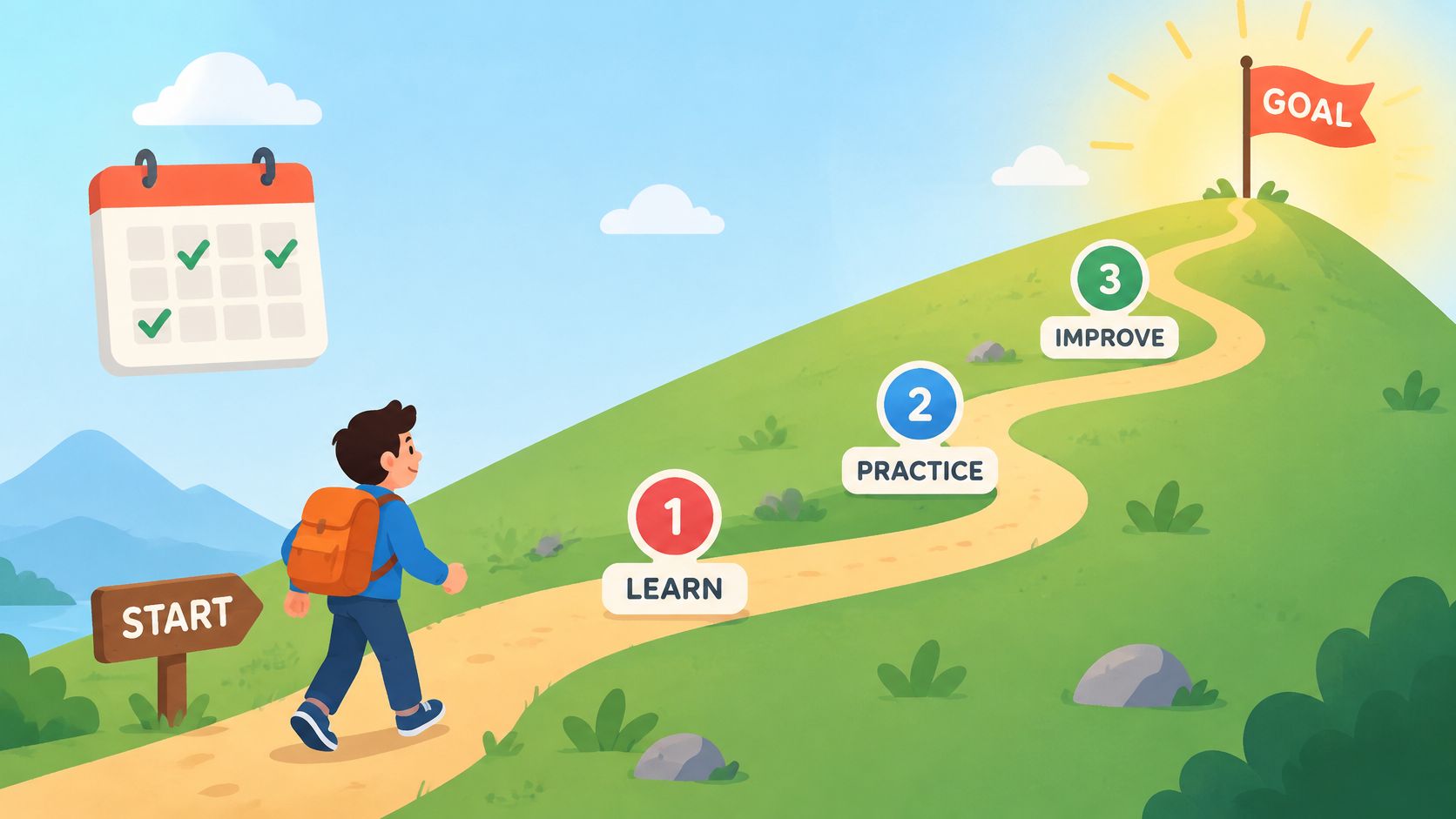
Instead of "grow my business," the goal becomes "sign three new retainer clients by week 10, with a pipeline review every Monday." A health coach turns "feel better" into "walk 6,000 steps on four days per week by week four," tracked where the client can see it. Our goal-setting examples give you more translations in that pattern.
Keep asking, "How will you know this has happened?" until she describes something a third person could verify. Limit the program to three to five primary goals. Then design around time to value, the elapsed time from start to the first verifiable outcome, not administrative completion. Benchmarks placing strong self-serve onboarding near a 10-day median time to value are summarized in IBM's customer onboarding automation guidance. Book a midpoint review now, and adjust goals there without shame when reality teaches you something.
6. Kickoff Session and Working Agreement
You've done the admin, so your instinct says, "Time to deliver value, I should teach something impressive." Resist it. The kickoff isn't a content session. It's where she decides whether it's safe to tell you the truth, and that decision shapes every session after it.
Open with a question that reveals her fears. Try, "What would make you want to hang up at the end of today's call?" Uncomfortable for three seconds, then she tells you exactly what she needs. Write her answer into a shared working agreement in her own words, covering how direct she wants your feedback, how to interrupt her when she goes off track, and what she'll do when she misses a commitment.
Say you're a career coach. Ask about a past coaching or mentoring experience that went badly. She might say, "He lectured and never listened," or "She was so gentle nothing changed." Now you know her preferred challenge level without guessing. An executive coach who captures this on one page stops re-negotiating it every week.
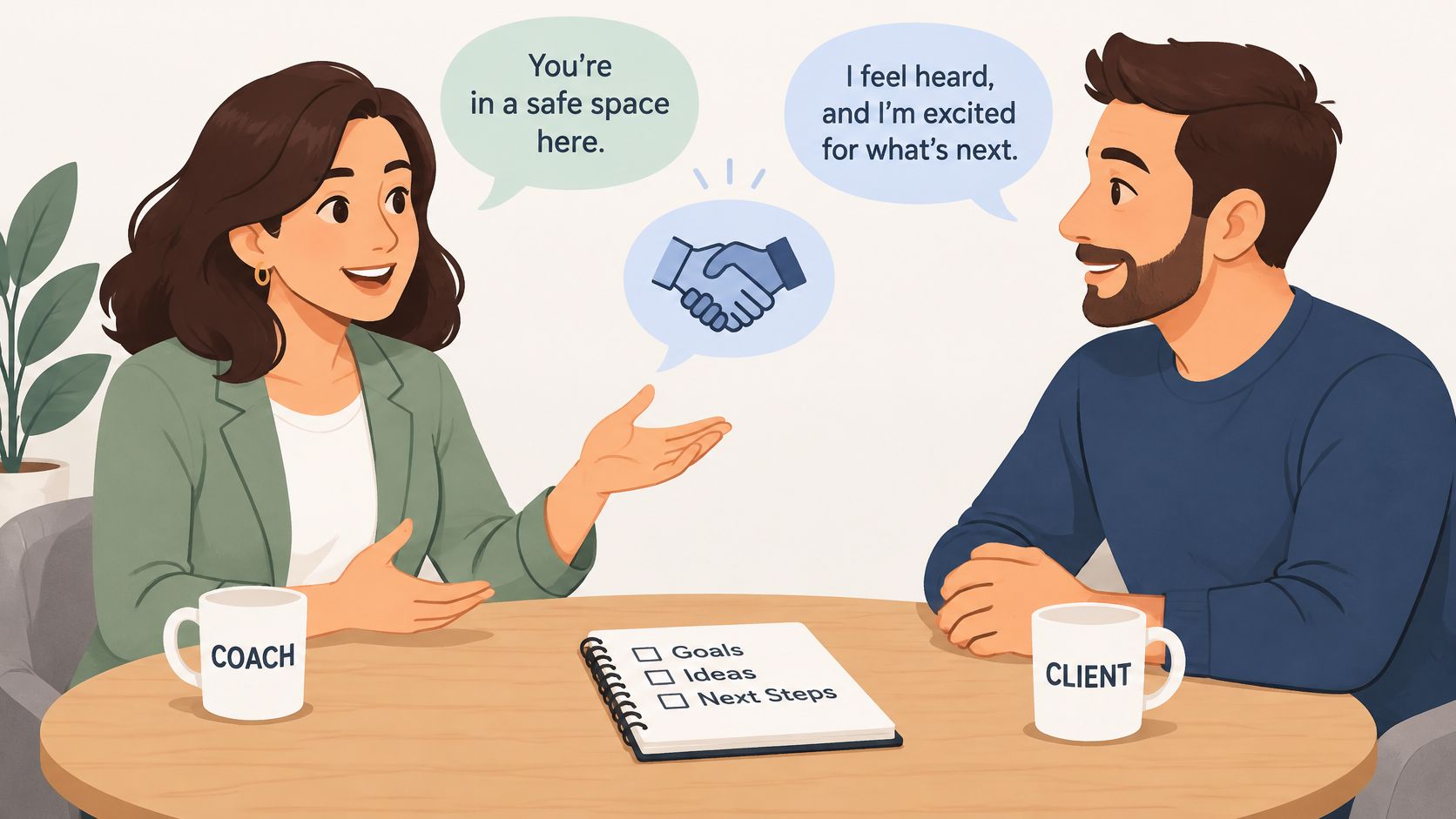
If you want help structuring the agenda itself, the kickoff planning tips from Fluidwave adapt well to coaching. Two essentials before you hang up. Confirm the goal from intake still sounds right to her, and schedule session two while she's on the call. Momentum booked is momentum kept.
7. Resource Setup, Tools, and Welcome Sequence
Your fear here is the reverse of step three. "If I automate the welcome, she'll feel processed, not cared for." Clients don't object to automation that answers their question at 9 p.m. They object to silence. Automate the logistics so you can be personal where it counts.
In 2025, 68% of organizations rated personalization as very important in customer onboarding, according to Moxo's study of more than 300 companies. Personal doesn't mean manual. It means the right message, in her situation, at the right moment.
Build a short sequence with one action per message. Day one, confirmation, login link, and a two-minute video of you saying what session one will cover. Day two, the worksheet to complete before that session. Day three, community norms and one small ask, post a two-line introduction. Say you're running a group program. That intro post is your first engagement signal, and the member who skips it gets a personal nudge from you, not another automated email.
This short video walks through how a sequenced welcome keeps new clients oriented between payment and session one.
Standardize consent, boundaries, and data permissions. Personalize her goals, pace, and preferred accountability method. Test every link while logged in as a new client, because a broken login on day one tells her your practice is disorganized, however brilliant your coaching is.
8. First-30-Day Check-In and Transition to Ongoing Engagement
Your last doubt sounds sensible. "Onboarding's done, she's attended two sessions, surely we're fine now." This is precisely when people slip away. Enthusiasm is spent, habits aren't formed yet, and the first hard week at work wins.
Treat onboarding as a 90-day retention intervention, not a week of admin. One onboarding survey estimates that approximately 70% of customer churn occurs during the first 90 days, reported in Userflow's SaaS onboarding benchmarks. So build a structured check-in at day 14 or day 30 that catches friction while it's still small.
Send three questions two days before a 20-minute review call. "What has been most useful? What has been hard to do? What do you want more of?" Then show her progress visually against her intake baseline. A business coach who brings a one-page summary of pipeline growth to day 30 can propose a six-month retainer with two optional add-ons, and the client chooses rather than being sold.
A missed session is information, not a character flaw. Ask whether the timing or the approach needs changing before you assume she's lost motivation.
Watch the signals between sessions, attendance, assignment submission, response latency. When one drops, trigger a lightweight reset instead of waiting for the cancellation email. That habit extends past day 90, too. A 2025 survey of more than 950 onboarding professionals found 34% of organizations had already re-onboarded customers to reinforce long-term value, per Rocketlane's 2025 customer onboarding report. Pause, program change, new cohort phase, each deserves a short re-entry, not an assumption.
Onboarding Steps at a Glance
| Item | When It Happens | Core Deliverable | Main Trade-off |
|---|---|---|---|
| Pre-Onboarding Inquiry and Fit Qualification | Before the client pays | Fit assessment through an intake form and discovery call | Reduces mismatches, but adds friction and unpaid time |
| Coaching Agreement and Scope Definition | After the client agrees to proceed | Written agreement on scope, payment, confidentiality, and exit terms | Prevents disputes, but can feel rigid or overly formal |
| Secure Payment Setup and Billing Transparency | At enrollment, before coaching begins | Secure checkout with clear pricing, billing, and refund terms | Simplifies payment, but installments and failed charges require monitoring |
| Intake Questionnaire and Baseline Assessment | Before the first session | Client background, goals, and a progress baseline | Enables focused coaching, but long or sensitive forms can deter clients |
| Goal Setting, Milestones, and Success Criteria | After intake and baseline assessment | Shared measurable goals, milestones, and review points | Improves clarity and accountability, but rigid metrics may not fit changing circumstances |
| Kickoff Session and Working Agreement | At the start of the engagement | Shared expectations for communication, feedback, and accountability | Builds trust, but can feel slow or unfocused without structure |
| Resource Setup, Tools, and Welcome Sequence | Between signing and the first session | Welcome messages, tool access, and preparation instructions | Saves administrative effort, but generic or faulty automation can frustrate clients |
| First-30-Day Check-In and Transition to Ongoing Engagement | Around days 14–30 | Feedback and progress review with next-step options | Catches disengagement early, but feedback or renewal discussions can feel awkward or pushy |
Turn These Eight Steps Into One Repeatable Client Journey
Read those eight steps again and notice the through line. Nobody's guessing. She applies, so you know she's a fit. She signs, so scope is shared. She pays, so access opens. She completes intake, sets an observable goal, attends a kickoff, and hits a day-30 review that ends in a deliberate decision, continue, adjust focus, or pause. That's the whole journey, from first inquiry to renewal, with no silent week anywhere in it.
Here's your concrete move this week. Draw your current process on one page and map it against these eight steps. You'll find one step where clients most often stall, usually the gap between payment and session one, or the intake form nobody finishes. Build or automate that one step first. Don't rebuild everything. Fix the leak that's costing you clients, watch what changes, then move to the next one.
You're probably thinking you need the perfect version before you launch it. You don't. A simple sequence live this month teaches you what clients do, which no amount of planning for next year can tell you. Write the three-question form. Record the two-minute welcome video on your phone. Book the day-30 calls for your current clients today. Every one of those exists within a week if you let it be imperfect.
Track a handful of numbers so you improve on evidence. First-session attendance, intake completion, days from payment to first session, and whether she's still engaged at day 30 and day 90. When a number dips, you'll know which step to open up instead of blaming your marketing or your coaching.
A single workspace helps, because stitching together a form tool, a payment link, a scheduler, and a spreadsheet is how steps get dropped. On Coachful, a client journey attached to an offer starts when the purchase goes through, and each step completes when the client does it, signing the agreement or answering the intake worksheet. We can also draft that journey from your offer itself, with a welcome step, private chat, first call booking, program access, and a review at the end. Build it once, then let every new client walk the same clear path while you spend your attention on the coaching.
Coachful brings your onboarding, scheduling, secure payments, agreements, and progress tracking into one workspace, so a client moves from purchase to first session without you chasing links across five tools. Set up your first offer and client journey during a free trial, and see your next client walk a clear path instead of a silent week. Start today at Coachful.


