Best Software for Mindset Coaches in 2026: 7 Compared
Software for mindset coaches has one hard job: keeping a new belief alive between Tuesday's breakthrough and next Tuesday's session. The reframe lands on the call, the client feels lighter, and by Thursday the old story is back ("I'm just not that kind of person"). Whatever you choose should give that new belief somewhere to collect evidence while you are not there.
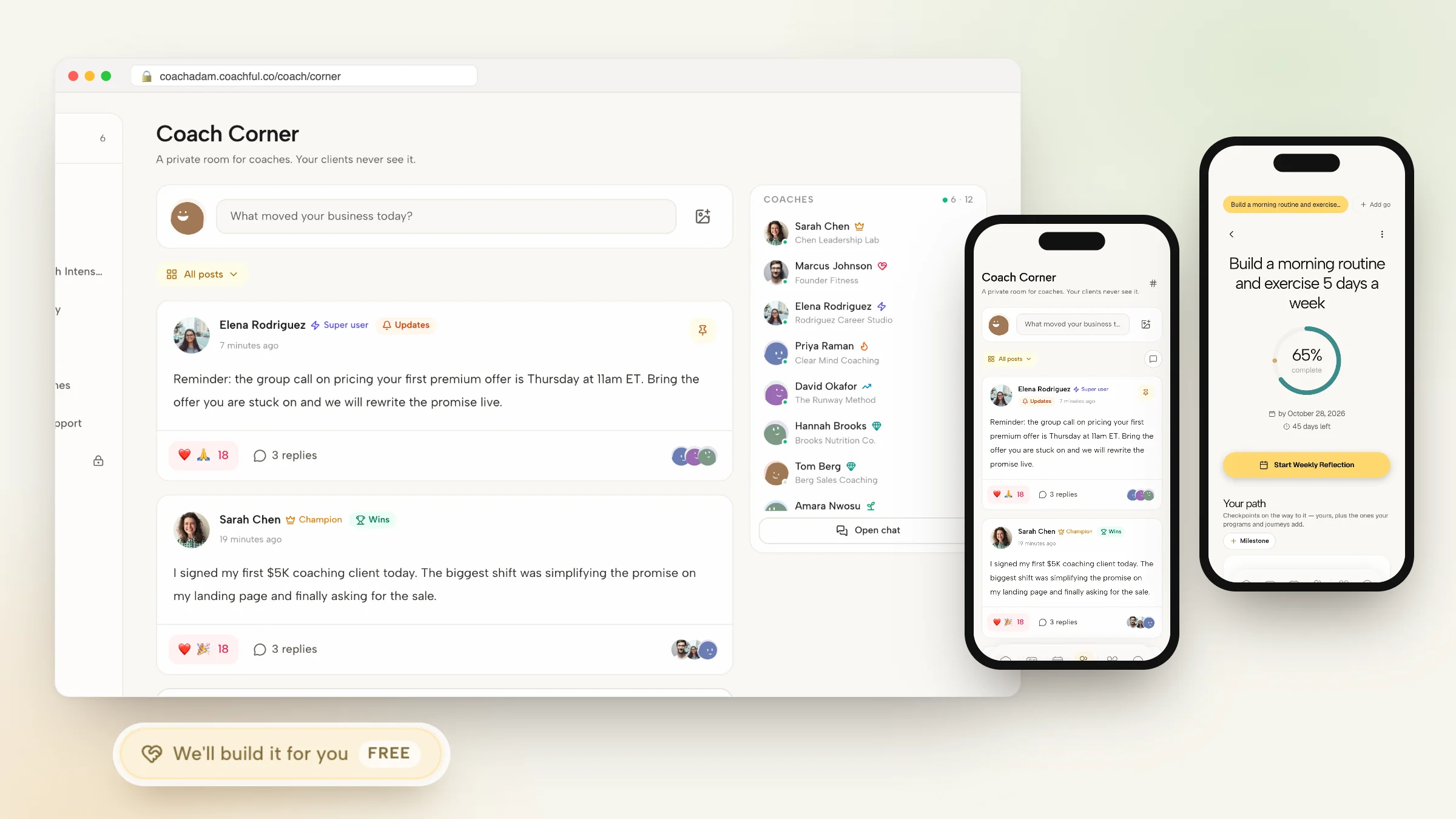
We ranked seven tools on that job and on the business around it. Coachful is first: its Life & Mindset power-up gives clients a belief board, small brave experiments with confidence before and after, a wins list filed as evidence and a private journal, next to your courses, community, booking and payments. Quenza is second for its exercise library, Kajabi third for content-led coaches, and CoachAccountable, Circle, Skool and Stan Store each suit a particular kind of mindset business.
If you would rather someone else built your website, funnel or signature program, Coachful's team does that inside your account for free, usually within about 24 hours. It is explained in the Coachful section.
Where mindset work actually happens
Most of the change in mindset coaching happens in three small moments, none of them on a call.
- The moment of doubt. Wednesday, 4pm, the client is about to apologise for something that was not their fault. Can they open a reframe they wrote in their own words?
- The brave step. They agreed to speak up in the all-hands. Did anyone remind them that morning, and did they write down what actually happened afterwards?
- The evidence. A small win that disproves the old belief. If it is not written down, it is forgotten by the weekend.
Session notes do not capture any of these. You need something the client uses, and something that shows you the result before the next call.
Content-led or client-led? Know which business you run
Mindset coaches split into two business shapes, and the right software depends on which one you are.
- Client-led: one-to-one or small-group coaching at a higher price, where the depth of work between sessions is what clients pay for. You need belief work, journals and check-ins, plus booking and agreements.
- Content-led: a podcast, YouTube channel or Instagram audience, with a course, a community and a premium coaching tier on top. You need course hosting, a community and a way to sell from your bio link.
Most coaches drift toward a mix, which is why the list below includes both kinds of tool.
How we ranked the software
Our criteria, weighted in this order: belief and reframe work between sessions, delivering content alongside coaching, group and mastermind spaces, and selling from your content to a paid offer.
Prices, fees and ratings come from our competitor registry and are given as listed in October 2026. We do not count a feature unless the vendor documents it or reviewers confirm it.
Mindset coaching software compared
| Tool | Belief work between sessions | Courses and content | Groups and masterminds | Price, as listed in October 2026 |
|---|---|---|---|---|
| 1. Coachful | Belief board, experiments, wins as evidence, private journal | Courses, audio, podcasts, downloads | Cohort groups, community, group calls | Flat monthly plans, 0% platform fee |
| 2. Quenza | Large library of science-based exercises | Pathways, no video course player | Groups from Growth | From $25/month for 10 clients |
| 3. Kajabi | None | Courses, podcasts, memberships | Communities with challenges | Basic $179/month |
| 4. CoachAccountable | Worksheets, actions and metrics | Drip courses | Groups with shared actions | $20/month for 2 clients |
| 5. Circle | None | Courses, events, live streams | Strong community spaces | Professional $89/month billed annually |
| 6. Skool | None | Simple classroom | Community with gamification | Hobby $9/month plus 10% fee |
| 7. Stan Store | None | Courses and downloads | Community on the entry plan | Creator $29/month |
1. Coachful: the best software for mindset coaches
Coachful is a coaching platform, and its Life & Mindset power-up was built for the gap between sessions that mindset coaches describe. You add it from Power-ups inside your account, and it does not change your plan.
Belief work your client can open on a hard day
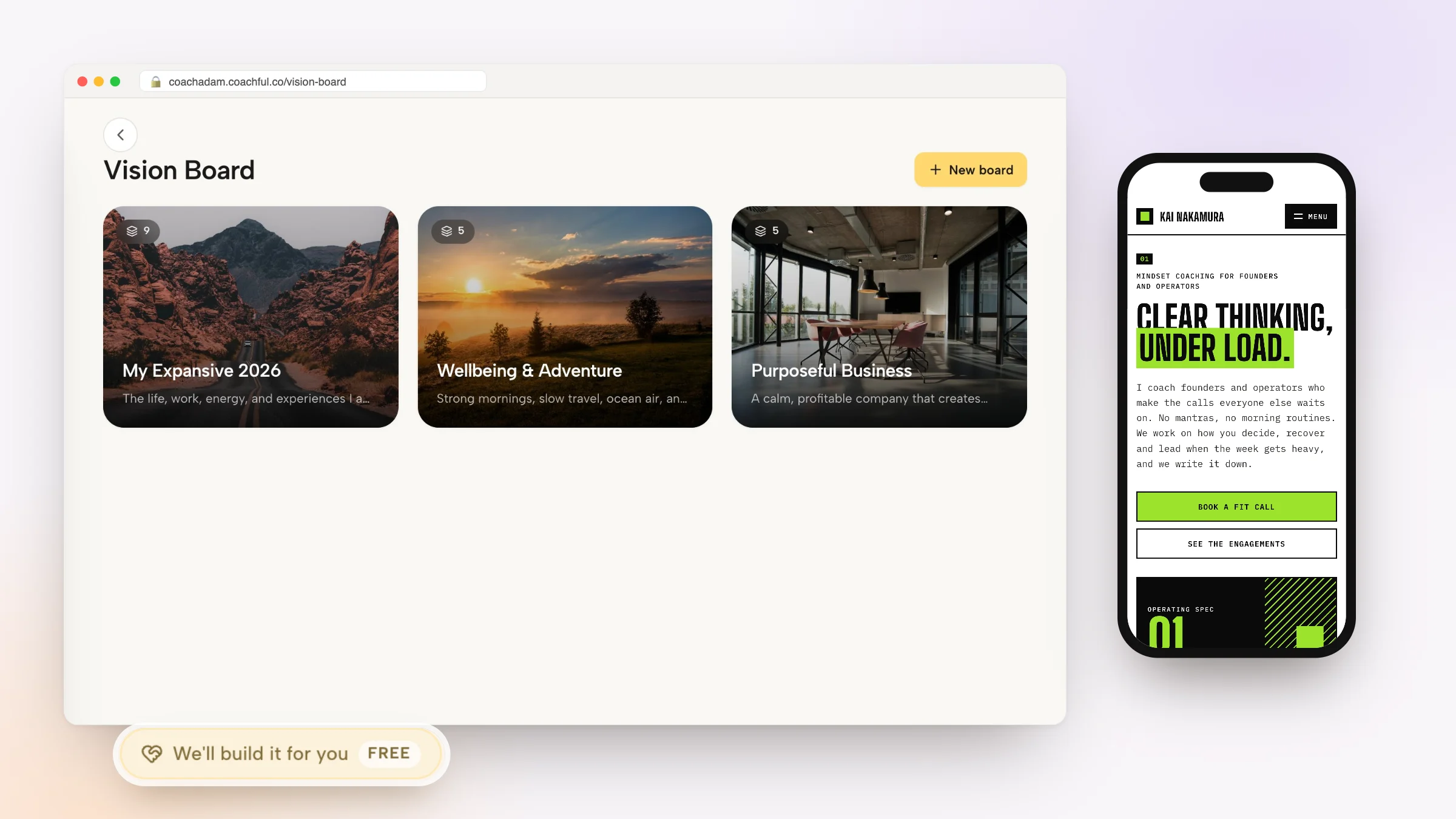
- A belief board. The client writes the belief, what it costs them, the evidence for and against, and a reframe in their own words. You can draft a reframe beside theirs, and your draft never overwrites it. Each belief moves from active to testing to released and can be linked to one of their five core values.
- Brave experiments. The situation, the step, what they predict will happen and a day, with confidence rated out of ten before and after. You can propose one; it starts once they accept. A reminder arrives at 9:00 on the day.
- Wins filed as evidence. A win, a piece of proof or a moment of gratitude, logged in seconds and filed against the belief it disproves, so the old story's evidence count visibly shrinks.
- A private journal with your prompts. Four ready-made sets of thirty prompts, or a set you write. Pages are private unless the client shares one; if they share their mood and energy tags, you see the trend.
Your overview flags what needs a look, such as a belief with no new evidence for three weeks or an experiment that is overdue. Coaching flow templates add on-demand tools such as Reframe a Thought, where the client rates how strongly they believe a thought before and after, and a Self-Compassion Break.
Content and community in the same account
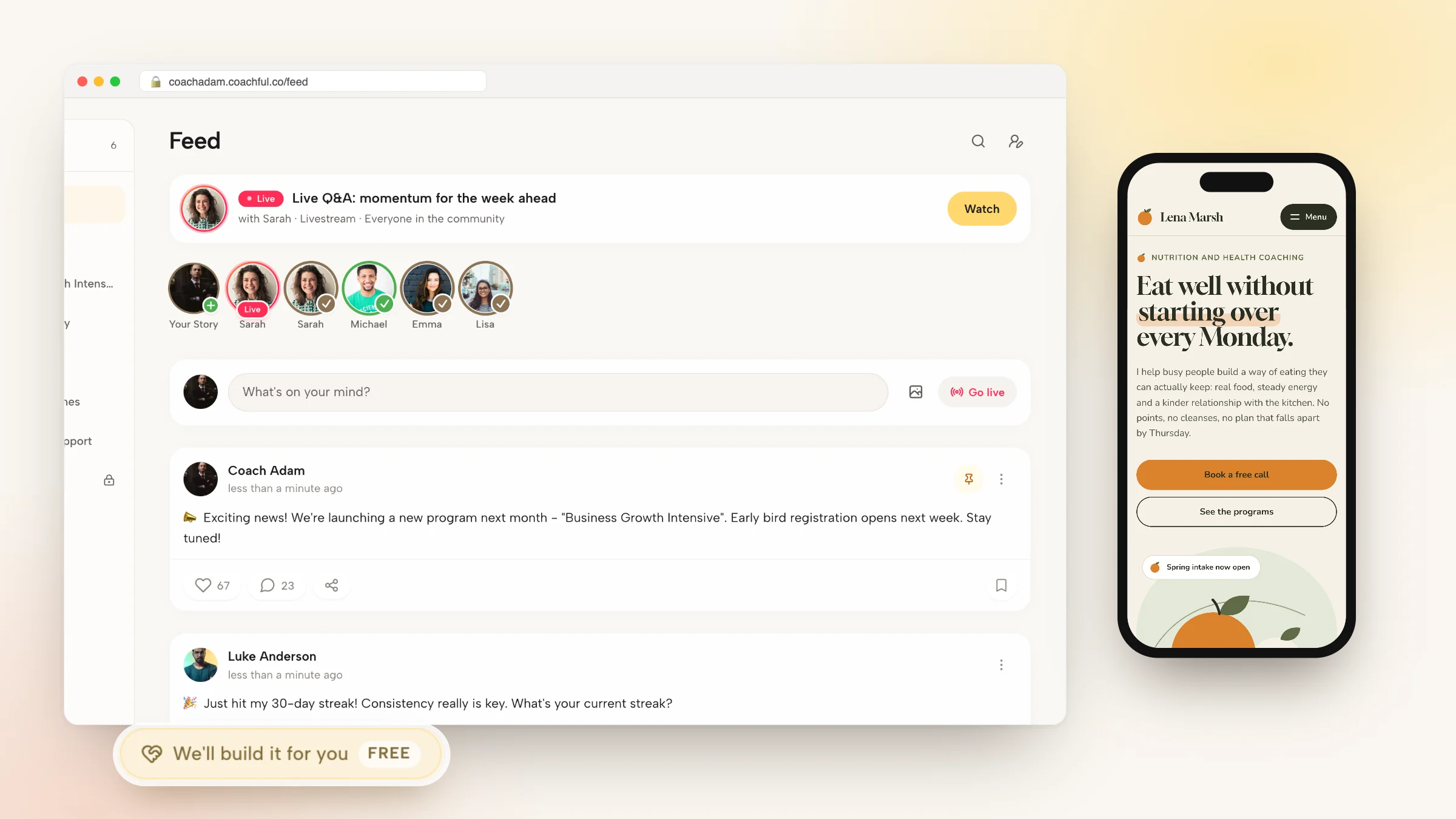
Courses with modules, lessons, drip release and completion tracking sit beside audio, podcasts, downloads and worksheets, all delivered into the client's branded app. There are 48 course templates with quizzes to start from, and program templates such as Beyond Perfectionism and Calm Under Pressure. Group programs create a cohort with a community feed, group chat and group calls, while each member keeps their own private belief board and journal.

To sell from your content, use a link-in-bio page that sells sessions and programs directly, funnels for a lead magnet or an application, email sequences, and checkout through your own Stripe or Razorpay account with a 0% platform fee. The Coachful for mindset coaches page shows every module.

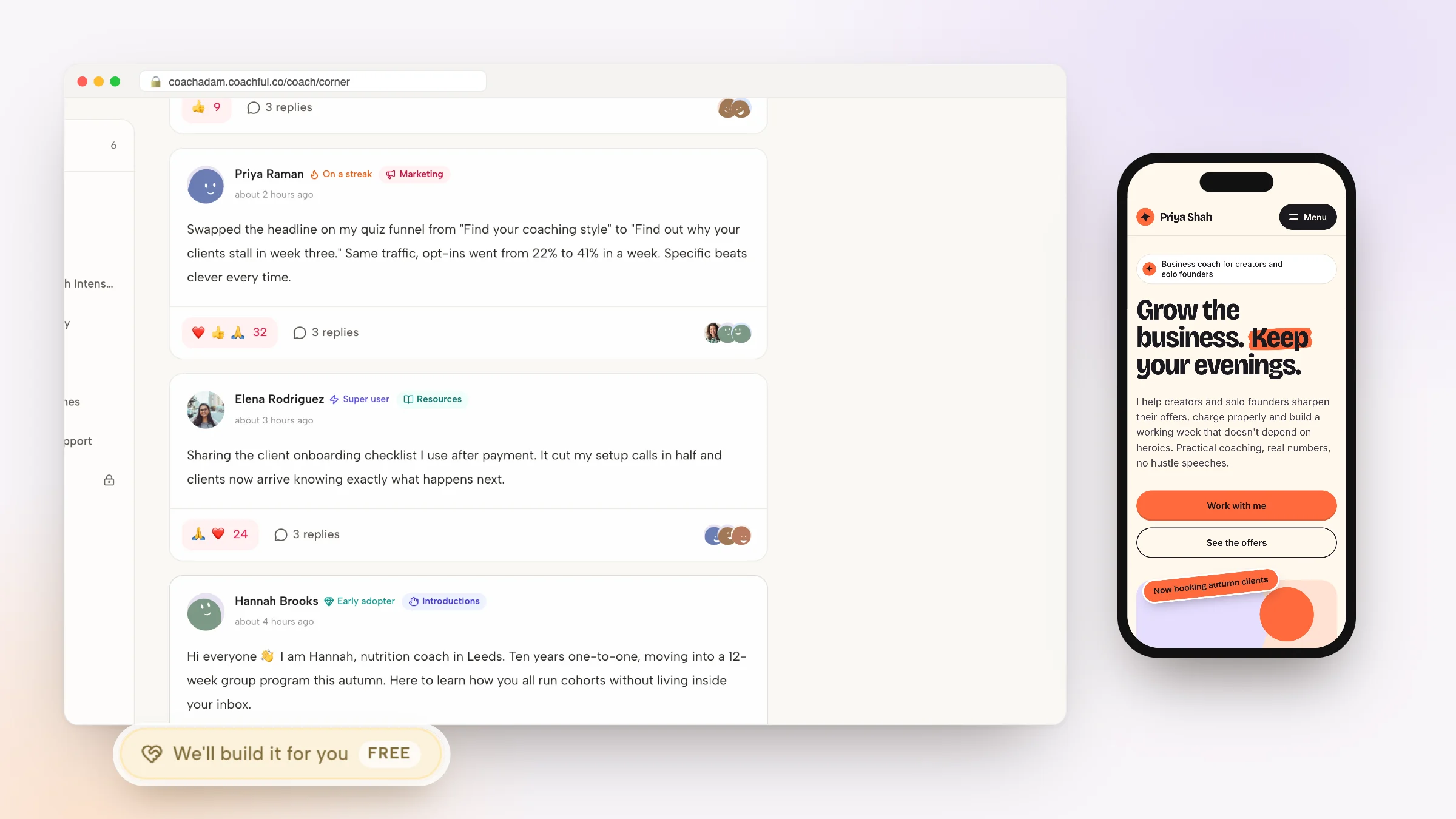
Why Coachful stands out: a free white-glove service. On every Coachful plan, our team will build the pieces content-led mindset coaches tend to postpone: a website, a free-community or lead-magnet funnel, a signature program outline, a course structure with written lessons, or a newsletter sequence. Fill in the short form in your account, add up to eight reference links and ten files such as your copy document, photos or brand guide, and the team builds it in your account, usually within about 24 hours. One recent request came from an author and speaker: five pages built from the coach's own copy document and photos, a new welcome homepage, a free community signup page and a book page that waits for the book to launch. Coachful does not record your videos for you, and nothing is invented, so missing testimonials stay missing until you add them. See what the free build includes.

Where Coachful falls short
- You only read journal pages the client shares. There is no switch to override that, by design.
- Scores and confidence ratings are self-reports. It is a coaching record, not a psychological assessment.
- No public discovery marketplace like Skool's, so your audience has to come from your own content.
- Entry plans cap clients, and the app sits under Coachful's listing with your branding inside.
Choose Coachful when the work between sessions is what your clients pay for, and you also want the course, the community and the checkout in one place.
2. Quenza: the biggest library of mindset exercises
Quenza comes from the founders of PositivePsychology.com and is built for assigning structured exercises, reflections and assessments between sessions, arranged in Pathways that release activities on a schedule.

What stands out: between 100 and 400 or more pre-made, science-based activities depending on the plan, client responses tracked on each profile, a client app, and ratings of 4.8 on Capterra from 33 reviews and 4.9 on G2 from 20, as listed in October 2026. Spark is $25 a month for 10 clients and Growth $50 for 250, after a 30-day trial with no card.
Where it falls short for mindset coaches: no payments, booking, contracts or community, no video course player, and the app stays Quenza-branded.
Pick it over Coachful if you want hundreds of ready-made exercises and already run sales and scheduling elsewhere.
3. Kajabi: for content-led mindset brands
Kajabi is built for knowledge businesses that sell courses, podcasts, memberships and coaching from one platform, with email marketing and funnels included.

What stands out: a mature course builder, native podcasts, communities with challenges and leaderboards, a coaching product with built-in live video, and a branded app on Growth. Basic is $179 a month with 5 products and 2,500 contacts; Growth is $249 with 50 products and an affiliate program, as listed in October 2026.
Where it falls short: no belief work, journals or check-ins between sessions, no coaching agreements, and a 0.5% to 2% surcharge since January 2026 on third-party payment processors.
Pick it over Coachful if your audience is large and courses carry most of your revenue. See Coachful vs Kajabi.
4. CoachAccountable: structured worksheets and follow-through
CoachAccountable turns sessions into Actions, Metrics and fillable Worksheets, with routine tracking and drip courses, and it has been continuously developed since 2012.

What stands out: unlimited coach accounts on every plan, a 30-day trial without a card, and a perfect 5.0 on Capterra from 67 reviews, as listed in October 2026.
Where it falls short for mindset coaches: pricing rises with your roster, from $20 for two active clients to $250 for fifty; there is no community feed, no website and no native app, and some reviewers find the interface dated.
Pick it over Coachful if you teach through structured worksheets and numbers, and your roster is small.
5. Circle: a premium home for a mastermind
Circle is a community platform with spaces, chat, events, live rooms, live streams and courses under your own brand.

What stands out: unlimited members on every plan, polished live rooms and events, and 4.5 on G2 from 501 reviews. Professional is $129 a month or $89 billed annually, with a 2% transaction fee, as listed in October 2026.
Where it falls short: no one-to-one booking, intake, notes or contracts, and the email hub and fully branded apps cost extra.
Pick it over Coachful if your offer is a premium mastermind community and one-to-one coaching happens elsewhere.
6. Skool: the cheapest way to launch a paid group
Skool is a community-plus-course platform popular with self-improvement and mindset creators, with a simple feed, a classroom, a calendar and gamified points and levels.

What stands out: the Hobby plan at $9 a month with unlimited members and courses, a Discovery marketplace that can bring members in, and an app on iOS and Android, as listed in October 2026.
Where it falls short: a 10% transaction fee on Hobby, no custom domain or white-label, no one-to-one tools, and a Trustpilot score of 1.7 from 51 reviews on an unclaimed profile, with complaints about charges and support. Member exports are limited to name, email and join date.
Pick it over Coachful if you want to test a paid group this week for the lowest possible monthly cost.
7. Stan Store: selling straight from your bio link
Stan Store is a creator storefront for the link in your bio: digital downloads, mini-courses, memberships and paid calls.

What stands out: setup in an afternoon, 0% platform fee, and community, courses and bookings on the $29 Creator plan, with 4.7 on Trustpilot from 2,156 reviews, as listed in October 2026.
Where it falls short: email marketing, upsells and affiliates wait for the $99 Creator Pro plan, and there are no contracts, client records or coaching tools. Some reviewers report delayed payouts.
Pick it over Coachful if you are early, social-first and selling low-priced digital products before you take coaching clients.
A belief board you can run in any tool
Whatever software you use, this five-step structure keeps a reframe working between sessions.
- Name the belief in the client's exact words. "If I ask for help, I'm a burden," not your summary of it.
- Write its cost. What has it stopped them doing this month?
- List the evidence on both sides. Honestly, including the evidence for it.
- Write the reframe together, in their words. Yours can sit beside it as a suggestion.
- Set one experiment with a prediction and a confidence rating before and after, then file the result as evidence.
Our article on reframing in coaching has examples for step four, and these imposter syndrome questions help with step one.
Frequently asked questions
What is the best software for mindset coaches?
Coachful, for mindset coaches who want the work between sessions on record. Its Life & Mindset power-up adds a belief board with reframes, brave experiments with confidence before and after, wins filed as evidence and a private journal, alongside courses, community, booking and payments. Quenza is the best exercise library, and Kajabi the best for content-led brands.
Is there an app for reframing limiting beliefs with coaching clients?
Yes. In Coachful, the client writes a belief with its cost and the evidence for and against, then a reframe in their own words, and you can draft one beside it without overwriting theirs. A Reframe a Thought flow lets them do the same exercise on demand, rating how strongly they believe the thought before and after.
Can mindset coaches sell courses and coaching from the same platform?
Yes. Coachful hosts courses, audio and downloads alongside one-to-one and group coaching, and sells them through funnels, a link-in-bio page and checkout with a 0% platform fee. Kajabi does the same for courses and community but has no between-session belief tools, and Stan Store sells downloads and calls without client records.
Should I run my mindset community on Skool or Circle?
Skool is cheaper to start, at $9 a month plus a 10% transaction fee on Hobby, and has a discovery marketplace. Circle is more polished and brandable, from $89 a month billed annually plus 2%, as listed in October 2026. If you also coach one to one, a platform that keeps the group and each client's private record together saves a login.
Can I see my clients' journals?
In Coachful, only the pages a client chooses to share, plus a count of the rest. Mood and energy tags reach you only while their sharing switch is on. Clients tend to write more honestly when they know who reads it.
Will Coachful build my mindset coaching website or program?
Yes, for free on every plan. Ask through the "We'll build it for you · FREE" chip under Create, describe the website, funnel, program or course outline you want, and attach your copy, photos and links. The team builds it in your account, usually within about 24 hours, and replies by email. Courses come as structure and written material; you record any video.
If you are still choosing a business shape, start with our guide to the mindset coach website, then compare tools once you know whether your clients pay for content or for the work between sessions. For phone-first options, see the top coaching apps for life coaches.