Certificate of Attendance Wording: 5 Templates for Coaches

Nour
Founder, Coachful
You can give a coaching workshop participant a certificate without claiming that they are qualified to coach, manage people or deliver a professional service. Use factual certificate of attendance wording: name the person, the workshop, the actual event date and the issuer, then state only the participation you can verify.
The risk is not that your certificate looks too simple. It is that “successfully certified” slips into the design when all you know is that someone joined a workshop. A polished document should not make a bigger promise than your attendance record.
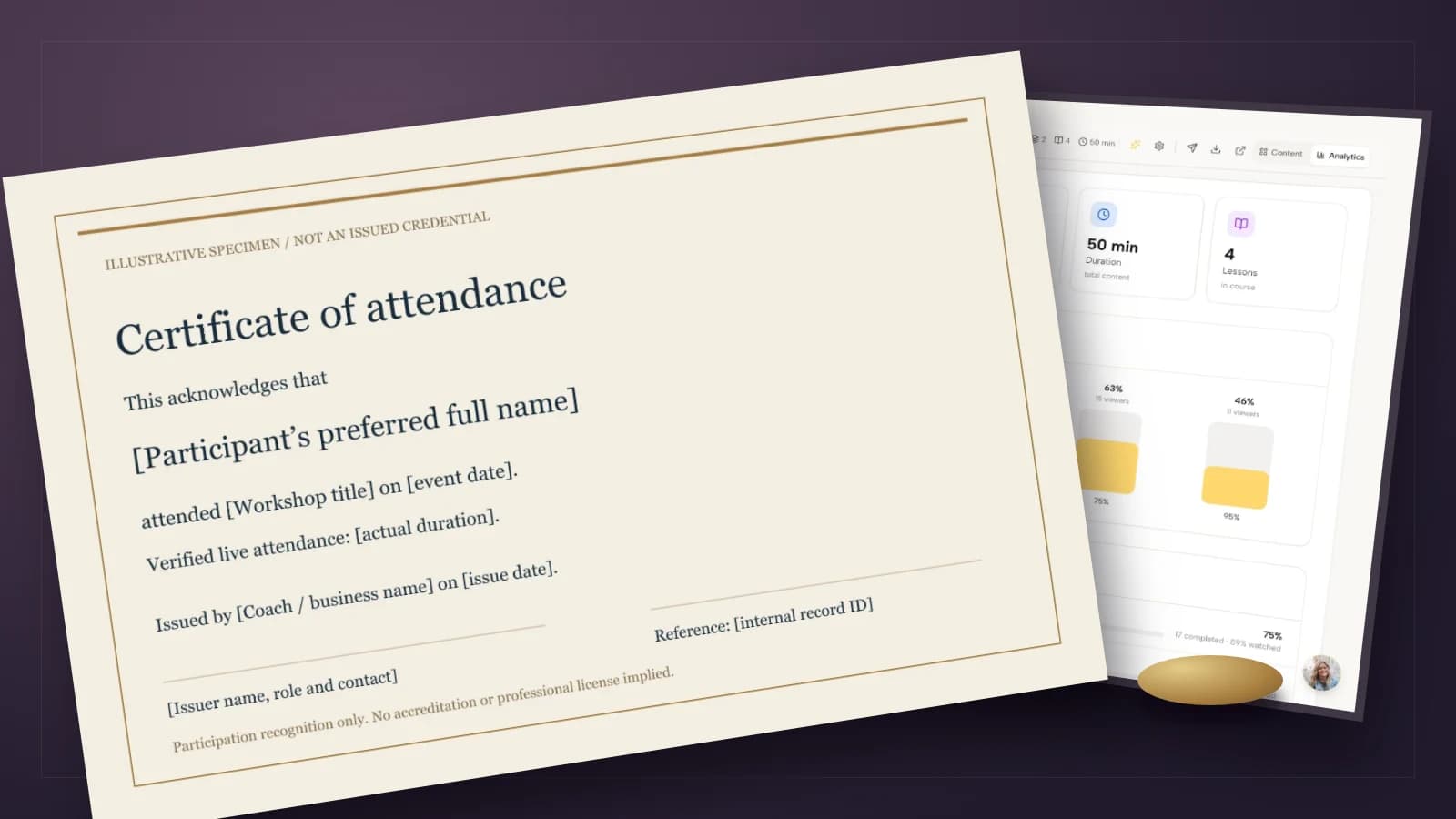
This guide gives coaches five copyable attendance wordings, a separate completion alternative and an issuance process. Every example is an illustrative template, not a real award or a statement about a real participant.
Attendance is a record, not a professional qualification
An attendance certificate records participation in a named event. A completion certificate records that someone met your stated requirements. An assessed achievement statement describes an assessment outcome. None automatically establishes professional certification, external accreditation or permission to practise a regulated profession.
Choose the claim first, then design the certificate. Gold borders, signatures and seals cannot turn attendance into assessed competence. “Certificate of attendance” is often the most useful heading precisely because it says something limited and understandable.
Before issuing anything, write one private sentence: “We can confirm that this person did [specific activity], based on [specific evidence].” If you cannot finish that sentence, resolve the record before making the PDF. Registration, payment and access to materials are not the same as attending.

What should an attendance certificate include?
Build your template around these fields. You do not need a decorative seal, an elaborate serial number or a claim that the workshop transformed someone’s career.
- Participant: the spelling and name the recipient wants on the document.
- Event: the exact workshop title and, where relevant, the cohort or series.
- Participation statement: attended, participated in, or attended the listed sessions. Avoid vague award language.
- Event date: when the activity happened, not simply the day you exported the file.
- Issuer: your name or business name, with a useful contact route and issue date.
Add the delivery format, actual contact duration, session dates or an internal reference when they help the recipient or sponsor understand the record. A signature can identify the responsible issuer, but do not copy a sponsor’s logo or a credentialing body’s mark without the appropriate permission.
If the workshop title itself contains a potentially misleading claim, a disclaimer in tiny text will not necessarily solve it. “Introduction to coaching conversations” and “Certified workplace coach training” promise different things. Fix the title and sales description before issuing a document that repeats them.
1. Simple attendance wording for a standalone workshop
Use this when you ran one workshop, verified attendance and did not assess competence. It is suitable for a short introduction, a practical learning session or an optional professional-development event that makes no external credit claim.
Certificate of attendance
This acknowledges that [participant name] attended [workshop title], delivered by [coach or business name] on [event date] in [location or online format].
Issued on [issue date] by [issuer name and role]. For record queries: [contact route].
“Attended” does the work. You do not need “successfully attended,” which can sound as though a pass standard existed. If you want to describe the topic, add a short factual subtitle such as “An introductory workshop on preparing for difficult workplace conversations.”
For a hypothetical career-coaching workshop, the event title might be “Planning Your Next Career Experiment.” The certificate can confirm attendance at that event. It should not announce that the participant is now a career coach or that they have achieved a career transition.
2. Attendance wording when contact hours matter
Use this when a participant or corporate buyer needs a record of the actual live learning time. Define your method for breaks, late arrivals and early departures before you issue hours. Do not count a lunch break merely because it appeared inside the event’s calendar block.
Certificate of attendance
This confirms that [participant name] attended [workshop title] on [event date], delivered by [issuer].
Verified live attendance: [duration]. The recorded duration excludes [breaks or other excluded time, where relevant].
Topics covered: [brief factual topic list]. Issued on [issue date]. Record reference: [reference]. Contact: [contact route].
Use “live attendance hours” rather than “approved continuing education credits” unless the relevant approval genuinely exists and covers this activity. A participant’s professional body or employer decides what it accepts; your attendance statement should not make that decision for it.
For example, a half-day event may include introductions, breaks and an optional networking period. Record the learning time you can support rather than rounding the event up to a more impressive number. If your evidence is uncertain, omit the hour claim and issue a date-based attendance statement instead.

3. Attendance wording for a multi-session workshop series
Use this when participants attended several sessions and the difference between some attendance and the entire series matters. A series title alone can conceal missing sessions, especially when someone later forwards the document to an employer.
Certificate of attendance
This acknowledges that [participant name] attended the following sessions within [series title], delivered by [issuer]:
[Session title and date]
[Session title and date]
[Additional verified session, if applicable]This document records the sessions listed above. It does not confirm completion of sessions or requirements not listed.
Issued on [issue date]. Issuer: [name and role]. Reference and contact: [details].
If everyone must attend all sessions to receive a separate completion award, keep the attendance record and completion decision distinct. Someone may legitimately receive a record of two attended workshops without being described as having completed a four-part program.
Do not add a catch-up requirement after enrollment simply because attendance was lower than expected. Use the completion rules participants were actually given, and handle exceptions through a documented agreement. The article on group coaching attendance policies explains the separate question of missed sessions and make-up entitlements.

4. Attendance wording for a live online workshop
Use this when the event was live online and the attendance record could otherwise be confused with watching a recording. A registration confirmation or a replay link does not establish live participation.
Certificate of live workshop attendance
This confirms that [participant name] attended the live online workshop [workshop title] on [date], delivered by [coach or business name].
Delivery format: live online. [Optional: Verified attendance duration: duration.]
This statement records live attendance only. It does not certify professional competence or confer an independently accredited qualification.
Issued on [issue date] by [issuer name and role]. Contact: [contact route].
Decide what evidence you will use before the event: an appropriate attendance report, facilitator check-in or another proportionate record. A shared display name can be ambiguous, so resolve identity questions privately rather than publishing a roster or demanding unnecessary personal information.
Do not require cameras solely to make certificate administration convenient without considering accessibility, privacy and your published participation arrangements. Choose evidence that fits the workshop. If a participant used an agreed alternative, record that accurately instead of quietly redefining attendance afterwards.

5. Honest wording for partial attendance
Use this when someone attended only part of an event and needs an accurate record of that portion. Do not issue the standard full-event wording as a kindness if it would misstate what happened.
Record of workshop attendance
This records that [participant name] attended [specific session, segment or verified duration] of [workshop title] on [date], delivered by [issuer].
This is a record of the participation stated above, not confirmation of full workshop completion.
Issued on [issue date] by [issuer name and role]. Record queries: [contact route].
Keep the explanation neutral. The certificate does not need to say why the person left, whether they were ill or what adjustment they requested. Record only the participation that the document needs to establish.
If they later complete an agreed alternative, review the new evidence and issue the appropriate updated document. A replacement should have its own issue date and an administrative note explaining what it replaces. Avoid leaving two inconsistent certificates circulating without a way to identify the current version.
When to use completion wording instead
If your workshop has published requirements beyond showing up, use a completion statement only after those requirements are met. A workbook submission, a practice exercise and a formally assessed demonstration are different requirements; name the relevant one rather than using “completed successfully” as a catch-all.
Certificate of completion
This confirms that [participant name] completed [workshop title] on [completion date] by meeting the following published requirements: [accurate requirements].
Issued by [issuer] on [issue date]. This is the issuer’s workshop-completion record, not a professional license or an independently accredited coaching credential.
For example, “attended the live workshop and submitted the reflection exercise” is a bounded completion claim. “Demonstrated mastery of leadership” is a much broader claim that a short reflection exercise is unlikely to establish.
If an external credential or credit scheme is genuinely involved, use its authorized wording and current rules. This guide does not decide eligibility for professional credits, regulated practice or a third party’s credential. Seek appropriate advice where those obligations affect your offer.


A practical certificate issuance process for a coach
Keep the process small enough to use every time. The expensive mistake is often not a typo; it is issuing a strong claim from an unchecked list, then having to explain it to a participant or sponsor.
- Confirm the rule. Check whether you promised attendance recognition, completion or an assessed award. Read the actual workshop description.
- Check the individual record. Confirm the relevant dates, sessions, duration and any requirements. Do not treat everyone in a cohort as having identical status.
- Confirm the name. Ask for the name to display, particularly where registration used a nickname, former name or billing contact.
- Personalize and proofread. Replace every placeholder. Check the workshop title, event date, issue date, issuer and any hours.
- Export a usable document. Provide a PDF with selectable text where your design tool supports it, and include the essential statement in the delivery message.
- Send privately. Use the correct recipient’s existing communication route. A certificate should not reveal another participant’s name or coaching relationship.
- Log the issued version. Keep the exact document and enough evidence to explain it. Follow an appropriate retention and access policy.
A private issuance register can be a modest spreadsheet or another controlled business record. Include an internal reference only if it helps you find the right document. An impressive-looking certificate number is not useful if it leads nowhere.

How Coachful fits without inventing a certificate feature
Coachful can support the surrounding learning and communication workflow, but do not assume that a progress percentage is a certificate decision. You still need to decide what your document means and verify that the participant met that definition.
Coachful’s program completion help guide describes designing a certificate externally, personalizing it and delivering the PDF manually through chat. It explicitly says that Coachful does not automatically generate PDF certificates. The specimens in this article were independently designed examples, not platform-generated awards.
If you already use Coachful for workshop resources, compare the actual learning and communication screens with your issuance process. Keep the certificate’s claim separate from task completion, course access and a learner’s private coaching reflections.

Before building a certificate routine around a platform, check whether you can identify the right learning record and deliver a personal follow-up without exposing someone else’s information. Try the interactive demo to explore those surrounding course and communication surfaces; it is not a demonstration of automated certificate issuance.
Common wording mistakes to remove
- “Certified coach” after an introductory workshop: use attendance or accurately defined completion wording instead.
- “Accredited” without named, current authorization: remove the claim rather than adding an unexplained badge.
- “Completed all requirements” for the entire registration list: check each person’s record.
- “Four training hours” copied from the calendar: verify actual contact time and exclusions.
- A sponsor logo that suggests endorsement: use only the branding and description you are authorized to use.
- A public verification list containing client details: do not expose participant identities by default. Assess privacy, consent and security before offering public verification.
Use a document or design tool you can maintain, and test the exported PDF before sending it. A design template is a starting point for layout, not evidence that a particular title, seal or qualification claim is appropriate for your workshop.
Frequently asked questions
Can a coach issue a certificate of attendance?
A coach can create an issuer-authored record of attendance at their own workshop. The important limit is what the wording claims. Do not imply that an outside body approved it, that it awards professional credits or that it qualifies the recipient to practise unless those claims are actually supported.
Does an attendance certificate need a signature?
A signature can help identify the responsible issuer, but it is not a substitute for accurate details and a supporting record. Include the issuer’s name, role, issue date and a contact route. Check any specific requirements imposed by your buyer or an applicable scheme.
Should I use “participation” or “attendance”?
Choose the term that matches what you can verify. Attendance records presence at an event; participation may imply involvement in activities. If you use participation, describe the activity rather than letting the word imply an assessed skill.
Can replay viewers receive the same certificate?
Not if it says they attended a live event they did not attend. If you offer a replay pathway, define its requirements and use a separate, accurate completion statement. Merely sending the replay link is not proof that someone watched it.
What if a participant wants a stronger credential title?
Explain the document’s actual scope and offer accurate wording, not an inflated title. You can correct a name, clarify a topic or confirm verified hours without turning workshop attendance into professional certification. The best certificate is one you can explain calmly if a buyer asks what it proves.