Coaching Client Offboarding Email: 5 Templates to Adapt

Nour
Founder, Coachful
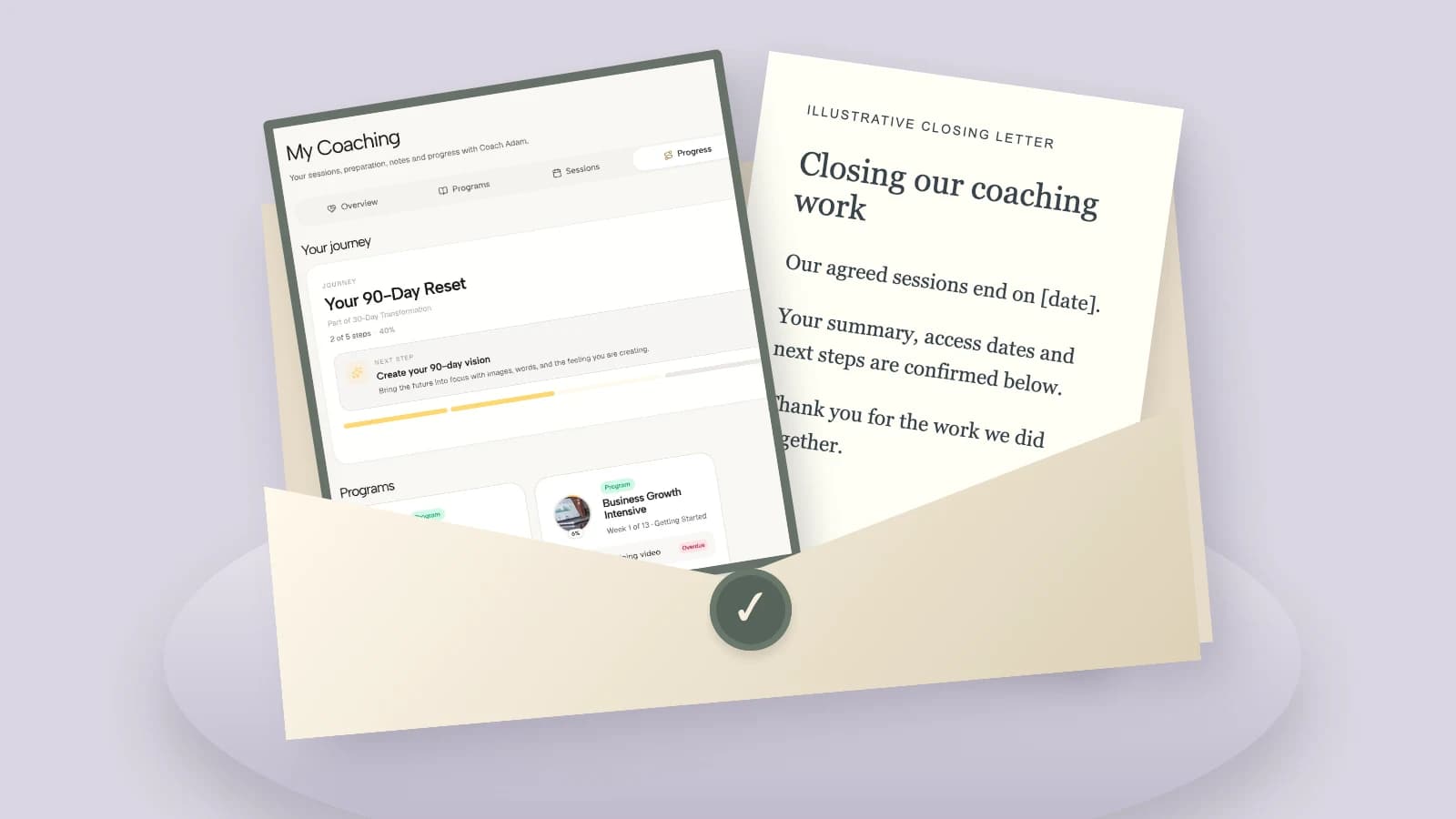
What should you say when a coaching relationship ends without making the client feel abandoned, pressured to renew or confused about their access? Confirm the actual ending, separate coaching support from resource access and payment commitments, then give one necessary next step. A good coaching client offboarding email closes the practical loop. It does not turn goodbye into a surprise sales conversation.
The annoying version is familiar: the final session went well, you sent a warm thank-you, and a week later the client asks whether their messages are still monitored or another installment will be collected. Warmth matters, but it cannot substitute for an accurate date.
These five original templates cover a planned finish, a client choosing not to renew, an agreed pause, an agreed early ending and the close of employer-funded coaching. They are examples for coaches to adapt, not legal notices, messages sent to real clients or automatic Coachful emails.
What to include in a coaching client offboarding email
Start with the agreement and the conversation you have actually had. An offboarding email should confirm an ending, not manufacture one from a silent inbox or introduce terms the client never accepted. If the position is disputed, resolve that uncertainty before using a cheerful closing template.
- The event: name the engagement and say whether it is completed, not renewing, paused or ending early.
- The coaching end date: identify the last session and the end of between-session support when those differ.
- The access arrangement: state which resources remain available and until when, based on verified terms and settings.
- The financial position: accurately explain any remaining payment, credit or refund arrangement without implying that ending sessions automatically cancels it.
- One practical action: open the closing summary, check the arrangements or use a specific support route.
- A human acknowledgment: mention work you can honestly recognize, without inventing achievements.
You do not have to cram every administrative detail into one dense paragraph. Use short labeled lines when the facts differ. “Coaching ends,” “Resource access,” and “Payments” are easier to understand than “Your account closes Friday,” which can mean several things.

For the separate decision about returning records, use the client data handover guide. This article focuses on what to write in the closing message, not who owns particular records or how to process a formal data request.
1. Planned completion of a coaching package
Use this when: the agreed engagement has reached its planned finish and both of you understand that regular coaching is ending. Send it after the closing conversation, or at the point agreed in your process. There is no universal timing rule that fits every practice.
Subject: Closing our [engagement name] work: your summary and next step
Hi [first name],
Our agreed [engagement name] sessions concluded on [date]. Thank you for the thought and effort you brought to our work on [specific, non-sensitive focus].
Your closing summary brings together [the agreed contents]. It includes the next action you chose: [client-owned action, if appropriate to include by email].
Coaching support ends on [verified date]. Access to [named resources] remains available under [verified arrangement]. [State the actual financial position if relevant.]
Please open your closing summary through [insert the verified private destination] and let me know through [support route] if a practical detail needs correcting.
Wishing you well with the next stage,
[coach name]
Replace “thought and effort” with something genuine if it does not fit. You can acknowledge participation without claiming that the client has solved the original problem. Finishing six sessions is a fact; “you are now a confident leader” is a conclusion that needs different evidence.
The closing summary should reflect the client’s choices rather than prescribe months of additional unpaid work. Agree its contents beforehand. If no summary was promised or prepared, do not send a template that suggests one already exists.

2. A client chooses not to renew
Use this when: a client has clearly decided not to buy another package after the current agreement. Non-renewal is not necessarily a complaint, a failure of commitment or an invitation to negotiate. Confirm the decision without making them defend it again.
Subject: Confirming the end of your current coaching package
Hi [first name],
Thank you for confirming that you will not be renewing after [current engagement]. Our remaining agreed session is [date and time zone / accurate remaining arrangement].
We will use that time to review what you want to take forward and any practical questions about the ending.
Between-session support ends on [verified date]. Your access to [resources] follows [verified arrangement]. [Describe any remaining payment commitment accurately.]
Your next step is [one necessary action, or say that no action is needed]. If any of these details differs from your understanding, contact me through [support route].
Thank you for working with me,
[coach name]
Do not add “before you make a final decision” when the client has already made one. If you have not yet discussed renewal, use a renewal conversation instead of pretending that an expiry date is a confirmed choice.
Be particularly careful with recurring billing. A message saying “your package ends” is not proof that billing has stopped. Check the actual arrangement and follow the appropriate cancellation process. Where action is still pending, state that accurately rather than giving a premature confirmation.

3. An agreed pause with a defined review point
Use this when: you and the client have explicitly agreed a temporary pause. A pause needs its own terms. It is not simply leaving the person in a program while hoping they return.
Subject: Your coaching pause: dates and arrangements
Hi [first name],
As agreed, we are pausing [engagement name] from [start date] until [review date or other precise arrangement]. There are no coaching sessions scheduled during that period.
During the pause, [state the actual support availability]. Access to [resources] is [verified arrangement]. Payments are [the specific agreed position, including any action still required].
We agreed to [one review or restart step] on [date]. Restarting will depend on [the actual conditions, such as mutual agreement and availability].
Please check these arrangements through [verified private destination or contact route] and tell me if anything differs from what we agreed.
Take care,
[coach name]
Remove any restart promise you cannot honor. “Your place is waiting whenever you are ready” may sound kind while committing you to unlimited capacity. If the pause has no guaranteed place or preserved rate, say so before the client relies on it.
You also do not need to repeat the client’s personal reason. “As agreed” can be enough. A private health, family or employment situation does not belong in a subject line or routine administrative email unless there is a real, appropriate reason to include it.

4. A mutually agreed early ending
Use this when: you and the client have agreed to finish before the original end date and the practical terms are settled. This is not a substitute for a formal termination notice, a response to misconduct, debt recovery or an unresolved complaint.
Subject: Confirming our agreed coaching end date
Hi [first name],
Following our conversation, we have agreed to end [engagement name] on [date], before the original planned finish.
[State the final session or transition arrangement.] Support through [channel] ends on [verified date]. Access to [resources] follows [verified arrangement].
The agreed financial arrangement is [specific balance, refund or credit position, including timing and whether processing is complete].
Your next step is [one agreed handover action]. Please use [private support route] if any practical detail does not match our agreement.
Thank you for the work we have done together,
[coach name]
Keep the financial line factual. “A refund of [amount] has been processed on [date]” and “I will submit the agreed refund by [date]” describe different states. Do not promise a bank arrival date you cannot control.
If an early ending follows dissatisfaction, avoid placing a glowing testimonial request underneath it. Resolve the concern through the appropriate process. If a client needs another professional, discuss an appropriate referral with permission rather than forwarding private coaching information as part of an improvised goodbye.

5. Closing employer-funded coaching with the client
Use this when: a sponsored engagement is ending and you are writing to the coaching client. The sponsor may need a separate operational confirmation. Funding the work does not automatically entitle an employer to the contents of private coaching conversations.
Subject: Closing [engagement name]: your final arrangements
Hi [first name],
Our scheduled coaching under [engagement name] concludes on [date]. Thank you for your participation in the work.
Your private closing summary is available through [verified private destination], with [the agreed contents]. Your next step is [one client-owned action].
Our support arrangement ends on [verified date], and access to [resources] follows [verified terms].
Any separate sponsor update will follow the reporting boundaries we agreed: [brief, accurate description]. Private coaching content will not be added outside those arrangements and applicable obligations.
Please contact me through [private route] with questions about the summary or these closing details.
[coach name]
Do not copy HR or the manager into this message simply to show that the work is finished. Check the agreement, permissions and recipient list. If a sponsor needs an invoice or attendance confirmation, give them the appropriate information separately, without attaching the client’s reflections.
A client may choose to share a summary with their employer. That is different from the coach doing it automatically. Where confidentiality has legal or safety exceptions, follow the relevant obligations and professional process rather than relying on a template’s wording.

Before sending: check the client’s actual experience
Work through the ending from the recipient’s side. A link opening for you as a coach does not establish that it opens for the client. Use an authorized test account or an appropriate permission-checking method, without exposing another client’s material.
- Confirm the event. Check whether the engagement is complete, paused or still subject to a decision.
- Compare dates. Match the email to the agreement, calendar and actual support arrangement.
- Check access. Open the intended destination with the relevant permissions and confirm any expiry you mention.
- Check money separately. Verify the balance and billing state before writing that anything has stopped or been refunded.
- Remove unnecessary private detail. Review subject, attachments, recipients and quoted message history.
- Read the final copy. Replace every placeholder, remove unused alternatives and keep one essential next step.

Check connected processes as well. A person can receive a perfectly accurate closing email and still get an inappropriate reminder afterward. Review relevant session invitations, support commitments and messages through the controls your tools actually provide. Do not assume that marking one record complete updates every other system.
Keep feedback, testimonials and new offers optional
Your essential closing information should not depend on the client praising you, booking another call or making a referral. It should be usable even if they do none of those things.
A private feedback invitation can be worthwhile, but it is a different request from permission to publish a quotation. A positive survey response does not by itself authorize a named case study. Equally, an employer-funded engagement does not make the employer the automatic owner of the client’s feedback.

If you want to mention future work, keep it proportionate and transparent. “You can enquire about a future engagement through [route]” is different from implying that continued access requires buying again. Do not quietly add former clients to a promotional sequence because you sent them an administrative email.
Frequently asked questions
How long should a coaching offboarding email be?
Long enough to confirm the ending, dates and next action, but short enough to read without searching for the practical facts. Use a private linked summary for detailed reflections where appropriate. The template is a communication aid, not the complete coaching record.
Can I send the same message to a whole group?
Shared logistics can be reused, but individual status, billing and support arrangements need checking. Protect recipient addresses and private information. A group’s final meeting does not prove that every participant has the same completion or access position.
Should I call this graduation?
Only if the wording accurately describes the experience. Reaching the end of a coaching package does not automatically establish a credential, competence or achievement of a particular goal. A straightforward “closing our work” is often clearer.
What if the client never replies?
Do not treat silence as a new agreement, consent to marketing or evidence that a disputed matter is resolved. Follow the existing contract and applicable process. A delivery or link problem may justify a practical follow-up; repeated sales messages are a different decision.
Build a reliable ending before automating it
Choose the template that matches the actual event, verify its facts and rehearse the recipient’s next step. Only then consider whether any part can be safely standardized. An automated mistake is still a mistake, just delivered with admirable punctuality.
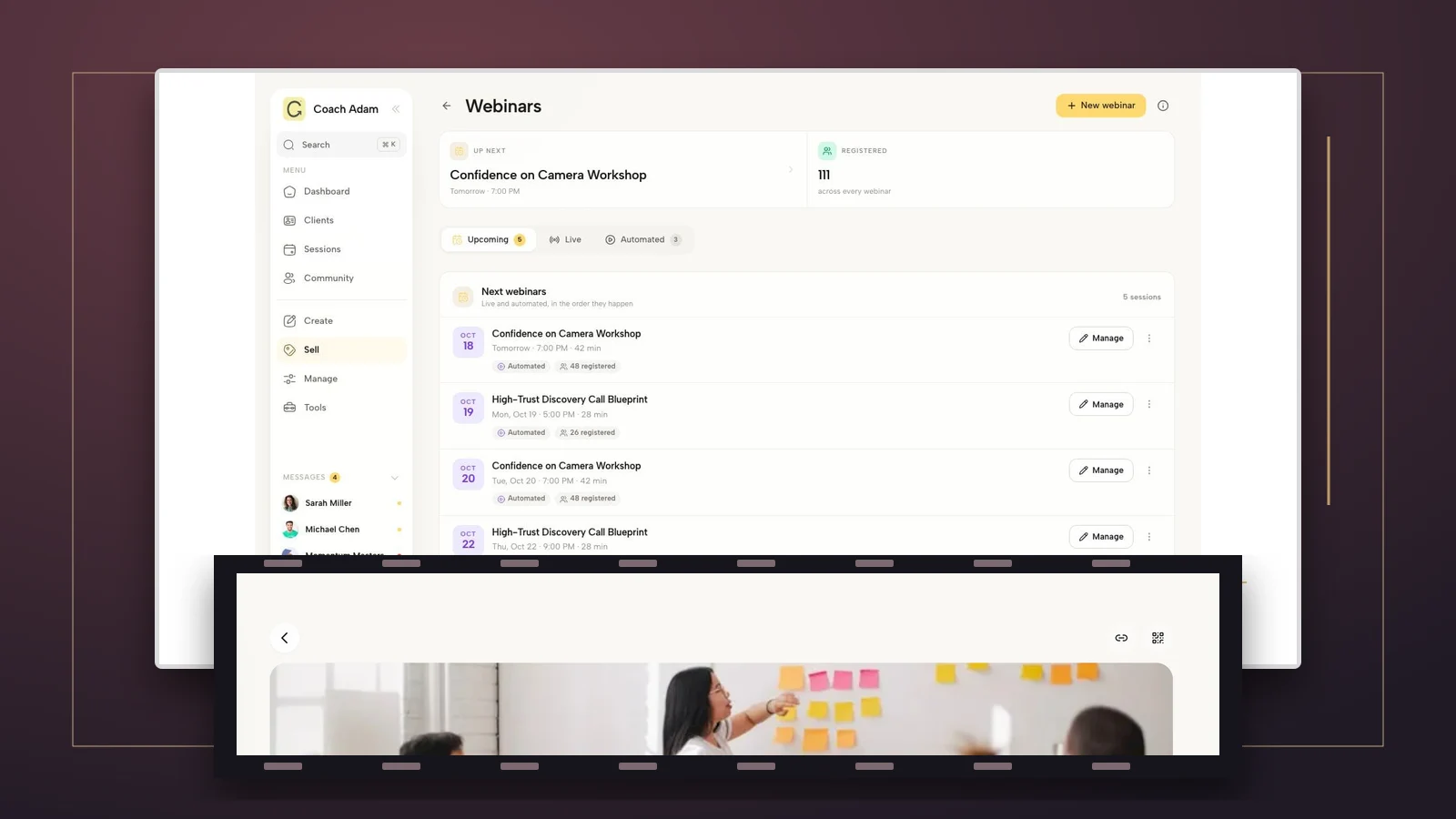
If you want to examine the records and communication surfaces behind that process, Try the interactive demo. Compare the client progress view, portal and individual communication workspace with what your closing message promises. The screens here do not establish an automatic offboarding trigger, billing cancellation, data export or timed access removal.
Sources and boundaries: Current search results include coach-specific offboarding templates and broader client offboarding email examples, supporting this recognizable communication task. The templates and decision method here are original editorial recommendations, not measured retention claims. Contractual, privacy, consumer and professional obligations vary; obtain appropriate advice for disputed endings or formal notices. For course-only completion, use the separate course completion email guide.