Coaching Pilot Evaluation: 5 Checks Before You Scale

Nour
Founder, Coachful
Everyone says the coaching pilot was valuable. Should you offer the employer a bigger program, change the design, or stop? Evaluate five things separately: delivery, evidence of useful change, participant trust, delivery economics and the buyer’s next decision. Positive feedback alone is not a reason to scale.
A coaching pilot evaluation should tell you what the small engagement actually established, what remains uncertain and what another paid phase would test. It should not turn private coaching conversations into sales evidence or manufacture an ROI figure from a handful of favorable comments.
This guide is for coaches reviewing an employer-funded pilot that is already underway or ending. If you are still trying to sell the first engagement, start with our employer-paid coaching pilot pitch. Here, the task is deciding whether a rollout is justified, not writing another proposal.
The five checks in a coaching pilot evaluation
- Delivery: Did the intended people receive the service you agreed to provide?
- Change: What evidence supports the intended development outcome, and how strong is it?
- Trust: Can you explain the findings without breaking the reporting agreement or exposing participants?
- Economics: Could you deliver the proposed next phase responsibly at its actual price?
- Decision: Is there a justified, authorized next step, including the option not to expand?
Use these as separate judgments, not ingredients in a flattering overall score. An excellent satisfaction rating does not cancel a confidentiality problem. A commercially attractive contract does not prove that the coaching helped. A promising outcome does not make an unmanageable delivery model sustainable.
Before the review, reopen the original scope, success criteria and reporting agreement. Distinguish what was agreed before results appeared from questions added later. New questions can be useful, but label them exploratory rather than pretending the pilot was designed to answer them.
1. Check delivery before interpreting outcomes
Start with the denominator: who was eligible, invited, enrolled and actually received the planned coaching? Those groups are not interchangeable. A pilot can have enthusiastic participants while reaching only the employees who already had the most time or support.
Make a minimal delivery reconciliation using the information you are permitted to hold and share. Record planned service units, delivered units, cancellations, substitutions and unresolved access problems. Keep an employee’s personal explanation for absence out of a broadly circulated administrative summary.

For example, imagine a fictional eight-manager pilot offering three individual sessions each. Twenty-four sessions were planned; twenty took place by the review date. Two remained booked and two were canceled without replacement. Report those categories rather than calling the pilot “83% successful.” Session delivery and coaching success are different questions.
Ask why the gap matters operationally. Was scheduling difficult? Did the employer protect time? Was the invitation clear? Did employees understand that participation was voluntary where that was the agreed arrangement? An access problem may require a delivery redesign, not a new coaching method.
Also identify hidden work. Sponsor calls, rescheduling, accessibility adjustments and administrative coordination are part of delivering an engagement even when they were not counted as coaching sessions. Log them proportionately so the next phase does not inherit invisible obligations.

Decision: If the pilot did not deliver the intended exposure, avoid confidently judging the full method. Explain what was and was not tested, then decide whether a bounded repair is worthwhile. Do not erase the missing participants from the story.
2. Separate satisfaction, behavior and business impact
“I enjoyed the sessions,” “I tried a different approach” and “the team’s results improved” are three different claims. Each needs its own evidence. Keep the label attached to the measure all the way into the final discussion.
A useful evaluation can contain three evidence layers:
- Experience: participant feedback about relevance, accessibility and usefulness.
- Application: specific behaviors or work practices the pilot was intended to support.
- Business context: relevant organizational indicators, with their owners and other plausible influences identified.
Do not force every pilot to establish all three. A short engagement may provide useful evidence about participation and early application without establishing retention, promotion or financial impact. State that limitation instead of borrowing a longer-term outcome for the closing slide.

For a new-manager pilot, a practical application question might be: “During your last five relevant one-to-one meetings, in how many did you agree a specific next action and owner?” Ask the same defined question at the beginning and end. This is a hypothetical question, not a validated assessment instrument.
Record the source too. A participant’s recollection, a manager’s observation and a reviewed work artifact provide different kinds of evidence. They can complement one another, but combining them does not automatically produce independent confirmation. A manager may know about the coaching and expect an improvement.
If your pilot began without a baseline, say so. You can collect end-of-pilot experience feedback and a retrospective account of change, while labeling recall limitations. Do not reconstruct a precise starting score from memory and present it as a contemporaneous measurement.

Show missing responses, not just favorable ones
Suppose six of eight participants answer the final application question. Four report improvement, one reports no change and one reports deterioration. Report all four categories, including the two missing responses. “Four of six respondents reported improvement” is accurate; “the program improved half the company’s managers” is not.
Small samples deserve counts before percentages. Missing responses can also be informative: people with more difficult experiences may be less inclined to reply, or simply unavailable. You do not know which explanation applies until you have appropriate evidence.

A before-and-after comparison also does not isolate causation. A new manager, restructuring, workload change or different company process may influence the same behavior. Write “participants reported this change during the pilot” unless your evaluation design supports a stronger attribution claim.
Decision: Identify what the evidence reasonably supports: useful experience, promising early application, no detectable change, or an unresolved question. Never convert a completion bar into a percentage of leadership capability gained.
3. Check whether the findings are safe to share
The employer’s funding role does not make every available data point appropriate for the closing meeting. Revisit the reporting arrangement with participants and the sponsor before preparing the version that will circulate.
The ICF Code of Ethics is an important professional reference for agreements, confidentiality and responsible conduct. Your actual responsibilities also depend on applicable law, contracts and professional obligations. This article is operational guidance, not legal advice.
Keep an evaluation evidence file separate from a sponsor-facing summary. The summary should contain only the information appropriate for its purpose and recipients. A private reflection may help you understand the engagement without belonging in the buyer’s report.

Small cohorts make anonymity difficult. Removing names from an eight-person group does not necessarily prevent identification if one person changed role, took leave or described a recognizable incident. Avoid a quotation, subgroup breakdown or individual score when the disclosure risk outweighs its evaluation value.
Likewise, do not ask for testimonials during the review as though continued coaching depends on praise. Feedback for improving a service, agreed reporting to an employer and permission to publish marketing material are separate purposes. Handle each through its appropriate process.
Ask three release questions: Is this field necessary for the stated decision? Is sharing it covered by the agreed arrangement? Could this combination of details identify someone unexpectedly? If any answer is unclear, resolve the boundary before circulation, not after the presentation.
Decision: A scale-up that requires intrusive reporting is not simply a more lucrative version of the same service. It may be a materially different engagement that needs different terms, a different design or a refusal.
4. Test the economics of the next phase, not just the pilot fee
A pilot can be successful for participants and still be an unsustainable offer. Review actual delivery time, external costs and the support burden before giving the employer a rollout price.
Separate a one-time setup cost from work that recurs for each cohort or participant. Creating an initial worksheet may be reusable. Reviewing each participant’s assessment, coordinating each new manager and preparing each agreed report are recurring work even when you already own the template.

Here is a deliberately simple hypothetical calculation, excluding tax and many business overheads. A pilot fee of $4,800, less $600 in external delivery costs, leaves $4,200 before the coach’s labor and overhead. If the engagement used 42 hours, that is $100 per hour before those remaining costs. It is not $4,800 of profit.
Suppose the proposed next cohort adds six hours of reporting while the fee and external costs stay unchanged. At 48 hours, the same $4,200 leaves $87.50 per hour before labor and overhead. That does not automatically make the offer unacceptable. It makes the extra reporting a real pricing and capacity decision rather than a free improvement.
Also check payment timing. A profitable engagement on paper can create a cash problem if your coach contractors must be paid before the employer settles an invoice. Review purchasing authorization, invoice routing and the actual terms before reserving the next cohort’s capacity.
Decision: Expand only on terms you can deliver responsibly. Reprice material additions, simplify the service or decline a scale-up whose economics depend on unpaid overtime. Do not assume that more participants automatically produce better margins.
5. Make a scale, redesign or stop decision
The final meeting should not be an improvised renewal pitch. Send the agreed summary in advance, distinguish findings from interpretations and give the decision-maker a small number of explicit choices.
- Scale: the relevant evidence is sufficiently encouraging, delivery is feasible, boundaries remain acceptable and the buyer authorizes a defined next phase.
- Redesign: the need remains credible, but a specific problem with access, format, evidence collection or scope needs another bounded test.
- Stop: the service is not a suitable response, risks outweigh its value, responsible delivery is not viable or there is no authorized purchase.
There is no universal success percentage that makes expansion correct. Use the criteria agreed for the particular engagement, alongside material issues discovered during delivery. If a new concern changes the decision, explain it rather than quietly moving a threshold to protect a sale.

A redesign needs a hypothesis and a limit. “Try again” is not enough. For example: “Offer protected working-time appointments to the same eligible population, then review access and the agreed behavior question after the defined phase.” Specify the purchased service and decision date; do not promise that the adjustment will improve outcomes.
A stop decision can still preserve a good relationship. You might recommend a different intervention, acknowledge that the organization is not ready or explain that the evidence does not justify more of the same. Do not turn an employee’s continued need into an argument for a service that does not fit.
A copyable one-page coaching pilot evaluation brief
Use the following outline as a decision document. It is not a psychometric assessment, research protocol or ready-to-sign agreement. Keep restricted supporting material outside the version shared with the buyer.
- Decision and audience: [What decision is required, by whom, and by what date? Who may receive this version?]
- Original pilot question: [Population, intended development focus, scope and criteria agreed before delivery.]
- Delivery reconciliation: [Eligible, enrolled, planned, completed, canceled and outstanding. Explain meaningful gaps.]
- Evidence: [Measure, source, baseline if available, current observation, response count and missing information.]
- Limits: [Self-report, absent baseline, small sample, concurrent changes, follow-up period and disclosure constraints.]
- Operational and commercial findings: [Actual hours, recurring costs, capacity, support load and payment dependencies.]
- Recommendation: [Scale, redesign or stop. Explain why and name conditions or unresolved questions.]
- Authorized next action: [Owner, written approval required, scope, fee discussion and next review. No assumed renewal.]
For example: “The pilot was deliverable, with two appointments still outstanding. Four of six respondents reported improved application; two participants did not respond. No independent behavior measure was collected. Recommend a bounded redesign of access and measurement before wider rollout.” That is a hypothetical conclusion, not a description of a real client.
Turn the decision into a better delivery system
If the evaluation justifies another phase, make the agreed changes before reopening enrollment. Update the program scope, collection questions, coach allocation and commercial terms. Keep the participant’s private coaching record separate from the material the employer is entitled to receive.
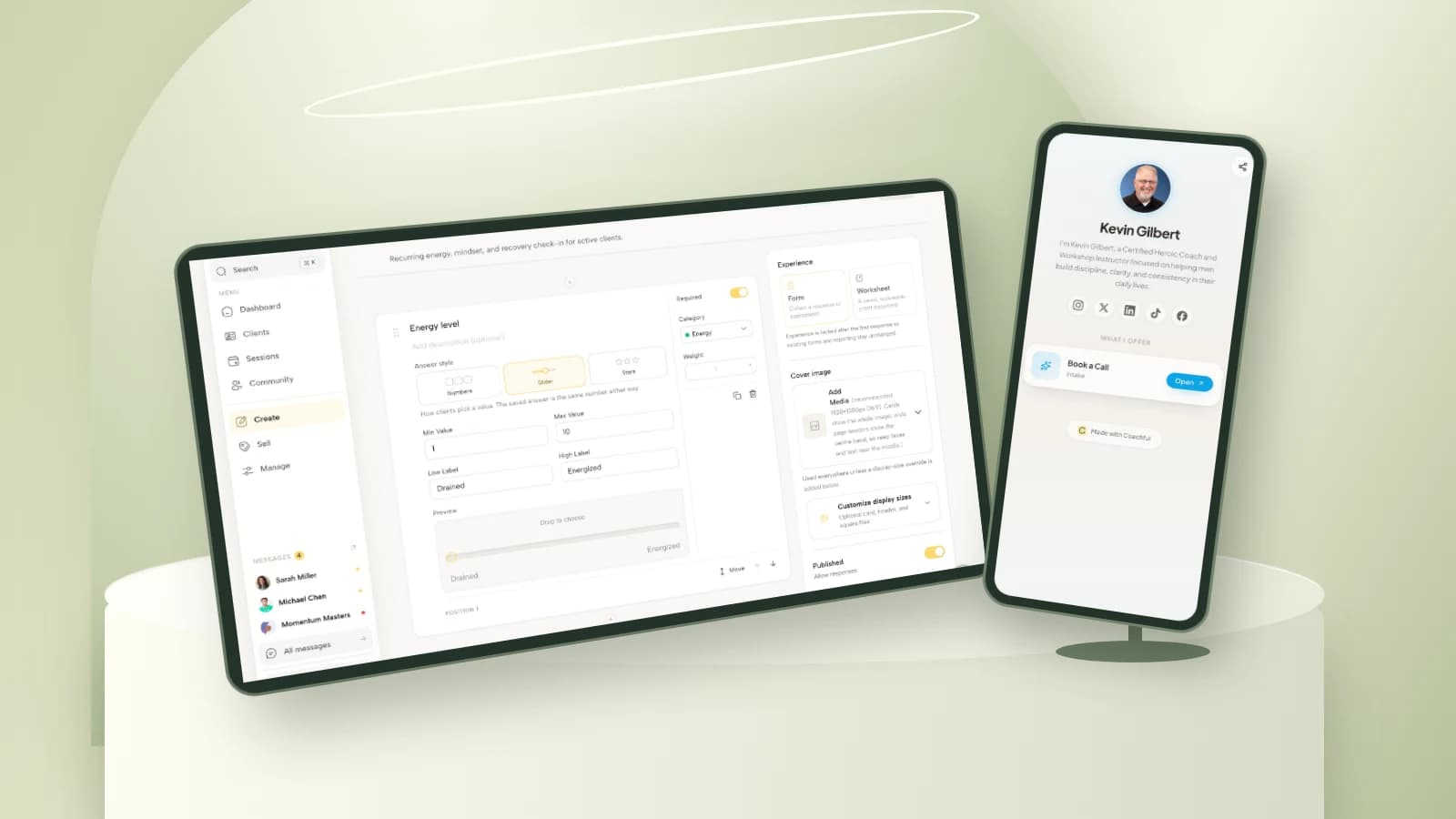
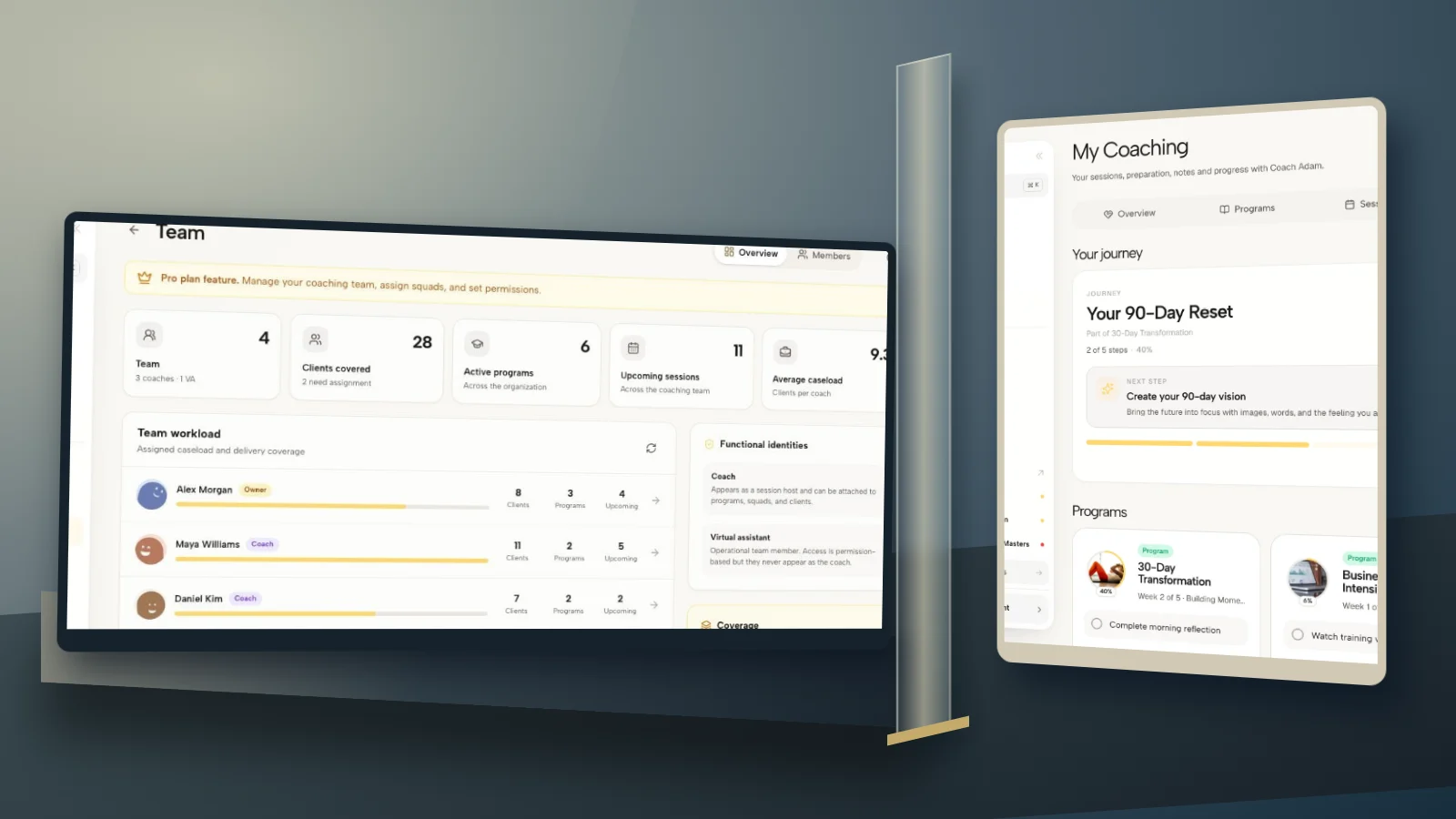
The real Coachful screens in this guide show programs, team allocation, forms, coaching flows, client progress and payments. They illustrate useful delivery surfaces, not an automatic research evaluation, attribution model or sponsor-reporting permission system. The interpretation and disclosure decisions remain your responsibility.
If your next step is making that delivery process concrete, try the interactive Coachful demo. Walk through the program and client experience with your evaluation brief beside you. Check whether the next phase can be delivered as promised before committing to a bigger engagement.
Frequently asked questions
How do you measure a coaching pilot’s success?
Compare the agreed question with delivery, experience and application evidence, then examine risks and feasibility. Show response counts and missing information. Business indicators may add context, but a short before-and-after pilot does not by itself establish financial return or causation.
What if participants liked the pilot but behavior did not change?
Report satisfaction and application separately. Investigate whether participants had the opportunity, support and time to apply the work, and whether the question measured the intended behavior. A focused redesign may be justified; satisfaction alone does not justify expansion.
Should a coach guarantee a pilot will convert into a contract?
No. A pilot should support a responsible decision, including stopping. A follow-on engagement needs an appropriate scope, acceptable terms, capacity and buyer authorization. Treat any contract-conversion claim as separate from evidence that the coaching was useful.
Does a pilot need a control group?
Not every practical service evaluation can support a comparison group. Be clear about what the design can establish. If the buyer needs a causal effectiveness or ROI claim, agree an appropriately qualified evaluation approach rather than treating ordinary coaching records as a controlled study.
Sources and scope
Mentor Group’s executive coaching pilot guidance provides a practitioner reference for bounded scope, baseline observations and purposeful evaluation. The ICF Code of Ethics is the professional reference for ethical responsibilities. This article’s examples, counts, costs and decision framework are educational illustrations, not research findings, market benchmarks or Coachful customer outcomes.