Health Coach Booth Ideas: 5 Activities for a Wellness Fair

Coachful
Editorial Team
What can you do at a wellness-fair booth that shows the value of health coaching without offering medical advice or collecting a pile of uninterested email addresses? Give visitors a short, voluntary experience of choosing a realistic next step. Then offer a relevant resource or introductory conversation, with permission, rather than treating every passerby as a sales lead.
The strongest health coach booth ideas do not require a prize wheel, expensive equipment or an impromptu health assessment. They make your role understandable: you help people explore their own goals, notice obstacles and decide what they want to try. A stranger should be able to participate without discussing their weight, diagnosis or medication in a crowded hall.
Below are five nonclinical activities selected for low equipment needs, a clear coaching purpose and a sensible follow-up. Choose one main activity, not five competing attractions. The scripts, timings and examples are suggested planning choices, not measured conversion benchmarks or clinical interventions.
First, set the boundaries of your health-coaching booth
A wellness fair can place a coach beside clinicians, supplement sellers, fitness instructors and benefits providers. Visitors may reasonably assume everyone offers similar services. Make your own role explicit before inviting participation.
The NBHWC scope of practice describes health and wellness coaching as supporting self-determined goals and behavior change. It also distinguishes coaching from diagnosing, interpreting medical data, prescribing, nutrition consultation, exercise prescription and psychological treatment. Additional professional credentials can create a different scope, but those roles and their boundaries need clear disclosure.
For a coaching-only booth, avoid blood-pressure interpretation, body-composition assessments, personalized meal plans or claims that your activity detects burnout or a health condition. A busy fair is not a reason to drift into another profession. If you also practice under a clinical or other credential, plan that service separately with the appropriate safeguards.
- Ask the host: who is attending, what promotion is allowed, whether you may collect contact details, and whether there are restrictions on photography, food, electricity or demonstrations.
- Check the environment: accessible approach, seating options, noise, device connectivity and a way to pause a private conversation.
- State the offer: a brief coaching-related activity, not a consultation, diagnosis or guaranteed result.
- Protect choice: visitors may watch, participate, take a handout or leave without giving you personal information.

For an employer fair, agree who receives any follow-up information. Do not promise employees privacy from their employer while operating a sign-up process that sends individual responses to HR. When the arrangement is unclear, use an anonymous activity and direct people to a separate private inquiry route.
1. Run a two-minute “make it smaller” activity
Best for: a busy fair where visitors have little time and you need a concise way to explain coaching. The activity helps someone turn a broad intention into an action they choose themselves. It does not test their health or tell them which goal they should have.
Offer a blank slip of paper with three prompts: “Something I want to make easier,” “A small action I could choose,” and “An even smaller version for a difficult day.” The visitor keeps the paper. They can use a fictional example if they prefer not to discuss themselves.
“Would you like to try a two-minute planning exercise? You choose the subject, and you do not need to share anything personal. We will make one possible next step smaller, not write you a health plan.”
If someone chooses an action, ask: “What would make that realistic in your actual week?” Then: “Would you like to keep it, change it or leave it?” Avoid praising compliance with your preferred habit. The demonstration is about their agency, not your ability to prescribe a better life.
A hypothetical visitor might choose to put their walking shoes somewhere visible. Another might decide that the action is unsuitable and choose a different topic. Either response can demonstrate coaching well. Do not turn a brief activity into advice about exercise intensity, symptoms or treatment.
Trade-off: a very short activity offers only a glimpse of coaching. Close by explaining that an ongoing engagement involves agreed goals, boundaries and a working relationship, rather than implying that two minutes is a complete session.
For visitors who want to explore further, offer a page explaining your service. Decide that destination before creating signs or codes. The QR-code guide for coaches covers the technical handoff; here, the important decision is what the visitor has actually asked for.

2. Offer a take-home habit experiment worksheet
Best for: a fair where visitors prefer something they can use privately later. A good worksheet should work without your commentary and without a compulsory email exchange. Think one useful page, not a miniature coaching textbook.
Use four live prompts: “An action I choose,” “A cue I already notice,” “A smaller version,” and “When I want to review it.” Leave generous writing space. Explain that visitors can adapt or abandon their experiment, and that it does not replace advice from their healthcare team.

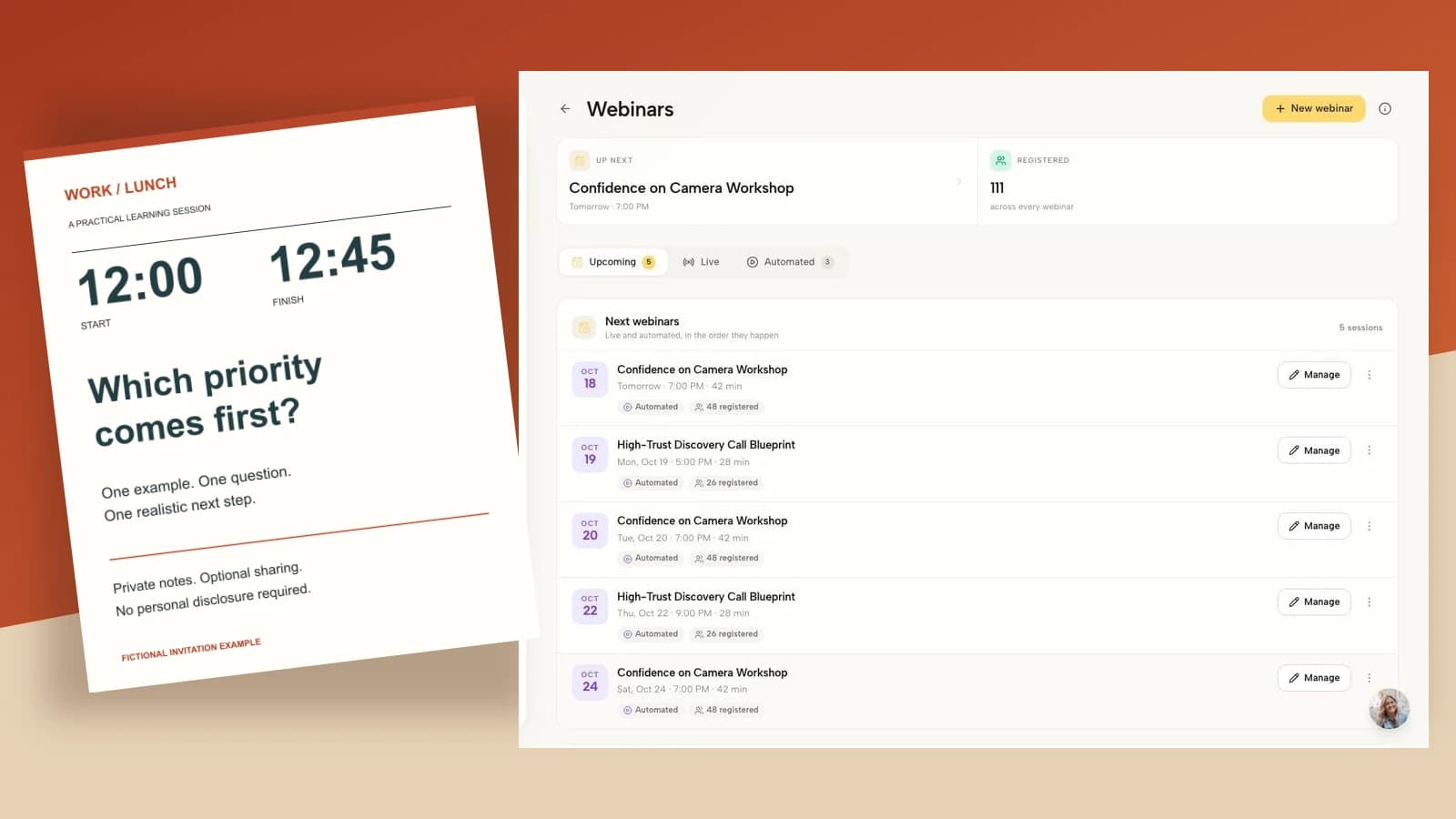
The pictured sheet is an original fictional example, not a recommendation that every visitor should walk. The same structure can accommodate a nonmedical planning goal such as preparing a question for an appointment or making time to review an existing routine.
“You can take this away without signing up. It helps you choose one small experiment and decide when to look at what happened. If you want an explanation of how coaching works, the address is at the bottom.”
Keep the resource readable: plain language, useful contrast, enough space to write, and a digital version with live text rather than only a photograph of the paper. Include your professional identity and an ordinary web address. A visitor should not need a particular camera app to find you.
Trade-off: you may distribute useful material without knowing who takes it. That is not automatically a failure. If the event’s purpose is public education or relationship-building, forcing every handout behind a form may work against the purpose.
If you offer an optional digital copy, its first page should match the handout’s promise. A generic menu of unrelated programs creates more work for the visitor. Use a mobile preview and test with someone who did not help build the page.

3. Host a “spot the friction” demonstration
Best for: a booth that needs an engaging activity without asking attendees to disclose personal difficulties. Use a fictional scenario to show how a coach explores context instead of blaming motivation.
Print a short scenario on a reusable display: “Sam wants a calmer start to the workday, but the plan depends on an uninterrupted hour that never appears.” Offer three possible questions, written plainly on the same sheet:
- What does Sam actually control before work?
- Which part of the plan depends on another person or an uncertain schedule?
- What smaller experiment could Sam choose?
Invite the visitor to choose the question they find most useful. Discuss their reasoning without declaring a single correct answer. This is a conversation prompt, not a quiz that scores how healthy, disciplined or resilient someone is.
“There is no diagnosis or personality score here. Which question would help Sam understand the situation before making another plan?”
The fictional setup is particularly useful when the fair is noisy or colleagues are standing nearby. If someone begins describing a sensitive situation, stop the public detail kindly: “We do not need to explore that here. Would you prefer the general information or a separate conversation?”
Trade-off: an anonymous scenario can feel less personally relevant. Offer a range of everyday contexts, but avoid adding clinical symptoms, body measurements or private family conflicts merely to make the display feel serious.
You can offer the scenario as a follow-up resource, with an optional email request. Keep that form small: name if needed, email address, the requested resource and a separate choice about ongoing marketing. Do not copy clinical-looking demo questions into a public event form.

4. Offer a bounded coaching taster, with privacy
Best for: a quieter event with suitable space, enough staffing and visitors who actively want a short conversation. This is the most demanding option on the list. Do not choose it simply because “free mini sessions” sounds more impressive than a worksheet.
Set a short duration you can honor, such as a suggested ten-minute slot, and explain its limits. Agree one nonclinical topic, check whether the visitor wants to continue, explore one possible action and close on time. Do not solicit disclosures that the setting cannot protect.
“This is a brief introduction to the coaching process, not a health assessment or a complete coaching engagement. We can explore one practical goal you choose. You can stop at any point, and I will explain the options before any paid next step.”
Before offering tasters, decide how to handle unsuitable topics, distress, interruptions and visitors who need another professional. Know the host’s first-aid or emergency process. A referral boundary is more useful than trying to rescue every situation yourself.
Check your engagement wording, professional obligations and insurance arrangements for this format. If you cannot provide an appropriate private setting or manage the queue while coaching, use one of the first three activities instead.
Trade-off: a conversation can demonstrate your approach, but it takes you away from the rest of the booth. Allow reset time and breaks. Do not advertise a stream of walk-in sessions that you cannot deliver responsibly.
Record only the follow-up the visitor requested. “Asked for service information” is more proportionate than a note about a personal condition shared in passing. If there is a genuine next conversation, agree its purpose and contact route rather than assuming the taster created a client relationship.

5. Create a resource station around one real workshop
Best for: a coach with a confirmed, relevant workshop or introductory event. The booth gives visitors something useful now and a truthful explanation of the longer learning experience. It is not an excuse to invent an event that you hope to organize later.
Choose a narrow nonclinical subject, such as planning a realistic weekly routine or preparing questions for a wellbeing conversation. Demonstrate one short reflection prompt at the booth, then show the workshop’s actual audience, format, timing, price and participation expectations.
“This prompt is yours to keep. If you would like more time to work through a routine-planning exercise, the workshop details are here. You can read them before deciding whether it suits you.”
A real workshop can be a more appropriate next step than a private sales call for someone who wants education rather than ongoing coaching. Do not describe a sales presentation as a learning workshop, or conceal that an advertised free event includes an optional paid offer.
Make information available without a sign-up where possible. If you need an email to deliver an item, explain that before submission. Give ongoing newsletter permission its own clear choice and follow the rules that apply to your audience and jurisdiction.

Trade-off: dated events create maintenance work. Close registration when appropriate, update the destination and stop using printed material that promises unavailable places. If your workshop is only an idea, label the next step as optional interest, not registration.
Choose one activity using your actual constraints
- High footfall, one coach: choose the two-minute activity or take-home sheet. Keep the conversation short enough that the next visitor is not waiting through a private session.
- No private space: choose the fictional friction demonstration. Do not collect personal stories in a public queue.
- Low connectivity: make the paper resource fully usable and print a readable address. Do not depend on a tablet that stops working when the venue Wi-Fi fails.
- Suitable space and another staff member: consider bounded tasters, with clear scope and an actual queue plan.
- A confirmed relevant workshop: demonstrate one useful prompt and invite people to inspect its real details.
Match your materials to that choice. You usually need a clear role statement, the activity materials, an optional next-step destination, basic stationery and an accessible setup. A complicated display is not compensation for an unclear invitation.
Plan capacity and event costs before booking
Ask what would make the event worthwhile for your practice. That might be suitable inquiries, a relationship with an employer or an opportunity to test whether people understand your service. Choose the objective before paying for the space.
Include the stand fee, travel, printing, equipment, any staffing and the preparation and follow-up time you are committing. Compare that commitment with other ways to reach the same audience. A full hall is not necessarily a room full of people who can use your offer.
A simple capacity illustration: a ten-minute taster plus a five-minute reset uses fifteen minutes. In a two-hour period, that leaves eight possible slots before allowing for breaks or delays. This is planning arithmetic, not a recommended service volume; reduce capacity when the setting or staffing requires it.
Record aggregate conversations and requested next steps without identifying people unnecessarily. Review suitable inquiries, attended introductory calls and eventual paid work where you can measure them appropriately. Do not treat a scan count or a bucket of business cards as revenue.
Follow up with the promise, not a surprise sales sequence
Before the event, decide who responds, what they send and when visitors can reasonably expect it. Do not offer immediate personal follow-up if your calendar is already full. A smaller promise kept is better than a polished sign-up process followed by silence.

Resource delivery example: “Hi [Name], here is the routine-planning worksheet you requested at [Event]. The instructions are included, and you can use it without booking anything. If you also asked about coaching, the service information is here: [link].” Replace every placeholder and include only the communication the person requested.
Keep a resource request, a workshop registration, a coaching inquiry and newsletter permission distinct. Do not upload an organizer’s attendee list into your marketing system simply because your stand fee included access to it. Confirm the actual permissions and applicable requirements first.
If you are checking whether your current setup can support this handoff, try the interactive Coachful demo. Inspect the real links, forms, lead, email and scheduling surfaces shown above, then test your own visitor journey from resource promise to follow-up. The demo helps you evaluate the workflow; it does not replace event permissions, professional boundaries or consent.
Frequently asked questions
What should a health coach give away at a wellness fair?
A useful, small resource related to your actual work is a good starting point: a self-directed experiment sheet, a planning prompt or a clear explanation of coaching. It should make sense without a sales call. Avoid implying that a generic handout is a personalized health plan.
Should I collect email addresses at my booth?
Only for a clear purpose the visitor understands. Delivering a requested worksheet and subscribing someone to ongoing marketing are different actions. Offer a non-email way to participate where possible, and do not collect health details simply to qualify a sales lead.
Can health coaches offer screenings at a health fair?
A coaching credential alone is not a reason to provide clinical screening or interpret measurements. Work within your actual credentials, training, jurisdiction and professional obligations. Where another professional provides a service, make the roles clear rather than presenting that service as coaching.
What is the best booth idea for a new health coach?
Start with the take-home worksheet or fictional friction demonstration. Both let you explain your role without expensive equipment or public personal disclosure. Practice the invitation and closing with another person before the fair. The aim is a useful, bounded encounter, not the busiest table in the room.
Bottom line: choose an activity you can deliver safely, let visitors keep their agency, and make the next step match the conversation. A wellness-fair booth should give people a clearer understanding of coaching, not another form they regret completing.