LinkedIn Headline for Coaches: 15 Examples and a Formula

Coachful
Editorial Team
“Does my LinkedIn headline tell a potential client what I do, or just tell other coaches that I am a coach?”
A useful LinkedIn headline for coaches names your coaching role, the people you work with and a recognizable area of work. Start with [coaching role] for [specific audience] | [two or three coaching priorities]. Add a relevant credential or professional background only when it is accurate and helps that reader assess fit.
You do not need a dramatic income claim, a guaranteed promotion or a new personal brand every fortnight. You need a line that the right person can understand without opening a glossary. This guide gives you 15 original examples, a practical writing process and a way to check whether the words make sense before treating profile views as a business result.
What should a coach put in a LinkedIn headline?
Give the reader three pieces of information in order: what kind of coach you are, who the work is for and what you can help them work on. That order is a useful default, not a LinkedIn ranking formula. A sponsor looking for executive coaching may need a different emphasis from a professional considering private career coaching.
Example: “Leadership coach for first-time managers | Delegation, feedback and difficult conversations.” The role is recognizable. The audience can identify itself. The topics describe work the coach could actually support, rather than an outcome controlled by an employer.

A headline is not an abbreviated autobiography. “Coach, speaker, author, entrepreneur, change-maker and lifelong learner” gives six descriptions of you without explaining which problem brings someone to your practice. Keep secondary roles for the About or Experience sections unless they are central to the work you want to be hired for.
If you need the wider acquisition process, our guide to getting coaching clients on LinkedIn covers networking, conversations and follow-up. The job here is narrower: writing the small piece of profile copy that helps a relevant person decide whether to look further.
Write your headline with these five decisions
1. Choose the reader before the wording
Decide who needs to recognize themselves. “Executives” is a broad category. “Newly appointed directors” describes a professional transition. “HR teams commissioning leadership coaching” names the buyer rather than the participant. Each can be appropriate, but putting all three into one sentence usually makes the sentence less useful.
Write down the person receiving coaching and the person paying for it. If they differ, decide which one your LinkedIn profile primarily addresses. An executive coach selling to organizations might lead with the participant group and add sponsor-relevant language about leadership transitions. A career coach selling directly can speak more plainly about role decisions.
2. Use the role people already recognize
Start with an ordinary description such as career coach, executive coach, leadership coach or business coach. Your proprietary method can appear later. A reader should not need to understand “identity expansion architect” before discovering that you help newly promoted managers learn to delegate.
Use wording that accurately reflects your training, competence and offer. Do not add a popular specialty because it seems more lucrative. When your services combine coaching and consulting, describe the combination clearly instead of implying that practical advice and facilitation are the same service as coaching.

Research can help you notice whether buyers say “career change,” “leadership transition” or something else. It cannot justify copying a competitor's positioning or claiming a search trend from a handful of examples. Use conversations with appropriate prospective buyers and language from your real inquiries, without exposing private client details.
3. Name the work rather than guaranteeing the result
“Interview practice, career decisions and transition planning” is specific. “Land your dream job in 30 days” makes a promise that depends on employers, the market and the client's circumstances. A more aggressive headline is not automatically a more credible one.
You can describe an intended direction without guaranteeing it. “Supporting managers to delegate with more confidence” describes a coaching purpose. “Double your team's productivity” suggests an outcome that needs evidence and careful qualification. If the qualification would take a paragraph, the claim probably does not belong in the headline.

4. Add proof only when it earns the space
A relevant credential, former role or language capability can help the right reader assess you. Use the exact credential you currently hold. Completing coach training is not the same as holding an individual professional credential, and a program's accreditation does not automatically transfer to its graduates.
Coaching-hour totals, client counts and previous employers also need support. Do not borrow the numbers in someone else's sample headline. If you cannot explain what a number measures, how you counted it and why you have permission to use it, leave it out.

A new coach does not need to decorate a modest experience base. A clear audience, an honest description of your work and a transparent About section are stronger than an impressive-sounding phrase that collapses when someone asks a follow-up question.
5. Make the beginning work on its own
People encounter headlines in different contexts and on different screen sizes. Do not assume every reader sees the whole line. Put the role and audience early, then check the actual presentation in your own account on desktop and mobile. Avoid relying on a fixed truncation count across every LinkedIn surface.
Use separators sparingly. A vertical bar can divide two meaningful clauses; six bars usually signal that you have avoided choosing. Before saving, remove every phrase that repeats a meaning already present elsewhere in the line. Check the current field limit in LinkedIn rather than treating unused characters as a target to fill.
15 LinkedIn headline examples for coaches
All examples below are fictional writing samples. They are not taken from verified profiles, and they are not evidence of bookings or revenue. Adapt only the audience and work you can honestly serve. The selection rule is simple: each example identifies a plausible buyer or participant and a concrete coaching focus without promising a result outside the coach's control.
Career and executive coaching
- Career coach for mid-career professionals | Career decisions, transition planning and interview practice. Use this when your offer covers the decision and preparation around a change. Narrow “mid-career professionals” further if your actual expertise is industry-specific.
- Executive coach for newly appointed directors | Leadership transitions, stakeholder relationships and delegation. Suitable for a defined seniority transition. Do not use executive positioning to imply experience with senior leadership you do not have.
- Leadership coach for first-time managers | Feedback, delegation and difficult conversations. A practical choice when your work concerns the move from individual contributor to manager. It does not promise promotions or team performance gains.
- Career coach for professionals returning after a break | Role choices, interview preparation and return-to-work planning. Names a recognizable situation without treating the break as a deficit. Keep employment-law advice outside your coaching scope unless separately qualified.
- Coach for technical leaders | People management, communication and the shift from expert to team leader. Useful when technical credibility is genuinely part of your practice. Add an accurate former role only if it improves relevance.
Business and specialist professional coaching
- Business coach for independent consultants | Offer decisions, workload and business priorities. Names operational decisions rather than a revenue guarantee. If you also provide consulting deliverables, explain that distinction in your service description.
- Leadership coach for women in professional services | Role transitions, influence and boundaries. Appropriate when that audience reflects your actual expertise and offer. Avoid implying that structural workplace barriers can be resolved by individual confidence alone.
- Coach for nonprofit leaders | Decision-making, delegation and sustainable leadership practice. Signals an organizational context. Experience working with nonprofits should support the positioning rather than being assumed from the wording.
- Sales coach for client-facing consultants | Discovery conversations, proposals and ethical follow-up. Useful when you genuinely coach these skills. It is more assessable than “close any client,” and it leaves room to explain methods and boundaries.
- Coach and facilitator for small leadership teams | Working agreements, team conversations and shared priorities. Makes the two roles visible. A team-development engagement still needs a clear scope and confidentiality agreement, not just a good headline.
Life, wellbeing and other coaching practices
- Life coach for professionals navigating change | Priorities, personal decisions and practical next steps. A more recognizable starting point than “transform your life.” Make the type of transition more specific when your practice supports that choice.
- Health coach for busy professionals | Everyday routines, client-led goals and sustainable habit practice. Describes coaching work without claiming diagnosis, treatment or guaranteed weight loss. Match your terminology to your qualifications and local scope rules.
- ADHD coach for working adults | Planning, task initiation and practical accountability. Use only with relevant competence. Coaching does not replace assessment or clinical care, and the headline should not imply that it does.
- Relationship coach for couples making shared decisions | Communication, expectations and everyday agreements. Focuses on the work rather than guaranteeing reconciliation. Explain suitability and referral boundaries elsewhere before someone books.
- Retirement coach for professionals planning their next chapter | Identity, weekly structure and meaningful commitments. Distinguishes non-financial transition work. If you do not provide regulated financial advice, do not let the profile suggest otherwise.
The point is not to paste the most flattering sentence. Choose the example whose scope most closely matches what you actually do, then rewrite it in the language your intended reader would recognize. If none fits, use the formula rather than stretching your practice to fit a template.
Should you lead with your credential or your client?
Usually, lead with the role and reader. Put a credential first when it is genuinely important to how that buyer selects a coach and the rest of the line still explains the work. “PCC | Executive coach for newly appointed directors” can be coherent for a credentialed practitioner. A string of unexplained initials without an audience is much less useful.
For corporate buyers, relevant professional history may matter alongside coach training. For an individual exploring a personal transition, a recognizable situation may matter first. Neither choice removes the need for accurate evidence elsewhere in the profile. A headline is not the right place to compress every qualification you have ever earned.
If your current day job remains important, make the dual identity explicit: “[Current role] | Career coach for [audience].” Check employer policies and conflicts before presenting outside services. Do not imply that your employer endorses your coaching business unless it actually does.
Make the page after the headline confirm the promise
A precise headline can still lead to a muddled experience. Someone recognizes the work, opens your profile and finds an About section for a different audience. Or they follow the link and land on a page listing every possible coaching specialty. That is not a headline problem anymore.
Keep the same basic answer across your headline, About section and next-step page: who the coaching is for, what you work on and how someone can explore fit. You do not need identical wording. You need a reader to recognize the same service rather than wonder whether they clicked the wrong link.

A short public profile can be enough when the next step is a clearly described introductory conversation. If the offer needs more explanation, link to a relevant service page. Do not force every visitor through a newsletter form before letting them understand what the coaching involves.

Look at the first visible website headline, not just the logo. If your LinkedIn headline focuses on first-time managers, the destination should explain that offer rather than making the reader hunt through unrelated programs. Credentials, boundaries and practical terms can follow without overwhelming the opening.

The booking description should then explain the purpose, duration and practical expectations of the conversation. Do not label a sales conversation as a free coaching session unless you actually intend to provide that service. An honest invitation is better than a clever headline followed by a bait-and-switch.
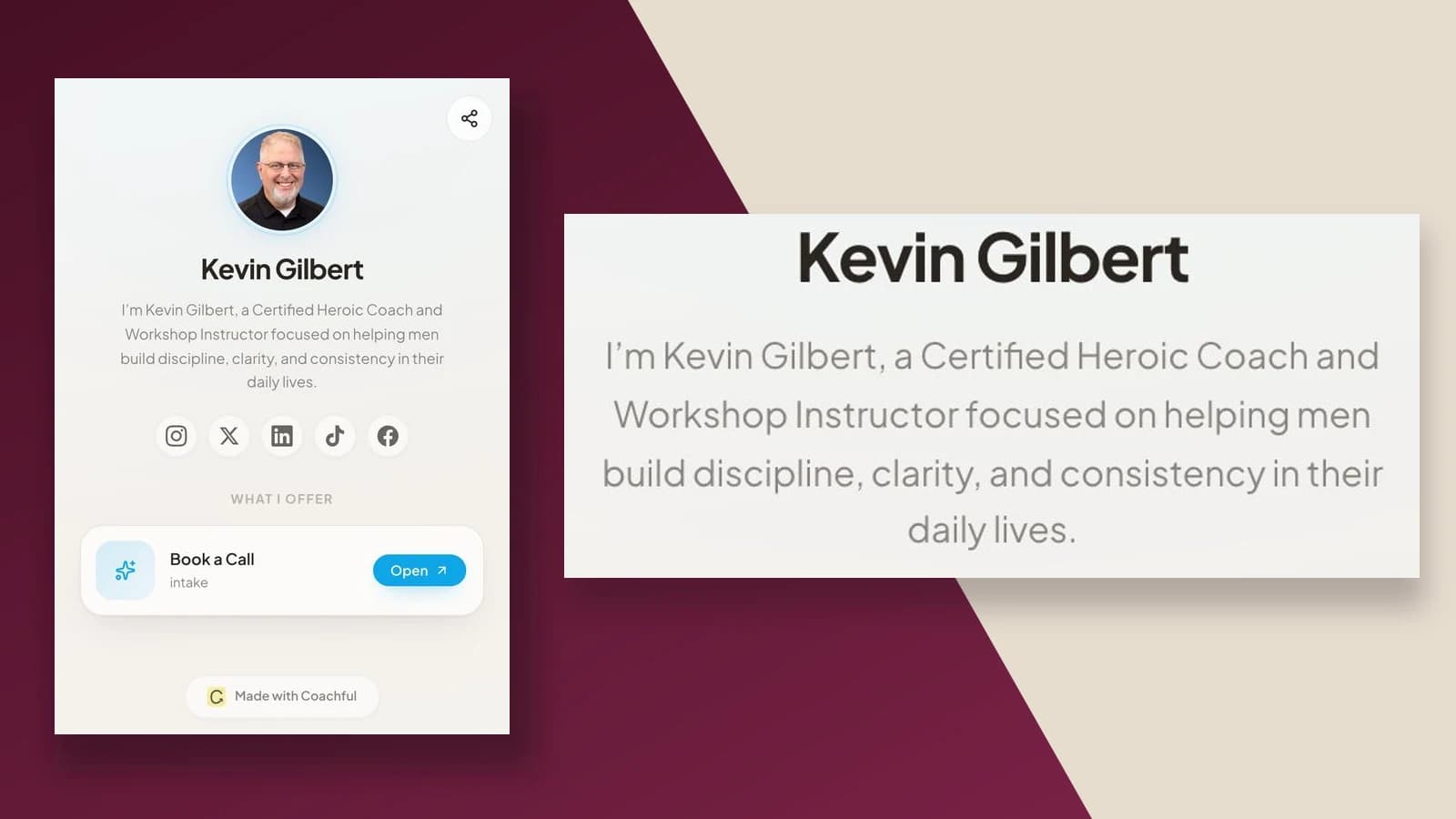
If you want to examine that handoff, try the interactive Coachful demo and compare the public-profile, website and scheduling surfaces with your actual offer. The useful test is whether the destination confirms your promise. Coachful does not need to edit your LinkedIn account for you to do that review.
How to test your headline without fooling yourself
Start with comprehension. Show one version to an appropriate reader without explaining your business first. Ask: “Who do you think this is for?” “What would you expect the coach to help with?” “What would you need to know before considering a conversation?” Listen to the answer rather than defending the sentence.

If the answer is “anyone who wants to improve,” your audience or scope is still vague. If the answer describes a service you do not provide, you have a different problem: the sentence is misleading. Revise one clause, then repeat the exercise with someone else who resembles the intended buyer.
After that, use the information actually available to you. Note the wording and date of each change, relevant inquiries and what people say they understood. Keep a record of other activity, such as posting, events or referrals, so you do not credit every change in attention to the headline.
Do not call two sequential versions an A/B test. Your audience, posting and external circumstances may have changed between them. Profile views can be useful context, but they do not prove comprehension, suitability or revenue. Avoid inventing a conversion rate when you cannot connect a voluntary inquiry to the activity.
Common questions
Can I use “I help” in a coaching headline?
Yes, if what follows is specific and true. “I help new managers prepare for difficult conversations” is understandable. “I help ambitious people unlock unlimited potential” gives the reader less useful information. The phrase is not the problem; an undefined audience and an inflated promise are.
Should I put “Founder” in my headline?
Include it when the company identity matters to the reader. If you run a solo coaching practice, “Founder” alone does not explain the coaching. Keep the coaching role and audience visible, and use Experience to explain the business. You are choosing useful information, not downgrading your achievements.
Do I need keywords in my LinkedIn headline?
Use ordinary language that accurately names your service, such as career coach or executive coach. That also helps human readers recognize the work. Do not stack unrelated specialties or claim a guaranteed search position. This article provides a writing method, not a verified model of LinkedIn's ranking system.
How often should I change it?
Change it when the offer changes, the current version misrepresents the work or appropriate readers consistently misunderstand it. Do not rewrite it after every quiet week. First check whether you are reaching the right people and whether the destination is usable.
Your next draft
Write one line with a recognizable role, one audience and two or three priorities you can actually coach. Remove any claim you would struggle to substantiate. Read the beginning on its own, then open the destination on your phone.
The best headline is not the most impressive sentence you can write about yourself. It is the clearest truthful signpost to the coaching you are equipped to deliver.