Coaching Workshop Budget Template: Costs and Break-Even

Nour
Founder, Coachful
Will this workshop pay me properly, or will a full room disguise a loss? Build your coaching workshop budget before committing to a venue or advertising. Separate fixed costs from costs per participant, include the value of your preparation time, and calculate how many paid places you need to cover both.
For an open-enrollment workshop, the essential calculation is break-even paid seats = fixed costs ÷ contribution per seat, rounded up. Contribution per seat is the ticket revenue you keep, before fixed costs, minus the costs that increase with each participant. If the required number exceeds the group you can coach well, change the offer rather than quietly squeezing in more people.
This guide gives you a copyable budget structure, a complete fictional example and a decision process for running, adapting or canceling an event. It is written for coaches selling places to individual participants. An employer buying an entire session needs a different commercial decision; see our corporate coaching workshop pricing guide for that quotation process.
Start with the workshop you can actually deliver
A budget becomes misleading when it prices one experience and sells another. Before entering costs, define the learning purpose, delivery format, session length, realistic participant cap and follow-up. Decide whether people receive individual feedback, paired practice, facilitated discussion or mainly teaching.
For example, a career coach might offer a two-hour interview-practice workshop with paired exercises, a worksheet and a short follow-up resource. That is a concrete scope to budget. “Unlimited confidence coaching for everyone who attends” is not. Any individual follow-up sessions add work and should appear in the cost estimate.
Write down which elements are essential and which can change. You may be able to replace a hired room with an appropriate online format. You cannot remove the promised practice or accessibility support after people have purchased without addressing the change honestly. The budget must support the promise, not gradually hollow it out.

A coaching workshop budget template you can copy
Use a spreadsheet or document with the following sections. Give every line an estimate, an actual amount and a short note about its source. A venue quotation is stronger evidence than a remembered price from last year. Keep tax treatment consistent throughout the sheet and ask an accountant where you are uncertain.
1. Revenue assumptions
- Ticket price: the amount attributable to the workshop, with any tax component identified separately.
- Paid places: conservative, expected and capacity scenarios, not the number of people who liked the announcement.
- Discounted places: quantity, actual price and any eligibility conditions.
- Complimentary places: people who create delivery costs without ticket revenue.
- Other confirmed income: sponsorship or a host contribution that has actually been agreed.
- Refund assumptions: expected reductions in retained revenue and any costs you cannot recover.
Do not add the future value of potential coaching clients to ticket revenue. A participant might later buy a package, but that is a separate, uncertain transaction. If you deliberately subsidize the workshop as marketing, show the subsidy as a conscious acquisition budget rather than disguising it as event profit.
2. Fixed event costs
- Room hire, equipment and the event-specific portion of relevant software costs.
- Workshop design, preparation, rehearsal and administration time.
- Facilitator and assistant commitments that do not change within the planned capacity.
- Fixed promotion, travel and accessibility arrangements.
- Agreed follow-up work that is independent of the final headcount.
- A stated contingency allowance for identified uncertainty.
“Fixed” means fixed within this decision, not permanently fixed for your business. A larger room or second facilitator may become necessary above a threshold. If that happens, create a separate scenario. Do not extend a small-group budget indefinitely by multiplying ticket revenue alone.
3. Variable costs per participant
- Printed materials, refreshments and participant supplies.
- Per-person licenses or assessments, where relevant and appropriately used.
- Payment processing and ticketing costs under your actual arrangement.
- Individual review or feedback time promised to each attendee.
- Any other cost genuinely triggered by another registration.
A digital worksheet may have little additional distribution cost, but personally reviewing it is not free. Likewise, a payment provider may charge a percentage, a fixed amount, currency conversion or different fees for different transactions. Replace planning allowances with your own verified terms; there is no universal workshop transaction fee.
4. Cash commitments and decision dates
Finally, add a simple timetable: when suppliers must be paid, when deposits become committed, when participants pay, and the latest date you can change the event responsibly. A workshop can look viable on paper while leaving you unable to fund the venue deposit. Profitability and liquidity are related, not interchangeable.
A worked budget for a small coach-led workshop
The following amounts are entirely hypothetical USD planning assumptions. They are not market rates, Coachful pricing, customer results or a recommendation for your own fees. Assume a two-hour workshop priced at $120 per person, with a maximum of 12 paid participants and no complimentary places.
Our coach budgets eight hours of their own time: four for preparation, two for delivery, one for administration and one for follow-up. At an assumed internal value of $60 per hour, that contributes $480 to the economic cost. This is a way to value work, not an instruction to withdraw $480 from the business.
- Venue: $200.
- Coach’s time: $480.
- Assistant, three hours at $30: $90.
- Fixed promotion budget: $100.
- Fixed contingency allowance: $70.
- Total fixed economic cost: $940.

Assume an additional $10 per participant for materials and refreshments and a $6 transaction-cost allowance. Total variable cost is therefore $16 per paid place. The $6 is deliberately just an example allowance, not a quoted provider rate. This simplified example excludes tax complications and assumes every ticket has the same price and cost.
At a $120 ticket price, contribution per participant is $120 minus $16, or $104. That money is available to cover the $940 fixed cost. It is not yet profit. Only after fixed costs are covered does additional contribution create a surplus within this model.
Calculate break-even without forgetting your own time
Divide $940 by $104 and round up to the next whole seat. The economic break-even point is 10 paid participants. Nine places do not quite cover the modeled cost, even though the room would look reasonably full.
It is worth checking the cash-only view separately. Excluding the $480 value assigned to the owner’s time leaves $460 of fixed cash cost in this example. That cash-only threshold is five paid places, assuming the full cash contingency is spent and the same variable costs apply.
Both figures are useful, but they answer different questions. Five seats may cover the modeled cash outlay while leaving the coach inadequately compensated for eight hours of work. Calling that a successful profitable workshop would hide the very problem the budget is meant to reveal.

Do not count owner time twice. If you already include an explicit labor allowance, do not also subtract the same compensation again from the resulting surplus. Conversely, if you exclude owner time, say so plainly. Use “surplus after the modeled costs” rather than “net profit” when business overhead, taxes or other expenses remain outside the calculation.
Run seat scenarios before you buy anything non-refundable
A single expected attendance number encourages wishful thinking. Use at least one low-enrollment case, the break-even case and a realistic capacity case. In our example, these are the results after the full $940 economic cost and the $16 variable cost for every paid participant:
- Eight seats: $960 ticket revenue, $832 contribution and a $108 modeled loss.
- Nine seats: $1,080 revenue, $936 contribution and a $4 modeled loss.
- Ten seats: $1,200 revenue, $1,040 contribution and a $100 modeled surplus.
- Twelve seats: $1,440 revenue, $1,248 contribution and a $308 modeled surplus.

The maximum-capacity scenario is not a forecast. If your entire plan depends on every place selling at full price, you have little room for refunds, discounts or cost surprises. Ask what you would do if enrollment stopped at eight, while there is still time to make a responsible decision.
Now test a discount. A 20% reduction makes the ticket $96. Keeping the same conservative $16 variable-cost allowance gives $80 contribution per place, so the threshold becomes 12 paid seats. At 12 seats, the modeled surplus is only $20. A discount intended to fill the room can consume nearly all the cushion.
If transaction costs actually change with price, update those too. For mixed prices, calculate each ticket category’s contribution separately rather than pretending every seat earns the headline price. A complimentary guest has zero ticket contribution before costs and still uses capacity; place that person in the model explicitly.
Check the costs that jump when the group grows
Capacity is a coaching-design decision as well as a financial one. If ten people can receive the promised experience but twelve require another facilitator, you cannot use the same fixed-cost total for both scenarios. Add the new commitment and recalculate before announcing extra places.
Review the workload with anyone helping you. Who answers arrival questions, supports access needs, handles technology, facilitates exercises and follows up? Confirm the fee, scope, cancellation terms and availability rather than relying on an enthusiastic conversation. A colleague’s goodwill is not a reliable budget category.

Separate first-run development from repeat delivery. The first event may legitimately carry more preparation. A repeat may reuse materials but still requires audience checks, communications, administration and updates. You can allocate development across a confirmed series, but imaginary future runs should not make today’s committed costs disappear.
Validate demand before locking in the expensive version
An interest form can help you test the topic, timing, delivery mode and appropriate audience. Ask only what informs that decision. A coach planning an interview workshop might ask about target roles, preferred dates and the skill participants want to practice, without collecting private employment disputes or detailed health histories.

Interest is not enrollment. Separate form responses, people who have requested information, confirmed bookings and paid places. If you accept advance payments subject to minimum enrollment, explain the condition, the decision date and the refund process before purchase. Avoid presenting a provisional event as guaranteed.
Reduce uncertainty with a smaller commitment where possible: an appropriate online venue, an existing workshop design, a confirmed host contribution or a room with workable release terms. Those choices change the risk. They do not remove your responsibility to deliver the stated experience or honor consumer rights.
Put a run-or-cancel decision on the calendar
Choose a genuine decision date based on supplier terms and reasonable participant notice. Then compare paid enrollment, remaining selling time, committed costs and delivery quality. A minimum-enrollment threshold is useful only when you can still act on it without breaching your promises.
Possible decisions are to run as sold, offer a clearly explained alternative with appropriate participant agreement, postpone under the agreed terms, or cancel and refund as required. Do not silently replace a practical workshop with a sales call because too few people booked. That solves your budget problem by creating a trust problem.

Cash collected matters more than the value of outstanding invoices when paying suppliers. Track payment states and refunds separately from your attendance list. Do not treat every invoiced place as cleared money or assume a promised sponsor payment will arrive before your venue deadline.

When costs are already sunk, the forward-looking decision changes. Ask whether running adds more unavoidable cost than it covers, while considering contractual obligations and participant expectations. Do not confuse that immediate cash decision with proof the original workshop was economically viable. Review both honestly afterward.
Reconcile the event before repeating it
After delivery, replace estimates with actuals: retained ticket revenue, refunds, supplier bills, payment costs, promotion and hours worked. Note what the contingency actually covered. Compare the paid-seat count with attendance, but do not erase a paid no-show from revenue if their payment was properly retained under applicable terms.
Then choose one concrete change. Perhaps preparation took twice as long as expected, follow-up needs a tighter boundary, the room cost was excessive or the participant cap was too ambitious. A fuller room is not automatically the right repair. A clearer scope or better-designed repeat may be more useful.
Use Coachful to test the administration, not to invent the margin
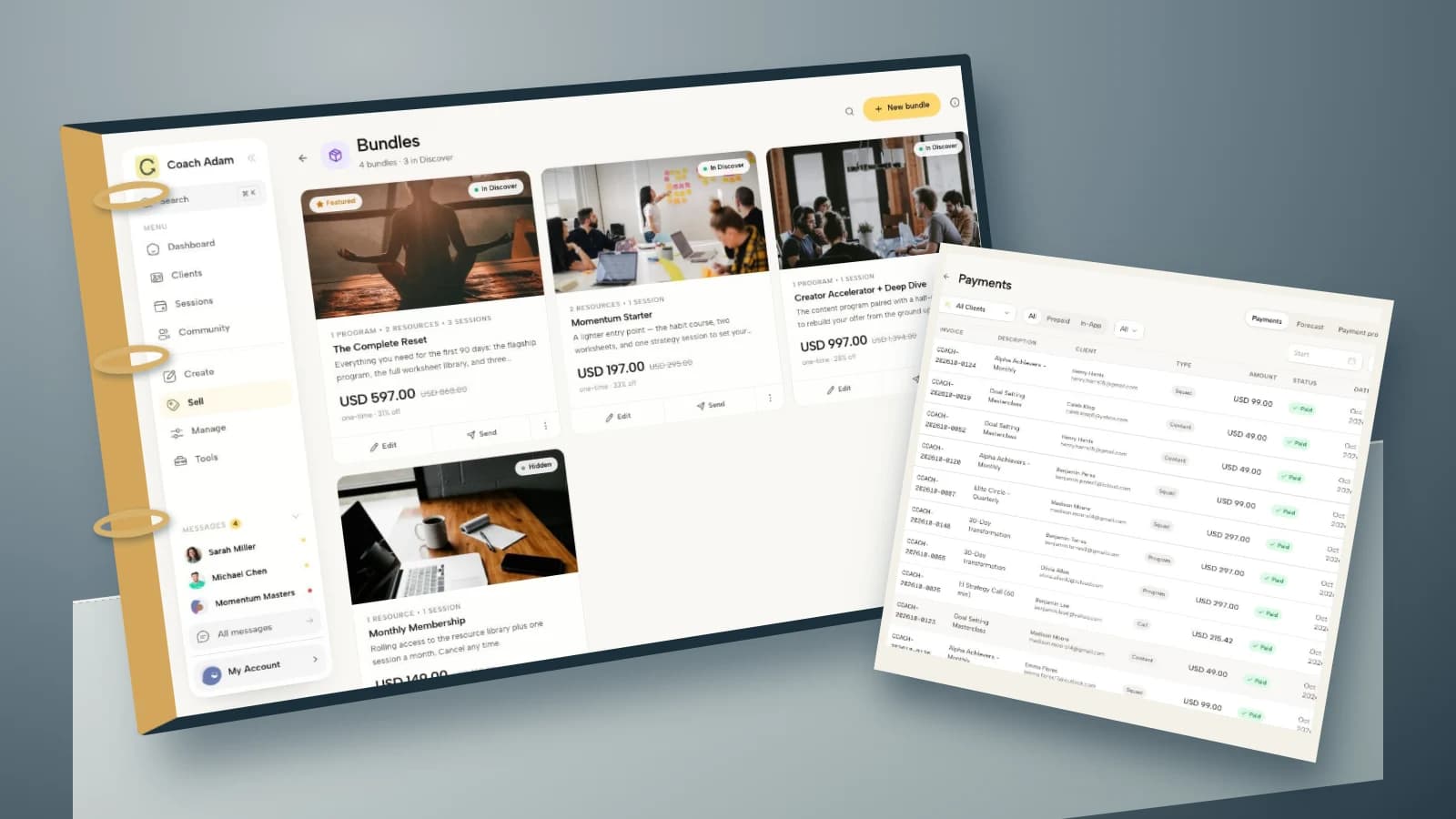
The real demo screens here show offer contents, scheduling, team information, form editing and payment records. They do not show a native workshop budget calculator, tax assessment or automatic event profit report. Keep the financial model in a suitable worksheet and reconcile it against the records you actually use.
If you are choosing software for workshop delivery, bring one budget and one real workshop brief to the interactive Coachful demo. Check how you would organize the offer, preparation questions, delivery responsibilities and payment administration. Identify the decisions your own commercial and accounting processes still need to handle.
Frequently asked questions
How much should I budget for a coaching workshop?
There is no universal amount. Budget the format, venue, preparation, delivery, support and participant costs you actually require. The example above is a calculation demonstration, not an industry benchmark. Obtain current quotes and test low-enrollment scenarios before committing.
Should I include my preparation time if I do not pay myself hourly?
Yes, in the economic view. Assigning a deliberate value to your time helps you distinguish cash coverage from worthwhile work. Keep that internal allowance separate from cash expenses and from any later owner withdrawal.
Can I run a workshop at a loss to get coaching clients?
You can choose a bounded marketing investment if you can afford it and the offer is honest. Record the subsidy and measure actual subsequent sales separately. Do not budget unconfirmed package sales as if participants already bought them.
Does break-even mean the workshop is worth running?
No. It means the modeled revenue covers the modeled costs. You still need a suitable audience, a deliverable learning experience, workable cash timing and a reason the engagement deserves the capacity it uses. The budget informs the coaching-business decision; it does not make that decision for you.