Find Your Tribe: A Coach's Guide to Building a Community of Ideal Clients

Coachful
To truly find your tribe, you have to move past generic marketing and get crystal clear on who your ideal client really is. This isn't just about demographics; it's about zeroing in on a select group whose problems you are uniquely wired to solve. When you do this, something magical happens: your marketing becomes effortless, and your client base becomes fiercely loyal.
The Real Secret to a Thriving Coaching Business
If you’re like most coaches I’ve worked with, you're incredibly talented, but your client roster is a mixed bag. Some clients are a dream—their progress lights you up. Others, well, they leave you feeling drained and wondering if you're making any difference at all. You feel like you're constantly chasing leads, and frankly, it's exhausting.
That little voice in your head keeps whispering, 'If I niche down, I'll miss out on potential clients!' It’s a fear almost every coach grapples with. But what if the secret to a packed-out, high-impact coaching business isn't about casting a wider net? What if it’s about becoming a magnet for a very specific group of people?
From Generalist to Specialist
Let’s be honest, the coaching world is crowded. The industry is projected to hit $5.34 billion by 2025, with over 122,000 certified coaches now practicing worldwide—a staggering 62% jump since 2019. While North America leads the market with $2.08 billion in revenue, the real story is in who's earning the most. The top 10% of coaches, many of whom pull in over $150,000 annually, aren't the ones serving everyone. They’re the specialists.
This tells us one thing loud and clear: specificity is your superpower. It’s what attracts clients who are all-in, get incredible results, and then turn into your biggest fans.
Trying to be everything to everyone is a recipe for burnout. The alternative is to build a focused practice where you are the go-to expert for a specific group. This table breaks down the two paths.
Generalist Coach vs Tribe-Focused Coach
| Aspect | The Generalist Coach | The Tribe-Focused Coach |
|---|---|---|
| Marketing Message | Vague and broad; tries to appeal to everyone. | Sharp and specific; speaks directly to one person's pain points. |
| Client Attraction | Spends heavily on ads, constantly chasing leads. | Attracts clients organically through reputation and word-of-mouth. |
| Client Quality | Attracts a mix of committed and uncommitted clients. | Attracts highly motivated clients who are a perfect fit. |
| Results & Impact | Inconsistent client results and diluted impact. | Consistently delivers powerful transformations. |
| Income | Unpredictable, often struggles to hit income goals. | Commands premium rates with a predictable, scalable income. |
| Fulfillment | Often feels drained, frustrated, and spread thin. | Feels energized, purposeful, and deeply fulfilled by their work. |
The difference is stark. Focusing on a tribe doesn't limit your business; it amplifies it.
This shift from a generalist to a specialist is the exact journey that separates struggling coaches from the ones who build a thriving, sustainable practice.
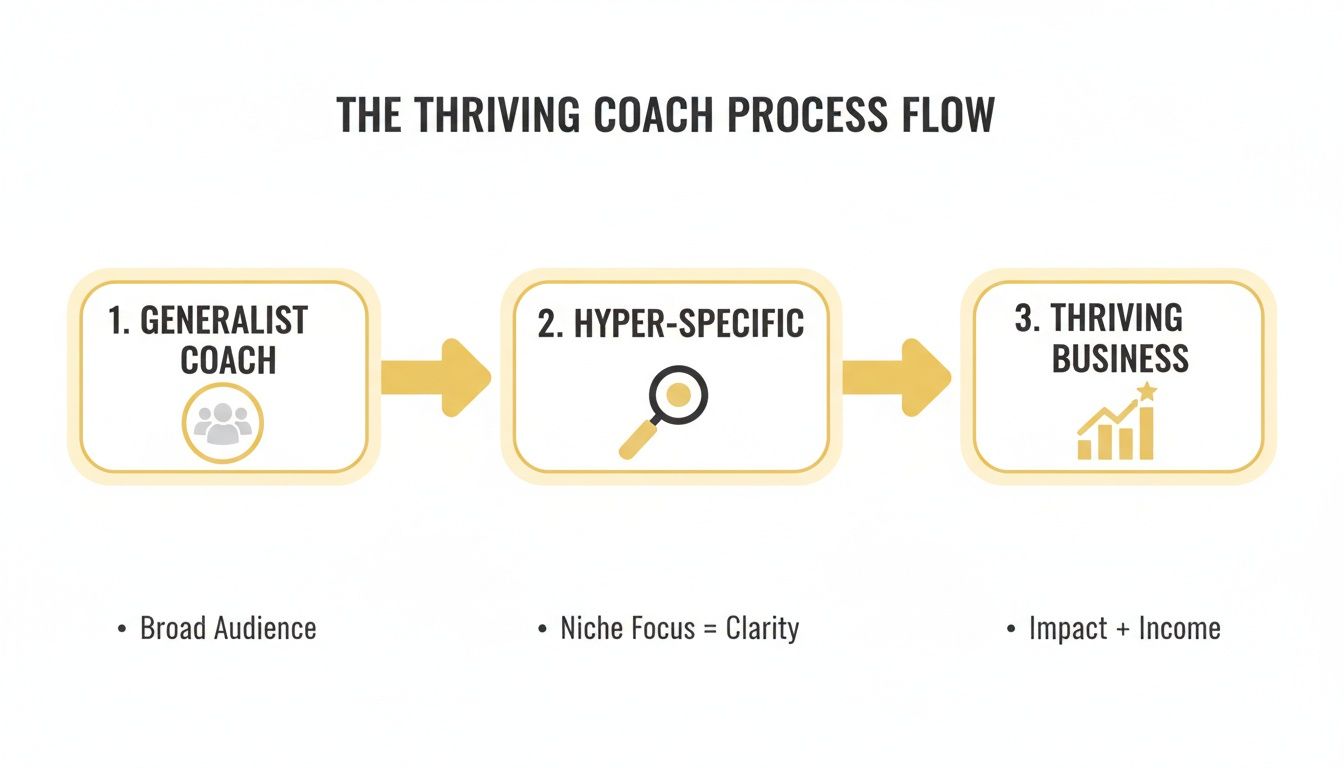
Being hyper-specific acts as a powerful filter. It automatically attracts the people you're meant to serve and gives you the foundation to grow a business that lasts.
Shifting from a generalist to a specialist isn't about limitation; it's about authority. When you speak to everyone, no one truly listens. When you speak to a specific person's deepest challenges, you become the only voice they want to hear.
This reframes "finding your tribe" from a trendy catchphrase into a core business strategy. Imagine a practice where your work feels deeply meaningful because you've created a powerful draw for the exact people you were put here to help. To get there, you have to become a thought leader and lead your industry. This isn't just about filling your calendar; it's about starting a movement.
Define Who You Are Meant to Serve
Before you can build a community, you have to know—with crystal clarity—exactly who you're building it for. This is where so many coaches stumble. They think about simple demographics like age or location, but that's barely scratching the surface. To truly find your tribe, you need to go deeper into their psychographics: their fears, their ambitions, and the exact words they whisper to themselves when no one is around.

I know what you’re probably thinking: “But I can help anyone who’s motivated! My coaching is versatile.” While that’s a beautiful sentiment, it’s a terrible business strategy. It leads to bland marketing and clients who aren’t quite the right fit.
So, let’s get specific. Whose transformation truly lights you up? Whose win feels like your own? That feeling is your north star.
From Vague Ideas to a Vivid Avatar
The first real step is to create an "Ideal Tribe Member" avatar. This isn't just a fluffy marketing task; it's an act of deep empathy that will inform every single thing you do from here on out. You need to map out their 'before' state—the specific pain that has them staring at the ceiling at 2 AM—and their desired 'after' state—the life-changing result they'd do almost anything to achieve.
The goal is to know your ideal client so well that they feel like you're reading their mind. When your content speaks directly to their inner monologue, they don't just see a coach; they see a guide who truly understands them.
This isn’t just good practice; it’s a survival tactic. There are an estimated 4.7 million coaches on LinkedIn alone, so being a generalist is a fast track to being invisible. Clients are craving real connection, and when they find it, 80% report gaining self-confidence. Understanding the market—like knowing the average client age is 42 and 72% of coaches are women—helps ground your avatar in reality.
Uncovering Their Inner World
So, how do you actually get that specific? It starts by asking the right questions—the ones that go beyond the obvious. Get a blank document and, imagining your ideal client, write down the answers to these prompts:
- What are they secretly Googling? Are they searching for "how to stop feeling like a fraud at work" or "what to do when you feel stuck in your career"? Use their exact language.
- What's the one limiting belief holding them hostage? Is it the voice that says, "I'm not qualified enough to apply for that," or, "It's too late for me to make a big change"?
- What result would make them feel like they've finally 'made it'? Does it look like landing a C-suite role, confidently launching their own business, or finally leaving work at 5 PM without guilt?
Answering these gives you the raw material for marketing that feels like a genuine conversation, not a sales pitch. If you want a structured way to test your assumptions, consider running a small experiment on how to identify your target audience.
This deep empathy is the bedrock of your entire business. It's the most crucial part of finding your coaching niche and ensures you attract people who aren't just one-off clients, but true, dedicated members of your tribe.
Create Content That Attracts Your Tribe
You’ve done the hard work of figuring out exactly who you’re meant to serve. Now, the real magic begins: getting them to find you. This isn't about shouting into the digital void and hoping someone listens. It’s about creating ‘dog whistle’ content—content so specific and insightful that only your ideal clients can truly hear it.
The goal is to make them stop mid-scroll and think, “Wow, it’s like this person is inside my head.”

I can almost hear the objection now: “But I’m a coach, not a content creator!” I get it, but let’s reframe that thinking. Your content is your coaching, just delivered at scale. It’s how you build trust and demonstrate your expertise long before anyone even thinks about paying you.
A Simple, Effective Content Strategy
You don't need to post all day, every day. You just need to be strategic. I’ve found that the most effective content consistently touches on three key themes. Each one is designed to connect with your ideal client on a different level.
Think of it this way: you’re showing them you understand their pain, painting a vivid picture of the future they want, and proving you’re the one who can help them get there.
Here are the three types of posts that will become the bedrock of your content plan:
- Speak to Their Pain: This is all about empathy. You need to name the specific struggle that’s keeping your ideal client stuck, using the same words they’d use themselves.
- Illustrate the Vision: This is where you inspire them. You vividly describe the 'after' state they're craving, making their desired transformation feel not just possible, but tangible.
- Show Your Proof: This is how you build credibility. You can showcase client wins, share social proof, or offer a peek behind the scenes of your process to prove your methods work.
By rotating through these three angles, you create a compelling narrative that resonates deeply and positions you as the only logical guide for their journey.
From Strategy to Action
Let's put this into practice. Imagine you're a leadership coach who helps newly promoted female managers overcome imposter syndrome. Just telling them to "be more confident" is a waste of time. Instead, you need to create content that speaks directly to their inner monologue.
Example 1: Speak to Their Pain (LinkedIn Post)
You could write a post starting with, "It's 5 PM. Your team has gone home, but you're still at your desk, rewriting an email for the fifth time." This immediately dives into that specific feeling of needing to over-prove your worth. You’re not selling anything; you’re just saying, “I see you. I get it.”
Example 2: Illustrate the Vision (Instagram Reel)
How about a quick Reel showing a thriving leader confidently delegating a big task, then packing up and leaving the office on time to meet a friend? The caption could be something like: "This isn't a pipe dream. This is what leading from a place of trust, instead of fear, actually looks like."
Example 3: Show Your Proof (Email Newsletter)
In your weekly email, you could share a short, anonymized client story. "When 'Sarah' first came to me, she dreaded Monday mornings. Last week, she confidently led her team through a major project launch and was home for dinner. Here's the one mindset shift we worked on that changed everything for her." This makes the results feel real and achievable.
The most effective content doesn't just attract followers; it qualifies leads. It naturally repels people who aren't a good fit and irresistibly draws in the ones who are, making the eventual sales conversation feel like a natural next step.
This is how you truly find your tribe. You stop broadcasting and start connecting. You build a community of people who feel seen, understood, and genuinely inspired by the work you do.
Build a Community They Never Want to Leave
Getting your ideal clients to follow you is a fantastic start, but it’s just that—a start. If you want to build something that lasts, you need to give them a place to belong. A scattered audience across various social media feeds isn't a real community; it's a crowd. The key is to bring them home to a central hub where they can connect, share, and grow together.
I know what you might be thinking: “Not another Facebook group! Do those even work anymore?” And you're right to be skeptical. While some coaches make them work, the real opportunity lies in creating an exclusive, premium experience that feels a world away from a noisy social media feed.
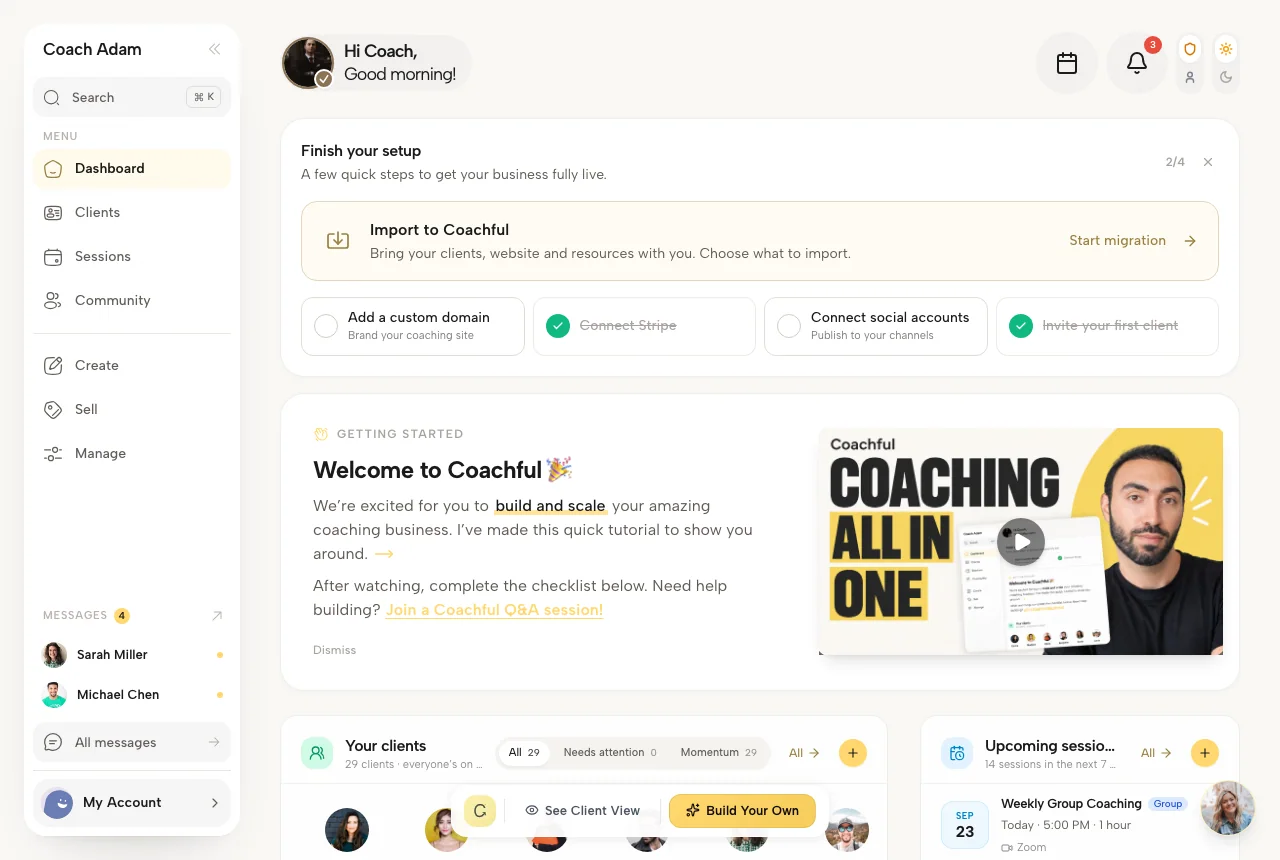
This is where a dedicated space comes in. Whether it’s a private Slack channel, a members-only forum on your website, or an all-in-one platform like Coachful, creating a focused hub changes everything. It’s how you turn passive followers into committed members who feel like they’ve finally found their people.
Designing Your Community Hub
Think of this hub as the living room for your coaching practice. It’s where the magic of belonging happens and an extension of the value you provide, even outside of your sessions. The goal isn't just to foster a connection between you and your members, but to spark connections between the members themselves.
The whole idea of 'finding your tribe' has become a major driver in the coaching world for a reason. The global coaching market swelled to $4.56 billion in 2022, largely fueled by this power of community. The numbers don't lie: group dynamics have been shown to amplify coaching results, leading to an 80% boost in client confidence, a 63% increase in retention, and a 70% gain in productivity, according to Kinkajou Consulting.
These stats prove that a thriving community isn't just a feel-good bonus; it’s a powerful engine for client success and business growth. For a deeper look at the nuts and bolts, check out our guide on building an online community.
Sparking Consistent Engagement
So you've built the space. Now, how do you get people talking? An empty forum can feel like an awkward, silent party. Your first job is to be the host—to get conversations started and make introductions until your members feel comfortable taking the lead.
A ‘Community Engagement Calendar’ is your secret weapon here. It’s a simple schedule that gives your community a predictable rhythm, making it easy and natural for people to jump in. You don’t need to overthink it.
Your job as a community leader is to be the spark. You create the container and provide the initial prompts, but the real fire comes from the members connecting with each other, sharing their wins, and supporting each other through challenges.
Here’s a simple weekly framework you can adapt for your own tribe:
- Mindset Monday: Kick off the week with a thought-provoking question. For example, “What’s one limiting belief you’re choosing to release this week?”
- Tactics Tuesday: Share a practical tool or a quick tip that solves a common pain point for your members.
- Wins Wednesday: Designate a thread for everyone to celebrate their progress, no matter how small. This builds incredible momentum and powerful social proof.
- Feedback Friday: Ask for input or share something you're working on. Try something like, “I’m brainstorming a new workshop. What’s the #1 thing you’d want to learn about [topic]?”
This simple structure helps create that exclusive, high-value experience people are looking for. It's how you turn an audience into a true community—a place they are genuinely proud to be part of.
Turn Engaged Members into Ideal Clients
You’ve done the hard work of building a vibrant, engaged tribe. People love the space you've created. Now what? It’s time to invite them to become paying clients, a step that makes even seasoned coaches a little squeamish.
If you’re hearing that little voice in your head saying, “I hate selling; it feels so pushy and inauthentic,” just take a breath. The key is to reframe this entire process. You're not "selling" at all. You're simply offering a more direct path to the transformation they already want.

Think of it as a natural extension of the value you already provide. You've established deep trust and credibility. The "conversion" is just a clear, helpful invitation for them to get more focused support from you.
The Clarity Call Framework
The most effective and ethical way I’ve seen this done is through what I call a "Clarity Call." Forget high-pressure sales tactics. This is a diagnostic conversation where you help your community member get crystal clear on their challenges and help them envision a path forward.
Your only job on this call is to listen intently and ask great questions.
- Pinpoint the Real Problem: Guide the conversation with questions that go deep. Try something like, "What's the one thing that feels most stuck for you right now?" or "If we could wave a magic wand and look ahead six months, what would be different in your life?"
- Bridge the Gap: As they describe their current situation and their desired future, you can begin to map out the space between those two points. Your coaching program isn't something you have to force; it simply becomes the logical bridge to get them where they want to go.
When you frame the conversation this way, you're not selling a program. You're offering a clear, tangible solution to a problem they just told you they have. If you want to dig deeper into this approach, we have a whole guide on how to get coaching clients without feeling salesy.
Creating a 'Wow' Onboarding Experience
Once a new client says "yes," your work is just getting started. A clunky, disorganized onboarding process is the fastest way to introduce buyer's remorse and kill all the excitement you’ve built. A seamless system, on the other hand, immediately validates their decision.
A smooth start proves your professionalism and shows you truly value their commitment.
Your client’s journey doesn’t start with their first coaching session. It starts the moment they say yes. A flawless onboarding process is your first opportunity to deliver on the promise of transformation.
Having a simple checklist is all it takes to create a "wow" experience every single time. A platform like Coachful can actually automate most of this, giving your new client a dedicated portal where everything they need is in one place.
Here’s what that looks like in practice:
- Immediate Welcome: An automated welcome email lands in their inbox, perhaps with a short, personal video from you.
- Intake & Scheduling: The email includes a link to your intake form and a calendar link to book their first session. No back-and-forth required.
- Resource Access: They get instant access to their client portal, which might include pre-work, session schedules, or foundational resources.
- Surprise & Delight: This is my favorite part. A few days later, a small, thoughtful welcome gift or a handwritten card arrives in the mail.
This kind of structured onboarding isn't just about being organized. It’s about making your new client feel seen, supported, and absolutely certain they made the right choice. It’s the final, crucial step in turning that community member into a true raving fan.
Common Questions About Finding Your Tribe
Whenever I talk to coaches about building their community, a few common fears always pop up. It's completely normal. Let's tackle these questions head-on, because addressing these doubts is the first step to making real progress.
How Narrow Should My Niche Be?
This is the big one. Almost every coach asks, "If I get super specific, am I closing myself off from too many potential clients?" It’s a totally valid fear, but I’ve learned from experience that the opposite is true. A tight niche actually amplifies your authority; it doesn't limit your income.
I like to call it the "inch-wide, mile-deep" principle. You can be a generalist who knows a little about helping everyone, or you can become the undisputed expert for a specific group of people with a very specific problem. That focus is what makes your marketing feel magnetic—you're speaking directly to their deepest pains and hopes with crystal clarity.
Think about it. When you're known as the go-to coach for "newly promoted female managers struggling with imposter syndrome," you stop competing on price. Your expertise is the draw, and you attract clients who are eager to invest in a real solution.
What If I Choose the Wrong Tribe?
Here's another worry I hear all the time: "What if I spend all this time building for one group and realize it’s the wrong one? Can I pivot?" My answer is always a resounding YES. Finding your tribe isn't a one-and-done decision. Your first choice is simply a hypothesis, not a life sentence.
Think of your niche as a living, breathing part of your business. It's meant to be tested, refined, and adjusted as you learn more about who you love to serve and where you get the best results. A pivot isn't a failure; it's a smart adjustment based on real-world data.
If you notice your energy is low or your clients aren't getting the transformations you'd hoped for, that's your sign to reassess. You can gracefully test a new direction by creating some content for a slightly different audience and seeing what sticks. This process of listening and adjusting is what builds a coaching practice that truly lasts.
Do I Have to Be All Over Social Media?
For the more introverted coaches out there, this question is a big source of anxiety: "Do I really have to be an extrovert who is live on Instagram all day?" Absolutely not. Please don't force yourself to do that.
You don't need to be everywhere. You just need to show up where your tribe already is, and you can do it in a way that honors your own energy.
Here are a few powerful, introvert-friendly strategies that work wonders:
- Strategic Partnerships: Team up with other professionals who serve the same audience but aren't your competitors.
- Guest Writing: Share your expertise on established blogs or in publications that your ideal clients are already reading.
- Deep Connections: Instead of broadcasting to the masses, focus on building meaningful one-on-one relationships in smaller, curated online forums or groups.
Remember, your authority comes from the depth of your insight, not the volume of your posts.
Ready to stop juggling tools and start building your tribe? Coachful brings everything you need to manage, grow, and scale your coaching practice into one seamless platform. Start your free trial today and build a home for your community.