Guest Blogging for Coaches: 7 Steps to Pitch the Right Sites

Coachful
Editorial Team
Is guest blogging worth your time as a coach, or are you about to write a free article for the wrong audience? It is worth testing when the publication reaches people you can genuinely help, your article answers a specific reader question, and the editor permits a relevant next step. Do not accept an opportunity merely because it promises exposure or a backlink.
The useful goal is not to collect bylines. It is to put a good explanation in front of a suitable audience and make it easy for interested readers to continue. A smaller specialist publication can be a better fit than a recognizable site whose readers will never need your work.
This guide gives coaches seven steps for choosing publications, pitching an original contribution, agreeing terms and evaluating the result. The examples are hypothetical. They are not accounts of Coachful customers, measured conversion results or promises that an editor will accept your work.
What guest blogging means for a coaching business
Guest blogging means contributing an article to a publication you do not own. The publisher controls its editorial standards and distribution. You contribute expertise that serves its readers, usually with an agreed author credit and sometimes a link to your website.
That differs from posting on your own blog, buying an advertorial or submitting the same article to a large network of sites. Those arrangements have different purposes, rights and disclosure needs. Find out which one you are being offered before spending a weekend writing.
For coaches, an appropriate contribution might help managers prepare a career conversation, help independent business owners compare a hiring decision, or help a community understand what coaching can and cannot provide. Keep the advice within your competence. A guest byline does not expand your professional scope.
Guest blogging is also not the same as podcast guesting. Written contributions involve originality, editing, publication rights, author credits and potentially text syndication. Our separate guide explains how to get booked on podcasts as a coach. Here, the job is to place a useful written article.
1. Choose publications by audience fit, not reputation alone
Write down the reader you want to reach and the decision you can help them make. “People interested in personal development” is too broad to guide a shortlist. “New managers preparing their first internal career conversation” gives you something to investigate.
Look at professional associations, trade publications, alumni publications, relevant community organizations and specialist blogs. These are places to research, not a claim that every organization accepts outside articles. Search for contributor guidance and inspect recent bylines before contacting anyone.
- Audience: Do recent articles address the people you serve, or mainly other coaches?
- Editorial fit: Does the publication accept outside expertise, and is your proposed angle missing?
- Terms: Are any fees, exclusivity conditions, disclosures and link restrictions acceptable?
- Reader route: Can an interested person identify you and take a suitable next step?

A coaching-industry publication can be valuable for professional relationships. It may be less useful if your immediate goal is reaching clients in another profession. Decide which purpose matters before treating all placements as equivalent.
Start with a small researched shortlist. For each candidate, record the audience, contributor instructions, relevant recent article, proposed gap, contact route and commercial terms. You do not need a scraped database. You need enough evidence to explain why your contribution belongs there.
2. Pitch an unanswered reader question
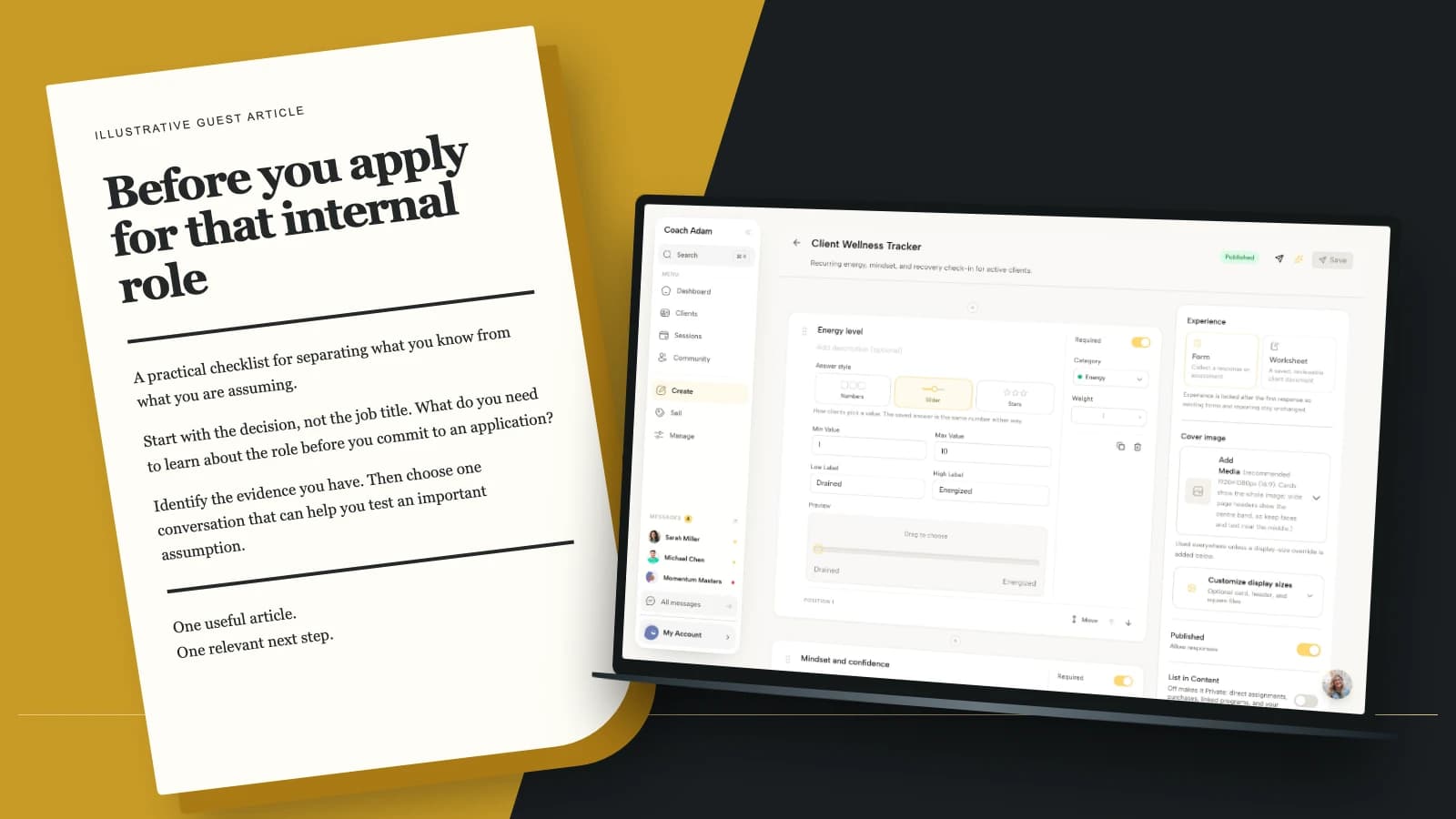
Read a recent relevant article and inspect the publication's existing coverage. Your idea should extend that coverage rather than repeat it. “I can write about confidence” makes the editor invent the assignment. “A checklist for deciding what to ask before applying for an internal role” proposes an actual article.
Choose one practical question, a clear point of view and something the reader can use. A checklist, worked example or decision comparison can help, provided it answers the question rather than decorating broad advice. For other structures, see our guide to blog post formats.

The same coaching expertise can support different articles without becoming a thin rewrite. An employee publication might need questions to investigate a role. A manager publication might need a way to support the conversation without making the employee's decision. Those are different readers doing different jobs.
Keep the promised result proportionate. “Prepare three useful questions” is something an article can teach. “Get the promotion you deserve” is an outcome you cannot guarantee. Avoid turning a sensible learning task into a marketing promise because the second headline sounds louder.
3. Send a short editorial pitch, not your life story
Follow the publication's submission process first. Some editors want a complete draft, others an outline, and others a form. Do not send attachments or a calendar invitation when the instructions request a brief email.
A useful pitch explains why this reader, why this question and why you can contribute. Include a relevant writing sample and accurately described experience. If your best sample is on your own website, that is fine. Do not imply it was an external commission.
Subject: Article idea for [Publication]: [specific reader question]
Hi [Editor],
Your article on [specific checked detail] left a useful follow-on question for [audience]: [unanswered decision].
I would like to propose [working title], a practical article showing readers how to [bounded task]. It would cover [point one], [point two] and a short [checklist or worked example].
I coach [accurate audience description]. Here is a relevant writing sample and my background: [public link]. The proposed article would be original and tailored to your contributor guidance.
Would this be useful for your readers? I can send an outline in your preferred format.
Thanks,
[Name]
This is a copyable structure, not a message to send unchanged. Verify the article detail, remove any experience you cannot substantiate, and replace every placeholder. One genuine observation is better than a paragraph of praise that could describe any website.
Use a professional contact channel provided for submissions. Do not add editors to your newsletter, scrape personal addresses or treat a public email as permission for repeated marketing. If the publication gives a response policy, follow it. Otherwise, one brief follow-up after a reasonable interval is an editorial judgment, not a universal rule.
4. Agree rights, fees and links before drafting
An interested editor has not necessarily agreed to your assumptions. Confirm the topic, length, deadline, review process and whether the contribution is paid, unpaid or a paid placement. Ask about any submission or publication fee before committing.
Clarify ownership and reuse. Can you publish a revised version later? Is there an exclusivity period? Can the publisher syndicate or substantially edit the work? May you share an extract or screenshot after publication? Get the important terms in writing and obtain legal advice where appropriate.
Also agree the author credit, bio length and permitted links. A link in the main article is different from a byline link. An editor may remove promotional links or prohibit lead magnets. Respect the rules instead of submitting useful advice with a concealed sales page attached.
Do not buy a guest post as a shortcut to search rankings. Google's link-spam policy identifies links created primarily to manipulate rankings, including certain paid links and optimized links in guest posts. Its guidance describes qualifying paid links with appropriate attributes such as rel="sponsored" or rel="nofollow". The publisher controls its implementation; ask questions rather than demanding a ranking-passing link.
A paid placement can be evaluated as advertising, with clear terms and appropriate disclosures. It should not be disguised as independent endorsement. Neither an unpaid contribution nor a prominent publication guarantees search visibility, enquiries or clients.
5. Prepare one relevant destination before publication
If the editor permits a byline link, choose a page that continues the article's practical task. A career-decision article might lead to a short role-research worksheet. A leadership article might lead to a conversation-preparation guide. A homepage is acceptable when it is genuinely the clearest next step, not merely the easiest link to copy.
Give the page a direct heading, a brief explanation, usable material and one appropriate action. Match the language to what the reader just learned. Do not promise a free checklist and deliver a mandatory sales call instead.

If you already use Coachful, its website workspace is relevant to preparing that destination. The screenshot illustrates real website administration, not a guest-post distribution service or a promise that a ready-made contributor page will appear automatically.

Check the exact public link outside your account and on a phone. Does it open without an editor login? Is the resource still available? Can a person understand the next step with images disabled? Provide the editor the final address, not a design preview or a link you intend to fix later.
If you use campaign parameters, keep them descriptive and free of personal data. They can help distinguish aggregate visits, but privacy tools, copied links and later visits limit attribution. Do not claim to know which individual read an external article because a referral appeared in a report.
6. Write a complete answer without exposing a client
The guest article should work even if nobody clicks your bio. Answer the question, show the method, include an example and explain the limits. A contribution that stops just before the useful part is an advert wearing an editorial jacket.
Draft against the agreed outline. Use original language and accurately attribute external material. Check evidence at its source. Do not turn an association, training organization or publication into an implied endorsement of your coaching business.
Prefer clearly labeled hypothetical examples when a real client story is unnecessary. Changing a name does not necessarily prevent recognition. A distinctive job, incident or combination of details can identify someone within their workplace or community.
Where a real story is essential, follow your agreement, professional obligations and applicable privacy requirements, and obtain appropriate specific permission. Do not pressure clients to supply promotional material. Permission to discuss something in a coaching session is not permission to publish it.
Review the final edited proof when the process allows it. Check that caveats, credentials, quoted material and the byline link survived editing accurately. If the publication changes a claim beyond what you can support, raise it before publication rather than quietly lending your name to it.
7. Follow up with readers only when they choose it
An external reader is not your subscriber. If a resource request collects contact details, explain what is needed for delivery and distinguish that from ongoing marketing permission where required. Make any newsletter choice understandable and follow the applicable rules for your audience and jurisdiction.

A short form usually needs less than a full coaching intake. Ask only for information necessary at that stage. A reader seeking a worksheet should not have to describe a health condition, workplace dispute or relationship history. Save individualized coaching questions for a suitable agreed process.

When someone makes a genuine enquiry, record its source and the next agreed action. Keep editorial outreach records separate from prospective-client records. An editor considering your article is not a person who has asked to buy coaching.

Coachful's sequence editor demonstrates ordered email follow-up. Use a sequence only for a permitted, appropriate relationship and check the actual settings in your account. This screenshot does not establish automatic attribution from guest publications or permission to send unsolicited messages to editors.
How to judge whether guest blogging is working
Separate the stages. Did an appropriate editor accept the idea? Did the article go live with an accurate credit? Did relevant readers arrive? Did any voluntarily request the resource or enquire? Those questions lead to different repairs.

If editors do not respond, revisit the shortlist, instructions and proposed angle. If articles publish but readers do not arrive, investigate distribution, audience fit and whether the allowed link is visible. If readers arrive but the resource is ignored, check whether the destination continues the article's promise.
Keep a simple record of publication, topic, pitch date, response, writing time, costs, live link and observed enquiries. Include “unknown” when you cannot attribute an outcome. A person may read an article, see you elsewhere and contact you later; the last recorded click is not the entire explanation.
Choose a review point before expanding the effort. For example, complete a small researched test and then compare its time cost and enquiry quality with your other activities. That is a planning choice, not a claim that a fixed number of pitches produces a client.
Common questions from coaches
Can a new coach write guest posts?
Yes, when the publication accepts the contribution and you have relevant knowledge to share. Describe your experience honestly, use an accurate writing sample and propose a bounded topic. Do not invent client numbers, publication credits or qualifications to appear established.
Should I pay for guest blogging opportunities?
Assess a paid opportunity as advertising, not automatic editorial validation. Ask what is included, how it will be disclosed, what rights you retain and what evidence supports the claimed audience. You can decline. A promise of search-ranking benefit is not a sufficient business case.
Can I publish the same article on my own website?
Only when your agreement permits it. Check ownership, exclusivity and syndication terms first. If you share an extract or a revised piece, follow the agreed attribution and linking requirements. Do not assume that being the author settles every publication right.
Do I need a free download?
No. A relevant public resource, an explanatory page or a suitable enquiry route can be enough. Add an email-gated download only when it genuinely helps and you can handle delivery, permission and follow-up responsibly.
Your next useful move
Choose one publication, identify one unanswered reader question and draft a short pitch. Before sending it, make sure your writing sample and proposed destination are accurate, public and relevant. The pitch should offer a useful contribution, not ask the editor to manufacture your marketing strategy.
If the weak point is the handoff from article reader to your own website, try the interactive Coachful demo. Explore the website, links, form and lead workspaces with one question in mind: can an interested reader take the next appropriate step without being pushed into a commitment they did not request?
Editorial note: Coachful provides the demo screens shown here. The pitch, selection framework and examples are original guidance, not measured booking results. Google Search Central supplies the linked search-policy reference. No external publication, editor contact or mailing action is carried out by this guide.