How to Create a Mini Course That Leads to Coaching
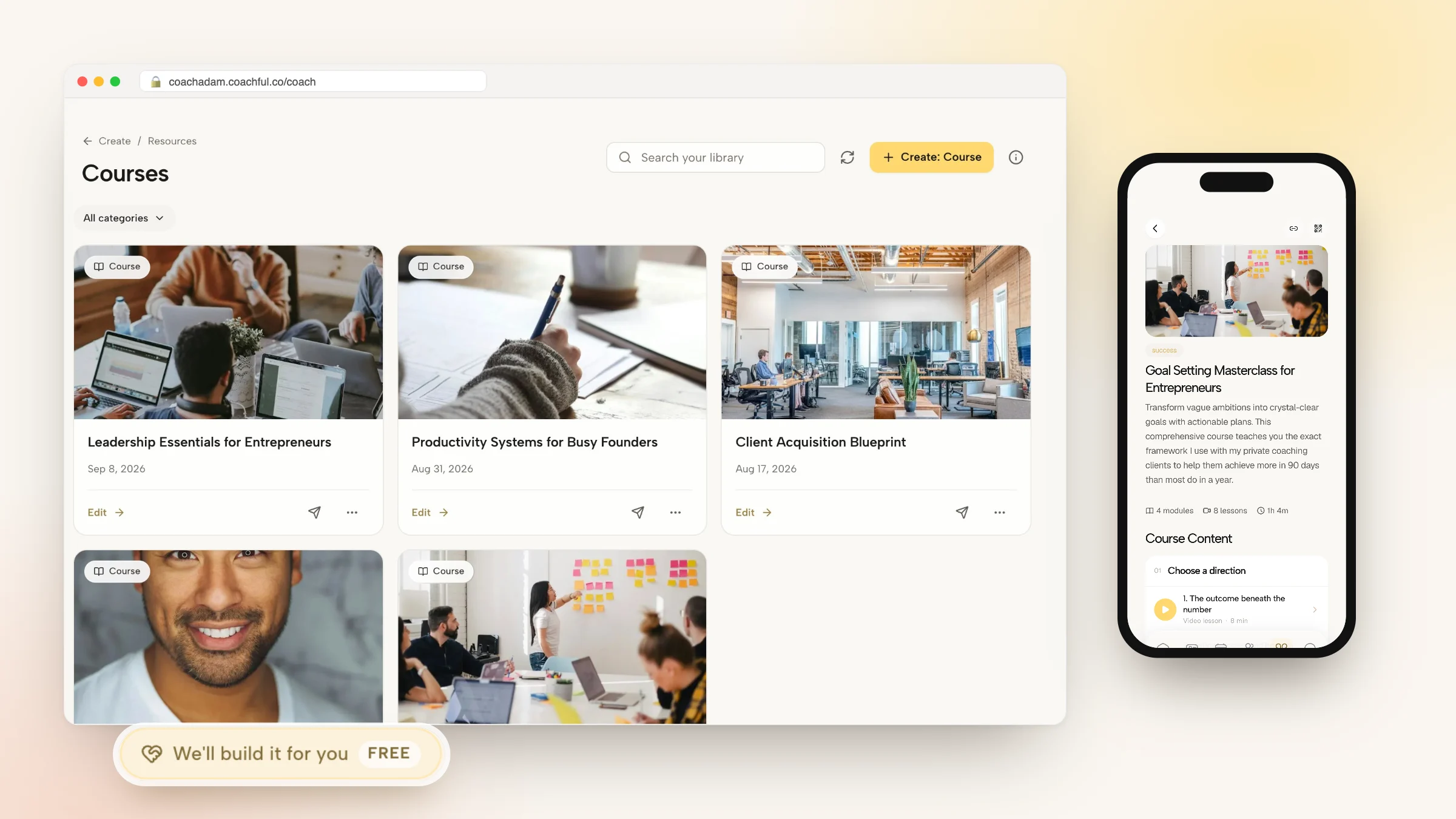
A mini course has one job: get someone a small, real result quickly, then make the next step with you obvious. Knowing how to create a mini course mostly means knowing what to leave out. Three to seven short lessons, under an hour in total, one win at the end. Anything bigger is a full course wearing a smaller name.
Below: how to pick the quick win, a complete five-lesson sample for a parenting coach, whether to make it free or paid, a lesson template you can write in an afternoon, the handoff to coaching, how to deliver it with a signup page and emails, and the mistakes that stop mini courses from leading anywhere.
If you would rather not write it yourself, Coachful's team will write the outline, lessons and worksheets for free on any Coachful plan. You send the topic and your notes; you film any videos.
What a mini course is for
Coaches use mini courses in two ways. As a free lead magnet, it replaces the PDF nobody opens with something that feels like a taste of working with you. As a low-priced product, it gives people who are not ready for coaching a way to start, and it often pays for the ads or time that brought them in.
Either way, its success is measured by what happens after it, which makes it different from a signature course. If you are still choosing which to build, our comparison of mini course versus signature course walks through when each one leads clients to coaching.
| Mini course | Full course | |
|---|---|---|
| Lessons | 3 to 7 | 10 to 30 |
| Time to finish | An evening, or a few days | Weeks |
| Result | One quick, felt win | A skill or method learned in depth |
| Main job | Start a relationship | Deliver a transformation |
Choose the quick win
The quick win is the whole course. Test your idea against four questions:
- Is it fast? Can someone get it within a few days of starting?
- Will they feel it? A calmer bedtime, a first page written, a budget that balances. Insight alone is not a win.
- Does it point at your paid offer? The win should be the first step of what you coach, so the natural next question is "how do I do the rest?"
- Can it be taught without you in the room? If it needs live feedback to work, it belongs in a session, not a course.
Good quick wins are usually the first thing you fix with every new client. Look at your last few first sessions: what did you solve in the opening twenty minutes?
A few quick wins by niche, to get you thinking:
| Niche | Mini course quick win | Leads naturally to |
|---|---|---|
| Career | A LinkedIn headline and About section rewritten in one evening | A job search program |
| Money | Every subscription found and sorted in a weekend | A budgeting or debt program |
| Fitness | A ten-minute morning mobility routine kept for a week | A strength program |
| Leadership | A first one-to-one agenda that new managers can use on Monday | A first-time manager program |
| Life coaching | A sorted list of what to keep, drop and delegate this week | A life transition program |
Sample: a five-lesson mini course for a parenting coach
The course is "Three Calmer Bedtimes", for parents of toddlers whose bedtime routine has turned into a nightly negotiation. The promise: "In three nights, bedtime is shorter, calmer and the same every night."
| Lesson | Length | What it teaches | Action tonight |
|---|---|---|---|
| 1. Why bedtime turns into a battle | 6 minutes | Tiredness, transitions and too many choices | Write down tonight's routine exactly as it happens |
| 2. The same five steps, every night | 8 minutes | Building a short, fixed routine with a picture chart | Choose your five steps and print the chart worksheet |
| 3. Two choices, not twenty | 6 minutes | Offering limited choices that give toddlers control | Pick the two choices you'll offer |
| 4. Night one, two and three | 7 minutes | What to expect, what to say when they protest | Run the routine for three nights and tick the tracker |
| 5. What's next | 5 minutes | Keeping it going, and the bigger sleep questions | Review the tracker; book a call if night waking is the real issue |
Thirty-two minutes of content, two worksheets (the routine chart and a three-night tracker) and a natural bridge: bedtime is fixed, but many parents then realize night waking is the bigger problem, and that is what the coach works on in paid sessions.

Free or paid?
| Free mini course | Low-priced mini course | |
|---|---|---|
| Good for | Growing your email list and booking calls | Finding buyers, offsetting ad or content costs |
| Signups | More | Fewer, but more committed |
| Completion | Often lower | Often higher, because they paid |
| Watch out for | Giving away the whole method | Pricing it like a full course |
Many coaches start free, measure how many finishers book a call, then test a small price once the course is proven. Our guide to creating a lead magnet for coaches compares a mini course with other free offers.
Write it in an afternoon
Mini course lessons are short enough that the script is the lesson. Use this template for each one:
- One line on the problem, in the words parents (or your clients) actually use.
- One idea, explained with one example.
- One action they can do today or tonight.
- One line pointing to the next lesson.
Before you record anything, check the whole course against this list: total time under an hour, every lesson ends with an action, there is at least one worksheet or tracker, the last lesson names the next step, and nothing in it requires you to be there live. Short text lessons with a worksheet are perfectly fine if you are not ready to film. The full process for longer courses is in our guide on how to create an online course.
The handoff to coaching
The last lesson is a sales conversation, done gently. It should:
- Celebrate the win and ask them to notice it ("Compare tonight with lesson one's notes").
- Name what the mini course did not cover, honestly ("Bedtime is the start. If night waking is still hard, that's a different problem").
- Describe who your paid coaching is for, in one or two sentences.
- Give one clear action: book a free call, or join the program waitlist.
Then follow up by email. Three emails over a week is plenty: a check-in on how night three went, a short story about the bigger problem (anonymized, from a real client who agreed), and a direct invitation to book.

Delivering a mini course with a signup page and emails
A free mini course needs three pieces: a signup page, the course itself and the follow-up emails. In Coachful, funnels handle the signup (the funnel templates include a mini-course lead magnet), courses hold the lessons, worksheets and quizzes, and email sequences send the follow-up. For an audience lead magnet, set lessons to open from the start rather than waiting on completion. Students take the course in your branded portal or the client app on iPhone and Android, and paid mini courses are sold through your own Stripe account with a 0% Coachful platform fee. See the coaching funnel software and course platform pages for the details.

The student side is the same course page your paying clients see, which makes the step up to coaching feel familiar.

Mistakes that stop mini courses from leading anywhere
- Too big. Twelve lessons is not mini. People who signed up for a quick win won't finish a semester.
- A win unrelated to your coaching. A bedtime course from a career coach brings the wrong people.
- No clear next step. If the last lesson ends with "good luck", the course ends there too.
- Giving away the whole method. Solve the first problem completely, and leave the deeper work for coaching.
- Silence after signup. Without follow-up emails, most signups never open lesson one.
Let Coachful's team write your mini course
Coachful's team builds courses as the outline and written material, free on every Coachful plan. The app labels it FREE and Complimentary gift; you film any videos.
Use the first chip on the Create page, We'll build it for you · FREE, or the Want us to build your course? card at the bottom of the Courses list. Its message is short: tell us your topic, we'll write the outline, lessons, quizzes and worksheets, and you film the videos. Opened from there, the form starts with "Course (outline only)" selected.

Describe the mini course ("a five-lesson free mini course for parents of toddlers, with a routine chart and a three-night tracker, ending with an invitation to book a call"), who it is for and what it should achieve. Add up to eight links and up to ten files: handouts, a blog post on the topic, slides or a voice memo. Video files are not accepted. Use the last box for deadlines and anything to avoid.
The team replies by email with next steps, usually within around 24 hours. That is a typical turnaround, not a guaranteed deadline. The lessons and worksheets are built in your account, ready for you to record and publish. The form asks you to choose one thing to build, so if you also want the signup funnel or the follow-up emails, send a second request and pick Funnel or "Email sequence or newsletter".
For a real-estate and money coach, a recent build included exactly this pattern: a free nine-day bootcamp course with its own signup funnel and emails, leading into a year-long cohort program.
The team does not film or record your lessons, design logos, manage ads or run ongoing marketing. Nothing is invented: no fake credentials, testimonials, results or prices; anything missing is left for you to fill. The guide to the free white-glove service has the rest.
Write lesson five first. If you know where the course ends, the other four lessons almost write themselves.
Frequently asked questions
How do I create a mini course?
Choose one quick win your ideal client can get within a few days, outline three to seven short lessons that each end with an action, add a worksheet or tracker, record or write the lessons, finish with a clear next step such as booking a call, and deliver it with a signup page and a few follow-up emails.
How long should a mini course be?
Under an hour of content in total, often 20 to 45 minutes, split into lessons of five to ten minutes. It should be finishable in an evening or over a few days.
Should a mini course be free?
Free works well for growing an email list and booking calls. A low price brings fewer but more committed students. Many coaches launch free, track how many finishers book a call, and test a price later.
What is the difference between a mini course and a lead magnet?
A mini course is one type of lead magnet. Compared with a PDF or checklist, it takes longer to make but gives people a fuller taste of how you teach, which can make the step to coaching easier.
Can Coachful create my mini course for free?
Yes, as the outline and written lessons. On any Coachful plan, choose "Course (outline only)" in the request form, describe the quick win and audience, and attach notes or a voice memo. The team replies by email, usually within around 24 hours, and builds it in your account. You film any videos.
Do mini course lessons need to be videos?
No. Short text lessons with a worksheet work well, and audio is a good middle ground. Video helps when you need to show something, but it is not required to launch.