How to Make and Sell a Product from Scratch

Coachful
You're sitting there after a long day, staring at a calendar full of calls, and the same thought keeps coming back. If you had to explain your process one more time, could you turn it into something people buy without booking your time?
That's the doorway into how to make and sell a product. Not from a flashy idea board. Not from “passive income” fantasies. From the ugly, useful question of what part of your expertise can stop living only in your sessions and start earning on its own.
The Decision to Finally Package What You Already Know
At 11 p.m., the doubt gets louder. You start thinking your frameworks are too ordinary, your templates are too simple, and your best questions only work because you say them out loud. Then the other fear shows up, the one that keeps coaches stuck for years, if I package this, will anyone buy it, and if they don't, what does that say about me?
That's the wrong question. The decision is whether you keep trading hours for money or finally package the repeatable part of your judgment into something that can sell without you being in the room every minute.
A coach usually doesn't have an idea problem. They have a commitment problem disguised as perfectionism. They wait for a breakthrough concept, when the market usually rewards the thing clients already ask for in plain language.
Practical rule: if you've explained the same fix three times in client calls, you're looking at a product seed, not a random thought.
Here's the honest inner conversation. You worry a product will make you look less custom, or cannibalize your high-touch work, or expose gaps in your thinking. Those fears are normal, but they're also expensive. Product creation is crowded, and launch volume is massive, with roughly 30,000 new products introduced each year, about 95% fail, and only about 30% of new product development projects become commercial successes according to the historical data summarized in the Harvard Business School–attributed product launch overview. That's not a reason to freeze. It's a reason to stop romanticizing invention and start respecting commercialization.
The better question is blunt: which version of my expertise should I package first? Not your whole method. Not your grand unified theory. The first offer should be the smallest version of your result that still feels specific enough to buy. If you coach leaders on boundaries, maybe the product isn't “leadership mastery,” it's the intake, language, and follow-up system you already use to help clients stop saying yes to everything. If you coach business owners, maybe it's the pricing audit you keep repeating in consults.
That shift matters because product success isn't about being the most original person in the room. It's about turning what you already know into something a stranger can understand, trust, and pay for quickly.
Choosing and Pressure-Testing Your Product Angle
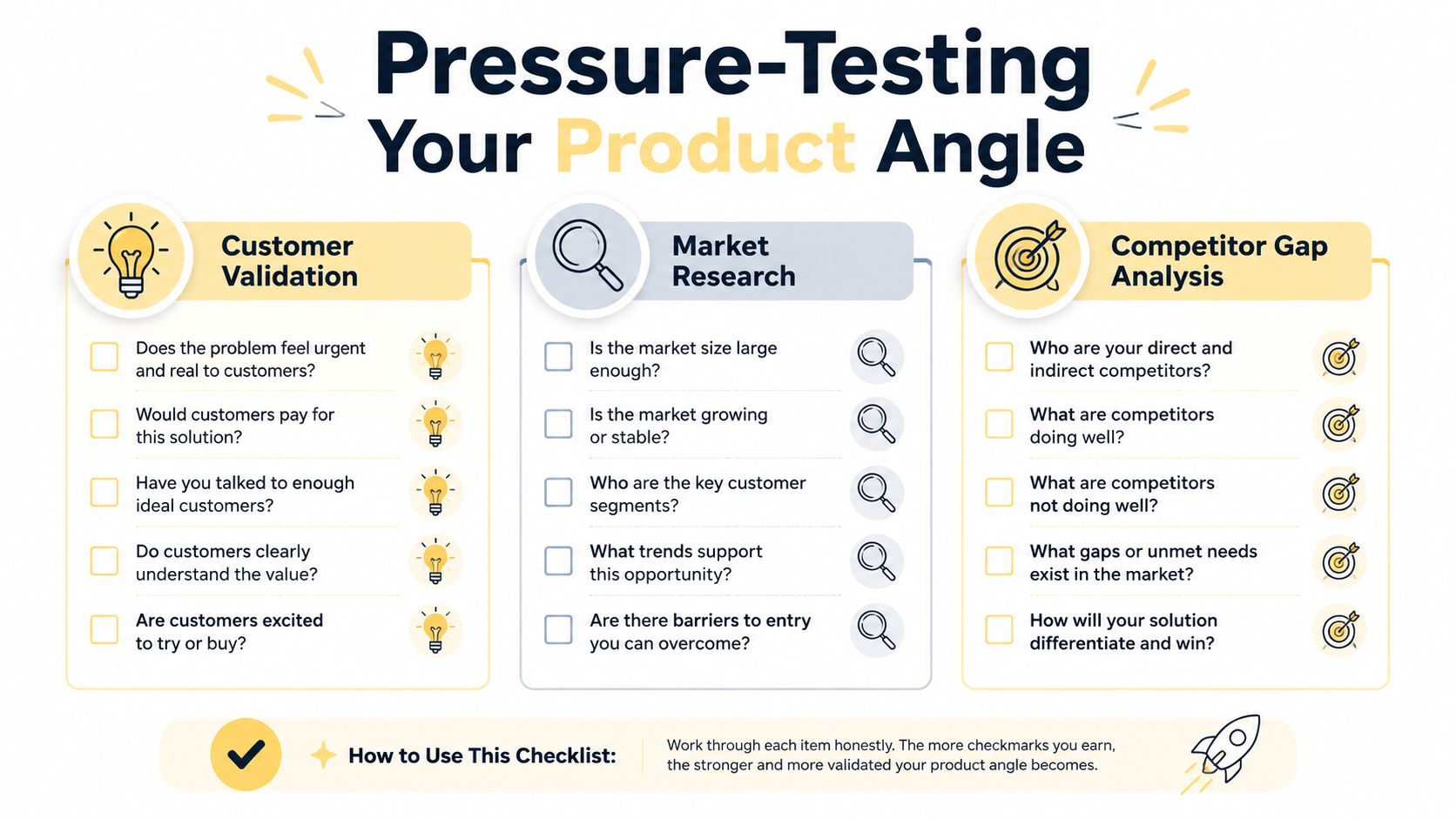
Before you build anything, pick one angle and try to kill it cheaply. If it survives that test, build. If it doesn't, move on without drama.
Start with your own evidence. Look at the questions people ask you repeatedly in DMs, sales calls, inbox replies, and post-session follow-ups. The strongest angles show up over and over in the same language, which tells you the problem is already alive in the market. A vague theme like “confidence” won't do that. A sharper angle like “how to stop freezing in high-stakes client conversations” will.
Use demand signals, not vibes
You're not guessing whether the problem exists. You're looking for proof that people are already spending attention on it. Shopify's product-opportunity guidance recommends checking search interest, social engagement, waitlists, repeated forum questions, and marketplace sales, then testing on a small scale with a landing page or limited preorder, which is a good standard for a solo coach too. If you want a tighter framework for this kind of testing, run experiments for product fit and use the logic, not the jargon.
Ask yourself three questions:
- Do people keep asking for this exact outcome? Repetition beats enthusiasm.
- Can I say the result in one sentence? If you need a paragraph, the angle is still muddy.
- Would anyone pay before I finish building it? If the answer is no, you probably have a content topic, not a product.
The test should be cheap and fast. Put up a landing page with a plain promise, collect interest, and offer a preorder or a short waitlist. If you hate the idea of charging before the product exists, that's usually a sign you need to narrow the promise, not a sign you should avoid validation. A product that nobody will pre-buy usually won't become compelling just because you spent two weekends building it.
Here's the useful contradiction. Competition is not automatically a warning sign. In crowded markets, competition can be evidence that demand is real. Your job is to find the gap in angle, audience, or delivery. That's where the money is.
If you want a deeper companion on what to look for in product ideas, the internal playbook on choosing the right digital product platform fits naturally here, because the angle you choose should match the way you plan to deliver it.
Picking the Right Product Shape for Your Business
Once the angle is clear, the shape decision gets real. Coaches love to overcomplicate this part, but the choice is simpler than it looks. You're deciding how much time you want to trade up front, how much support you're willing to provide, and how much room the offer has to grow.
Match the shape to your capacity
A self-paced digital product is the lightest structure. It works if you want something repeatable, low-touch, and easy to revisit without scheduling more live time. The downside is obvious. If you price it too low or position it vaguely, it can become a noisy little asset that barely moves the needle.
A group program sits in the middle. It gives buyers more guidance than a download and gives you more capacity than 1-to-1 work. It also demands structure, boundaries, and some comfort with group energy. If you like facilitating change but don't want every delivery moment to depend on your calendar, this shape usually makes sense.
A live cohort or 1-to-many offer is the most demanding and the most personal. It's the best fit when your credibility comes from direct teaching, live feedback, and momentum. It can carry a higher perceived value because people feel your presence, but it also requires stronger launch discipline and more active delivery.
Here's the choice in plain terms. If you're early, under-resourced, or still proving demand, start with the smallest usable version of the result. If you already have an audience and clients want proximity to you, group delivery can be the cleaner move. If your method depends on live correction, go cohort-led instead of hiding behind a passive format that doesn't fit your style.
| Shape | Best for | Main trade-off |
|---|---|---|
| Digital download | Fast entry, low support, simple delivery | Easy to underprice and under-position |
| Group program | Structured transformation, repeatable coaching | More facilitation and community management |
| Live cohort | High-touch teaching at scale | Heavier launch and delivery workload |
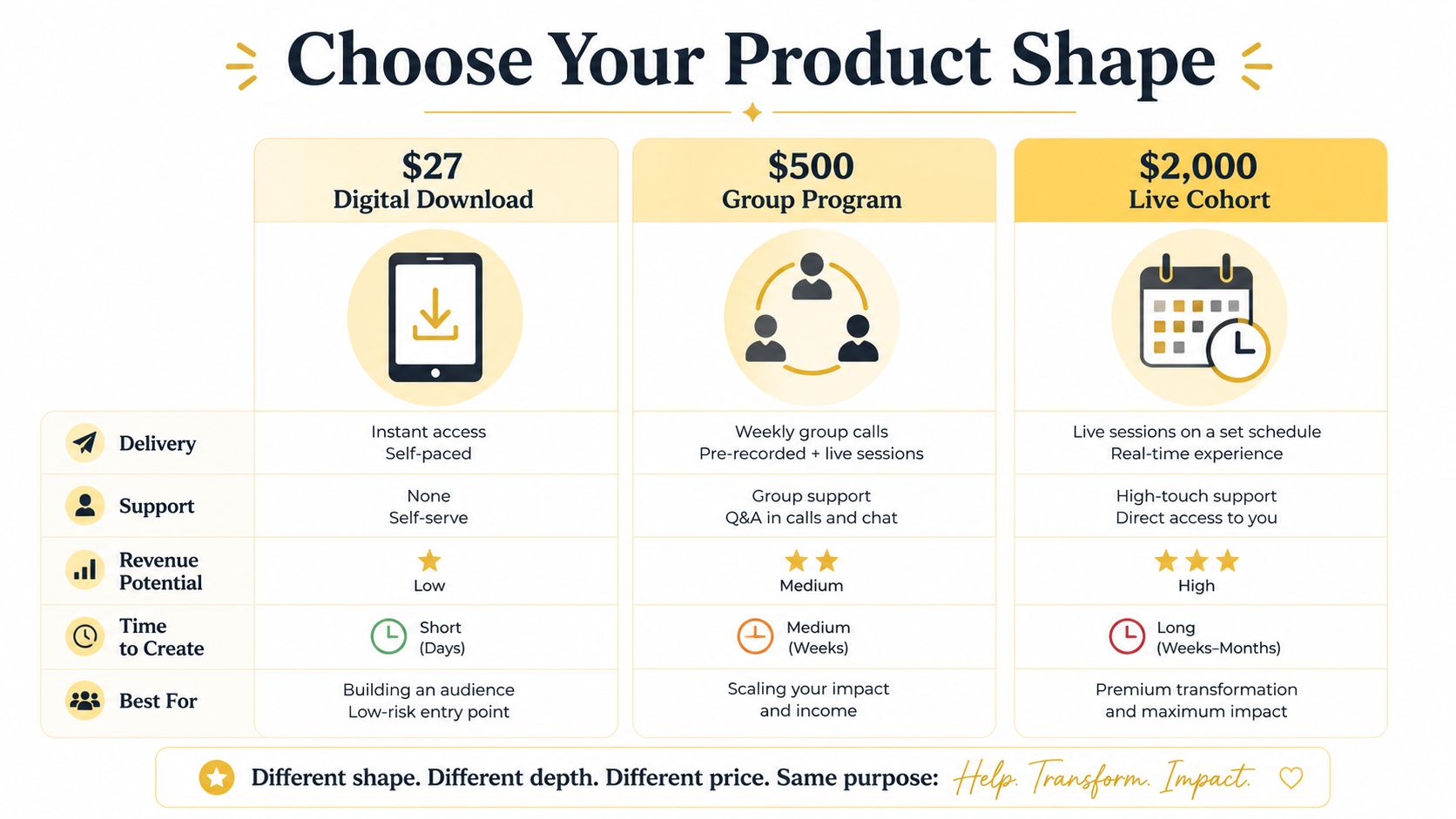
The clean default for a first product is the one you can explain, deliver, and support without inventing a new business model around it. That's the point. Your first offer should reduce complexity, not prove your ambition.
Packaging and Pricing Your Offer So People Actually Buy
Most coaches price from effort. They look at the hours, the emotional weight, or the amount of care they put into the work, and then they pick a number that feels fair to them. That's backwards. Buyers don't pay for your effort. They pay for a clear outcome they can picture using.
Make the promise obvious
Name the offer in plain language. No cleverness needed. If the product helps people build a stronger intake process, say that. If it helps them write better client follow-up messages, say that. The best names tell the buyer exactly what problem gets removed or what result gets easier.
Then write one promise that the buyer can repeat to someone else. If the promise needs a paragraph, the packaging is weak. Your promise should show the before, the after, and the specific mechanism only if it helps the buyer trust the outcome.
A simple three-tier structure helps here. Use an anchor option that frames the premium version, a core option that's the main purchase, and a lighter decoy or starter option that makes the middle choice feel more sensible. That's pricing psychology, but don't turn it into a game. You're helping buyers orient themselves. You're not tricking them.
People don't compare your price to your effort. They compare it to the cost of staying stuck.
That's why a $97 digital product can beat a $497 offer when the positioning is sloppy. A low price doesn't rescue weak clarity, and a high price doesn't fix confusion. The page has to do the heavy lifting. Your headline should name the outcome, your bullets should show the specifics, your proof should reduce skepticism, and your guarantee, if you use one, should lower the risk enough to make the next step easy.
If you want a practical reference point for the structure of a selling page, the sale page template is a useful model for seeing how promise, proof, and next step fit together. Use that logic, then adapt it to your own voice instead of copying the surface polish.
The best packaging makes the buyer think, “That's exactly what I need,” not “That sounds interesting.” Interest is cheap. Clarity converts.
The Three Channels Where Coaches Actually Sell
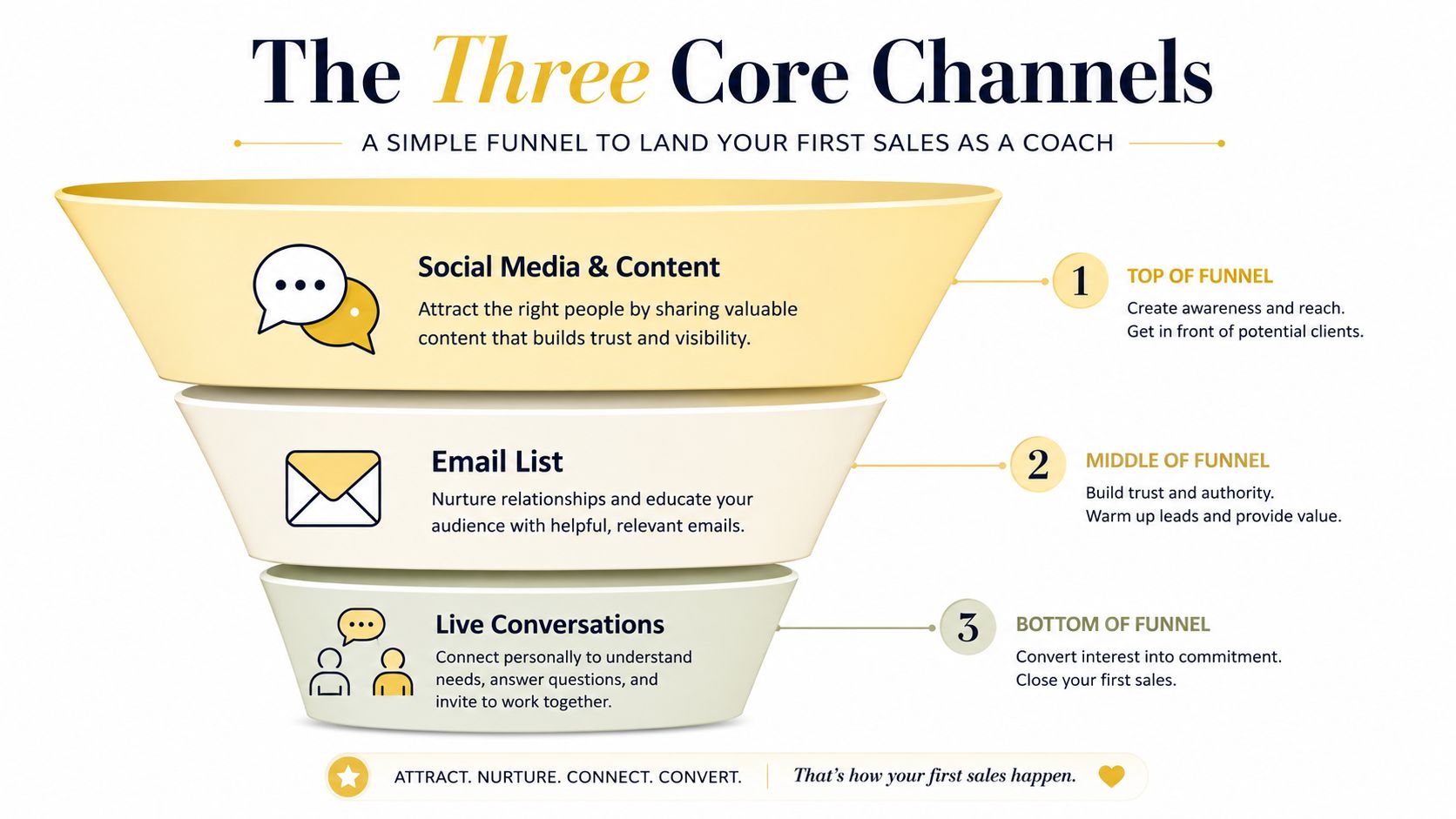
Most coaches waste time chasing every platform. That's a mistake. First sales usually come from three places, and only three places matter early on, the warm list and existing clients, aligned partnerships, and a small paid acquisition loop once the offer has earned traction.
Start where trust already exists
Your warm list is the fastest path to proof. These are the people who already know your voice, your style, or your results. For a coach with a small audience, this channel is about directness. Send a clear offer to people who've already raised a hand, then listen to which wording gets replies.
Partnerships work when another creator already has trust with your target buyer. Joint webinars, guest workshops, and creator swaps can work without a giant audience if the overlap is real. Don't chase the biggest name. Chase the most aligned one.
Paid acquisition comes last, not first. If you buy traffic before the offer has proof, you're just paying to learn expensive lessons. Use paid spend only after you know the message lands and the product converts in a controlled setting.
A useful comparison comes from marketplaces where selling depends on buyer trust and operational discipline rather than pure creativity. The AUSFF guide to eBay selling is a decent reminder that good selling usually comes from clear listings, strong timing, and reliable fulfillment, not wishful thinking. That logic translates well to coaching products too.
For the actual delivery stack, the platforms to sell digital products discussion helps you avoid duct-taping five tools together before you've earned the right to add complexity.
Your sequence should be simple. Sell to warm people first. Then test partnerships. Only then consider paid traffic. That order keeps your learning cheap and your confidence grounded in revenue instead of hope.
A 14-Day Launch Playbook for Your First Offer
A launch falls apart when the seller treats it like a burst of activity instead of a controlled sequence. If you want revenue, build a calendar, sharpen one message, and keep showing up after the first wave of attention fades.
Seven days before doors open
Use the first half of the launch to warm attention. Lead with the problem, not the product name. Share short stories, client patterns, or sharp observations that make the offer feel like the obvious next step instead of a random announcement. Open a waitlist, ask direct questions, and give people a simple way to raise their hand.
The launch research behind product timing is blunt about planning. A widely cited statistic says it takes an average of 28 weeks for a new product to reach 75% of its highest distribution via the product statistics summary, which is a reminder that visibility does not peak on day one. You are starting a process, not claiming victory. Analysts summarizing launch performance also note that launches with detailed go-to-market plans are more likely to hit sales targets, and that pre-launch marketing improves the odds of success. Use that standard. Plan first, improvise second.
The cart-open sequence does not need flair. A focused run of 3 to 5 emails is enough when the message is tight and the offer is clear. On social, keep the cadence steady. Do not post for applause. Post to move people from curiosity to a decision.
Seven days after doors open
Most launches get messy here. Momentum slows, self-doubt spikes, and people start asking whether the offer is still open. Answer directly. Do not hide behind fake scarcity if the offer is still available, and do not act offended by hesitation. Buyers are deciding.
Track the one number that matters most each day, actual sales against your target. Likes, saves, and views are secondary. Revenue is the judge, not applause. If people are clicking but not buying, the message is off. If they are asking questions but not converting, the promise needs to be sharper. If nobody is responding, the angle is too weak or the audience does not trust the offer yet.
A short launch calendar keeps you honest:
- Day 1 to Day 3 pre-launch: publish the problem, invite replies, and collect waitlist interest.
- Day 4 to Day 6 pre-launch: share proof, objections, and a simple behind-the-scenes look at the solution.
- Launch day: send the main email, post the offer, and invite direct questions.
- Days 2 to 5 live: answer objections, share examples, and repeat the core promise without drifting.
- Final day: close cleanly and say what happens next.
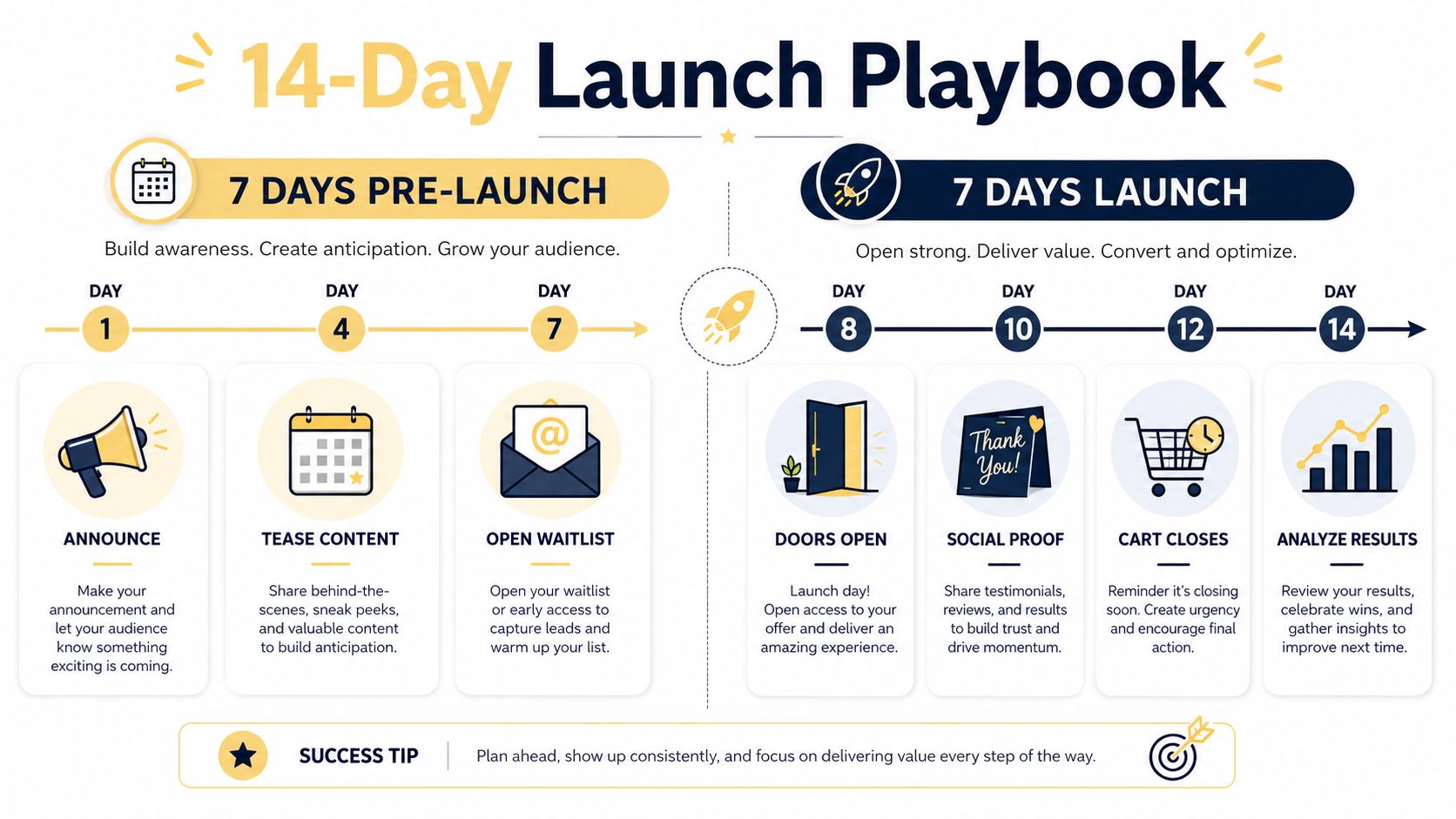
The lesson is simple. Small can work, vague almost never does. Print the calendar, stick to the message, and let the market answer instead of guessing.
Delivery, Operations, and the Money Side Most Guides Skip
The moment money comes in, the product stops being an idea and becomes an operating system. That's where a lot of coaches get sloppy. They celebrate the sale, then scramble to manage onboarding, access, reminders, refunds, and support across too many tools.
Build the back office before it breaks
Delivery needs to be boring. Buyers should know exactly where to log in, where to get help, and how they'll move through the material. If you're running coaching or a cohort, centralize the process instead of duct-taping forms, calendars, spreadsheets, and chat threads together. One option in this category is Coachful, which combines client onboarding, session scheduling, secure payments, messaging, progress tracking, and group-program workflows in one place.
For onboarding details, the client onboarding portal concept matters because it keeps the first handoff from feeling chaotic. A clean start reduces support friction later.
The product side also needs basic money hygiene. Price has to account for manufacturing, storage, shipping, and marketing when those costs exist, and launch plans should be adjusted after trial feedback so margins don't get eaten away by returns or rework, as noted in the product creation guidance from Ponoko. If you're selling a digital product, the same principle still applies, only the hidden costs look different. Your time, revisions, platform fees, and support load all count.
If the delivery flow is messy, customers blame the offer, not your process.
Review the five numbers that tell you whether the product is healthy:
- Lead-to-opt-in rate: are strangers willing to raise their hand?
- Opt-in-to-sale conversion: does interest turn into purchases?
- Average order value: are buyers choosing the package you want them to choose?
- Refund rate: are expectations and reality aligned?
- Repeat-buyer or upsell rate: do customers trust you enough to buy again?
Check those weekly. If lead-to-opt-in is weak, fix the message. If opt-in-to-sale is weak, fix the offer or page. If refunds climb, the promise is outpacing the actual experience. If repeat buying is flat, your delivery may be fine, but your next step isn't obvious.
That's the ultimate game. Not just making a product, but making a product that can survive contact with customers, support, and your own calendar.
If you want the delivery, payments, scheduling, and client experience to live in one place instead of a pile of half-connected tools, take a look at Coachful. It's built for coaches who want to package expertise, sell it cleanly, and manage the client side without adding more admin than the offer is worth.