How to Record an Audio Book: Pro Guide for Coaches 2026

Coachful
You've finished the manuscript. Clients keep telling you, “You should record this.” You know they're right. An audiobook can deepen trust, stretch the life of your book, and let people learn from you while driving, walking, or working out.
Then the inner dialogue starts.
Do I really have time for this?
Will my voice sound professional enough?
Do I need expensive gear?
Can I do this myself without getting stuck in editing hell?
Those are the right questions. Learning how to record an audio book isn't mainly a gear problem. For coaches, it's a business decision first and a production process second. The authors who finish usually aren't the ones with the fanciest setup. They're the ones who make clean decisions early, keep the workflow simple, and respect the technical standards that distributors expect.
Before You Press Record Plan Your Audiobook Project
A coach usually comes into this project with a strong emotional reason for doing it. You want your audience to hear your conviction, your rhythm, your nuance. You don't just want the words delivered. You want the experience delivered.
That instinct is often correct. For many nonfiction books, the author's own voice is part of the value. But it only works if your voice adds clarity, authority, and warmth without creating a production burden so heavy that the audiobook never gets finished.
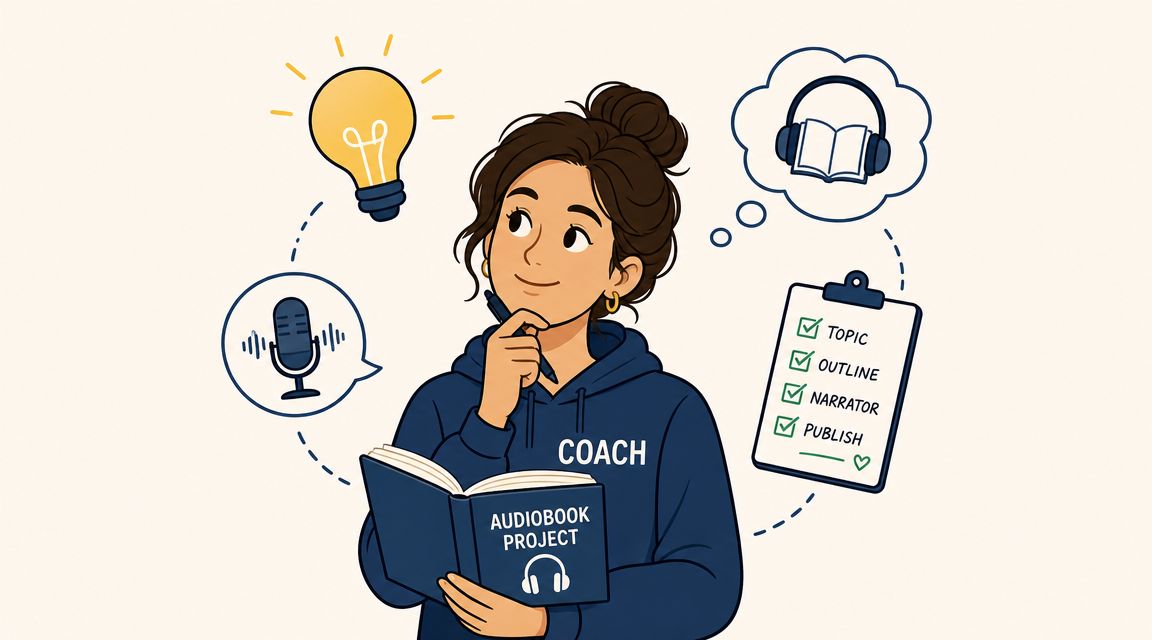
Decide whether you should narrate it yourself
This is the first fork in the road. Not “what mic should I buy?” but “am I the right narrator for this project?”
A simple test helps:
| Question | If the answer is yes | If the answer is no |
|---|---|---|
| Do people already respond well to your voice in coaching, speaking, or teaching? | Self-narration makes sense | Consider hiring narration help |
| Can you read your own material naturally instead of sounding like you're reading? | Keep going | You may need coaching or a different narrator |
| Can you protect time for repeated takes, edits, and revisions? | DIY is possible | Outsourcing may be smarter |
| Is your voice part of the brand promise of the book? | Your narration adds value | A professional narrator may serve the book better |
Practical rule: If your listeners buy your thinking partly because of your presence, your voice is an asset. If they buy your thinking despite your delivery, narration may not be your highest-value task.
One of the most useful realities to face early is that the labor doesn't stop when you finish reading. The hidden labor of meeting ACX specs, including editing, leveling, QA, and re-recording, can easily take longer than narration itself, which is why the primary constraint for many coaches is production time, not microphone choice, according to this discussion of ACX-focused audiobook production.
That matters because a coach doesn't run out of ideas first. A coach runs out of calendar.
Turn the manuscript into a script
A book you can read in your head isn't always a book you can say aloud cleanly.
Printed prose tolerates longer sentences, parenthetical tangents, visual references, and formatting cues that disappear in audio. Before recording, go through the manuscript and mark places that will trip your tongue or confuse a listener.
Common fixes include:
- Rewrite visual references: Change “as you can see in the chart above” to language a listener can follow.
- Break long sentences: If a sentence needs a second breath to survive, it probably needs an edit.
- Mark emphasis: Bold, highlight, or annotate key phrases so you don't flatten important ideas.
- Flag tricky language: Names, acronyms, and industry terms should be practiced before the session starts.
A coach often underestimates this part because you know the material so well. Familiarity can make you sloppy. You skip words. You paraphrase. You improvise inconsistently. That sounds harmless until chapter four no longer matches the manuscript and you're making judgment calls about whether to redo the section.
Define your narrator persona
Your audiobook voice shouldn't be fake. It should be intentional.
For most coaches, the best narrator persona sits somewhere between keynote speaker and private session. You're not performing a trailer voice. You're also not mumbling through a webinar. You're giving one smart listener your best, most grounded explanation.
Ask yourself:
- Are you calm and reflective?
- Direct and challenging?
- Warm and reassuring?
- Structured and instructional?
Pick the lane before you record. If chapter one sounds like a TED-style talk and chapter eight sounds like a tired voice note, listeners will feel the inconsistency even if they can't name it.
If the audiobook supports your larger funnel, think beyond the recording itself. You'll also want a simple place to direct listeners after they finish, whether that's a workbook, waitlist, or your link in bio for coaches.
Know what a finished project actually includes
An audiobook project is not just “read the book into a mic.” A usable production plan usually includes:
- Script prep
- Recording sessions
- Pickup sessions for mistakes
- Editing
- Mastering and compliance checks
- File packaging and upload
- Retail sample selection
- Cover and listing assets
That list is why planning saves so much frustration. If you decide upfront that you'll self-narrate but outsource editing, that's a smart plan. If you decide your voice matters but your time doesn't allow a full DIY workflow, that's also a smart plan.
The bad plan is drifting into production because buying a microphone felt like progress.
Building a Home Studio That Actually Works
Most first-time narrators imagine the wrong target. They think they need a music studio. You don't. You need a controlled voice environment.
That means one person, one microphone, one quiet space, and as few problems as possible.
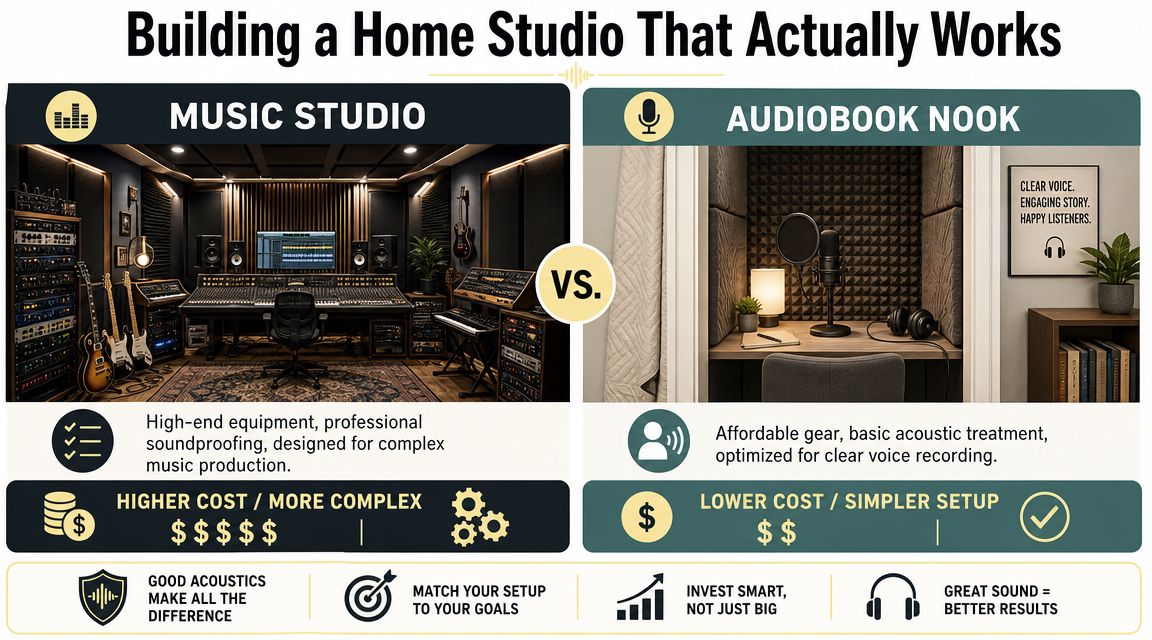
What matters more than gear
A mediocre microphone in a treated space will usually beat a fancy microphone in a reflective room.
That's the part busy authors resist, because gear is fun and room treatment feels boring. But the room is where your audiobook either starts sounding professional or starts sounding homemade.
You're trying to reduce two things:
- Background noise, such as HVAC, traffic, fans, appliances, and computer hum
- Room reflections, which create the hollow, echoey sound that screams “recorded in a bare room”
A dead space is useful. A merely quiet space often isn't enough.
The practical setup most coaches need
For spoken-word recording, keep the setup simple:
| Item | What to look for | Why it matters |
|---|---|---|
| Microphone | A voice-friendly mic for narration | Clear speech matters more than “broadcast hype” |
| Pop filter | Basic and inexpensive | Helps reduce plosives on P and B sounds |
| Headphones | Closed-back or over-ear monitoring | Lets you catch noise and mouth sounds |
| Computer | Quiet enough not to leak into the recording | Fan noise can ruin otherwise good takes |
| Stand or stable placement | No wobble, no desk bumps | Mechanical noise is hard to hide later |
You also need enough comfort to read for sustained sessions without fidgeting, tapping, or rustling pages.
Build the room before you buy more gear
A practical home booth can be a closet, a corner, or a small room with soft materials around you. Blankets, thick clothing, pillows, rugs, and curtains can all help reduce reflections. You're not decorating. You're controlling sound.
What tends to work:
- Closets with clothes nearby: Fabric absorbs reflections surprisingly well.
- Soft corners: A compact nook with blankets around and behind the mic can work.
- Tabletop setup with treatment: If a closet isn't realistic, treat the immediate recording area aggressively.
What tends not to work:
- Large open rooms: Even if they seem quiet, the reflections show up fast.
- Kitchen tables: Hard surfaces bounce sound everywhere.
- Untreated offices with bare walls: Great for Zoom. Bad for audiobooks.
- Phone mics: Convenient, but they create more problems than they solve for long-form narration.
A studio that “looks professional” doesn't matter. A room that sounds controlled does.
Good, better, and best thinking
You don't need the “best” version of everything. You need a setup that's stable and repeatable.
- Good: A decent microphone, pop filter, headphones, and a heavily softened closet or nook.
- Better: The same, but with improved mic placement, less ambient noise, and more consistent session conditions.
- Best: A dedicated treated recording space with a refined signal chain and disciplined monitoring.
Most coaches should aim for better, not best. The jump from bad to good is huge. The jump from better to best often costs time, money, and complexity that doesn't improve the listener experience enough to justify it.
The room test to run before chapter one
Before you record the actual book, record a short sample in your intended setup and listen on headphones. Don't just listen to your voice. Listen between phrases.
Do you hear hum?
Do you hear slapback or boxiness?
Do you hear your chair, desk, shirt, or lips more than expected?
If yes, fix the room and setup before you start the project. The most expensive sentence in audiobook production is, “I'll clean it up later.”
Mastering Your Vocal Performance
A lot of coaches worry they don't have the “right” voice. Usually that fear points in the wrong direction. Listeners rarely need a dramatic voice. They need a trustworthy one.
The performance problem is almost never “my voice isn't deep enough” or “I don't sound like a broadcaster.” Actual problems are inconsistent energy, poor pacing, audible strain, and sloppy mic technique.
What listeners actually want from your voice
They want to feel guided. That's different from sounding polished.
A strong nonfiction narration voice usually sounds like a coach having a focused conversation with one motivated client. It has shape. It has intention. It doesn't sound rushed, sleepy, or theatrically inflated.
Here's a common pattern. A coach starts chapter one with excellent energy because the material is fresh. By chapter three, the pace gets flat. By chapter six, the voice drifts lower, breaths become noisy, and every sentence lands with the same weight. The content is still good, but the delivery stops carrying it.
That's why vocal consistency matters more than vocal charm.
Fix performance at the source
The easiest edits are the ones you never need to make.
A few fundamentals save a surprising amount of cleanup time:
- Posture matters: Sit or stand in a way that lets you breathe without collapsing your chest.
- Hydration helps: A dry mouth creates clicks and sticky consonants that are tedious to remove.
- Mic discipline matters: Stay consistent in distance and angle so your tone doesn't shift every paragraph.
- Use the pop filter correctly: It reduces plosives, but only if you're not speaking straight into the capsule at point-blank range.
Mark the script like a speaker, not a writer
A printed manuscript hides performance cues. Add them back in.
Try marks such as:
- slash marks for brief pauses
- underline for emphasis
- breath marks before long sentences
- phonetic notes for awkward names or terms
- reminders like “slow down,” “smile,” or “drop energy here”
Read for meaning, not for punctuation. Punctuation helps. Meaning carries the listener.
For example, a sentence like “The goal isn't productivity for its own sake, it's recovery of attention, emotional stability, and follow-through” needs structure in your mouth. If you read it evenly, it blurs. If you mark the contrast and the list, it lands.
Handle long sessions like an athlete
Narration is physical work. Your voice gets tired before your ambition does.
A practical session rhythm is to stop while you still sound good, not when you're fully spent. If your tongue feels heavy, your articulation softens, or your energy starts sounding “performed,” take a break. Coaches often push because they're used to finishing the block they scheduled. In recording, that mindset creates pickup sessions later.
A useful pre-session routine might include:
- Read aloud before recording: Practice vocally. Your mouth needs rehearsal.
- Warm up with problem phrases: Don't let the first take of a difficult sentence happen on the paid take.
- Check mouth noise triggers: If a food or drink leaves residue, you'll hear it.
- Rehearse chapter openings: Those first lines set tone and usually need confidence.
Keep authenticity without sounding casual
There's a trap here. In trying to “sound natural,” some authors become too conversational and start swallowing endings, improvising, or drifting off point.
Natural is good. Loose is not.
If you're teaching a concept about boundaries, leadership, or burnout, let the authority stay in your voice. You can be warm and precise at the same time. That combination usually works best for coaches because it sounds like how you naturally help people.
A Practical Recording and Editing Workflow
You block off a Saturday, record for hours, and feel productive. On Monday, you open the files and realize half the chapter needs pickups, the filenames make no sense, and editing will take longer than recording did.
That is the moment a lot of authors ask whether doing this themselves was a mistake.
It usually was not a gear problem. It was a workflow problem. A steady process protects your time, lowers the odds of platform rejection, and keeps the audiobook from turning into a side project that drains the energy you need for your actual business.
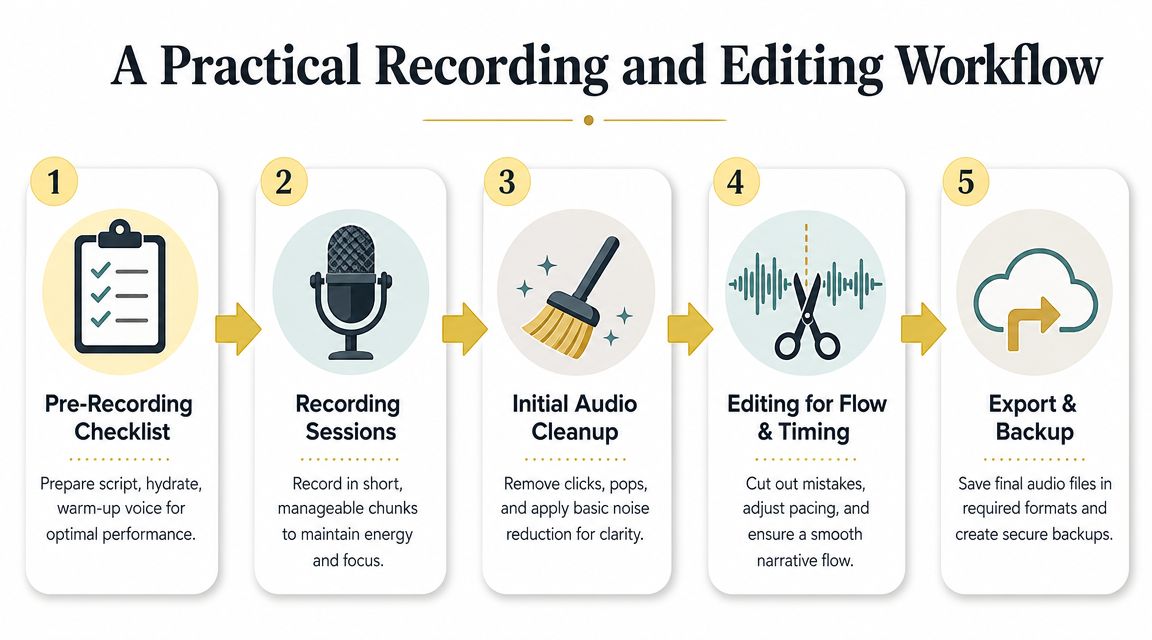
Record in a format that survives editing
Capture raw takes as WAV files, in mono, and keep them uncompressed until export. Compressed formats are smaller, but they are a poor place to edit spoken-word audio because every correction gives you less room to work cleanly.
Use one sample rate for the whole project and stick with it. Consistency matters more than chasing settings you saw in a forum thread.
If you are choosing software, Audacity and Reaper both work. The better choice is the one you can operate confidently after a long client day, without hunting through menus or second-guessing where files went.
Set up the project before the first take
Audiobook editing gets expensive in hours, not just money. File chaos is one of the fastest ways to waste both.
Create your folder structure first:
- Raw recordings
- Edited chapters
- Pickups
- Masters
- Exports
- Backup
Then name files in a way your tired future self can understand. Start with chapter number, then section name, then version if needed. “Chapter-03-Boundaries-v2.wav” is useful. “final REAL one.wav” is not.
For coaches and nonfiction authors, this matters more than it seems. You are usually fitting production around client work, launches, and content deadlines. A clean project structure cuts decision fatigue and makes it easier to stop and restart without losing momentum.
Record in short sections and fix errors close to the source
Do not aim for marathon takes. Aim for controlled takes.
This video gives a useful visual on the flow of audiobook recording and cleanup:
Record one chapter or a clear subsection at a time. If you stumble, pause, leave a visible waveform marker such as a finger snap or spoken note, then restart the sentence cleanly. Better yet, use punch and roll if your software supports it and you can do it without breaking your concentration.
That trade-off is real. Punch and roll saves editing time, but it adds a little technical overhead during the session. Some first-time producers work faster by recording clean retakes and marking mistakes clearly. Others prefer fixing lines immediately so they do not face a mountain of repairs later. Pick one method and use it consistently.
Keep room tone on purpose
Do not trim every file to absolute silence.
A few seconds of room tone at the start and end of each recording gives you matching ambience for edits, noise reduction, and pickups. Without it, patched sections often sound pasted in, even when the words are right.
That is one reason spoken-word producers borrow so much from podcast post-production. These tips for clean podcast sound apply well to audiobook cleanup too, especially around pacing, noise control, and making edits less obvious to the listener.
Edit in passes so you do not burn out
Trying to direct, perform, proofread, and engineer at the same time is how authors lose entire evenings.
Use separate passes instead:
| Pass | Listen for | Leave for later |
|---|---|---|
| First pass | Misreads, repeats, wrong words, bad takes | Fine pause timing |
| Second pass | Pacing, breaths, awkward transitions, flow | Loudness adjustments |
| Third pass | Noise cleanup, consistency, chapter starts and endings | Tiny edits nobody will hear |
This approach works because your attention has a job. You are not making every decision at once.
It also helps with the psychology of finishing. Many authors keep editing because the work still feels productive. Sometimes it is. Often it is just a cleaner form of procrastination.
Know what “done” sounds like
A professional audiobook does not sound hyper-edited. It sounds steady, clear, and easy to follow for hours.
Leave natural breaths when they support phrasing. Cut the distracting ones. Fix mouth noise that pulls attention away from the sentence. Ignore the tiny imperfections that disappear in normal listening. If you edit until the voice loses rhythm, you solved the wrong problem.
Once the chapter is approved, move it out of your active work area and keep the business side organized somewhere else. If you manage your author platform, offers, and audience assets through coachful, keep that system separate from your audio folders so production stays simple.
The Final Polish Mastering for Audible and Beyond
A clean edit still isn't a finished audiobook. You need the final layer that makes the files consistent, compliant, and ready to survive upload checks.
This is the point where many authors feel intimidated because the language gets technical. Peak. RMS. Noise floor. Normalization. Compression. None of that is mysterious once you translate it into one question: Will this chapter play back at a reliable level without distortion or distracting noise?
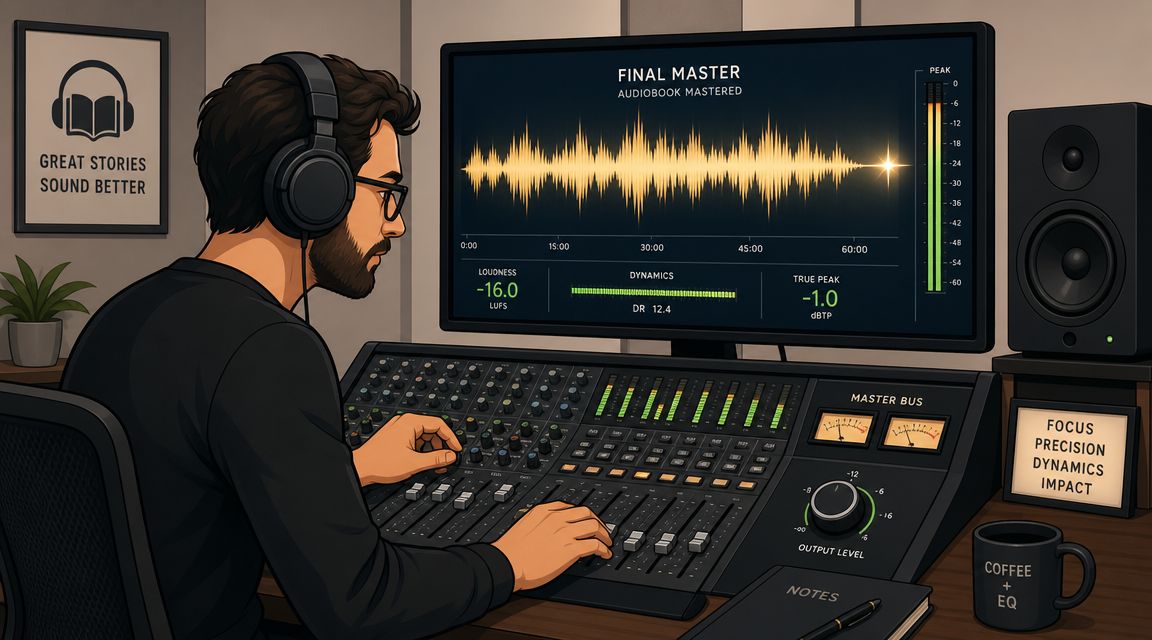
The numbers that actually matter
Major platforms like ACX enforce specific audio standards to ensure a consistent listener experience, including a peak level no higher than -3 dB and an average loudness between -23 dB and -18 dB RMS, which turns audiobook creation into compliance-driven audio engineering, not just performance, according to this overview of ACX audio standards.
Those numbers aren't random. They protect the listener from huge volume swings and protect the platform from inconsistent files.
A simple translation:
- Peak level is your loudest moment. It can't go above the ceiling.
- RMS is your average perceived loudness across the file.
- Noise floor is the low-level hiss, hum, or room noise sitting underneath your voice.
You don't need to become a mastering engineer. You do need to hit the targets.
What mastering looks like in practice
For most self-produced nonfiction audiobooks, mastering is a modest chain, not a dramatic transformation.
A typical sequence might involve:
- Clean up the edit so the file is stable before any loudness work
- Apply gentle processing if needed to control dynamics
- Normalize or level intelligently so the chapter sits in the required range
- Check peaks
- Listen again on headphones
What doesn't work is smashing the file with heavy compression because “louder sounds better.” In audiobooks, overprocessing makes the voice feel tiring and artificial.
If mastering changes your personality more than your consistency, you pushed it too far.
Translate technical checks into software actions
Inside your DAW or editor, you're usually looking for meters and analysis tools that answer basic questions:
| Problem | What you hear | What to do |
|---|---|---|
| Peaks too high | Harsh moments, potential clipping | Lower peak level and recheck |
| Average too low | Listener has to turn volume up too far | Raise overall loudness carefully |
| Average too high | Feels pushed and fatiguing | Back off loudness processing |
| Noise too obvious | Hiss, hum, room wash in pauses | Revisit cleanup or re-record |
If your software supports an ACX-style check, use it before export. It's faster to correct a chapter now than after a platform rejects it.
Run a final QC listen like a stranger would
The last listen should not be “I know what I meant to say.” It should be “what would a first-time buyer notice?”
Listen for:
- Volume jumps between chapters
- Clicks, pops, and obvious mouth sounds
- Stray background noise
- Awkward edits
- Missing words or duplicate phrases
- Chapter intros that don't match the spoken content
A useful trick is to do part of this listen in a different context than your edit desk. Headphones will reveal details. A car or consumer speaker can reveal whether the narration still feels stable in common listening scenarios.
Don't confuse clean with sterile
Some first-time producers remove every breath and every tiny human sound until the narration feels robotic. Don't do that.
Listeners expect a human voice. They don't expect a laboratory sample. Keep what sounds natural. Remove what distracts.
That distinction is the heart of good mastering for spoken-word work. You're not trying to impress another engineer. You're trying to make the listener forget there was an engineering process at all.
From Finished File to Published Audiobook
You can spend weeks recording, editing, and fixing technical mistakes, then lose time at the finish line because a chapter is named poorly, the metadata does not match, or the retail sample undersells the book. That is the part many first-time author-narrators underestimate.
Publishing is the business end of the project. The goal is simple: get approved fast, present the audiobook clearly, and turn the finished files into an asset that keeps working after launch.
Package the files the way platforms expect
Most audiobook platforms still follow conventions shaped by ACX. That usually means separate files for opening credits, each chapter, and closing credits, plus a short retail sample and clean, readable filenames.
A typical package includes:
- Opening credits
- One file per chapter
- Closing credits
- A retail sample
- Consistent file naming
Treat file organization like part of production, not admin cleanup. If Chapter 7 is labeled three different ways across the audio files, metadata, and upload form, you create avoidable review delays and extra support emails for yourself.
Reading chapter titles aloud also matters. The spoken structure should match what the listener sees in the listing and what the platform expects in the uploaded files. Consistency saves time here.
Build the assets listeners actually judge
The audio has to pass review. The listing has to earn the click.
Your cover needs to read well at thumbnail size, which is a different job than looking good as a full print cover. If you want a strong reference point, this expert advice on audiobook covers is useful because it focuses on what works in audio storefronts, where the image has only a second to register.
Then check the metadata with the same care you gave the audio:
| Asset | What to check |
|---|---|
| Title | Matches your published book and audio version |
| Author name | Consistent across platforms |
| Narrator name | Accurate and spelled correctly |
| Description | Written for listeners, not just readers |
| Sample | Represents the actual listening experience |
For coaches and consultants, the description does more than summarize the book. It filters the right listener. A vague listing gets casual clicks. A sharp listing attracts people who are more likely to join your email list, book a call, or buy the next offer.
Choose the sample carefully. Do not default to the first clean passage you find. Pick a section that sounds stable, shows your tone, and gives a new listener a clear reason to continue.
Plan for review, fixes, and follow-through
Uploads often feel easier than they are. The forms are simple. The consequences of small mistakes are annoying.
Platforms can still flag a chapter issue, a mismatch in naming, or a problem with the package. That does not mean the whole project failed. It means you are in the last revision cycle, and clean systems pay off.
Keep a final folder with only approved exports, final cover files, your book description, narrator credit, and platform-ready text. That one habit prevents a surprising amount of confusion.
If the audiobook supports your business, give listeners a next step outside the retail platform. Bonus resources, a lead magnet, or a simple landing page can turn a buyer into a lead. If that is part of your plan, you can create a website for coaches to support the launch and the client journey around it.
Finish the project with the same discipline you used to record it. Upload carefully. Check every field. Then submit and move on to promotion, knowing the audiobook is positioned to earn back the time you put into it.