How to Track Client Progress Without Losing Your Mind

Coachful

You're eight weeks into a client engagement. The notes are everywhere: a weight log from week two, half-completed habit tracking in a spreadsheet, and voice memos on your phone that made perfect sense when you recorded them. The client asks, “Am I making progress?” and you pause, not because you lack insight, but because you can't find a clean signal quickly.
That moment exposes the difference between collecting data and knowing how to track client progress. A useful system doesn't turn coaching into administration. It helps you define meaningful outcomes, choose evidence that fits the goal, and repeat a workflow that makes momentum visible without creating another job.
The Tracking Problem Most Coaches Are Quietly Stuck In
Broken tracking rarely looks broken at first. You may have plenty of information, yet still struggle to answer basic questions. Is the client following through more consistently? Has confidence changed? Which intervention helped? What should happen next?
The symptoms show up during ordinary coaching moments:
- Unclear progress: You rely on memory to decide whether the client is improving.
- A stressful review call: You spend the hour before a review reconstructing events from messages, notes, and scattered files.
- Weak client visibility: The client remembers missed actions more vividly than completed ones.
- Manual rework: You rewrite the same information into session notes, spreadsheets, and progress summaries.
The cost isn't only lost time. When clients can't see their own movement, they may interpret a slow period as failure. A client who has improved their preparation, follow-through, or decision-making may still say, “Nothing is changing,” because the evidence was never organized into a story they can recognize. That can weaken confidence in the program and reduce the likelihood of referrals.
Practical rule: If you can't explain progress without opening several tools, the tracking system is carrying too much friction.
Start with three decisions
A durable system begins with outcome definition, not software. Decide what the client is trying to change, what observable evidence would support that change, and how often you'll review it. Only then should you choose fields, forms, dashboards, or integrations.
The workflow rests on three fixes:
- Define the outcome: Translate broad language into something a client or observer could recognize.
- Select the measurements: Combine evidence types instead of trusting one noisy signal.
- Create a weekly rhythm: Capture, review, and discuss the same information on a consistent cadence.
For a client seeking support with menopause-related wellbeing, the coach might need a tracking approach that respects energy, symptoms, confidence, and daily capacity rather than forcing a generic fitness score. A client looking for specialized support can find coaching for menopause relief and use that context to clarify what progress should mean for them.
The practical standard is simple: every tracked item should help you make a coaching decision or help the client notice meaningful movement. If it does neither, remove it.
Defining the Outcomes and KPIs That Actually Mean Something
“Feel more confident at work” is a valid starting point, but it isn't yet trackable. Confidence is an outcome. A KPI is a signal that helps you observe it. A milestone is a dated piece of progress that moves the client toward the outcome.
Confusing these levels creates vague dashboards. The coach records “confidence” without defining what changed, or records every completed task without checking whether those tasks affected the client's real goal.
Translate one goal from aspiration to evidence
Take a client who wants to feel more confident leading meetings. Start by asking what the client, a manager, or a colleague would see.
The outcome might be: lead meetings with greater confidence and clarity.
Possible KPIs could include:
- A 1–10 confidence rating collected at the start of each session.
- Whether the client opens the meeting with a prepared agenda and intended decision.
- Whether the client contributes a clear recommendation instead of waiting for others to lead.
- A brief post-meeting reflection identifying what felt effective and what needs work.
A milestone could be: deliver a structured recommendation in an upcoming leadership meeting, with success defined as presenting the recommendation, answering questions, and recording the next decision. The milestone is not the whole outcome. It's a visible checkpoint.
A practical model recommends tracking 3 to 5 core outcomes week by week, with indicators such as attendance, goal milestones, confidence ratings, revenue wins, or habit completion, and turning the client's top 3 goals into dated milestones with clear criteria. This coaching progress checklist also illustrates how broad goals become observable weekly actions, such as completing a defined number of applications, sales calls, or script practices.
Capture the baseline before coaching changes it
Record the starting point in the first session. For the meeting example, the baseline might be a confidence rating, the client's current preparation behavior, and a recent example of how they handled a difficult meeting.
Use one compact record:
| Field | Example |
|---|---|
| Outcome | Lead meetings with greater confidence and clarity |
| KPI | Confidence rating, prepared agenda, clear recommendation |
| Baseline | Current rating and recent meeting behavior |
| Target date | Agreed review date |
| Milestone | Deliver a recommendation and document the decision |
| Review checkpoint | Weekly check-in and formal program review |
The threshold question keeps the record honest: What would the client, or an outside observer, see change? If the answer is “they'll feel better,” ask what feeling better makes possible. Perhaps they speak sooner, prepare more consistently, or recover faster after a challenging conversation.
A formal monitoring pattern uses weekly data collection and graphs the results after at least three data points, so the team can judge whether the client is on track or whether the program needs adjustment. This progress-tracking workflow also recommends 3–5 repeatable benchmarks, a fixed baseline, and records containing the benchmark name, unit, target, re-test date, and responsible coach.
Choosing Measurement Methods That Match the Real Goal
A body composition scan, a self-rating, and a completed action all tell different stories. The mistake is treating one category as more truthful than the others.
Objective measures can feel authoritative, but they may not capture the client's lived experience. Subjective ratings reveal confidence, energy, or clarity, but they can shift with mood and context. Behavioral measures show what the client did, although completion alone doesn't prove that the action produced the intended outcome.
Compare the evidence before choosing the field
| Method Type | What It Captures | Strength | Weakness | Best Use Case |
|---|---|---|---|---|
| Objective | Observable performance or physical measurement | Easier to compare across review points | Can miss context and may create pressure | Strength, attendance, performance, or other clearly observable outcomes |
| Subjective | Client experience, confidence, energy, or clarity | Captures internal change that outsiders can't see | Sensitive to mood, memory, and interpretation | Confidence, readiness, perceived progress, and wellbeing |
| Behavioral | Actions completed, habits practiced, or milestones reached | Connects coaching to daily execution | Can be gamed or completed mechanically | Accountability, routines, preparation, and follow-through |
| Qualitative | Examples, reflections, and observed patterns | Explains why a score changed | Harder to summarize quickly | Complex behavior, leadership, relationships, and identity-level work |
Consider a health client who wants to feel more capable during daily routines. A scan might provide an objective reference, but it won't explain whether the client has more energy or confidence. A weekly adherence record can show whether agreed actions happened. A short rating can show whether the client feels more ready to continue. Together, those methods create a more credible picture than any single score.
Use the lightest method that proves the outcome
A useful decision rule is: start with the outcome, ask what would prove it, then choose the lightest method that captures that proof without adding client burden. If the outcome is consistent preparation, a simple completion field and a short reflection may be enough. If the outcome is physical performance, a repeatable test may earn its place.
High-signal tracking often combines weekly adherence or commitment completion, milestone progress, and 1–10 ratings for energy, confidence, or clarity. Guidance also recommends a 7-day rolling average for weight-based trends, measurements or progress photos every 2–4 weeks, and weekly readiness checks, because isolated readings can be noisy and adherence often gives an early indication of how the program is progressing. These recommendations are summarized in this client progress tracking guide.
Don't ask a client to log every possible signal because your platform allows it. More fields can reduce completion, dilute your attention, and make the review feel like an audit. Two or three complementary measures that directly answer the outcome are usually more useful than a crowded dashboard.
For coaches managing programs, tracking client progress through a program can help organize completion, tasks, and milestones in one operational view. The tool matters less than the discipline behind the choice. A clean method that gets used beats a method the client avoids.
Building the Weekly Tracking Workflow Behind the Scenes
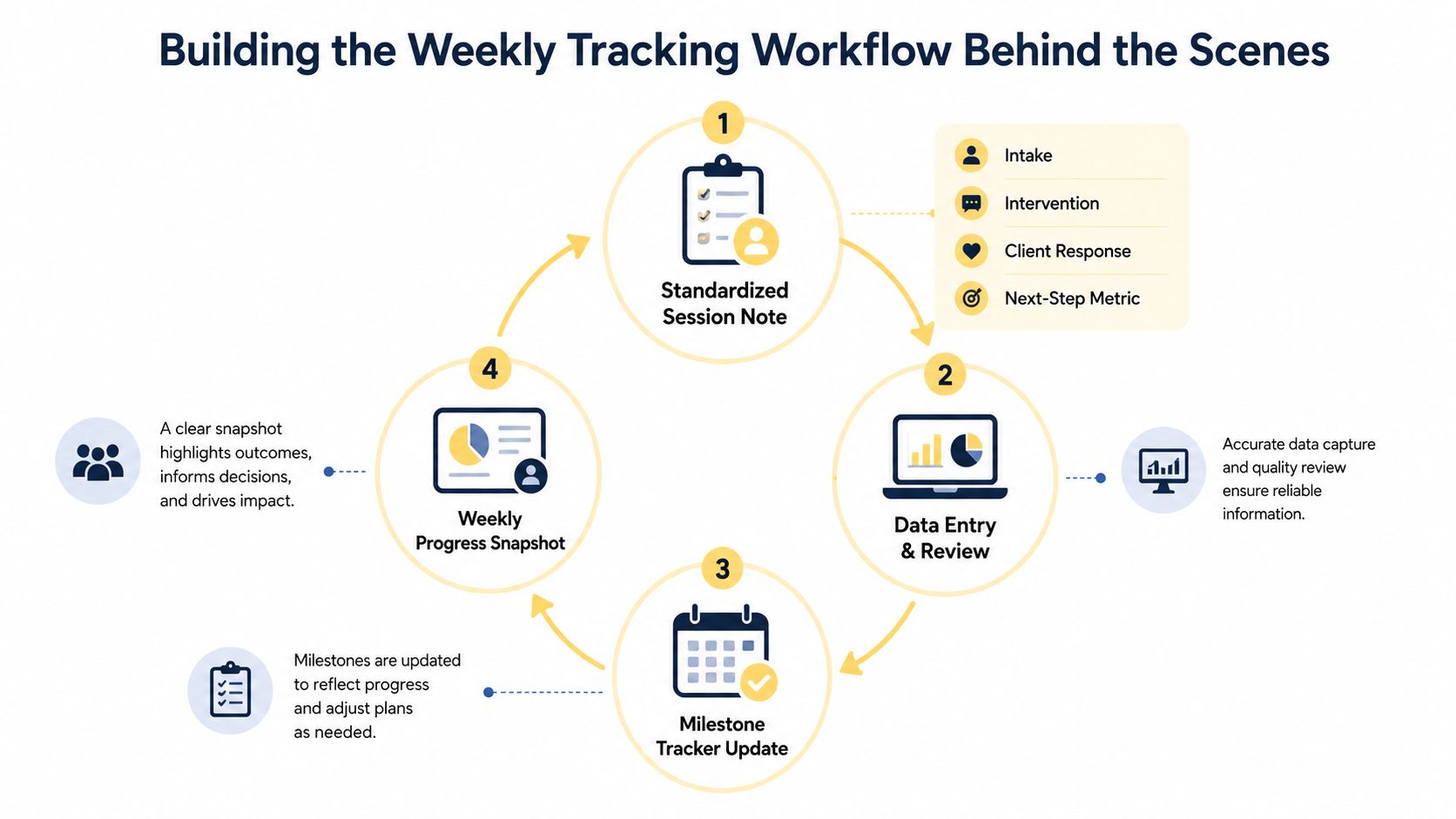
The system holds up when each session produces the same small set of outputs. I've watched coaches build beautiful spreadsheets that fail because updating them requires too many decisions. A standardized workflow removes those decisions while leaving room for professional judgment.
Use a session note with four sections:
- Intake: What changed since the last contact?
- Intervention: What did you coach, challenge, or practice?
- Client response: What did the client notice, resist, understand, or commit to?
- Next-step metric: What specific signal will show movement before the next review?
Update the milestone tracker within 24 hours of the session. Keep the dashboard deliberately small, with the two or three numbers that help you prepare for the next conversation. A program completion view, a milestone status, and one client-rated dimension may be enough for one client. Another may need attendance, action completion, and a performance indicator.
Make the workflow repeatable
A workable week might look like this:
- After each session: Complete the note while the conversation is still fresh.
- Later that day: Record the agreed action and link it to the relevant milestone.
- During the weekly admin block: Review dashboard changes, flag missing data, and prepare one progress observation.
- Before the next session: Read the previous note and choose the question that will test the next-step metric.
Schedule a weekly 20-minute admin block for this work. Protect it as part of delivery, not as optional cleanup. If the block keeps expanding, the system is too complicated or the fields aren't earning their place.
Automations can reduce repetitive setup. A new client can trigger goal capture, KPI assignment, and dashboard creation. Reminders can prompt a client to complete a check-in, while an activity timeline can show whether the client acted between sessions. Tools such as Nea Coach features may be useful when you're evaluating how technology can support structured coaching operations.
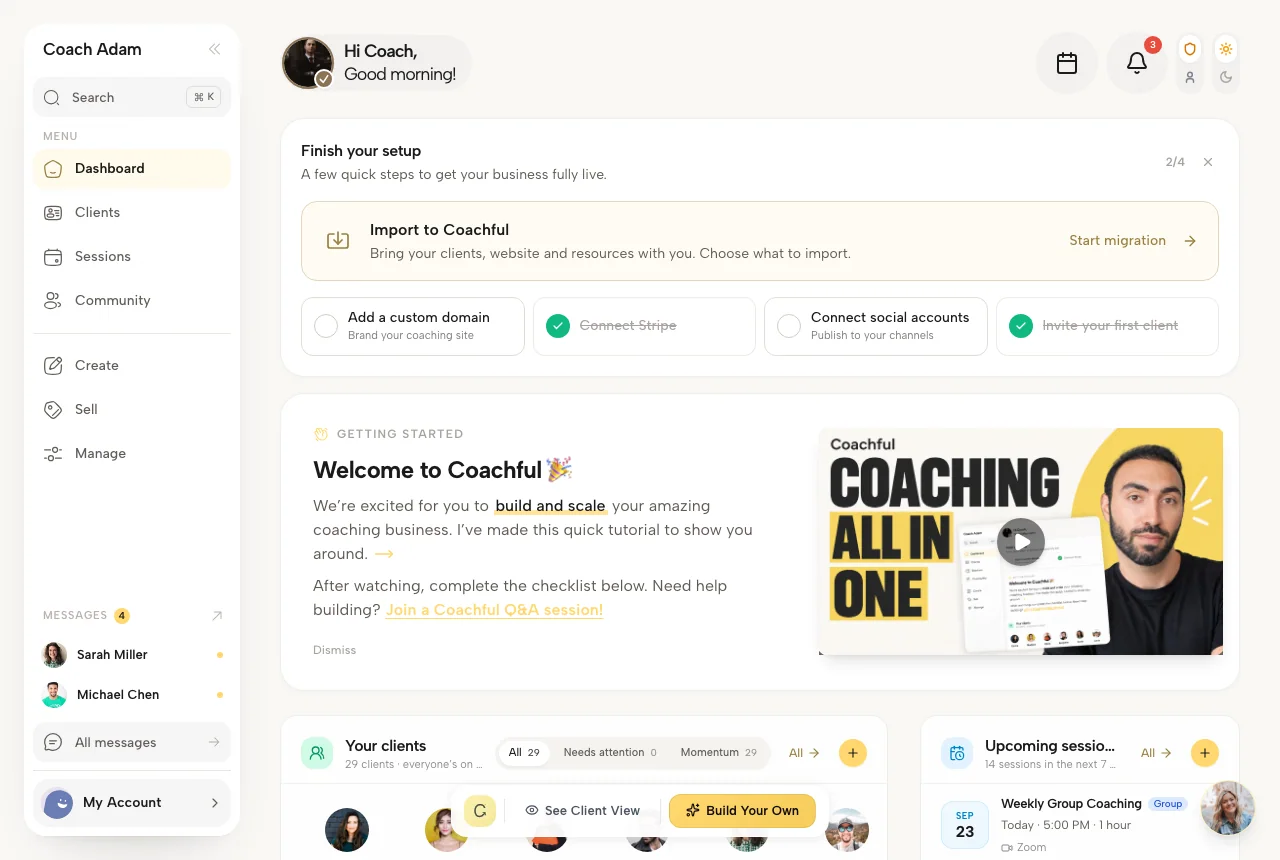
A progress tracker should support the workflow, not become the workflow. Coachful's progress tracker can be one option for generating a structured template and organizing the information you need. Whatever tool you use, test the process during a busy week. If you can't update it quickly between real sessions, simplify it before adding more clients.
Showing Progress to Clients in a Way That Builds Momentum
Clients don't need a data dump. They need a fair interpretation of what their effort is producing, what remains uncertain, and what the next useful action will be.
A progress update should reinforce agency rather than grade the person. “You completed the action” is factual, but “You completed the action, and that gave us evidence about which preparation method works for you” turns the same record into a learning conversation.
Use a three-beat communication rhythm
After each session, send a micro-recap. Tie it to one KPI and one next action. For the meeting client, that might read: “You identified the decision you want from the meeting and drafted the opening. Before we meet again, notice whether that preparation changes how quickly you contribute.”
At the midpoint, show the starting point beside the current picture. Use a simple chart, a short written comparison, or a shared dashboard. Avoid presenting a single score without context. If confidence moved upward but action completion stayed inconsistent, say both things. Clients trust a balanced view more than forced positivity.
At the end of a cycle, discuss patterns rather than pass or fail. Ask what improved, what stalled, what conditions supported follow-through, and what the next version of the plan should include. Independent coaching research describes outcomes across affective, cognitive, skill-based, behavioral, and organizational levels, which means a completed checklist can miss meaningful change if it only measures tasks. The coaching outcomes analysis is useful background when a sponsor or client expects a broader account of progress.
Match the format to the person
A data-oriented client may appreciate a shared dashboard. A busy executive may prefer a two-line message before the next meeting. A client doing reflective work may gain more from a short written summary that connects behavior, emotion, and decisions.
Let the client help choose what they see. Some people become motivated by visual trends. Others become anxious when every fluctuation is displayed. The coach's job isn't to hide information or overwhelm the client. It's to present enough evidence to support a useful next conversation.
This client-facing explanation of progress tracking can also help clients understand what is being recorded and why. Explain the metric in plain language, acknowledge uncertainty, and celebrate a meaningful behavior change without pretending that every week will move in one direction.
Mistakes to Avoid and Best-Practice Habits That Protect the Work
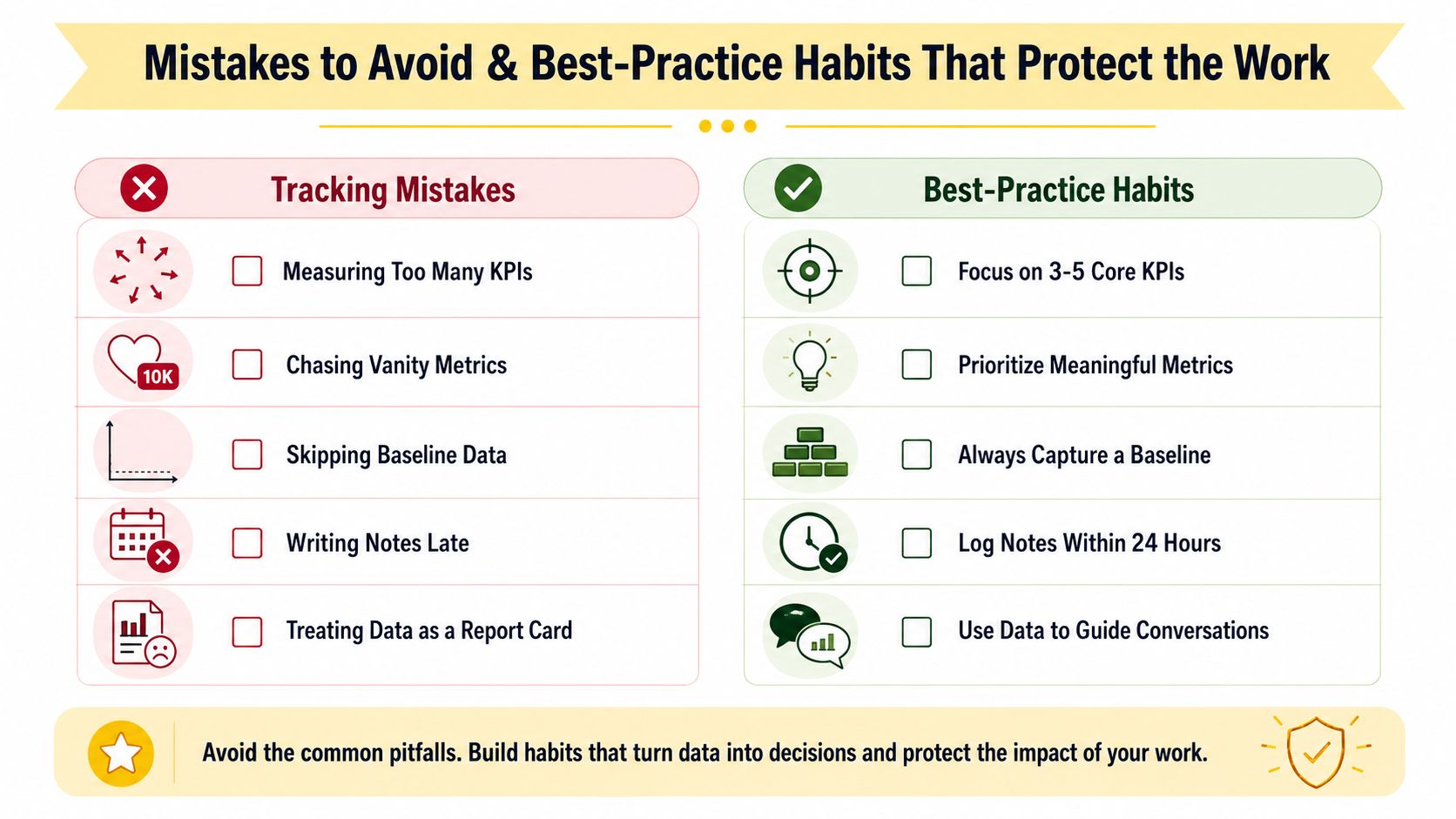
The most damaging tracking mistakes often look responsible. A coach adds another KPI, stores every detail “just in case,” or postpones notes until there's enough time to write them properly. The result is a system that produces volume but weakens attention.
Measuring too many KPIs is the first trap. A crowded dashboard encourages the coach to report activity instead of interpreting progress. Chasing vanity metrics creates a similar problem. A number can rise while the client's actual outcome remains unchanged.
Skipping the baseline makes later conversations speculative. Writing notes after a week has passed makes memory fill in the gaps. Treating data like a report card invites defensiveness, especially when a client has made progress that the chosen metric fails to capture.
Protect trust through deliberate habits
Privacy isn't administrative decoration. Clients disclose sensitive information because they expect the coach to handle it carefully. A clear tracking policy signals that you understand the difference between useful evidence and unnecessary collection.
Use this checklist:
- Get written consent: Explain what you'll track, why you need it, and who can access it.
- Collect the minimum necessary: Don't store intimate details that have no coaching purpose.
- Use protected storage: Choose systems with appropriate access controls and encryption.
- Define a retention window: Decide when records should be reviewed, archived, or deleted.
- Audit the system quarterly: Remove fields that no longer support decisions and check who can view client data.
A monthly review of the tracking system itself keeps the practice honest. Ask which KPI changed a coaching decision, which field clients skipped, and which information you gathered without using. The answers will usually point to a simpler, safer workflow.
The best tracking system doesn't prove that the coach is right. It helps the coach ask a better question.
Use the data as a conversation starter, never as a verdict. A missed action may reflect unclear instructions, a poor fit, an unexpected constraint, or a goal that needs revision. The record gives you a place to begin. Professional judgment determines where the conversation goes next.
Start this week by choosing 3–5 repeatable benchmarks, recording a clean baseline, and reserving your weekly 20-minute admin block. Then use a platform such as Coachful to organize goals, milestones, session notes, client activity, and progress tracking in one workspace. Visit Coachful to see how the workflow can replace scattered spreadsheets with a repeatable system you and your clients can use.