How to Write Progress Notes That Actually Help

Coachful

It's Friday afternoon, and your session notes are still open beside a cold cup of coffee. You remember the client's frustration, the useful question you asked, and the moment something clicked. But the cursor is blinking under “Progress,” and you're not sure what belongs there.
Learning how to write progress notes isn't about finding more professional-sounding words. It's about recording the evidence that something changed, or explaining clearly why it hasn't changed yet, so you can make a better decision next time.
Why Progress Notes Stress Coaches Out
You open a client's file and type: “Discussed confidence, boundaries, and workload. Client engaged well.”
It sounds reasonable. It also tells you almost nothing about where to begin the next session.
The pressure comes from competing instincts. You want to preserve the richness of the conversation, protect the client's privacy, demonstrate that the work matters, and finish before dinner. Writing everything feels safer than choosing what counts.
The anxiety behind the blank field
A coach might think, If I leave out the story about the manager, will I forget why the client struggled? Another might worry, If there wasn't a breakthrough, what can I possibly write under progress?
Neither question requires a longer narrative. Both require a clearer distinction between session content and change signals.
Session content is what you talked about. A change signal is new evidence that affects your understanding of the goal: a completed action, a newly identified barrier, a revised decision, or a commitment the client declined.
A useful progress note records what changed in your understanding of the work, not just what changed in the client.
Length can disguise the absence of that distinction. In research on electronic health-record documentation, progress notes averaged 46% unique information, with approximately 54% duplicated content and an interquartile range of 30% to 53% unique content. That's healthcare evidence, not a measurement of coaching notes, but it provides a useful warning against equating volume with usefulness.
Give the note a narrower job
Don't ask your note to recreate the session. Ask it to support the next coaching decision.
- Preserve movement: What did the client do, discover, reconsider, or stop doing?
- Preserve friction: What prevented the agreed action, and what evidence supports that explanation?
- Preserve direction: What will you and the client do differently next?
For a stalled client, “The agreed action wasn't completed; the client identified uncertainty about decision authority” can be more useful than an upbeat paragraph about engagement. You haven't failed to document progress. You've documented information that changes the plan.
The SOAP Framework Translated for Coaching
SOAP gives those change signals a structure. Physician Lawrence Weed developed the approach in the 1960s to make clinical reasoning explicit; a Cleveland Clinic Journal of Medicine review of SOAP's origins describes its deliberate brevity to avoid extraneous information.
Coaches can borrow that reasoning without borrowing clinical diagnoses or turning clients into patients.
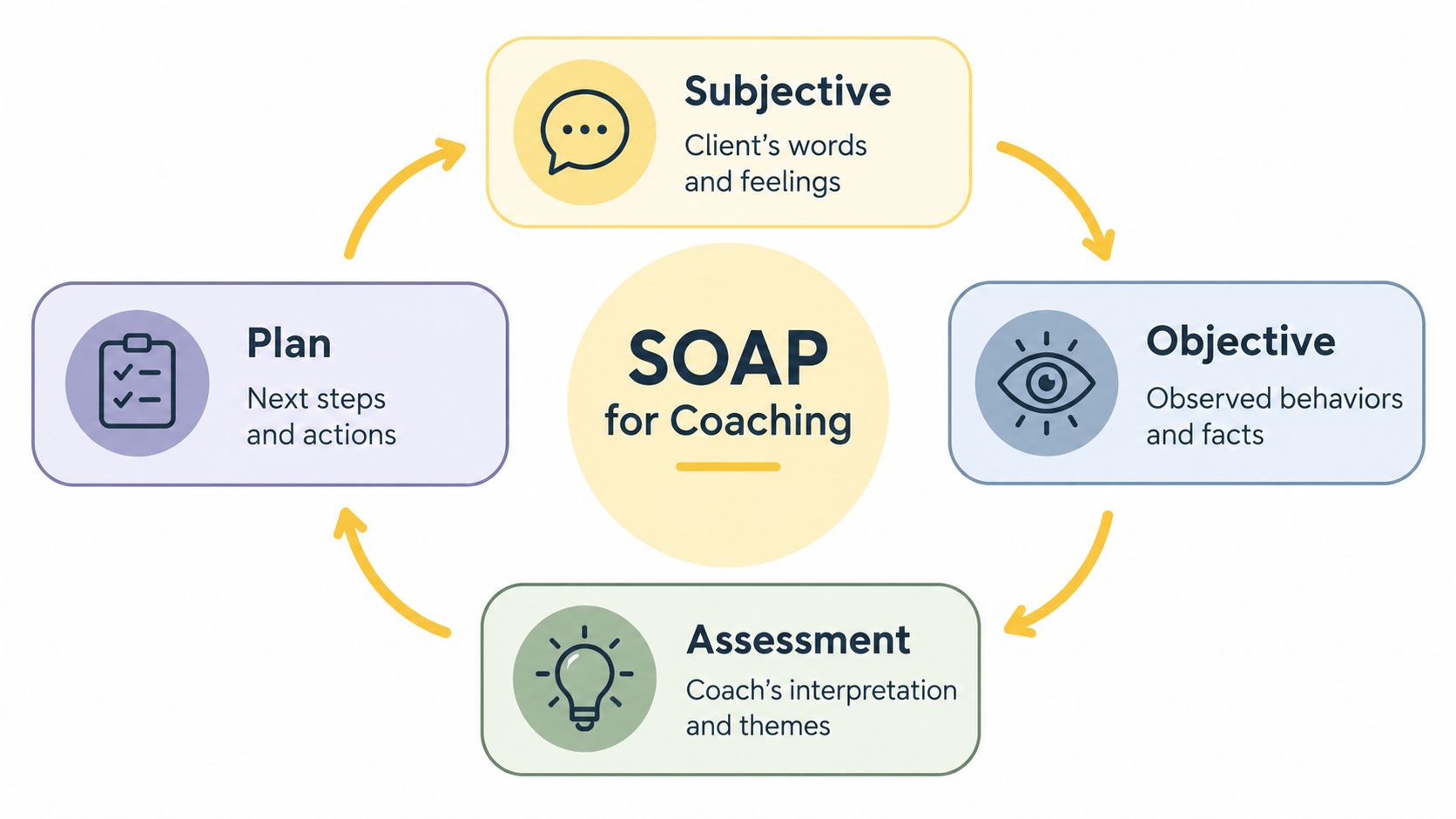
Separate the kinds of evidence
Subjective captures the client's account: reported experience, priorities, perceived barriers, and relevant changes. "Client reports less avoidance before outreach" belongs here. Do not convert that report into a verified outcome without verification.
Objective records observable or checkable evidence. This might be a worksheet completed during the session, an action log you reviewed, or behavior demonstrated in rehearsal. If the client reports completing something but you haven't reviewed it, preserve that provenance rather than presenting it as independently observed.
Assessment is your interpretation of the evidence in relation to the goal. It isn't a personality verdict. “Initiating outreach appears easier; follow-through remains inconsistent” connects the available evidence to a coaching decision without claiming certainty you don't have.
Plan specifies the agreed action, owner, deadline, review measure, and follow-up date. “Continue working on confidence” is an intention, not an executable plan.
Turn a vague entry into a usable record
Here's an illustrative rewrite, not an actual client record:
| Generic entry | SOAP-style replacement |
|---|---|
| Client is making progress and feels more confident. Continue outreach work. | S: Client reports reduced avoidance before contacting prospects. O: Reviewed outreach log showing completed calls and an outstanding call. A: Evidence supports improved initiation, but the agreed outreach milestone remains incomplete. P: Client will complete the outstanding call by Friday and update the log; coach will review completion at the next scheduled session. |
The stronger version doesn't claim that confidence has permanently improved. It identifies the evidence, offers a bounded interpretation, and makes the next commitment visible.
- Keep the chain connected: The assessment should follow from the subjective and objective information.
- Avoid category drift: Don't place the interpretation under Objective because it sounds authoritative.
- Make uncertainty readable: Write “not yet established” when the available evidence doesn't support a conclusion.
Before saving, ask whether an authorized colleague could understand the current position without asking you to retell the conversation. If not, the missing piece is usually evidence or a usable plan, not another paragraph.
Anatomy of a One-Page Coaching Progress Note
A leader working on weekly prioritization doesn't need a miniature biography after every session. They need a record showing whether their choices and working practices are moving toward the agreed goal.
The following is an illustrative coaching note, not a case study or proof of results. Replace every example field with information from the actual encounter.

A completed note with a clear purpose
| Field | Illustrative entry |
|---|---|
| Encounter | Client identifier: [identifier]. Service date: [date]. Video session. Start time and actual duration: [details]. Author: [coach]. |
| Goal reference | Improve weekly prioritization by protecting time for agreed strategic work. |
| Subjective | Client reports that incoming requests displaced planned focus time. Describes difficulty deciding which requests can wait. |
| Objective and method | Coach facilitated values-based prioritization and an implementation-intention exercise. Client ranked competing tasks and entered protected focus periods into the calendar during the session. |
| Assessment | Client demonstrated prioritization in-session. Maintaining those choices when new requests arrive remains untested. |
| Plan | Client will use the agreed prioritization rule during the coming workweek and record whether planned focus periods occurred. Due date: [date]. Coach will review the record at the next session on [date]. |
| Completion | Note completed: [date]. Authentication: [author/signature]. |
The encounter details establish what service occurred. The goal reference explains why it occurred. The evidence and interpretation show what the session contributed, while the plan makes responsibility explicit.
Washington State's encounter-documentation guidance offers a useful model for recording purpose, method, participation, and strategy adjustment. Its behavioral-health requirements aren't a universal coaching rule, but the underlying questions are practical.
What counts when progress feels subjective?
Confidence becomes easier to document when you choose an observable indicator without pretending it captures the whole experience. Montana's progress-note requirements call for individualized records and measurable movement toward objectives; an illustrative rehearsal note could record filler words decreasing from 18 to 9, alongside the client's remaining concern about hostile questions.
- Use a relevant indicator: Track behavior connected to the client's goal, not whatever is easiest to count.
- Retain the client's response: A stronger performance doesn't automatically mean the client feels ready.
- Name the limitation: In-session success doesn't establish consistent behavior outside the session.
For a cross-disciplinary reference on evidence recording, the Verbex guide to lab notes is a useful companion resource to consider. Keep the coaching note distinct from a stakeholder update, too; the guide to coaching progress reports for clients and sponsors addresses that separate sharing decision.
What to Cut When the Note Gets Too Long
The sentence you're reluctant to delete is often the sentence you worked hardest to write. That doesn't mean a future reader needs it.
A detailed account of the client's week can feel attentive while burying the decision that matters: the agreed action wasn't completed, the obstacle is now clearer, and the next action needs to change. Use the duplication finding above as a reason to inspect repetition, not as a target for your own word count.
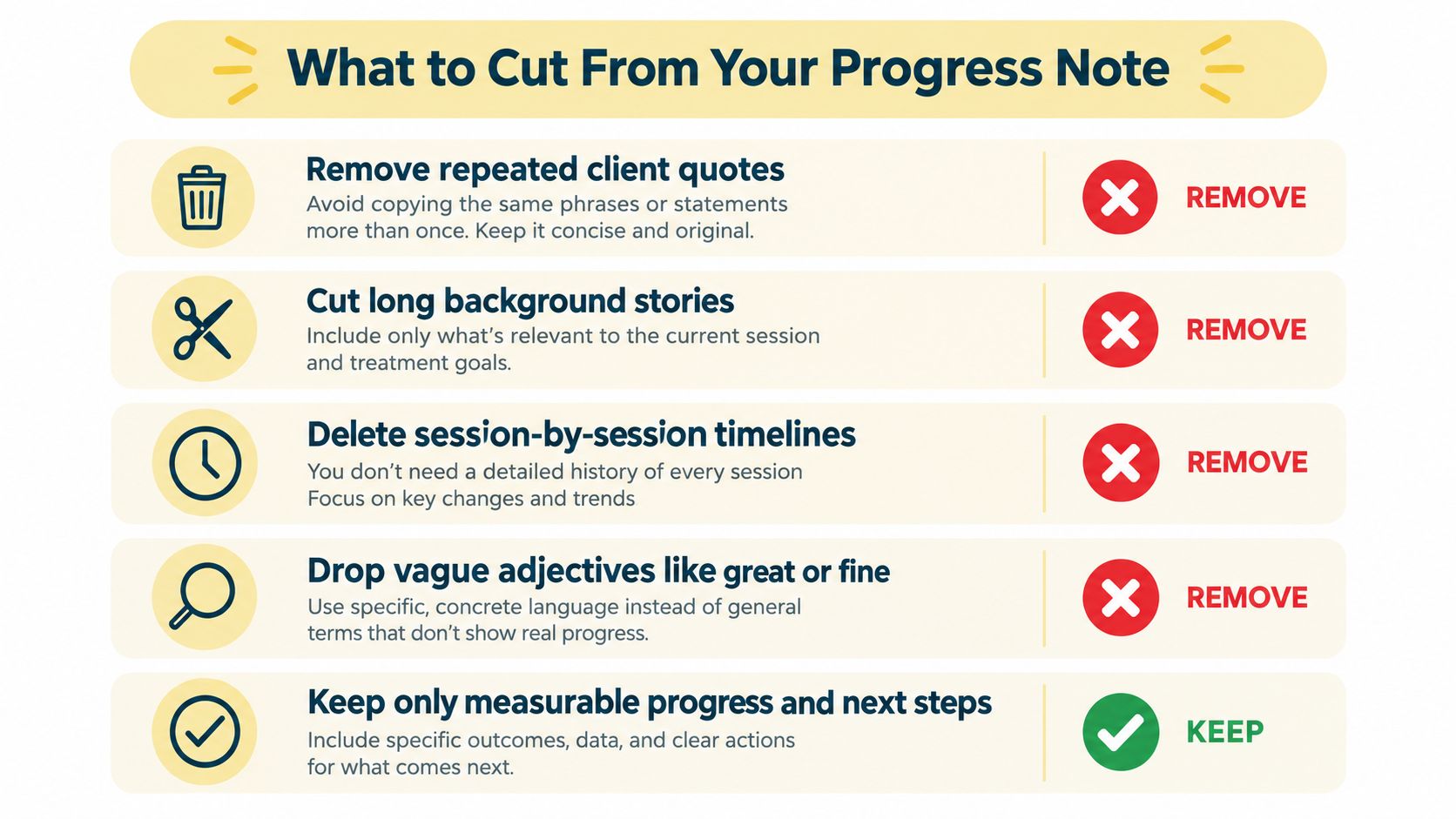
Run a deletion audit
Ask these questions while editing:
- Is this new? Remove unchanged background already available in the client profile unless it affects today's decision.
- Does it explain movement or a barrier? Keep relevant setbacks. Cut anecdotes that don't change the goal assessment.
- Is the evidence visible? Replace "great," "productive," or "insightful" with what the client did or reported.
- Will someone use this detail? Preserve decisions, resources assigned, revised milestones, and unresolved questions.
- Would deleting it change the next step? If not, it may belong in a separate reference record, or nowhere.
Don't delete all context in pursuit of a tidy page. A brief explanation of why the plan changed may prevent the next coach from repeating an unhelpful approach.
Editing rule: Cut repetition before you cut the explanation that makes a decision understandable.
Trim the story without trimming the reasoning
Before, an illustrative narrative draft:
The client discussed workload and described several situations involving requests from colleagues. We explored how these requests affected the week and returned to the ongoing prioritization goal. The client talked about wanting to be helpful and finding it uncomfortable to delay requests. We discussed boundaries, reflected on previous conversations about focus time, and explored possible responses. The session was productive, and the client appeared to gain useful insight. The client plans to work on protecting time and will report back.
After, a decision-focused rewrite:
Client reports that unplanned colleague requests displaced scheduled focus time. During rehearsal, client developed a response that acknowledges the request and proposes an alternative deadline. The current barrier is applying that response under pressure, not identifying priorities. Client will use the response when a competing request arises, record the result, and bring the record to the next session. Deadline and review date: [dates].
The revision retains the obstacle, the intervention, the demonstrated response, and the next commitment. It removes conversational sequencing and unsupported praise. That's the trade-off to aim for: less narration, no loss of reasoning.
Legal and Ethical Guardrails Coaches Actually Need
“What if the client reads this?” is a useful editing question. “What wording will protect me?” is less useful if it tempts you to write defensively rather than accurately.
A defensible note should be factual, respectful, and proportionate. Don't assume independent coaching is exempt from all documentation or privacy obligations; check the rules that apply to your location, credentials, contracts, and services.
Agree on access before there's a problem
Explain why you keep notes, where you store them, who may access them, and what may be shared with a sponsor. Recording, transcription, and automated processing deserve explicit discussion rather than being buried inside a general statement about administration.
- Define the audience: Separate your working record from information authorized for client or sponsor sharing.
- Restrict access: Use permissions appropriate to each person's role and avoid unnecessary copies in email or shared folders.
- Set a retention policy: Establish a documented schedule based on applicable obligations and professional advice. There isn't a universal retention period supplied by the coaching label alone.
The guide to confidentiality with clients provides a focused resource for working through those boundaries. A practical test is whether the client would be surprised by who can see the note.
Document difficult encounters without judgment
If a client discloses sensitive information, record only what's necessary to explain your response and next steps. Don't reproduce intimate detail just because it was memorable.
For a missed session, an illustrative entry might read: “Client did not attend the scheduled appointment. Contact attempt and response: [facts]. Rescheduling status: [status].” Don't infer avoidance or lack of commitment from absence alone.
For a disagreement, distinguish accounts: “Client states the action was optional; coach's earlier note records it as agreed. Clarified expectations and documented the revised agreement.” If an earlier entry is wrong, correct it through a traceable amendment rather than rewriting history.
Crisis disclosures require a different response from ordinary coaching barriers. Follow applicable emergency procedures and your scope of practice, seek appropriate assistance, and document the disclosure, actions taken, contacts, and follow-up accurately.
Write the action you took and the basis for it. Don't substitute a reassuring label for an adequate response.
Complete notes promptly. California's Department of Health Care Services requires completion within three business days, or one calendar day for crisis services; those deadlines apply to the covered services, not automatically to every independent coach.
For your own workflow, distinguish the encounter date from the documentation date. Don't backdate a late note to make it appear contemporaneous.
Using AI and Templates Without Losing the Plot
An AI draft can sound more certain than the conversation was. “Client considered approaching their manager” can become “Client committed to meeting with their manager,” and suddenly the record contains an agreement nobody made.
That's why fluency isn't a review standard. The question is whether each consequential statement is supported by the session.
Evidence on ambient AI documentation and copied-note errors includes a 2025 quality-improvement finding of shorter documentation time and notes averaging about 259 fewer characters; the supplied copy-forward analysis found errors in 86% of reviewed notes, with omissions representing 61% of identified errors. These findings concern healthcare documentation, not proven coaching outcomes.
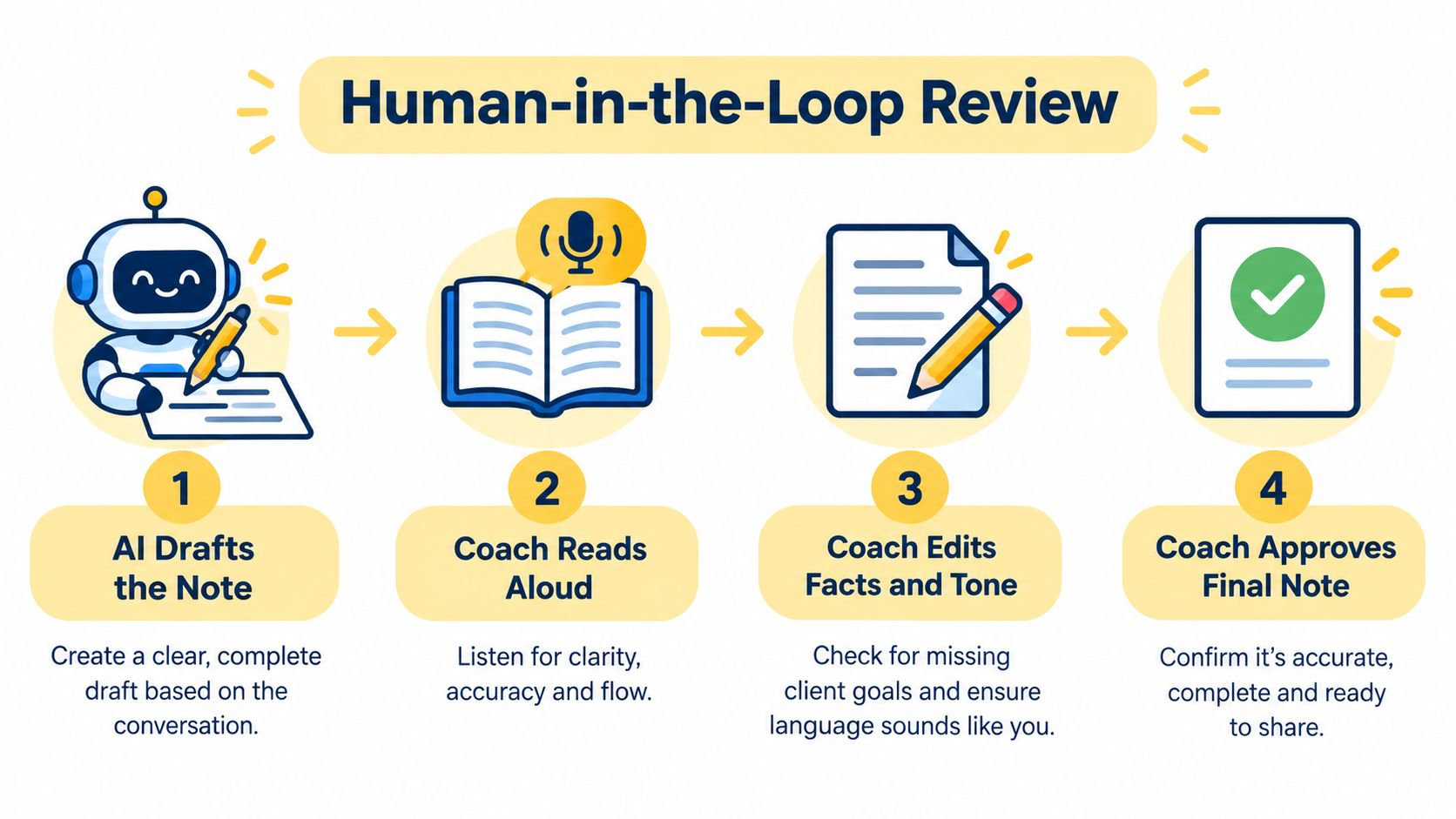
Verify meaning, not just spelling
Review an automated draft against contemporaneous notes or an appropriately authorized recording. Reading aloud may help you notice awkward tone, but it won't establish factual accuracy.
- Identity and encounter: Confirm the client, date, delivery format, duration, and author.
- Goal linkage: Check that the draft names the goal addressed, not a plausible goal imported from another session.
- Intervention and response: Verify what you did and how the client responded.
- Commitments: Distinguish suggestions, possibilities, and explicit agreements. Confirm owners and deadlines.
- Evidence and uncertainty: Delete invented results, unsupported causal explanations, and certainty the session didn't justify.
- Privacy and repetition: Remove unnecessary sensitive details and verify every copied-forward statement against the current encounter.
Omissions deserve equal attention. A draft can contain no false sentences and still be misleading because it leaves out the client's refusal, an unresolved concern, or a condition attached to an agreement.
Choose where automation belongs
Templates are useful for prompting missing fields. AI can help organize rough notes. Neither should decide what the client meant when the source material is ambiguous.
For broader context outside coaching, Premiere Education's 5 AI healthcare strategies to know is a companion resource, not a substitute for a coaching documentation policy. Use the client-consent guide for AI coaching session notes to prepare the conversation before introducing automated processing.
Explain what enters the tool, how it's handled, and who approves the final note. Keep provenance visible through draft status, review records, and version history where available.
If consent, secure handling, or adequate verification isn't possible, write the note manually. Administrative convenience isn't a reason to save an account you can't substantiate.
Templates and a Final Audit You Can Use Today
Use a template as a prompt, not a source of prewritten conclusions. Leave brackets visible until you've supplied the actual evidence; an unfinished field is safer than boilerplate that falsely implies something happened.
A SOAP-template quality-improvement initiative reached 84% median compliance, exceeding its 80% target. That supports using structure to guide completion, not assuming that completed boxes guarantee a useful note.
Field-by-Field Progress Note Templates for Three Coaching Contexts
| Field | Life Coaching | Business Coaching | Executive Coaching |
|---|---|---|---|
| Encounter | [Client, date, modality, duration, author] | [Client, date, modality, duration, author] | [Client, date, modality, duration, author] |
| Goal and baseline | Establish [routine]; baseline [current pattern]. | Improve [business process]; baseline [current evidence]. | Strengthen [leadership behavior]; baseline [observed pattern]. |
| Subjective | Client reports [experience and barrier]. | Client reports [commercial concern or operational change]. | Leader reports [workplace experience and constraint]. |
| Objective and intervention | Practiced [technique]; observed/reviewed [evidence]. | Reviewed [work artifact]; used [exercise]; response [facts]. | Rehearsed [behavior]; demonstrated [specific response]. |
| Assessment | [Movement toward goal], supported by [evidence]; unresolved [barrier]. | [Interpretation of change]; limitation [unknown]. | [Behavioral movement]; transfer to work [verified/unverified]. |
| Plan | Client will [action] by [date]; review [indicator] on [date]. | [Owner] will [action] by [date]; review [measure] on [date]. | Leader will [action] by [date]; coach reviews [evidence] on [date]. |
| Authentication | [Completion date and signature] | [Completion date and signature] | [Completion date and signature] |
Make quality a repeatable check
Run the final check before saving, then review a sample monthly. Track the proportion meeting each criterion rather than relying on whether the notes look polished.
- Prompt completion: Encounter and completion dates are accurate.
- Authentication: The responsible author is identifiable.
- Goal connection: The note explains which objective was addressed.
- Evidence support: Conclusions follow from documented information.
- Action clarity: The next step includes responsibility, timing, and a review measure.
- Draft verification: Repeated or automated text has been checked against the encounter.
The compact rule is goal, evidence, interpretation, commitment. Keep the context needed to understand that chain, and remove details that don't contribute to it.
Coachful is one option for keeping session notes, client goals, milestones, and shared resources in a single coaching workspace. Visit it to explore how configurable templates and progress tracking could support your workflow, then adapt the fields above before writing your next note.