Optimize Instagram Ad Cost for Coaching ROI in 2026

Coachful

You're probably staring at that Promote button with two competing thoughts in your head.
One says, “If this gets me even one right-fit client, it could be worth it.”
The other says, “I'm about to light money on fire, aren't I?”
That tension is normal. Coaches don't usually fear marketing because they hate growth. They fear it because ad platforms can feel opaque. You put money in, numbers appear, and unless you know what those numbers mean, it's hard to tell whether you're buying visibility, buying leads, or just buying confusion.
The good news is that Instagram ad cost isn't random. It moves, but it's not mysterious. Once you stop asking, “What does Instagram charge?” and start asking, “What can I afford to pay to acquire a client?”, your budget gets a lot calmer and a lot more strategic.
Is Investing in Instagram Ads Worth It for Coaches?
A familiar coaching scenario looks like this. You've been posting consistently. A few people engage. Some watch your Stories. A handful download your freebie or reply to a poll. But client flow still feels uneven, and every month starts with the same low-grade anxiety about where the next inquiry will come from.
That's where paid reach starts to make sense.
Instagram isn't some fringe channel coaches are experimenting with on the side. In the U.S., Instagram ad revenue is projected to reach $42.52 billion in 2026, up from $37.13 billion in 2025, and it's expected to account for 11.1% of all U.S. digital ad spending and 37.5% of U.S. social network ad spending in 2026, according to Gupta Media's Instagram ad market overview. For a coach, the takeaway is simple. Your buyers are already there, and businesses are paying serious money to get in front of them.
Why the fear feels bigger for coaches
A coach isn't selling a low-risk impulse purchase. You're selling trust, transformation, and often a premium service. So the fear isn't just “Will this ad get clicks?” It's “Will I waste money attracting the wrong people?”
That's the right question.
Cheap traffic is not the goal. Qualified conversations are.
If you run ads without a business model behind them, Instagram can feel expensive fast. If you run ads with a client acquisition model behind them, ad spend becomes easier to judge. You stop obsessing over whether a click felt pricey and start measuring whether the campaign creates enough booked calls and clients to justify the spend.
What worth actually means
For a coaching business, “worth it” doesn't mean every ad must close clients immediately. It means your ads help you build a pipeline you can measure.
That might look like:
- A lead magnet campaign that builds your email list with the right audience
- A webinar or workshop campaign that warms up cold traffic
- A call booking campaign aimed at people who already know your work
- A retargeting campaign that brings back profile visitors, video viewers, or past leads
If you want a practical walkthrough on optimizing Instagram ad campaigns, that guide is useful because it helps connect setup choices to actual outcomes instead of treating ads like a slot machine.
Decoding Instagram Ad Pricing Metrics
A coach can spend $300 on Instagram in a week and still feel like they learned nothing. Usually that happens because they watched the wrong number.
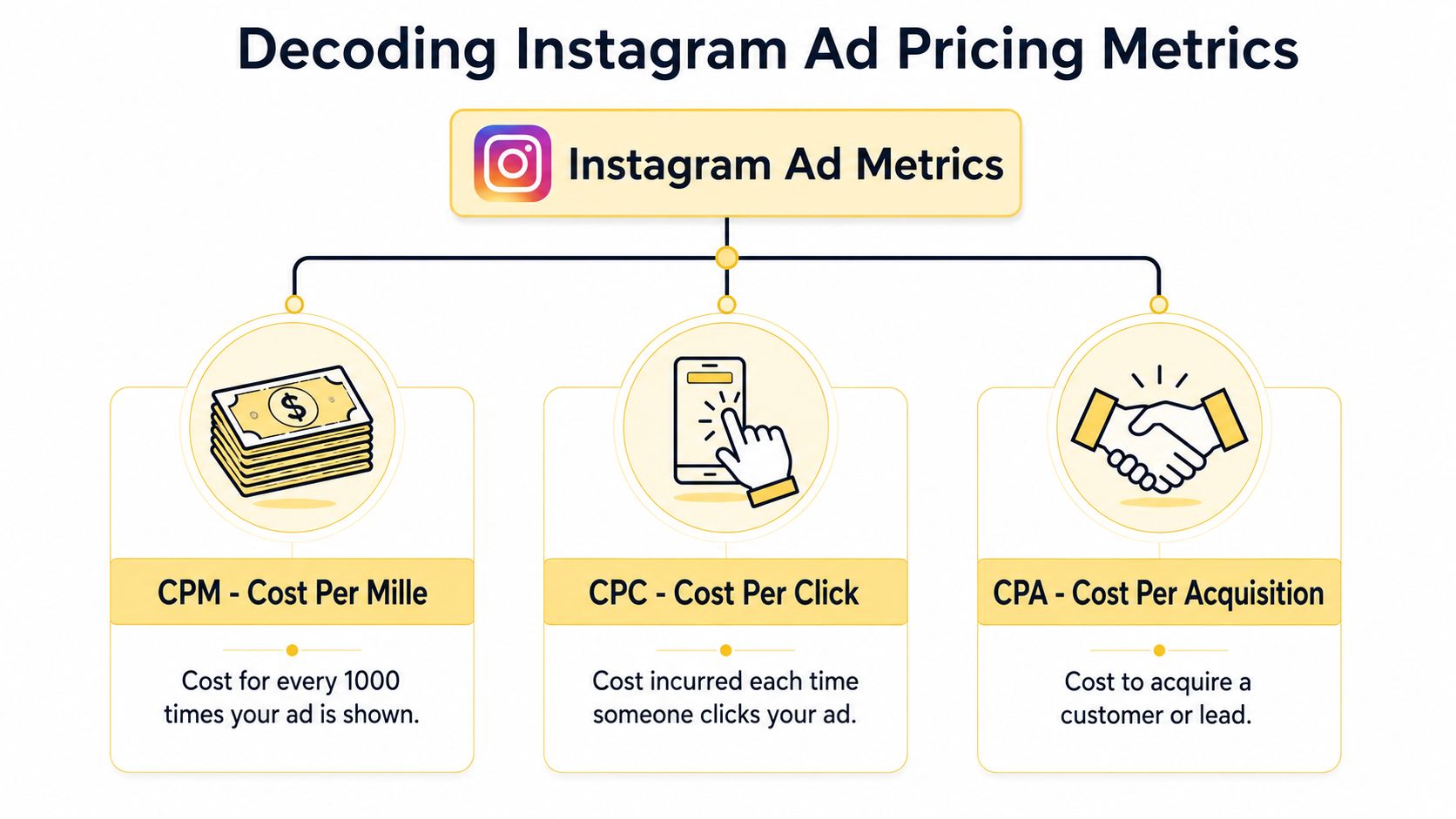
Ads Manager throws a lot of acronyms at you, but only a few matter for budgeting. For a coaching business, the job is simple. Understand what each metric measures, then connect it to the stage of your client journey. That is how you stop treating ad spend like a guessing game and start building toward a predictable client acquisition cost.
CPM means you're paying for reach
CPM is cost per thousand impressions. It tells you what it costs to get your ad in front of people.
This matters most at the top of the funnel, where the goal is visibility, video views, or building an audience you can retarget later. If your CPM is high, you are paying more just to get attention. That does not automatically mean the campaign is failing. It means attention is expensive for that audience, placement, or season.
CPC means you're paying for interest
CPC is cost per click. Someone saw the ad and decided your message was relevant enough to tap.
Coaches often fixate on CPC because it feels concrete. I get that. A click feels like progress. But cheap clicks from the wrong people create false confidence. If the audience is curious but not qualified, your CPC can look healthy while your sales pipeline stays empty.
CPL and CPA mean you're paying for business results
CPL is cost per lead. A person opts in, fills out a form, or joins your email list.
CPA usually means cost per acquisition or cost per action. For coaches, that action might be a booked call, an application, or a paid client, depending on how the funnel is set up.
These are the numbers that make budgeting real. A lead cost might be acceptable for one coaching offer and terrible for another. A leadership coach selling a $3,000 package can tolerate a very different CPA than a coach selling a $97 mini-offer.
Benchmarks can give you context. Hootsuite's Instagram ads guide notes average ranges for CPM, CPC, and lead costs, but those averages are only a starting point for decision-making, not a budget model: https://blog.hootsuite.com/instagram-ads-guide/
Which metric matters most for a coach
The right metric depends on the job the campaign is doing.
| Goal | Metric to watch first | What it tells you |
|---|---|---|
| Build visibility | CPM | What you're paying for reach |
| Drive profile or page visits | CPC | What interest costs |
| Grow your list | CPL | What each lead costs |
| Fill your calendar | CPA or booked-call cost | What each real sales opportunity costs |
The practical shift for coaches is this. Do not stop at CPM or CPC. Track the number that connects ad spend to revenue.
If you know an average client is worth $2,000, and one in five sales calls becomes a client, you can work backward. A booked call can cost far more than a click and still be profitable. That is why a CAC model is more useful than staring at platform benchmarks in isolation.
A simple coaching example
Say you run a Reel promoting a free burnout recovery guide for mid-career managers.
Instagram charges you for impressions first. Some people click. Some of those people opt in. A smaller group books a consult. One or two become clients. Every step has its own cost, and each cost tells you something different.
If CPM is reasonable but clicks are weak, the message or creative likely is not connecting. If clicks are affordable but leads are expensive, the landing page or offer probably needs work. If leads are cheap but calls are scarce, the follow-up process may be the bottleneck.
That is the primary use of pricing metrics for coaches. They help you find where money is being wasted so you can fix the right part of the funnel instead of blaming the whole campaign.
What Really Determines Your Instagram Ad Cost?
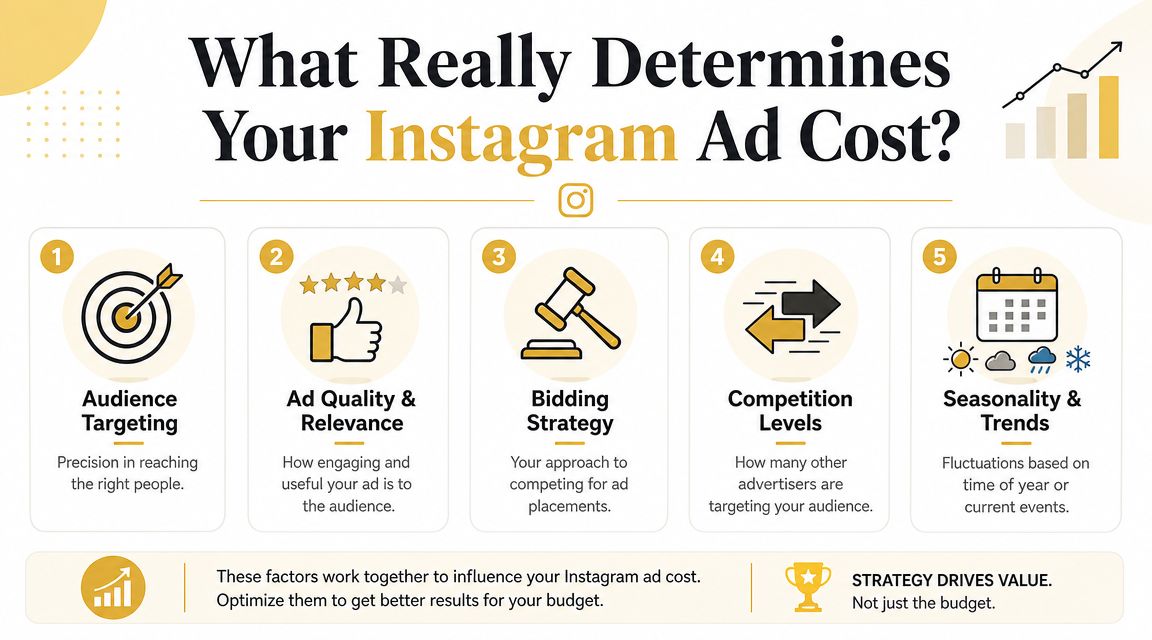
A coach can spend $20 a day and feel stuck. Another can spend the same amount and book calls consistently. The difference usually comes from how the campaign is set up, what the ad says, and how well the whole path from click to inquiry holds together.
Your objective sets the kind of cost you buy
Meta charges differently based on the outcome you ask it to optimize for. If you optimize for reach, you usually buy cheaper attention. If you optimize for leads, booked calls, or purchases, you usually pay more because the platform is searching for people more likely to take a harder action.
For coaches, that trade-off is normal. A higher cost is fine if it produces the kind of response that can turn into revenue. Cheap traffic that never becomes a consult is expensive in the way that matters.
This is why I push coaches to judge cost through a CAC lens. The platform metric matters, but the main question is whether the campaign is producing clients at a sensible acquisition cost.
Placement changes both price and intent
Feed, Stories, and Reels do different jobs. A short, direct Reel can stop the scroll and get lower-cost attention. A Story ad can work well for a warm, simple offer. Feed often gives you more room to make a nuanced case, which can help if your coaching niche needs context before someone clicks.
The right placement depends on the sale. If you are offering a free guide or webinar, lower-friction placements can work well. If you are asking for a strategy call, your creative usually needs stronger qualification so you do not pay for a pile of low-intent clicks.
Audience definition affects efficiency fast
Many coaches overspend early. They build an audience that feels precise, but it is so tight that Meta has little room to find responsive people at a reasonable price.
Broad does not mean careless. Narrow does not mean smart.
A good audience gives the system enough room to learn while still signaling who the offer is for. A career coach might target professionals with a common pain point and let the message do more of the filtering. A coach who stacks too many interests, job titles, and exclusions can drive costs up before the ad has a fair chance.
Creative quality changes auction performance
Instagram ads run in an auction. Meta weighs your bid, the likelihood that someone will act, and how useful the ad seems to the user, as explained in WASK's overview of Instagram ad auctions.
That matters because weak creative gets punished twice. It attracts less response, and it gives the system less confidence that showing the ad will lead to a good user experience.
For coaches, the usual problem is not design. It is vagueness. “Helping you step into your best self” is expensive copy because it does not connect to a concrete problem. “Burned out managers who want a promotion without another 60-hour week” gives the platform and the buyer something clearer to work with.
Your offer and destination page affect cost more than many coaches expect
If the ad promises one thing and the landing page feels generic, costs rise quickly. Meta sees weaker post-click behavior. Your audience feels friction. Conversion rates slip, which pushes your effective lead cost up even if the click price looks acceptable.
That is why the page after the click matters so much. A simple, focused page built with a coaching website builder will usually outperform a cluttered site with too many menu options, mixed offers, and vague calls to action.
I see this often. Coaches blame targeting first, when the main issue is that the page does not continue the conversation the ad started.
Competition and timing still matter
Some weeks are more expensive. If more advertisers are competing for the same audience, your costs can rise even if your campaign settings have not changed. Coaches often feel this around New Year planning, career transition periods, and back-to-business seasons.
That does not mean your campaign is broken. It means you need to read results in context and focus on the numbers farther down the funnel. If booked-call cost and client acquisition cost still work, a higher CPM is annoying, not fatal.
What to check first when costs climb
- Objective mismatch: You are optimizing for cheap traffic instead of qualified action
- Placement mismatch: The format gets attention, but not the kind that converts
- Audience too tight: Delivery becomes expensive and unstable
- Creative too generic: People scroll past, and Meta predicts weak response
- Weak landing page: Clicks happen, but inquiries do not
- Seasonal competition: The same audience costs more to reach this month
Instagram ad cost feels random when you only watch the top-line numbers. It gets much easier to manage when you trace the full path from impression to client and find the exact point where money starts leaking.
How to Budget for Your First Coaching Campaign
You open Ads Manager, type in a daily budget, and immediately wonder if you're about to burn money on clicks that go nowhere.
That's the moment to stop thinking in terms of “What should I spend per day?” and start thinking in terms of “What can I afford to pay to acquire a client?”
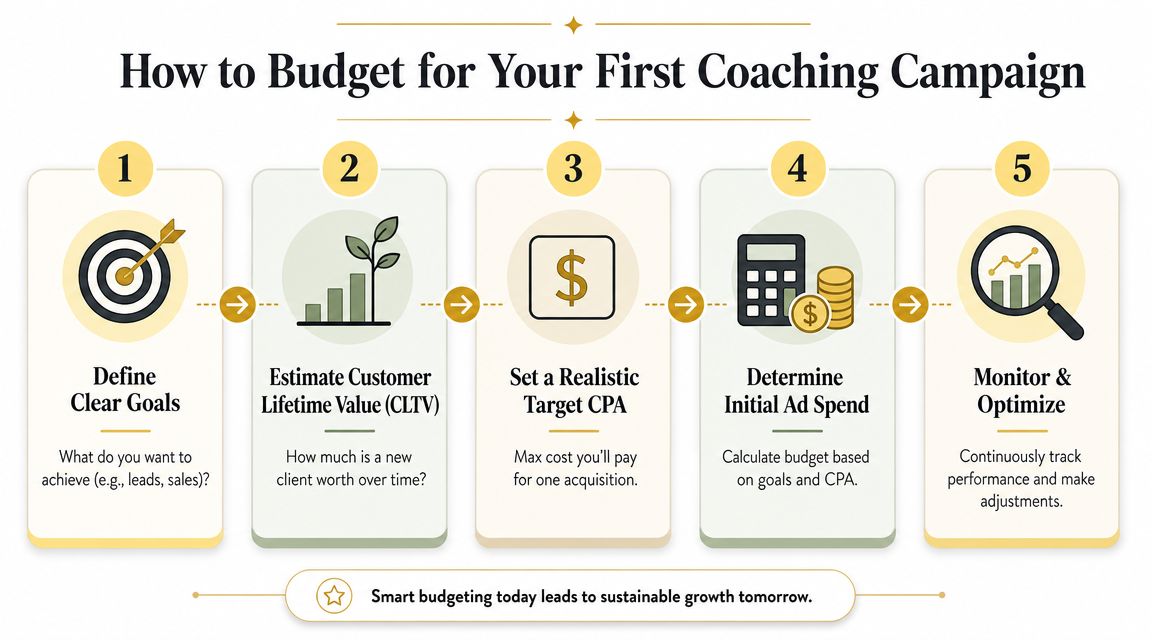
For coaches, that shift changes everything. A workable Instagram budget comes from client acquisition cost, not generic platform averages. If you know what a new client is worth, how many calls usually turn into clients, and what kind of lead quality you need, you can set a budget with a lot more confidence.
Build your budget backward from revenue
Start with a real business target.
If your coaching package is high enough value that one client can more than cover a test campaign, you do not need dirt-cheap leads. You need a path to profitable leads. Those are very different standards.
Use this simple budgeting flow:
Set a client goal
Example: two new clients from the campaign.Choose your maximum CAC
Decide the highest amount you are willing to spend to acquire one paying client while keeping the sale worth it.Estimate the number of sales conversations you need
If you usually close one out of every four qualified calls, then one client requires about four strong calls. Two clients require about eight.Estimate the number of leads required to produce those calls
If half your leads book, eight calls means roughly sixteen leads.Set a test budget that can produce enough volume The goal is enough data to judge lead quality, booked-call cost, and CAC. A tiny budget rarely gives you that.
That is the model. Simple, practical, and much more useful than staring at CPC benchmarks in isolation.
Track the funnel a coach actually cares about
Instagram metrics matter, but they are not your budget model.
Your budget model is the path from impression to client:
| Stage | What to watch |
|---|---|
| Click | Is the message getting the right people to act? |
| Lead | Is the offer strong enough to get contact details? |
| Booked call | Are leads showing real buying intent? |
| Sales call | Are the right prospects reaching your calendar? |
| Client | Is ad spend turning into revenue? |
I usually tell coaches to judge a first campaign by booked calls and client acquisition trend, not just by lead cost. Cheap leads can wreck your budget if they never book or never buy.
Give the campaign enough room to learn
A very small budget feels safe, but it often creates noisy results.
If an ad set cannot generate enough activity, Meta has very little to work with. You end up reacting to weak signals, changing things too early, and calling the campaign a failure before it had a fair shot. That is one of the fastest ways coaches waste money. Not because the budget was too high, but because it was too low to produce a clear read.
A better starting point is a budget that can support a real test window. That usually means enough spend to run for several days without daily edits and enough volume to see where the funnel breaks.
Budget rule: Set a test budget large enough to answer a business question. Can this offer generate qualified calls at an acceptable CAC?
Use a simple first-campaign budget formula
Here's a clean way to set your first number:
Target clients x acceptable CAC = campaign budget ceiling
If your goal is 2 clients and your acceptable CAC is $500, your ceiling is $1,000.
Then pressure-test it against your funnel:
- Can this budget realistically generate enough leads?
- Can your sales process convert those leads?
- Can your offer support that CAC and still make sense?
If the answer is no, do not force the ads to “be cheaper.” Rework the offer, sales process, or follow-up before spending more.
Prepare the destination before you spend
The ad budget is only half the decision. The page matters just as much.
If you send paid traffic to a cluttered site, weak copy, or a vague booking page, your CAC rises fast. Coaches who want a cleaner setup often do better with a focused page built in a dedicated coaching website builder, especially if their current site was pieced together over time.
Before launch, check these four items:
- One offer: No mixed services, side offers, or multiple next steps
- One audience: Speak to one problem for one type of client
- One conversion action: Apply, book, or opt in
- One test period: Let the campaign run long enough to gather usable results
Treat the first budget like paid research
Your first campaign is buying information and opportunities at the same time.
You are finding out which message attracts the right coach-fit prospect, which offer gets action, and whether your funnel can convert attention into sales conversations. Once you know those numbers, budgeting gets easier. You are no longer guessing at ad cost. You are managing CAC with a clear target and a process you can repeat.
Proven Tactics to Lower Your Instagram Ad Costs
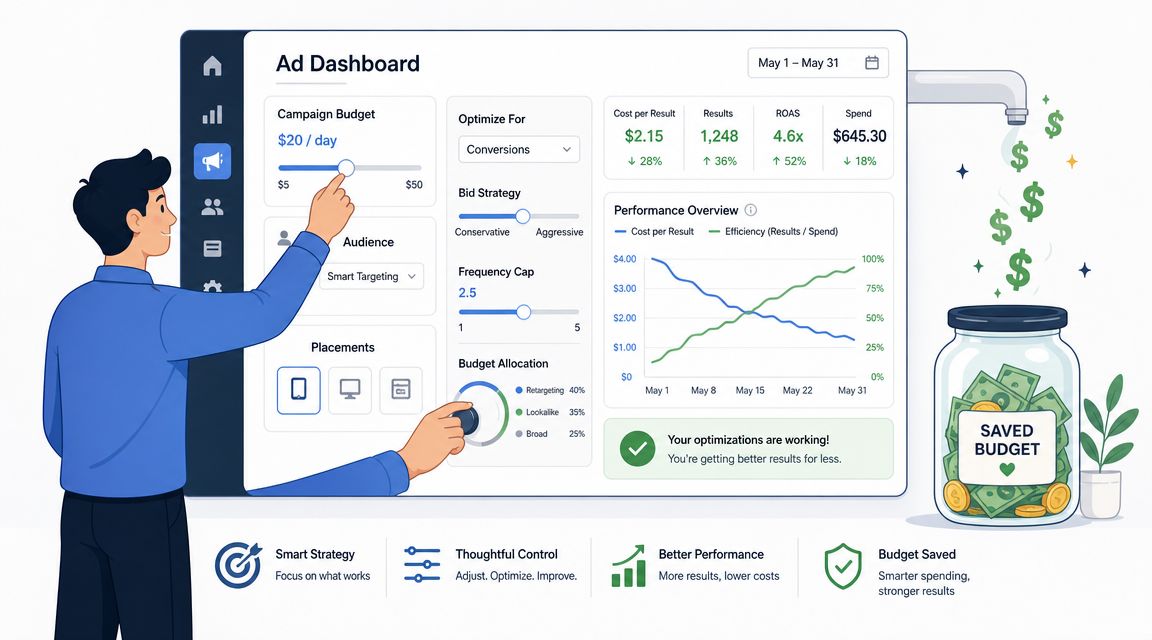
Lower costs usually don't come from “hacks.” They come from making the ad easier for the right person to say yes to.
That means stronger creative, better offer alignment, and a smarter path from cold attention to warm action.
Use placement strategically, not evenly
A lot of coaches spread budget across placements without a real reason. That's usually lazy planning.
Current benchmark content shows average CPMs of $4.29 for Reels and $7.25 for Stories in one 2025 tracker, and the more useful takeaway from Gupta Media's placement cost analysis is to treat cost as a placement-objective tradeoff. Use cheaper reach placements to build audiences, then use higher-intent placements for retargeting and conversion.
For a coach, that can look like this:
- Reels for cold traffic: Short problem-led videos that call out a pain point
- Stories for direct response: Fast offers, free resources, quick actions
- Feed for warmer people: Deeper trust-building, testimonials, fuller context
Write ads like a coach, not like a brand deck
Most coaching ads fail because they sound polished but emotionally flat.
A better ad says something your buyer already feels. For example:
- “You're good at your work, but your calendar still depends on referrals.”
- “Your team got promoted into management, but nobody taught them how to lead.”
- “You're posting every week and still not getting qualified inquiries.”
Those lines don't try to impress. They create recognition.
Test the hook before the body
If the first line or first seconds don't land, the rest doesn't matter. Coaches often spend too much time refining the whole ad and too little time testing the opening.
Try variations such as:
- a direct pain-point hook
- a “mistake” hook
- a belief-challenging hook
- a short client-situation hook
If you also need a cleaner destination once people click, a solid link in bio for coaches can help you route traffic without making people hunt for the next step.
A short walkthrough can help sharpen your eye for optimization choices:
Use a two-step funnel instead of forcing the sale
Cold audiences rarely want a discovery call from someone they just met. Coaches waste money when they ask for too much too soon.
A cheaper and often more sensible path is:
- Cold ad to a useful free resource or short training
- Retarget engaged people with a stronger invitation
- Ask for the call after trust has started
Warmth changes economics. The same offer can feel expensive to a stranger and completely reasonable to someone who already trusts you.
Cut the friction after the click
If your ad promises clarity and your landing page feels vague, your costs go up in practice even if the platform metrics look acceptable.
Check these basics:
- Match the message: The page should continue the same promise as the ad.
- Reduce decisions: One action beats multiple options.
- Use plain language: “Book a consult” beats abstract transformation language.
- Make mobile easy: Users won't wrestle with a clunky page.
The lowest-cost ad account usually isn't the one with the cleverest settings. It's the one where the message, creative, offer, and page all line up cleanly.
Measuring What Matters Most Your Ad Spend ROI
A coach can get excited about clicks, reach, saves, and video views. None of those pay invoices by themselves.
The numbers that matter most are the ones tied to revenue.
CAC matters more than vanity metrics
Customer acquisition cost (CAC) is what you spend to acquire one client. For coaches, that's the number that puts Instagram ad cost in context.
If you spend money on ads and gain clients profitably, the campaign worked. If you generate cheap leads that never book or never buy, the campaign didn't work no matter how pretty the click cost looked.
That's why the right question is rarely, “Was that lead expensive?” It's usually, “Was that lead profitable once I look at the full path to a paying client?”
LTV changes what “expensive” means
Client lifetime value (LTV) helps you avoid short-term thinking.
If a client buys one package and that's it, your acceptable CAC is lower. If clients often renew, extend, join group programs, or refer others, your acceptable CAC can be higher than you first assumed.
A leadership coach, health coach, or executive coach may all evaluate the same lead very differently because their average client value and retention pattern differ. That's why copying someone else's benchmark often leads to bad decisions.
Track the full chain
Use a simple attribution habit. Ask every lead how they found you. Check your forms, calendar bookings, and CRM notes. Compare ad spend to actual consults and signed clients, not just front-end metrics.
A simple review rhythm looks like this:
| What to review | Why it matters |
|---|---|
| Leads generated | Tells you whether the offer attracts interest |
| Booked calls | Shows whether the lead quality is real |
| Show-up rate | Reveals whether intent is strong |
| Clients closed | Connects marketing to revenue |
| CAC versus client value | Determines whether scaling makes sense |
A practical coaching lens
A high-ticket coach can often afford a lead cost that would scare a low-ticket seller. A coach with weak sales follow-up may think the ads are broken when the problem is delayed outreach or a poor consult process.
Don't evaluate Instagram ads in isolation. Evaluate the whole client acquisition system.
That's the big shift. Instagram ad cost is only one input. Your message, page, consult process, follow-up, and offer determine whether that cost becomes profitable or painful.
Your Next Steps to Confident Ad Spending
You launch your first Instagram campaign with a $20 daily budget, check results by lunch, and wonder if you just lit money on fire. That reaction is normal. Coaches usually do not need more metrics. They need a spending plan that ties ad cost to signed clients.
Start there. Set a target for how many consults and clients you want this month, then work backward into a CAC range you can afford. If one new client pays for the whole test and the process is repeatable, the budget is doing its job.
Keep the setup simple. Run one offer to one audience with one clear next step. Give the campaign enough time to gather signal, then judge it on booked calls, sales conversations, and closed clients. If you are also using paid traffic to support trust and visibility, this guide on Boosting Instagram follower count can help you connect follower growth to the wider coaching funnel.
Then make decisions like an operator. Cut what brings in cheap but weak leads. Keep what produces qualified calls, even if the front-end click cost looks higher than you expected. Coaches get into trouble when they optimize for the lowest lead cost instead of the strongest path to revenue.
Once leads start coming in, your delivery system matters too. coachful helps you manage onboarding, scheduling, payments, client progress, and program delivery in one place, so the client experience stays smooth after the ad click.