Networking Follow-Up Email: 5 Templates for Coaches

Nour
Founder, Coachful
What should you email someone after a networking event without turning a good conversation into a coaching pitch? Remind them where you met, refer to one real detail, deliver anything you promised and offer only the next step the conversation supports. A potential referral partner, a peer and someone who asked about coaching should not receive the same message.
A useful networking follow-up email continues an exchange. It does not manufacture buying interest. If someone asked for your worksheet, send the worksheet. If they asked how your coaching works, explain that. If you simply enjoyed talking, you can say so without attaching a discovery-call link.
Below are five copyable templates for coaches, with selection rules, personalization notes and a small follow-up process. All names, situations and messages are fictional examples. Replace the brackets with true details and your actual terms before sending.
Choose the message before choosing the subject line
The awkward part is rarely finding a polite greeting. It is deciding whether the person is a prospective client, an introducer or just someone you liked. A friendly conversation about work is not automatically an invitation to sell coaching.
Use these five situations to choose your email:
- You promised something: use template 1 and deliver it directly.
- Your practices might complement each other: use template 2 to explore referral fit without requesting a client.
- They explicitly asked about coaching: use template 3 to explain the service and a possible fit conversation.
- You met a peer with no commercial next step: use template 4 and keep it genuinely collegial.
- An appropriate first message received no reply: use template 5 once, if the reminder is still useful.
Before writing, capture the event, the topic, any promise, the kind of relationship and the agreed channel. Keep the note factual. “Asked for the delegation worksheet” is helpful. “Clearly needs coaching because she seemed overwhelmed” is an interpretation you should not turn into a sales record.

If your real problem is finding better rooms to attend, start with our networking event guide instead. This article begins after you have had a conversation and need to write the actual follow-up.
1. The resource you promised
Use this when: the person asked for a resource or you offered to send something and they agreed. Your first obligation is fulfillment, not qualification. Do not make them book a call or enter their email again to receive a document you already promised.
Subject: The meeting-preparation worksheet from [event]
Hi [name],
Good talking at [event] about [specific topic]. Here is the [worksheet/article] I mentioned: [direct link].
The section on [relevant part] is the one we discussed. I hope it is useful for [their stated situation].
No need to book anything to use it. Glad we connected.
[Your name]
Personalize: name the actual conversation, not an intimate difficulty they did not volunteer. “Preparing for your first team meeting” is better than “your struggle with confidence.” The first reflects a practical topic. The second labels a person you barely know.
Leave out: the service brochure, three other downloads and an invitation to a call they never requested. Adding a pitch can change the meaning of the resource exchange. You promised a useful item, not an enrollment sequence.
If the person asked for your website or profile rather than a resource, send that exact destination and say what they will find there. Do not quietly substitute an application form. A link should fulfill the promise in your message.

2. The potential referral partner
Use this when: another professional serves a related audience and you both expressed interest in comparing your work. Your goal is to learn whether introductions could ever be appropriate, not to ask a stranger to lend you their reputation.
Subject: Comparing our work with [shared audience]
Hi [name],
I enjoyed our conversation at [event] about supporting [audience]. You mentioned [specific part of their work], which seems different from the [specific coaching focus] I offer.
Would a short conversation about our scopes be useful? I would like to understand who you help, where your boundaries sit and when an introduction would not be appropriate.
No referral needed. I am suggesting that we get to know each other's work first.
[Your name]
Personalize: explain the difference between your services. “We both help people” is not enough. A career coach and a recruiter may serve some of the same people while having very different responsibilities, payment arrangements and definitions of success.
Leave out: client names, sensitive examples and proposed commissions. If either profession is regulated, any arrangement needs separate consideration of professional duties, disclosures and applicable rules. A networking email is not the place to assume a financial referral arrangement is allowed.
If they agree, discuss the situations you take, the situations you decline, your current capacity and how a person can request an introduction. Seek permission from both parties before sharing contact details. Never send a client's story as evidence that a partnership could work.

3. Someone who asked about working with you
Use this when: the person actually asked about coaching, your process or your availability. Not when they said “interesting” after your introduction. Interest in the profession is different from interest in buying your service.
Subject: The [coaching focus] conversation you asked about
Hi [name],
At [event], you asked how my coaching supports [their stated goal]. I work with [accurate audience] on [specific focus], through [actual format].
The next step, if useful, is a [length] fit conversation. It is [free/actual fee], and we would discuss your goal, my scope and whether the practical arrangements suit you. It is not a coaching session.
Would you like the booking link? Happy to answer a question here first.
[Your name]
Personalize: describe what you genuinely offer, including whether the initial conversation is paid. Do not promise a promotion, business result or health outcome. Explain the service rather than predicting what it will do for a person whose circumstances you have not assessed.
Leave out: artificial scarcity, a surprise intake questionnaire and “I can tell you really need this.” A coach should not convert a casual disclosure into a diagnosis or pressure point.
If they explicitly asked you to send the booking link at the event, send it now rather than adding an unnecessary permission round. Explain the call's purpose, length and fee next to the link. If they only asked what coaching involves, answer that question first.

After a completed fit conversation, the next message has a different purpose. Use our discovery-call follow-up guide for that later stage rather than trying to close a sale in the networking email.
4. A peer you want to stay in touch with
Use this when: the conversation was worthwhile but there is no clear buying or referral opportunity. Professional relationships are allowed to be useful without immediately producing a lead. A peer can remain a peer.
Subject: Your point about [topic] at [event]
Hi [name],
I appreciated your point about [specific idea] at [event]. It made me reconsider [a genuine observation about your own work].
Good to meet another coach interested in [shared professional topic]. I would be glad to compare notes again if our paths cross at [real upcoming gathering, if applicable].
No action needed. Thanks for a thoughtful conversation.
[Your name]
Personalize: respond to an idea, not the person's status. You do not need to call someone inspirational or pretend their comment transformed your practice. A precise, proportionate acknowledgment sounds more credible.
Leave out: a disguised request for supervision, unpaid mentoring or an endorsement. “Pick your brain” can hide a substantial demand. If you want professional guidance, ask whether they provide it and on what terms.
Do not invent a next meeting to make the email look purposeful. Delete that sentence if there is no real gathering. Likewise, do not write “no action needed” and then attach three questions. The body should honor the permission its ending gives.

5. One useful reminder after no reply
Use this when: your first email was appropriate, the next step remains relevant and the person has not declined. As a practical house rule, consider one reminder about a week later, then stop. That is an editorial recommendation, not a universal timing rule or a legal entitlement to contact someone.
Subject: Reply in the original email thread
Hi [name],
One follow-up on the note below about [specific resource or agreed next step]. If [small proposed action] would still be useful, I am happy to [clear action you can actually take].
If it is not a priority, no problem. I will leave it here rather than keep following up.
[Your name]
Personalize: repeat the concrete action, not your disappointment. “Happy to send two possible times” is clear. “I have not heard back despite reaching out twice” puts the recipient in charge of managing your feelings.
Leave out: fake reply prefixes, guilt, a calendar invitation they did not accept and a new sales offer. Replying in a real thread preserves context. Adding “Re:” to a new message to imply an earlier exchange does not.
After this reminder, close your own task. Do not switch to several social accounts to get around their silence. If they return later, continue from the new context. A closed follow-up task is not a judgment about the person.

When to send a networking follow-up email
Send a promised resource when you said you would. If no timing was agreed, the next working day is a useful habit while the details are fresh. You do not need a supposedly perfect hour, and you should not claim that a later message is worthless.
If a week has passed, be straightforward: “We met at [event] last week. I am sending the [resource] we discussed.” A short acknowledgment is enough. A long apology makes the recipient read about your delay before reaching the useful part.
For an introduction or meeting, consider the person's stated schedule. Someone who told you they are away until next month has already given you a better timing signal than a generic outreach cadence. Honor it.
Use a small follow-up record, not a mass campaign
You do not need to enroll every event contact in a funnel. For each conversation worth continuing, keep a minimal record:
- Source: where you met and when.
- Context: the practical topic they chose to discuss.
- Promise: the exact item or introduction you agreed to provide.
- Relationship: peer, potential introducer or person exploring coaching.
- Next action: one task and date, or no action.
- Contact boundary: the channel and purpose agreed, plus any objection.
For example: “Tuesday breakfast; asked for meeting worksheet; possible referral peer; send direct link tomorrow; no newsletter request.” This tells you what to do without recording an unnecessary personal history. Store no more than the relationship requires, protect access and follow your retention practices.

A prospect pipeline can help once someone is genuinely exploring a service. It should not be the default label for every person you meet. Equally, a contact who declines marketing should not reappear in a campaign because you imported an old event list.
Keep the linked page consistent with the email
A thoughtful message can still send someone to the wrong destination. Open the link on your phone before sending. Check that the page contains the promised item, describes any next step accurately and does not force an unrelated signup.
If you link to a service page, it should explain who the coaching is for, what the format involves and how someone can ask a question. If you link to booking, the call's purpose and fee should be apparent. Do not call it a free session if it is a sales or fit conversation.

A direct resource link, a profile and a booking page serve different intentions. Choose one. A menu of every service you provide can turn a specific follow-up into homework.
Permission and confidentiality still matter after an event
Receiving a business card, scanning a badge or finding someone in an attendee directory does not automatically establish permission for every future marketing use. Follow event rules and the commercial-email and privacy requirements that apply to you and the recipient. A message sent individually can still be commercial.
In the United States, the FTC's CAN-SPAM compliance guide explains requirements for commercial email, including truthful headers and subject lines, required sender information and an effective opt-out. The rules also apply to business-to-business commercial messages. Other jurisdictions may require consent or impose additional restrictions. This is a practical boundary, not legal advice.
Do not turn an informal conversation into a coaching record full of sensitive assumptions. Avoid quoting private disclosures in subject lines, which may appear on a lock screen. For introductions, share only what both people have agreed can be shared.
Common questions
How long should a networking follow-up email be?
Long enough to establish context, deliver the promised value and make one appropriate next step clear. A few short paragraphs are usually sufficient. Explain an unusual arrangement if necessary; do not remove important fee or scope information to meet an arbitrary word count.
Should I include a calendar link in the first email?
Include it if they asked for it or agreed to a meeting. Otherwise, match the invitation to their interest. A resource request does not need a calendar link. A question about coaching may need an explanation before it needs a booking page.
Can I put networking contacts on my coaching newsletter?
Do not assume so. Keep a one-to-one follow-up distinct from a newsletter subscription. Establish the appropriate permission or other valid basis under applicable rules, explain what the subscription is and honor objections. Never present the event's attendee list as your own opted-in audience.
What should I measure?
Record whether you fulfilled promises, received relevant replies, arranged mutually agreed conversations or made appropriate introductions. A peer conversation is not a failed sale. For broader attribution, see our guide to tracking coaching visibility activities.
Make one promise easy to keep
Choose one real conversation from your last event. Identify what the person asked for, select the matching template and remove every sentence that serves only your desire to make a sale. Then test the one link you intend to send.
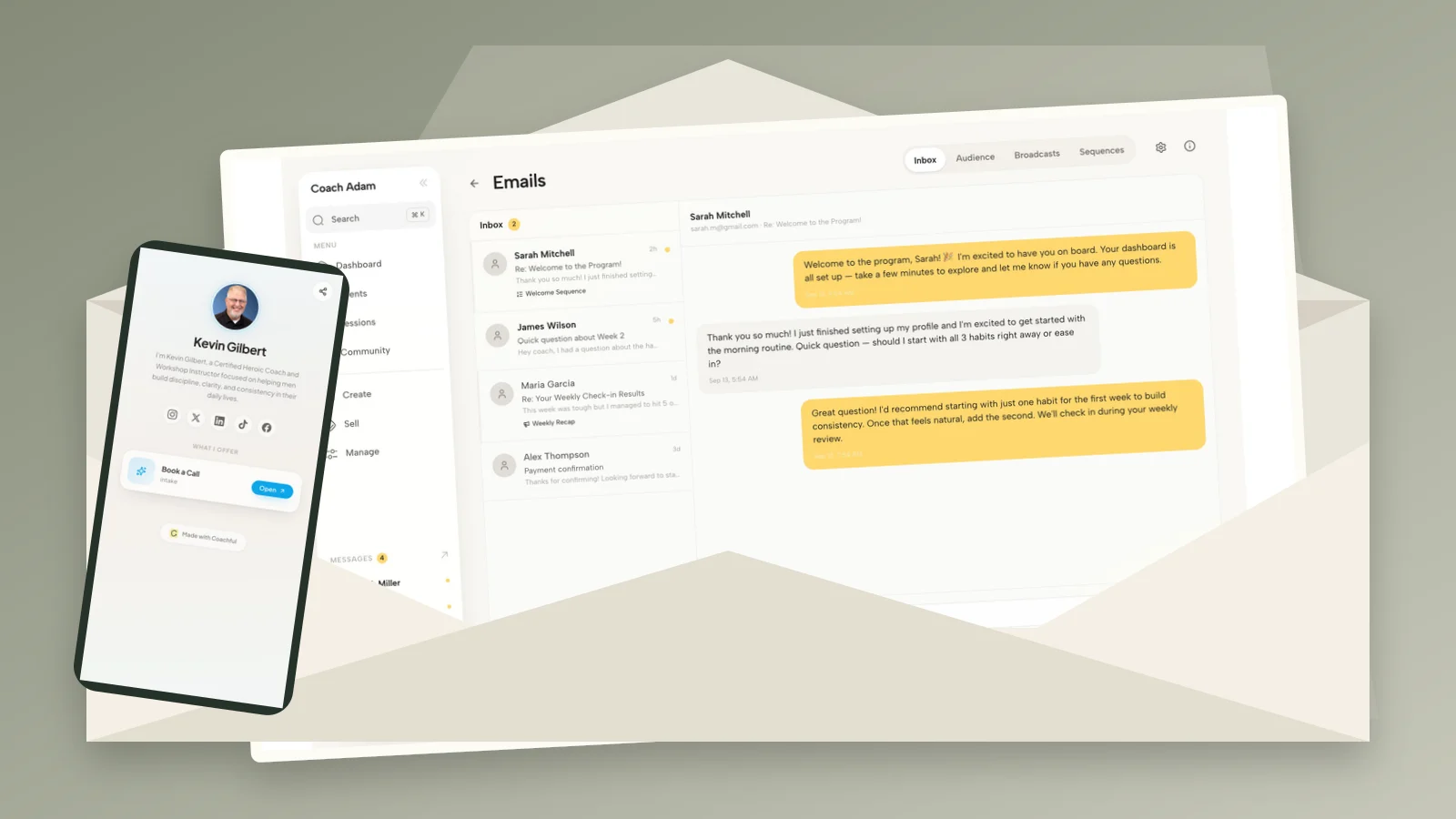
We make Coachful. The real demo screens here show email, prospects, scheduling, profiles and website editing, not an automatic networking engine. If your weak point is the handoff after someone expresses interest, try the interactive Coachful demo and inspect the destination you would want them to see. Better follow-up starts with honoring the conversation, not automating a bigger ask.