
Payment Reminder Email for Coaches: 5 Templates

Coachful
Coachful Editorial
A good payment reminder email for a coaching client states the invoice number, the verified unpaid balance, the due date and one way to pay. Keep it private and factual. You do not need to apologise for an agreed fee, describe your own financial stress or make the client defend their commitment to coaching.
The uncomfortable part is often not the money. It is opening the next session after sending a message that sounded colder than you intended. The answer is not another paragraph of reassurance. It is a short administrative message that leaves room for a payment error, a disputed charge or a genuine practical problem.
Below are five original templates for different situations, plus a way to choose, personalise and track them. They are business communication examples, not legal notices or a guarantee of collection. Your agreement, the facts and applicable law determine any fees, service changes or formal recovery action.
Before sending: confirm that the reminder is actually needed
Check the invoice against the payment record immediately before you send. A scheduled reminder can become wrong between breakfast and lunch. Look for a recent receipt, a pending transfer, a partial payment, a credit, a refund or an agreed extension. An issued invoice and an unpaid invoice are not interchangeable.

Then verify the recipient. The person attending coaching may not be the person who owes the bill. An employer, parent or other sponsor might be responsible under the agreement. Write to the authorised billing contact and disclose only the service description needed to identify the invoice. Do not forward session notes to prove that work happened.
Have these facts in front of you:
- Invoice reference: the identifier on the original invoice.
- Amount and currency: the remaining balance, not automatically the original total.
- Due date: the date established by the agreed terms.
- Payment route: a verified link for that invoice or the approved payment instructions.
- Last contact: what you already sent and whether the client replied.
- Next step: what you can actually do under the agreement if it remains unresolved.
If any of these are uncertain, resolve the uncertainty first. “Our records show” is a useful opening because it invites a correction, but it is not permission to send an unchecked balance.

The five templates at a glance
Choose by the situation, not by how annoyed you feel. Use template one for a payment approaching its due date, two for a first overdue reminder, three when you need a definite payment date, four when a company handles payment and five when you have reached a genuine review point.

These are alternatives, not a five-email campaign that every client should receive. A corporate payment issue may go straight to template four. A client who replies with a disputed charge should leave the routine reminder sequence until you have checked the dispute.
1. A polite reminder before the payment is due
Use when: the invoice has already been issued and the agreed due date is approaching. This is a heads-up, not an overdue notice. It can be especially useful when a package installment is separate from the date of the next session.
Subject: Coaching invoice [number] due on [date]
Hi [first name],
A quick reminder that the remaining [currency and amount] on invoice [number] for [brief service description] is due on [date].
You can view and pay the existing invoice here: [verified invoice link].
If you have already arranged payment, thank you. If you need me to check anything on the invoice, please reply here.
Thanks,
[your name]
[business name]
Personalise it: use the service name from the invoice, such as “October coaching installment,” rather than a description of the client's private goal. If payment is already scheduled to collect automatically, do not send a manual demand that could lead to a second payment. Check the scheduled collection and use the appropriate billing notification instead.
Avoid: “Your payment is late” before the due date, or “Please pay immediately” when the agreement allows more time. An early reminder should make the existing terms easier to follow, not quietly replace them.
2. A first reminder after the due date
Use when: the agreed date has passed and you have verified that a balance remains unpaid. Assume an administrative explanation is possible without declaring that you know why the client has not paid.
Subject: Invoice [number]: [amount] outstanding
Hi [first name],
Our records show that [currency and amount] remains unpaid on invoice [number] for [brief service description], due on [date].
Please pay the existing invoice here: [verified invoice link].
If you have already paid, please send the payment date and reference so I can check the record. If there is a question about the invoice, reply here and I will look into it.
Thanks,
[your name]
[business name]
Personalise it: if the client made a partial payment, say so: “Thank you for the [amount] received. The remaining balance is [amount].” That acknowledgement prevents a reminder about a balance from sounding like you ignored their payment completely.

Avoid: “Just a gentle nudge, sorry to bother you again.” It hides the action and makes ordinary billing sound like a favour. Equally, avoid claiming the client has ignored an email because a tracking tool says it was opened. An open is not evidence of agreement or deliberate nonpayment.
3. A firmer follow-up asking for a payment date
Use when: an earlier reminder has not resolved the balance and you need a concrete answer. Reference the previous contact without pasting a long history of every unanswered message.
Subject: Payment date requested: invoice [number]
Hi [first name],
I am following up on my message of [date]. Invoice [number], due on [due date], still shows a remaining balance of [currency and amount].
Please pay here: [verified invoice link], or reply by [reasonable response date] to confirm the payment date or explain any issue with the invoice.
If the original terms are no longer workable, please contact me so we can discuss whether a revised arrangement is possible.
Thanks,
[your name]
[business name]
Personalise it: distinguish a deadline to respond from a new due date. Asking someone to reply by Friday does not automatically extend or rewrite the original payment terms. If you agree to different terms, document the change separately and update the billing record.
Avoid: offering a payment plan you have not decided you can honour. A smaller installment arrangement may be sensible, but it creates dates to manage and may affect upcoming delivery. Consider the total remaining obligation, your cash needs and the client's circumstances before making an offer.
4. A corporate invoice follow-up for accounts payable
Use when: a company is the payer and payment appears held up by routing, approval or missing invoice information. Start with the authorised billing contact. Do not copy a coaching participant's manager simply to create pressure.
Subject: Payment status: [business name] invoice [number]
Hi [billing contact],
Could you confirm the payment status of invoice [number] for [currency and amount], due on [date], for [non-confidential service description]?
I have attached the invoice. The purchase order reference is [reference, if applicable].
Please let me know the expected payment date, or whether a supplier detail, approval or invoice correction is needed. If another team handles this, please point me to the appropriate billing contact.
Thanks,
[your name]
[business name]
[billing contact details]
Personalise it: confirm the legal entity, purchase order reference and supplier details against the buyer's actual requirements. Never invent a purchase order number or change the contractual payer to match a casual request. If the invoice needs correcting, preserve the appropriate audit trail and follow your accountant's process.
Avoid: including the coaching participant's challenges, assessment answers or progress to justify the bill. “Leadership coaching, October service period” may be enough. Whether the sponsor is entitled to progress reporting is a separate agreement, not a billing shortcut.
5. A final routine reminder before a real review point
Use when: earlier contact has not resolved the balance and you have decided to review the engagement. This is the end of your routine reminder sequence, not a fabricated legal ultimatum.
Subject: Action requested by [date]: invoice [number]
Hi [first name],
Invoice [number] remains unpaid, with [currency and amount] outstanding since [due date]. I previously contacted you on [dates].
Please pay here: [verified invoice link], or contact me by [reasonable response date] if you dispute the amount or need to discuss an arrangement.
If this remains unresolved, I will review the next steps available under our agreement. [Only if applicable: Under clause [reference], new sessions will be paused from [date] while the balance remains unpaid.]
I would prefer to resolve the billing directly. Please reply to [private billing contact].
[your name]
[business name]
Personalise it: delete the bracketed pause sentence unless your agreement and applicable law support that specific action. If no pause right exists, do not write one into existence through an email. Get local professional advice when the amount, dispute or proposed action warrants it.
Avoid: threatening collections, a lawsuit, a late fee or public disclosure that you are not entitled and prepared to pursue. Never suggest that paying a coaching invoice is proof of self-worth, readiness or commitment. It is a payment obligation, not a coaching intervention.
Make the payment action specific enough to use
The most elegant reminder can still fail operationally if its link opens your homepage. Before sending, test the existing invoice link using an appropriate authorised preview. Check the invoice reference, currency and remaining amount. Do not create a second purchase simply to provide a convenient button.

If you sell several packages, use the original offer name to orient the client, but take the balance from their billing record. The current public price may have changed since they bought. An installment is not necessarily equal to the listed package price, and a past discount does not disappear because your website now shows a higher amount.

Keep payment details out of public posts, group channels and shared program spaces. If you must ask a client to check their email, keep that message neutral and private. Never ask for full card numbers or bank-login credentials by email. Use the approved payment route.
What to do when the client replies
“I have paid.” Thank them and reconcile the amount, date and reference with the payment record. Where a transfer is still pending, record that fact rather than calling it settled or sending another automated demand. If your own record was wrong, correct it and apologise plainly.
“This invoice is wrong.” Ask which line or term they dispute, compare it with the agreement and resolve the specific question. Do not answer a factual billing dispute with a more forceful version of the same template.
“I cannot pay now.” Discuss the options you can actually offer, which might include a revised date, a documented installment arrangement or a delivery pause by agreement. You do not need intimate personal details to discuss a practical billing adjustment.
No reply. Verify the address, delivery and responsible billing contact before escalating. If the invoice remains unresolved, review your contract and local advice rather than sending daily messages or contacting unrelated people in the client's life.

A simple follow-up record for a coaching practice
For each outstanding invoice, record the verified balance, last message date, any response, the next action and who owns it. Keep this record separate from private session reflections. A colleague helping with billing needs the invoice and the agreed next step, not the client's coaching history.

Review the record before each follow-up and stop routine reminders when payment is reconciled, a dispute needs investigation or you agree revised terms. If you use automation, confirm its actual stop conditions and test them with non-client data. This article does not assume that a marketing email sequence can detect payment status or safely handle invoice disputes.
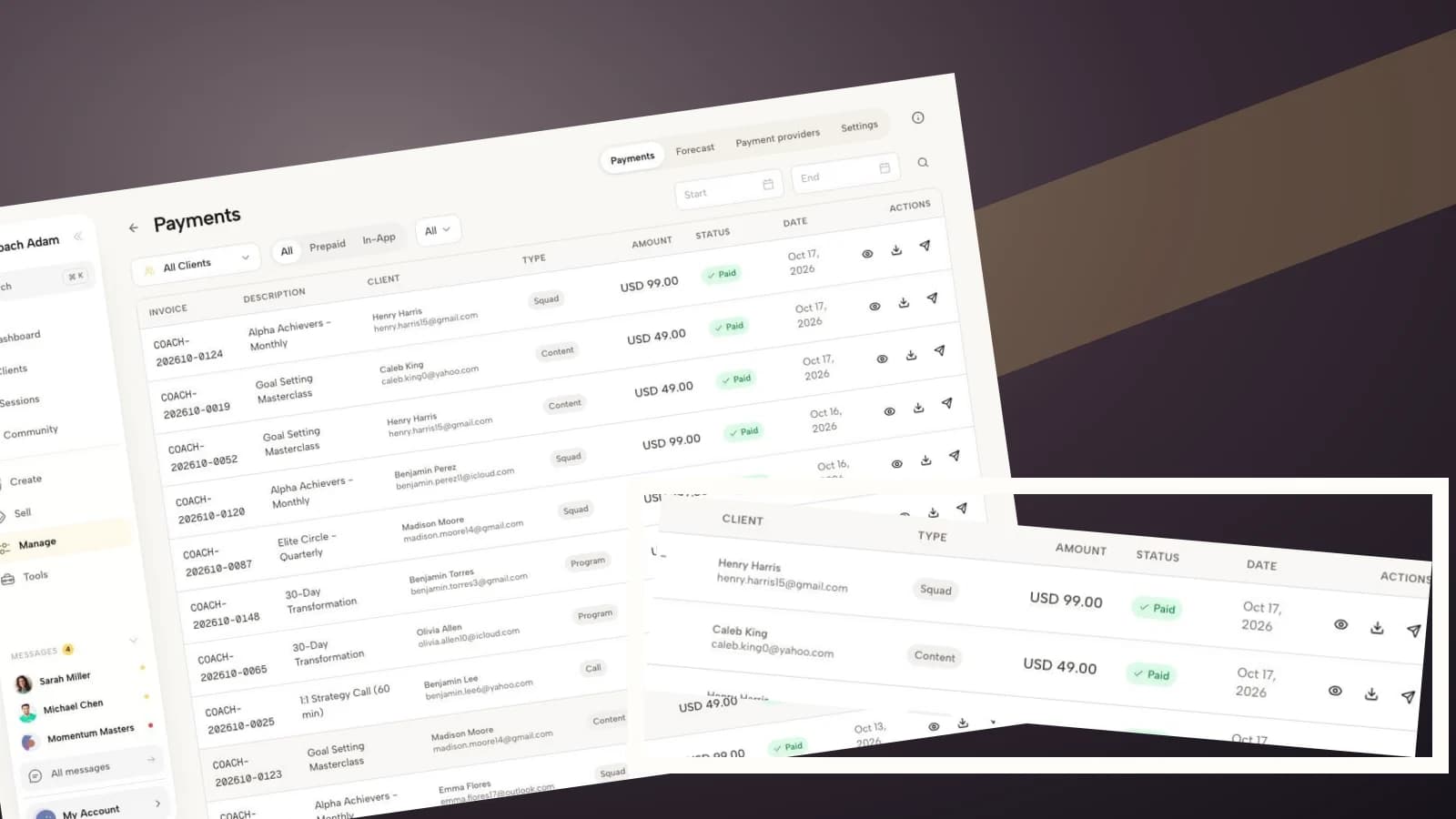
Coachful's demo includes invoice and payment views, illustrated above. If you are evaluating where you will check the record before sending a reminder, try the interactive Coachful demo and inspect those screens. The useful test is whether you can identify the right invoice and payment record, not whether you can send more emails.
Frequently asked questions
How do I politely ask a coaching client for payment?
State the invoice number, verified unpaid amount, due date and payment route. Ask them to send a payment reference if they have already paid, or reply if the invoice is wrong. A calm factual message is more useful than repeated apologies or a lecture about commitment.
How many payment reminder emails should I send?
There is no universal number. Choose a proportionate process based on the agreement, communication history and applicable rules. The five templates here cover different situations; they are not instructions to send all five. A reply that changes the facts should change the next action.
Can I add a late fee or cancel the next session?
Do not assume you can. Check the agreed terms and applicable law before applying a fee, changing access or cancelling delivery. Give any required notice. A reminder email cannot retroactively create a contractual right, and a disputed charge needs assessment rather than automatic escalation.
Should a payment reminder go through my newsletter tool?
Use an appropriate private billing channel and confirm the recipient. Do not add a client to a marketing audience to chase an invoice or send billing details as a broadcast. Any automated billing workflow needs tested recipient, payment-status and dispute handling, not just timed messages.
What if the client pays after I send the reminder?
Reconcile the receipt, update the balance and stop the outstanding reminder process. Send a concise acknowledgement where appropriate. If a receipt already confirms payment, avoid creating unnecessary duplicate messages.
Source and scope
These are original Coachful editorial templates, not messages copied from clients. QuickBooks' overdue-invoice guidance supports the underlying administrative essentials: a clear invoice reference, due date, amount, payment instructions and the correct billing contact. Its UK context is not a universal legal rule. No collection rates, payment improvements or search-volume figures are claimed here.
This page answers what to write about an existing invoice. It is not a billing-software comparison or a guide to redesigning your payment model. For those decisions, see invoicing software for coaches and the separate guide to prepayment and late-payment prevention. Before applying any specific automation described elsewhere, verify it against your current account and billing setup.












