Podcast Advertising for Coaches: 5 Checks Before You Pay

Nour
Founder, Coachful
You have found a podcast your ideal coaching clients might listen to, and the host has offered you a sponsorship. Should you pay for the ad, or are you buying an expensive mention that nobody will act on?
Buy a podcast placement only when you can explain the audience fit, the exact inventory, the maximum affordable acquisition cost and the listener’s next step. A familiar host and impressive download total are not a business case. For a small coaching practice, a bounded test with a defined review date is safer than an open-ended sponsorship commitment.
This guide is for coaches buying advertising on someone else’s show. It is not about selling ads on your own podcast or pitching an unpaid guest interview. The five checks below help you evaluate a real quote, brief the host and decide what evidence would justify another purchase.
1. Check whether the audience contains your buyers
Start with the coaching decision you want a listener to make. A career coach selling interview preparation needs people with a relevant interview ahead, not simply anyone interested in personal development. An executive coach selling employer-funded engagements needs access to buyers or credible internal advocates, not just a large audience of aspiring leaders.
Listen to recent episodes before asking for a rate. Notice whom the host addresses, the situations guests discuss, the countries represented and the kinds of products already advertised. A show’s title can sound relevant while its actual conversations serve a different life stage or budget.
Request the current media kit, then ask for the source and period behind its claims. Useful questions include:
- What are recent downloads per episode, measured over the same period after each release?
- Does the quoted inventory cover audio, video, newsletter distribution or some combination?
- What evidence supports the audience’s geography, professional role or interests?
- Which measurement provider supplies the figures, and which metric will appear on your report?
- How much of the audience can you actually serve, given language, location, scope and appointment times?
Do not compare a lifetime download total with another show’s first-month downloads for one episode. Equally, do not treat a listener survey as a census. Ask when it ran, how people were recruited and how many responded. “We think our listeners are mostly senior managers” is a hypothesis until supported.
The IAB Tech Lab’s podcast measurement guidance explains that podcast measurement relies on server logs and distinguishes downloads, audience and ad delivery. A reported download is not proof that a suitable buyer heard your entire message. Ask the seller to define its denominator rather than translating all numbers into “people reached.”
Pass this check when the evidence supports a plausible buyer match. Decline when the pitch relies on the host’s fame, a broad demographic label or an audience you cannot serve. A smaller relevant show may be worth investigating, but relevance does not guarantee a sale.
2. Calculate what the test must earn back
A podcast quote can use a flat fee, a cost per thousand measured impressions or downloads, or a negotiated package. Compare like with like. An episode read plus newsletter placement is not directly comparable with a dynamically inserted audio spot alone.
For a CPM quote, use: media cost = agreed measured units ÷ 1,000 × CPM. Clarify whether the units are downloads, delivered ad impressions or something else, and whether they are estimated or guaranteed. Ask whether the number applies to each episode, the full package or a campaign delivery total.
Hypothetical example: a $600 package associated with 20,000 agreed measured units implies a $30 CPM. That arithmetic does not establish a fair market rate or an expected coaching return. A low CPM can still buy the wrong audience, and a flat-fee niche placement may have other deliverables worth pricing separately.

Next calculate your acquisition allowance. Begin with realistically collectible package revenue, subtract delivery compensation and variable costs, then reserve the contribution you need for overhead and profit. The remainder is available for acquiring that client. Do not fund the test with a hoped-for lifetime value you have never observed.
In a fictional practice, a package collects $1,200, delivery and variable costs total $550, and the coach requires $200 left for overhead and profit. That leaves $450 per client for acquisition. These are invented planning inputs, not recommended prices or margins.
Suppose the podcast test costs $600 in media, $240 in setup and $360 in valued sales time. Its fully loaded acquisition cost is $1,200. Two paying clients produce a $600 acquisition cost each, which exceeds the $450 allowance. Three produce $400 each, which fits that assumption before any overlooked costs or refunds.

This is a decision threshold, not a forecast that three listeners will buy. Record an affordable cash-loss limit even if nobody responds. If losing the whole test budget would compromise existing clients or essential bills, do not purchase the placement. For the broader margin method, use our paid advertising and coaching acquisition-cost guide.
3. Define the placement, message and commercial boundaries
“A shout-out on the podcast” leaves too much undecided. Get a written order describing the show, number of placements, release dates or delivery period, position, approximate length, format, price and reporting. Specify which extras are included rather than assuming show notes or social promotion come automatically.
A host-read ad is delivered by the host. A produced spot uses supplied audio. A baked-in placement remains part of a particular episode file unless it is changed; dynamic insertion serves ads into available inventory. These characteristics can overlap: a host-read recording can be dynamically inserted. Ask how this specific purchase works.
For dynamic inventory, clarify targeting and the delivery window. For an episode-specific buy, clarify whether the read stays in the archive and for how long. Neither arrangement automatically entitles you to the host’s face, voice or endorsement in your own paid social ads.

Your order should address these practical decisions:
- Approval: Who checks factual claims and pronunciation, and when is the copy deadline?
- Disclosure: How will listeners recognize the paid sponsorship?
- Links: What exact spoken address and clickable show-notes URL will be used?
- Conflicts: Are competing coaching offers running nearby, and is any exclusivity actually agreed?
- Delivery: What proof arrives, on what date, and what happens if the placement is missed or misread?
- Rights: What can each side reuse, for how long and on which channels?
Keep approval focused on truth, scope and the offer. A host’s natural language can be useful, but it must not become a fabricated personal experience. A person who has not been your client should not claim that your coaching changed their career.
The FTC’s disclosure guidance for influencers is a useful US starting point on material relationships, not a universal podcast contract checklist. Review applicable advertising rules for the audience and arrangement. Health, financial and other regulated claims need particular care; coaching is not permission to make clinical promises.
A short, hypothetical host-read brief
“This episode is sponsored by [practice]. If you’re preparing for an internal promotion interview, [coach] offers coaching to help you organize examples and practise your answers. Visit [short address] to see the scope and book a fit conversation. Coaching cannot guarantee a promotion.”
Adapt this to a real, substantiated offer. Give the host the audience situation, what the service includes, what it does not promise, the exact destination and a pronunciation note. Do not pack five different offers into one read. The listener needs to remember one useful next move.
4. Test the listener’s next step before the ad runs
Audio creates a particular response problem: someone may be driving, walking or washing dishes when the invitation arrives. A complicated address and a page full of unrelated buttons make the response harder. Use a short, pronounceable route on a domain you control, and supply the precise clickable version for the show notes.
The destination should continue the ad’s promise. If the read offers interview preparation, send the listener to that offer or its relevant resource, not a homepage that makes them discover your specialty again. Explain who it is for, scope, price or pricing basis, and what happens after the main action.

For a cold audience, a useful resource may be a better invitation than immediately buying a substantial package. For a narrow show whose listeners already recognize the problem, a clearly described fit call can be appropriate. Choose based on the buying decision, not on collecting the largest possible number of email addresses.
If a resource requires an email, explain what the person receives and handle ongoing marketing consent appropriately. Sponsoring a show does not give you the listener list. Do not request private subscriber data from the host or assume a purchase agreement permits unsolicited follow-up.
Walk through the entire path on a phone: type the spoken address, open the show-notes link, read the page, submit a test response, book a real test slot if appropriate and inspect the confirmation. Remove your tests from campaign results. Check redirects, time zones and any change of domain rather than assuming attribution survives.

Also check capacity. An ad can run after your suitable appointment times disappear or a cohort closes. Agree how the destination will behave then: show the next genuine opening, offer an honestly described waitlist, or explain that enrollment is closed. Do not manufacture scarcity to rescue a poorly timed placement.
5. Measure delivery, qualified responses and collected payments separately
First verify that you received what you purchased. Request the published episode link and timestamp, the exact read or air-check, the show-notes destination and the agreed delivery report. A low response does not prove non-delivery, but a missing placement is not a marketing result to optimize.
Use a campaign-specific destination or tagged show-notes link where appropriate. Add a short optional question such as “Where did you first hear about this offer?” Keep the response alongside the inquiry. A listener who later searches your name may never use the campaign link, while a shared link may reach someone who never heard the show.

Your review record can be a spreadsheet. Include placement, release date, media cost, setup cost, sales time, reporting window, reported delivery, identifiable responses, booked calls, attended calls, qualified prospects and cleared first payments. Use one person per prospect record so a reschedule does not become another lead.
Define qualification before seeing the results. For the fictional promotion-interview offer, a qualified prospect has the relevant situation, wants support within scope, understands the fee and can make or obtain the buying decision. “Did not buy” is an outcome, not a qualification rule.

Record signed-but-unpaid agreements separately from collected money. Include refunds and delivery costs when judging affordability. If an employer’s purchasing process takes time, keep those decisions pending instead of comparing this week’s sponsorship bill with unrelated payments from older clients.

Attribution is incomplete evidence, not proof of causation. A special URL can show a response path without proving that the person would never have bought otherwise. Keep a host’s reported conversions, your observed responses and unknown sources separate. Never add overlapping claims together as extra customers.
Decide your review date before buying, allowing for the agreed delivery period and your actual sales cycle. With a small test, one sale can change the apparent result dramatically. Report the counts and limitations, not just a percentage that looks precise.
A concise email to request a podcast advertising quote
Hi [name], I’m considering a bounded sponsorship test for [specific coaching offer] serving [buyer and situation]. Your recent episode on [verified topic] seems relevant. Could you share your current inventory, rates, audience evidence and recent per-episode measurement with its reporting window?
I’d also like to confirm the read format, release or delivery dates, disclosure, show-notes link, approval process and delivery report. I’m evaluating one defined test rather than an ongoing commitment. Thank you, [name].
Send an individual inquiry through the show’s published commercial contact route, subject to applicable contact rules. This is a copyable example, not an instruction to scrape hosts or subscribe them to your newsletter. If the reply pressures you to pay before providing the inventory or evidence, decline.
When to renew, revise or walk away
- Renew cautiously: The placement was delivered, suitable people responded, completed sales fit your acquisition allowance and you have delivery capacity. Purchase another bounded block rather than assuming scale preserves the result.
- Revise: The audience appears relevant but people misunderstand the offer or abandon a broken response path. Fix a specific failure before paying for the same experience again.
- Wait: The agreed sales window is incomplete. Keep pending decisions visible; do not count them as won or lost.
- Walk away: Audience evidence remains weak, delivery cannot be verified, claims become misleading or the loss exceeds your limit.
A professionally delivered campaign can still be a poor investment for your particular practice. You do not owe the host a renewal because they were friendly, and a disappointing result does not justify demanding private listener information.
Your next step
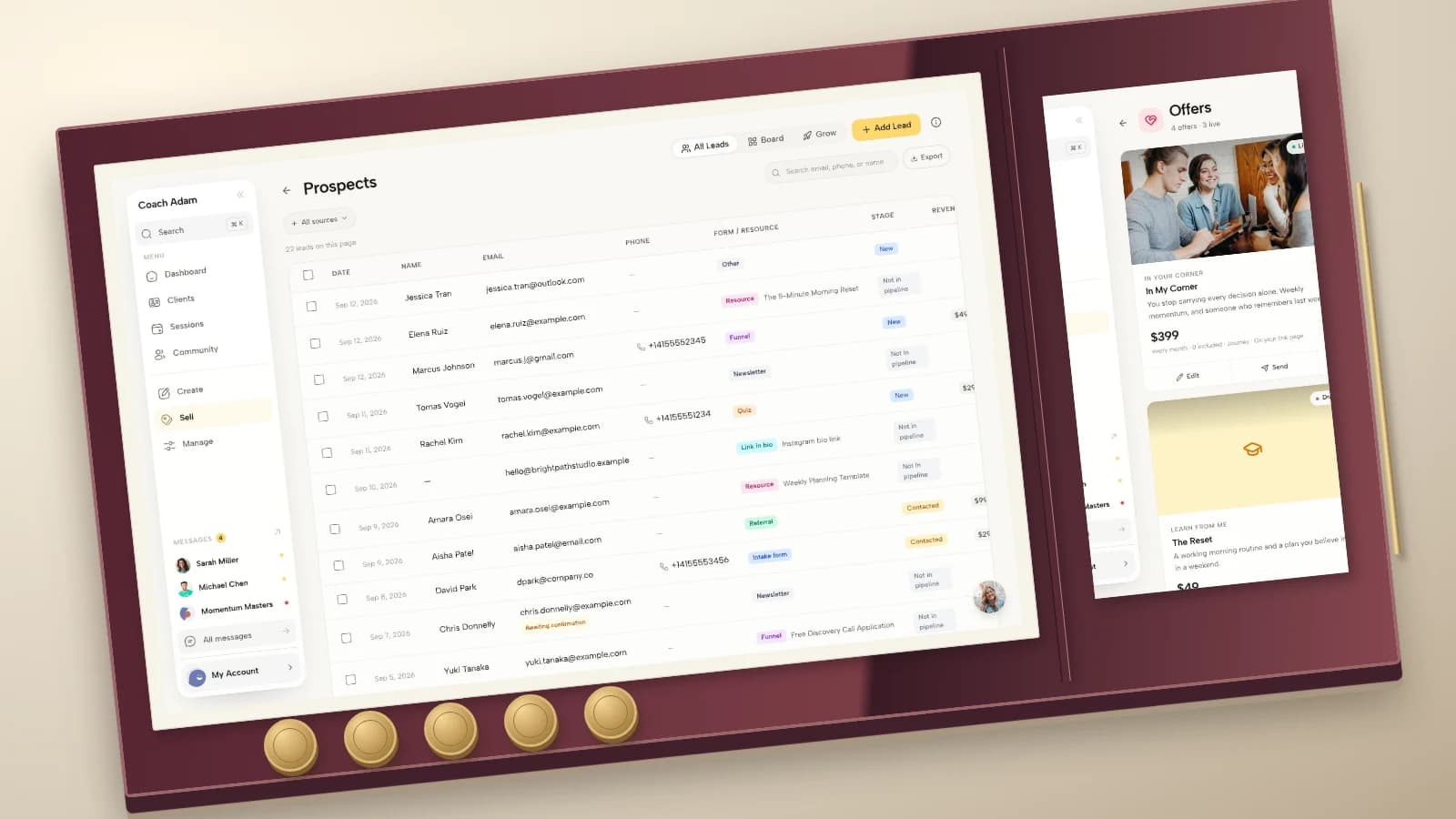
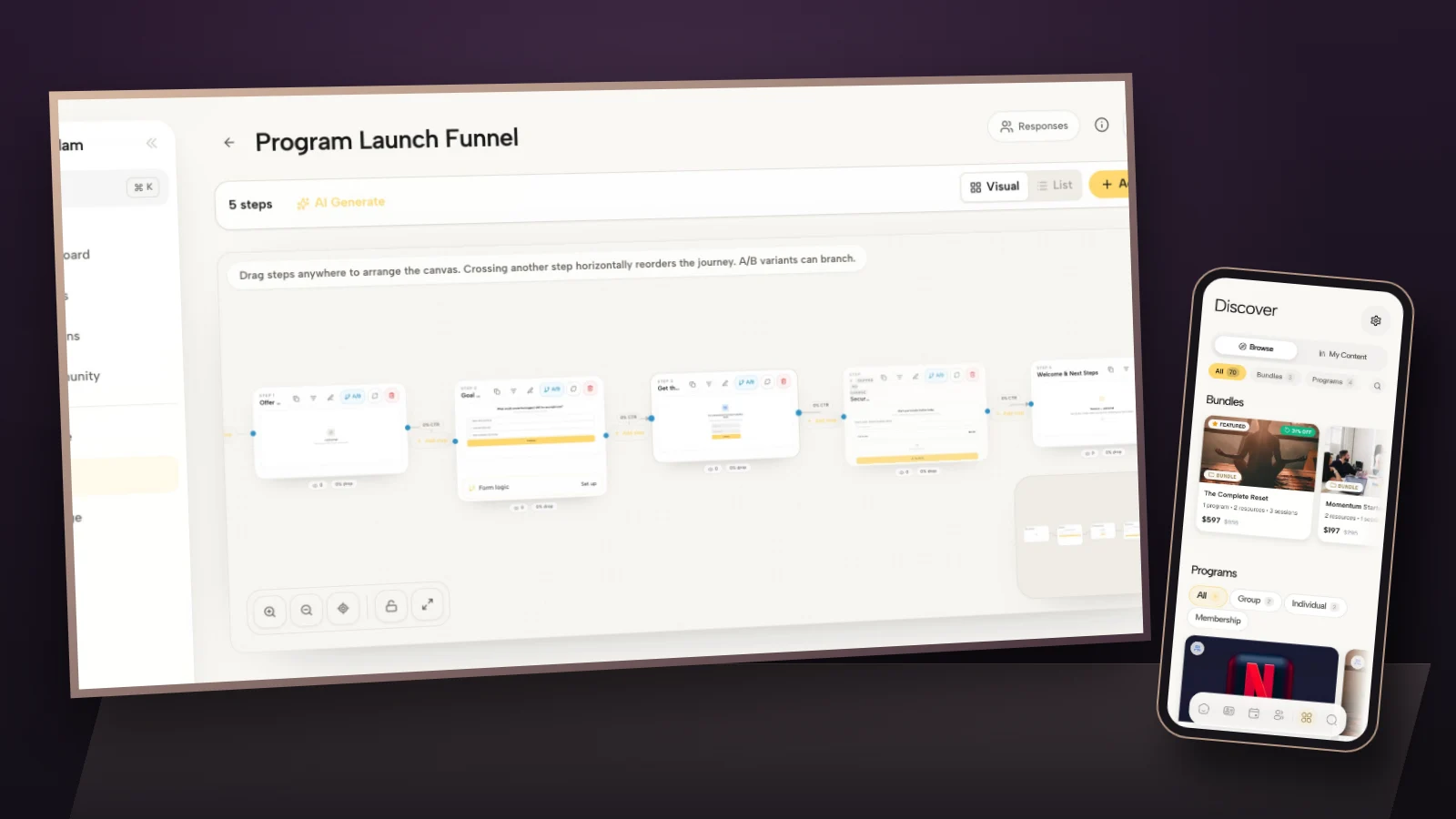
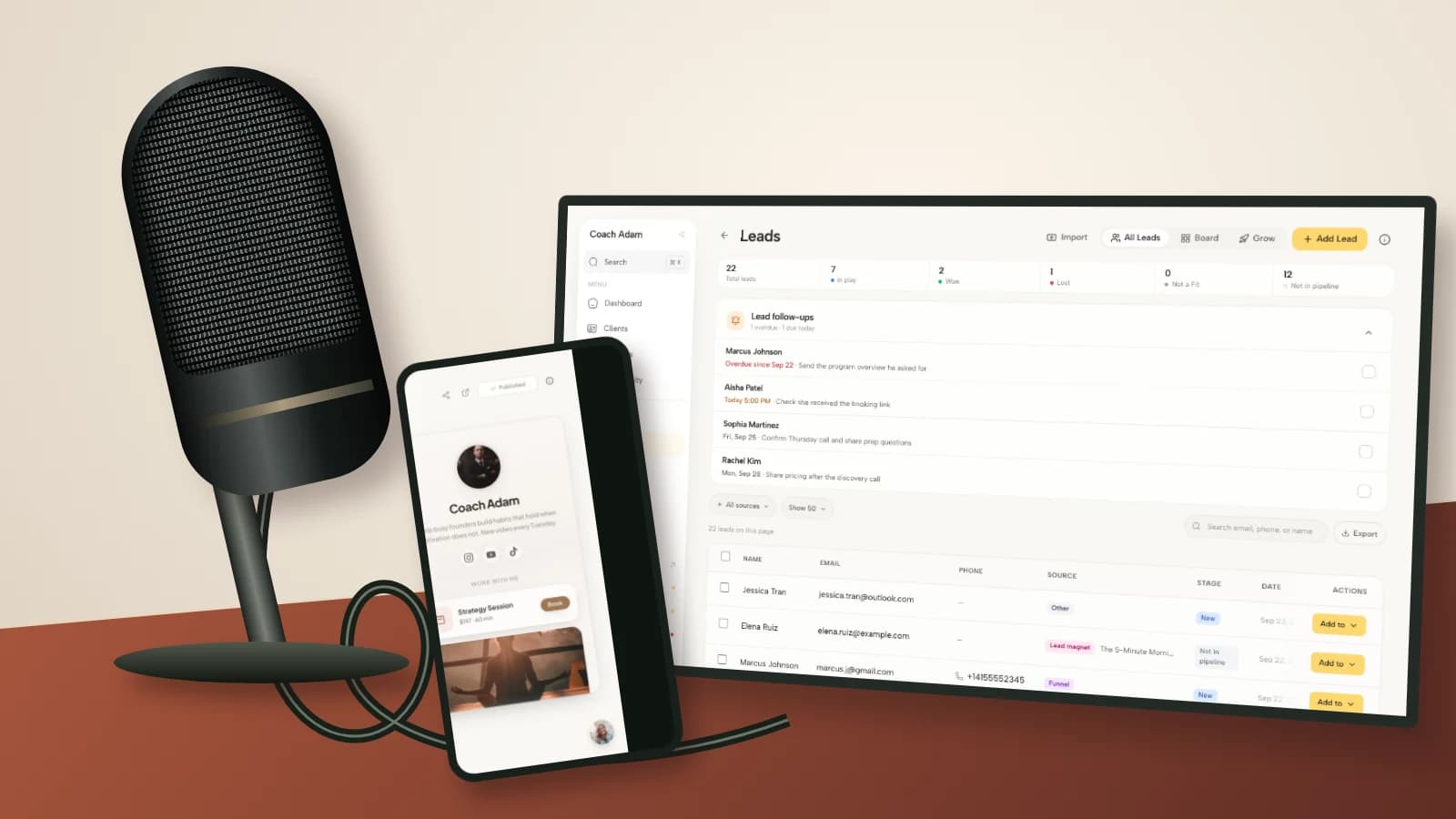
Before asking for another quote, make one response route work from a spoken invitation to an actual inquiry, booking and payment record. That is the part you control. If these handoffs are fragmented in your current setup, try the interactive Coachful demo and inspect the link page, scheduling, leads and payments surfaces shown here.
Coachful can support that response and delivery workflow. It does not choose a suitable show, purchase podcast inventory or establish that a sponsorship caused a sale. Keep the media agreement and campaign-cost record explicit even when the operational tools are connected.
Podcast advertising for coaches: frequently asked questions
How much should a coach spend on a podcast sponsorship?
There is no defensible universal budget. Start with the maximum fully loaded acquisition cost your offer can support and the amount you can afford to lose. Compare the actual inventory and evidence in the quote. The dollar figures above are hypothetical arithmetic, not market rates.
Is a paid podcast appearance the same as sponsorship?
Not necessarily. An interview package can include editorial participation, production and distribution rather than a discrete ad slot. Identify exactly what is purchased, how it is disclosed and what rights apply. For unpaid editorial pitching, use our separate guide to getting booked on podcasts.
Do I need a discount code?
No. A memorable address, campaign link and optional source question can support a test without reducing your fee. A code can be shared beyond the show and is not perfect attribution. If you offer a discount, include its cost and clear eligibility terms in the economics.
What if the sponsorship produces no paying clients?
Report the total spent, verified delivery, stage counts and remaining decisions. With zero paying clients, a finite acquisition cost per customer cannot be calculated. Do not replace customers with downloads or bookings to make the result look better. Revisit audience, message, response path and affordability before another purchase.