Video Sales Letter for Coaches: A 5-Part Script and Example

Nour
Founder, Coachful
How do you explain your coaching offer on video without sounding like an infomercial? Write a video sales letter that helps a suitable prospect make one decision: whether to take the next step. Show the situation you help with, demonstrate your approach, support your claims, explain the actual offer and invite one specific action.
A coaching VSL should make the offer easier to judge, not make the viewer harder to say no. You do not need a dramatic origin story, a countdown or a promise that your method works for everyone. You need an explanation you would be comfortable giving to the same person face to face.
This guide gives coaches a five-part structure, an adaptable script, recording choices and a practical review method. The examples are hypothetical. They are not testimonials, tested conversion claims or offers currently sold by Coachful.
What is a video sales letter for coaches?
A video sales letter, often shortened to VSL, is a prerecorded explanation of one offer, designed to help a viewer decide on a specific next action. That action might be reading the package details, completing an application or booking a fit conversation. For an appropriate standalone resource, it could be purchasing directly.
It is not a discovery call. You cannot listen, clarify or assess someone individually while a recording plays. It is also not a webinar that promises substantial teaching before an invitation. Tell viewers what they are watching rather than disguising a sales explanation as a free training.
A VSL is optional. If your written page answers the questions well and prospects understand the service, a recording may add little. Use video when hearing your explanation or seeing a short demonstration would resolve a real uncertainty. Do not add another production project simply because another coach has one.
Before scripting, choose one viewer, one offer and one action
Write these three lines first: “This is for [specific person in a specific situation]. The service helps them work on [bounded decision or capability]. After watching, the appropriate next step is [one action].” If those lines remain vague, the camera will not fix the offer.

For example, a career coach could address experienced professionals comparing a move into management with staying in a specialist role. The offer might be a defined decision-coaching package. The video should explain that engagement, not try to serve every person who dislikes their job.
Collect the questions people ask before engaging: what happens in sessions, what preparation involves, what the fee covers, what is excluded and whether this is suitable for their situation. Use those questions to decide what belongs in the recording. Remove identifying client details from your working notes.
The five-part coaching VSL script
Use these parts as an editing sequence, not a rigid minute-by-minute formula. There is no universal best length established here. A short explanation of a simple service and a detailed explanation of a complex engagement have different jobs. Keep the shortest version that still enables an informed decision.

1. Recognise the situation without inventing the pain
Start where the prospect is making a decision. “If you are choosing between a management role and staying on a specialist path, this explains how my coaching package helps you examine the options” is more useful than “Are you tired of living below your potential?”
The first version identifies a person and a practical question. The second assigns an emotional story to a stranger. Avoid telling viewers that they secretly lack confidence, are sabotaging themselves or will regret not buying. Recognition is not permission to diagnose.
Then name the boundaries. If your service is coaching rather than recruitment, therapy, financial advice or a clinical intervention, do not leave that distinction until the final seconds. An unsuitable viewer should be able to recognise the mismatch early.
2. Show how you work on the problem
Explain your process through a small example. A career coach might compare two hypothetical options against criteria such as responsibility, learning and working conditions. Show how a question changes the decision, rather than displaying a mysterious branded framework and asking for faith.
You do not need to reveal confidential material or perform an entire session. Use a blank worksheet, a fictional scenario or your own demonstration. Label it clearly. Do not present a staged exchange as an actual client session, and do not imply that an illustrative worksheet establishes effectiveness.
Keep the explanation understandable without your terminology. “We identify the criteria, examine the options and choose what to test next” says more than “We unlock your leadership identity through an integrated transformation pathway.”
3. Support the claims you actually make
Use relevant qualifications accurately, explain your experience without inflating it and include client material only with appropriate permission and context. A genuine testimonial still needs careful treatment: it describes one person's experience, not what every purchaser should expect.
If you do not have publishable testimonials, demonstrate the process instead. Show what a preparation exercise asks or how you help a client distinguish assumptions from information they still need. That demonstrates the nature of the work without inventing social proof.
Avoid generic assurances such as “proven to change your life.” Ask what evidence would substantiate the exact sentence you are about to say. If you do not have it, narrow the statement. A commitment to provide agreed sessions is different from a guarantee of a promotion, relationship outcome or income.
4. Define the offer in ordinary language
State the format, duration, session commitment, preparation, access period and support boundaries. Explain what the client does as well as what you provide. If the engagement requires weekly preparation, saying so helps a viewer assess whether they can participate.
Make price information consistent with the destination page. If the service has a fixed fee, present it plainly. If you quote after scoping, explain what determines the scope and what the next conversation covers. Do not imply a low entry price when a substantially larger commitment is required.

Do not make the video the only place to find exclusions, payment terms or cancellation information. Important details should remain readable on the page, including for people who cannot play audio or prefer to scan before watching. See the separate coaching sales page guide for the written page structure.
5. Invite one appropriate next action
Make the invitation specific: “Read the package scope below, then book a fit conversation if the engagement matches what you need.” Explain the purpose of that conversation and whether it includes discussing a paid service. Do not call it a free coaching session if its main purpose is assessment and sales.
A genuine deadline can be useful information, such as the closing date for a fixed cohort. An evergreen recording should not announce “only until tonight” unless the statement is true for the viewer. Watch for stale dates and capacity statements when you reuse a video.

Decide whether the next step should be an application, a booking or a purchase. An application makes sense when you genuinely need information before inviting someone to talk. A purchase makes sense only when the buyer can understand and appropriately choose the service without an individual suitability discussion.
A complete coaching VSL example to adapt
The following is an original, hypothetical career-coaching example. Replace the audience, process, package details and next action with your actual arrangement. It is not a recommended universal offer or a claim about the results coaching will produce.

“If you are deciding between moving into management and continuing as a specialist, this is a short explanation of how my decision-coaching package works.
You may have two plausible options and no obvious answer. We will not assume that management is progress or that staying technical means playing small. We start with what matters to you and what you need to learn before deciding.
For example, imagine that one option offers more influence but less time doing the work you enjoy. We would separate what you know from what you are guessing, identify the criteria that matter and decide which questions to ask before accepting a role.
That is an illustration of the process, not a client result. Coaching does not guarantee a promotion, a job offer or the right answer to every career question. My role is to help you examine the decision and choose actions you are willing to take.
The package includes [number and duration of sessions], delivered over [period], with [specific preparation and between-session support]. It does not include recruitment, a job search service or unlimited access to me. The current fee, payment terms and cancellation details are written below this video.
This may suit you if you want structured space to examine the options and can participate in the preparation. It is not the right service if you are looking for someone to choose your career for you or secure a role on your behalf.
If that matches the decision you are facing, read the package scope below. You can then book [the actual conversation type and duration]. We will discuss what you need, whether this service fits and any questions about working together. A booking is not a commitment to buy.”
Notice what the script leaves out: invented clients, inflated credentials, a guaranteed outcome and pressure to prove commitment by purchasing. Add your relevant verified background naturally, but do not turn the opening into a biography.
Record it so the explanation survives the production
A face-to-camera recording can help viewers hear your manner and pace. A screen demonstration can make a process easier to understand. Combine them only where the change of view helps explain something. Expensive production is not evidence that the service is appropriate.
Read the draft aloud before recording. Replace phrases you would never use in a real conversation. Cut repeated claims, long lists of package components and introductions that delay the answer. Leave pauses where someone needs time to understand the choice.
Use clear audio, a stable frame and lighting that makes your face or demonstration visible. Keep personal notifications, client names and private account information out of screen recordings. Check the final export, not just the source footage.
Provide accurate captions and a useful text alternative. The W3C caption guidance explains that captions include speech and relevant non-speech audio. Review automated captions for names, prices and specialist terms instead of assuming that automatic transcription is correct.
Build the handoff before you ask anyone to watch
A polished explanation followed by a confusing button wastes the viewer's effort. Keep the name of the service, the scope and the invitation consistent across the recording, page and next screen. Do not promise a short fit conversation and send someone to a long payment commitment.

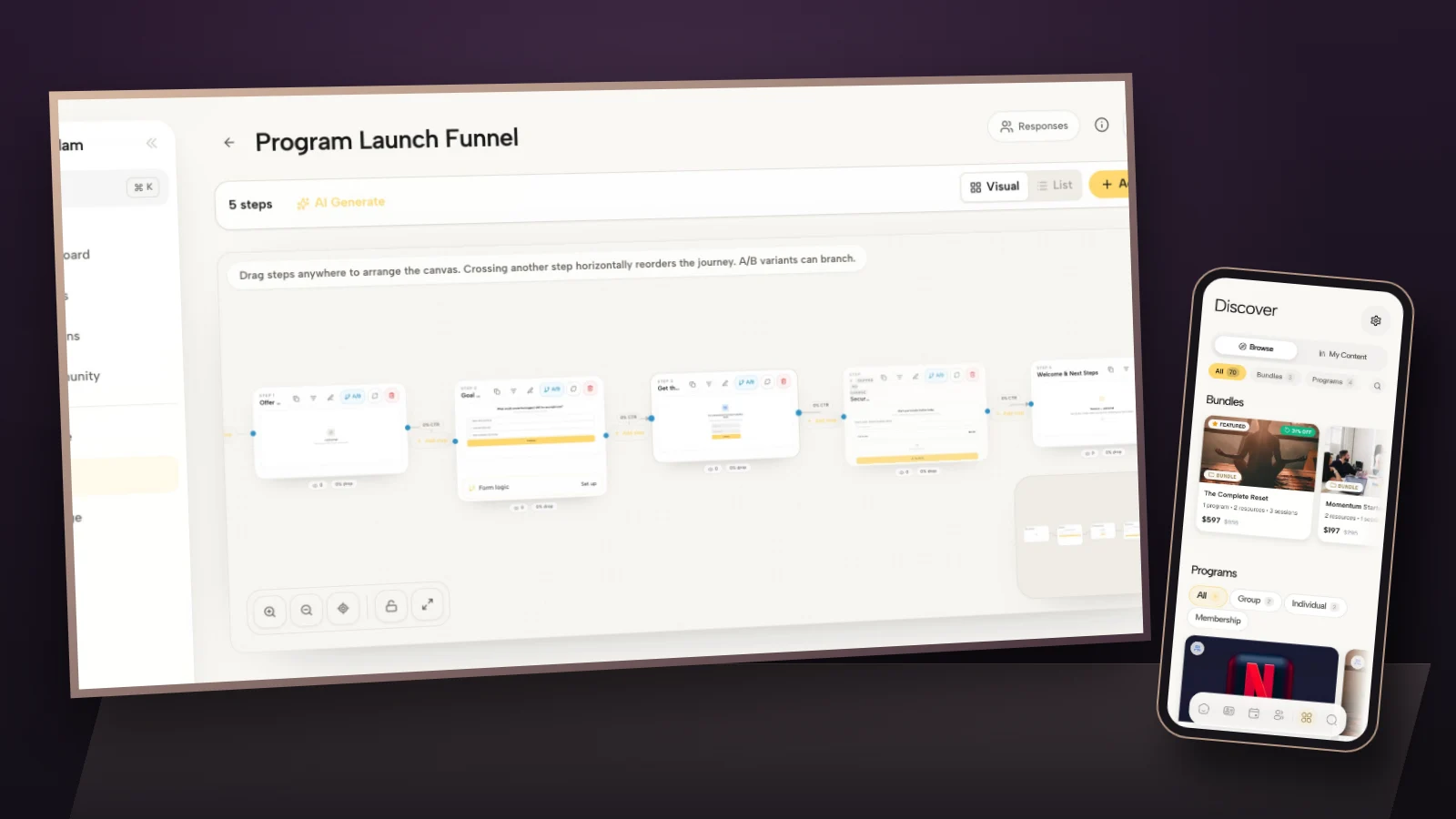
Coachful's public funnel overview describes video sales letter page types, a visual canvas and booking, application and checkout steps. Those are relevant building blocks for the handoff. The demo screenshots here illustrate actual surfaces, not a completed VSL campaign, hosting guarantee or evidence of video engagement tracking.
Check the page on a phone. Can someone read the offer, use the player controls, find captions and reach the next action without hunting? Keep the important details and action outside the video. Do not force sound, hide the button until a timer finishes or require an email address merely to reveal the basic scope.

Also test the awkward cases: the recording cannot load, the person uses assistive technology, the form fails, or the next available appointment is much later than the video suggests. Use authorized test methods. You do not need to make a live charge or collect real client information to inspect the basic journey.
Review the decision, not just the play count
Use the tracking you actually have. Separate page visits, video starts, completed views, action clicks, suitable inquiries and paid engagements. These are different events. A play count does not tell you whether the recording answered the right question, and a booking does not establish that the service suits the person.

For a hypothetical review period, imagine 200 page visits, 80 video starts, 20 action clicks and five suitable inquiries. That is 40% starts per page visit, 10% clicks per page visit and 2.5% suitable inquiries per page visit. These calculations describe the example only. They do not establish who watched before clicking, why someone acted or what another coach should expect.
If starts are low, examine placement, the stated purpose and loading. If people click but abandon the next screen, check consistency and friction there. If inquiries are unsuitable, tighten the audience and exclusions. These are diagnostic possibilities, not proof of a cause. Ask a few intended viewers what they understood before commissioning another polished edit.
Where analytics or player tools collect personal data, review appropriate permissions, disclosures and applicable privacy rules. Do not infer sensitive client circumstances from viewing behavior or chase someone with “I saw you watched twice.” Ordinary respectful follow-up remains ordinary respectful follow-up.
Frequently asked questions
How long should a coaching VSL be?
Long enough to explain the decision, approach, scope and next step without unnecessary repetition. This guide does not claim a universal winning duration. Record a concise first version, listen for unanswered questions and remove anything that does not help the viewer judge the offer.
Can I create a VSL without testimonials?
Yes. Use an honest demonstration, relevant verified experience and explicit scope. Label examples as hypothetical. Do not invent a client, borrow another coach's result or imply that a staged demonstration is independent evidence.
Should a VSL sell the package or book a call?
Match the action to the offer and the suitability assessment required. A clearly scoped standalone resource may support direct purchase. A substantial personal coaching engagement may need a fit conversation. The recording should explain the actual next step rather than conceal it.
Is this the same as a coaching sales script?
No. A VSL is a prerecorded one-way explanation. A discovery-call sales script structures a live conversation that should adapt to the person. Do not use a recording as a substitute for listening when individual assessment is needed.
Your next step
Write the three-line brief, adapt the five-part script and rehearse the route from explanation to action before buying production. If you cannot explain the engagement plainly in a rough recording, better lighting will not solve the problem.
Once that explanation is clear, Try the interactive Coachful demo to inspect the funnel and offer workspaces shown here. Use fictional details to evaluate where the written scope and next action belong. The useful test is whether a suitable prospect can understand the commitment, not whether you can add another persuasive screen.
Sources and limits: Direct search results, including Blue Digix's coaching VSL guide, establish the recognizable scriptwriting question. Their conversion assertions and preferred runtime are not adopted as benchmarks here. Product references are limited to the public Coachful funnel overview and real demo surfaces. Caption guidance comes from W3C. The framework, script, diagrams and numerical example are original editorial illustrations, not research findings or measured outcomes.