How to Find Webinar Partners as a Coach: 5 Practical Steps

Nour
Founder, Coachful
How do you find a webinar partner who can introduce you to potential coaching clients, rather than give you another unpaid presentation? Look for someone who already serves your specific buyer, can name a useful problem you could solve together and will agree to a concrete promotional contribution. Pitch one small educational event, not an open-ended collaboration.
A large following is not the selection rule. A career coach could get more relevant conversations from a small professional association than from a much larger general-interest account. That is a judgment about audience fit, not a promise that small audiences convert better.
This guide gives coaches five practical steps for finding, approaching and testing a webinar partner. It focuses on the commercial partnership: who to approach, what to offer and whether to repeat it. For the event pages and reminders themselves, use our webinar funnel guide.
What is a webinar partnership for a coaching business?
A webinar partnership is an agreement between businesses or organizations to create and promote a useful online session for a shared audience. One partner might provide the teaching while the other contributes distribution, audience insight or moderation. Both should know what they are contributing and what benefit they are seeking.
It differs from paying a guest speaker to appear inside your program. It also differs from buying a mailing list, receiving a casual referral or getting a technical co-host role in a meeting application. A partnership needs an audience proposition and agreed work, not merely two people on camera.
The audience should leave with something worth attending for even if nobody purchases coaching. Do not hold back the practical answer just to manufacture a sales call. Your paid service can offer application, individual attention or sustained support without making the free teaching deliberately incomplete.
1. Build a shortlist around one buyer problem
Write down the buyer before the partner. “People who want to grow” gives you almost no way to judge an opportunity. “New managers in small technology companies who are struggling to delegate” gives you a useful starting point.
Then identify where that person already goes for professional help, trusted information or community. Start with five possible routes:
- Professional associations. Look for local chapters or specialist member groups whose education calendar serves your buyer. Ask how educational sessions are selected before offering one.
- Complementary service providers. A career coach might approach a specialist recruiter; a business coach might approach a bookkeeper serving the same business type. Check for commercial conflicts and keep professional advice within each person's competence.
- Membership communities. A community organizer may know exactly which question members keep asking. Offer a session that answers it, not a generic motivational keynote.
- Independent educators and newsletter publishers. Look for sustained coverage of your buyer's problem, not just a subscriber total. Ask about relevant engagement without requesting private subscriber information.
- Organizations with an existing learning program. Coworking communities, alumni groups and small-business support organizations may have a suitable format. Confirm whether they permit a commercial invitation or require education only.
Find evidence in public event calendars, newsletter archives, member benefits and recent discussion topics. Record the audience, recurring problem, decision-maker and reason your contribution belongs. Five well-researched candidates are more useful than a spreadsheet of a hundred vaguely related accounts.

A useful shortlist entry reads: “This association runs monthly learning sessions for first-time managers. Recent topics include workload and difficult conversations. I can teach a delegation exercise that complements those sessions.” It does not read: “They have lots of followers.”
Check the organization's boundaries before contacting it. Some communities prohibit selling, some reserve events for paid sponsors and some will not share member information. Respect those conditions. An education-only opportunity may still be worthwhile, but evaluate it on that basis rather than assuming you can add a pitch later.
2. Qualify the partner before proposing a date
Use a simple fit conversation to test the opportunity. You are checking whether there is a genuine shared project, not auditioning to be liked. Ask what the audience needs, what the partner can contribute and what would make the event worth repeating.
- Audience fit: Who specifically would receive the invitation, and why would the topic matter to them?
- Problem evidence: What question, obstacle or member request prompted this opportunity?
- Contribution: Who will create the session, promote it, manage registration and answer attendee questions?
- Commercial fit: Is a relevant coaching invitation allowed? Are there sponsorship fees, commissions or competing offers?
- Operating fit: Can both sides meet a realistic preparation schedule and protect attendee information?
Do not demand access to their contact list to prove audience quality. An anonymized description of the relevant segment, previous event topics and the proposed invitation route may be enough to judge a first pilot. If you cannot establish who the event is for, stop before building slides.

Watch for mismatched expectations. “We would love content for our community” may mean a paid teaching commission, an unpaid guest appearance or a genuine co-marketing project. None is inherently wrong. They are different arrangements with different economics.
Decline when the partner cannot explain the audience, wants unrestricted access to your clients or expects you to carry preparation, promotion and support while they promise only “exposure.” You can say: “I don't think this is the right partnership format for us. If you want a commissioned workshop, I can scope that separately.”
3. Send a pitch that makes the contribution obvious
Your first message should connect a real observation to a specific class. Avoid “I'd love to collaborate” followed by a request for a meeting. That gives the recipient another piece of work: inventing the collaboration for you.
Use a subject such as “A practical delegation class for your new managers?” Then adapt the following hypothetical email. Only mention a discussion, article or community need you actually reviewed.

Hi [name],
I read your [specific article or public discussion] about [specific audience problem]. The question about [accurate detail] stood out.
I coach [specific audience] on [relevant work]. Would a practical online class on [one concrete decision or skill] be useful for your community?
I could bring a short teaching segment, a worked example and a private exercise. If it fits, we could agree on the invitation, registration and follow-up responsibilities before choosing a date.
My aim would be a useful first event, with an optional, clearly explained next step for people who want more help. No exchanged mailing lists or assumed promotional commitments.
Would a short conversation about audience fit be useful? If someone else owns your learning calendar, I'd appreciate being pointed in the right direction.
[Your name]
Make the proposed benefit credible. A relevant teaching sample, a clear outline or an accurate professional biography is better than an invented claim about how many clients a partner will gain. If you have permission to share genuine past feedback, keep its context intact.
Send through an appropriate professional route and follow the rules that apply to your outreach. A brief follow-up can add the proposed learning outcome or answer a likely concern. Do not move an unresponsive person into an automated sequence just because the software can send one.
4. Agree on a small pilot with named responsibilities
Once there is interest, write a one-page pilot brief before producing the whole event. This is an operating document, not a substitute for an appropriate agreement. Keep the first experiment small enough that a disappointing result does not consume a month of your practice.
Record the audience, learning outcome, format, date, time zone, named owners and next step. Agree on the exact promotional contribution each side is willing to make. “One invitation to the relevant member segment and one reminder” is inspectable; “we'll both promote it” is not.

Separate the work into clear commitments:
- You supply: the agreed teaching, materials, preparation and commercial invitation, if allowed.
- Your partner supplies: the agreed audience insight, introductions, promotion or moderation.
- One named owner supplies: the registration destination, attendee support and factual event updates.
- Both approve: the public description, permitted promotion, recording use and follow-up arrangement.
Agree costs before anyone incurs them. A flat fee, shared expenses and a referral commission are different arrangements. If commission is involved, define qualifying purchases, refunds, attribution limits, reporting and settlement. Obtain suitable legal and accounting advice rather than treating an informal percentage as a complete agreement.
For speaker appearance and recording decisions, use our webinar speaker agreement discussion template. Here, the partnership question is whether the exchange of work, access and commercial opportunity is fair enough to test.
Do not make “lead sharing” an unexamined benefit
Attending a shared class does not automatically authorize unrelated marketing from both businesses. Explain who operates registration, what information is collected, who receives it and what messages will follow. Match the process to the privacy and direct-marketing rules that apply to your audience.
The UK's ICO data-sharing code is a useful reference for organizations working under UK rules. The ICO notes that this guidance is under review. It is not a universal permission slip or a replacement for advice on your specific arrangement.

A straightforward pilot might have one event organizer send the promised event messages, while each partner offers a separate, clearly described optional resource signup. That is a possible design, not a legal conclusion. Check the wording, controls and actual behavior before inviting anyone.
Keep private coaching material out of the partnership process. You can explain common audience problems without supplying client notes, identifiable stories or screenshots of private conversations. A useful class does not need proof that compromises someone's confidentiality.
5. Review the pilot as a business decision, not a popularity contest
Before launch, decide what you are trying to learn. You might be testing audience relevance, the partner's ability to make the agreed contribution or whether the topic produces suitable inquiries. Pick observable questions rather than promising a fixed number of new clients.
Track the event chain separately: registrations, actual attendance, relevant next-step requests, qualified coaching inquiries and paid starts. Where reliable source information is available, retain it. Where it is not, say so rather than assigning every later client to the event.

In that hypothetical example, 24 of 40 registrants attended, four people made qualified inquiries and one began paid coaching. Those are different events, not interchangeable evidence of success. A qualified inquiry should meet criteria you defined before reviewing the numbers, such as audience fit and a need within your scope.
Record your own preparation, coordination, delivery and follow-up time. Ask the partner what work they actually completed and what they learned from their audience. An event can attract attention and still be an unattractive use of a coach's available hours.

Use three possible decisions: repeat, revise or stop. Repeat when the audience fit and contributions were credible and the economics justify another test. Revise when the audience was right but a fixable part failed. Stop when the audience was wrong, boundaries were ignored or the partner did not fulfill agreed commitments.
Do not quietly turn a single successful pilot into a monthly obligation. Confirm the next scope, date and work allocation. A partnership earns a repeat through evidence and a fresh agreement, not through the awkwardness of saying no.
A worked example: a career coach and a professional community
Imagine a career coach who helps experienced engineers prepare for management interviews. A small engineering community regularly hears questions about moving into leadership. This is a hypothetical example, not a Coachful customer story.
The coach proposes a session on choosing two relevant leadership examples for an interview. The community contributes audience insight and an agreed invitation to interested members. The coach provides the exercise, a fictional worked example and a short optional invitation to an appropriate consultation.
They use one registration destination, explain event messages clearly and do not exchange their existing mailing lists. Questions stay general; participants are not asked to disclose employer-confidential material. The partners agree the replay arrangement and review date before promotion.

After the event, the coach reviews appropriate inquiries and the hours spent. The community reviews whether the class served members. They compare those observations before discussing another event. The purpose is to discover whether this particular partnership works, not prove that webinars always work.
Frequently asked questions
Should webinar partners have the same audience size?
No. Equal audience size is not the same as a fair contribution. One side may bring specialized teaching while the other brings trusted distribution. Make the exchange explicit, especially if there is a fee, sponsorship or commission.
Where should a new coach find their first webinar partner?
Start with a credible community or professional contact whose audience problem you understand. A small relevant pilot with a clear teaching contribution is easier to evaluate than a cold request to a large publisher. Do not invent experience or audience numbers to make the pitch stronger.
Can both partners email all registrants afterward?
Not simply because they co-hosted the event. Establish a transparent, appropriate arrangement under the rules that apply, and check it before collecting information. Event logistics and ongoing promotional email are distinct purposes.
Does a co-host setting in webinar software create a partnership?
No. A technical permission controls what someone can do in the application. It does not settle promotion, payments, recording rights, data handling or the commercial relationship. Test the real permissions separately from your partnership agreement.
Your next step
Choose one buyer problem and identify five organizations that already serve that buyer. Write one accurate reason each could be a fit. Approach the strongest candidate with a specific class, your contribution and a small next conversation.
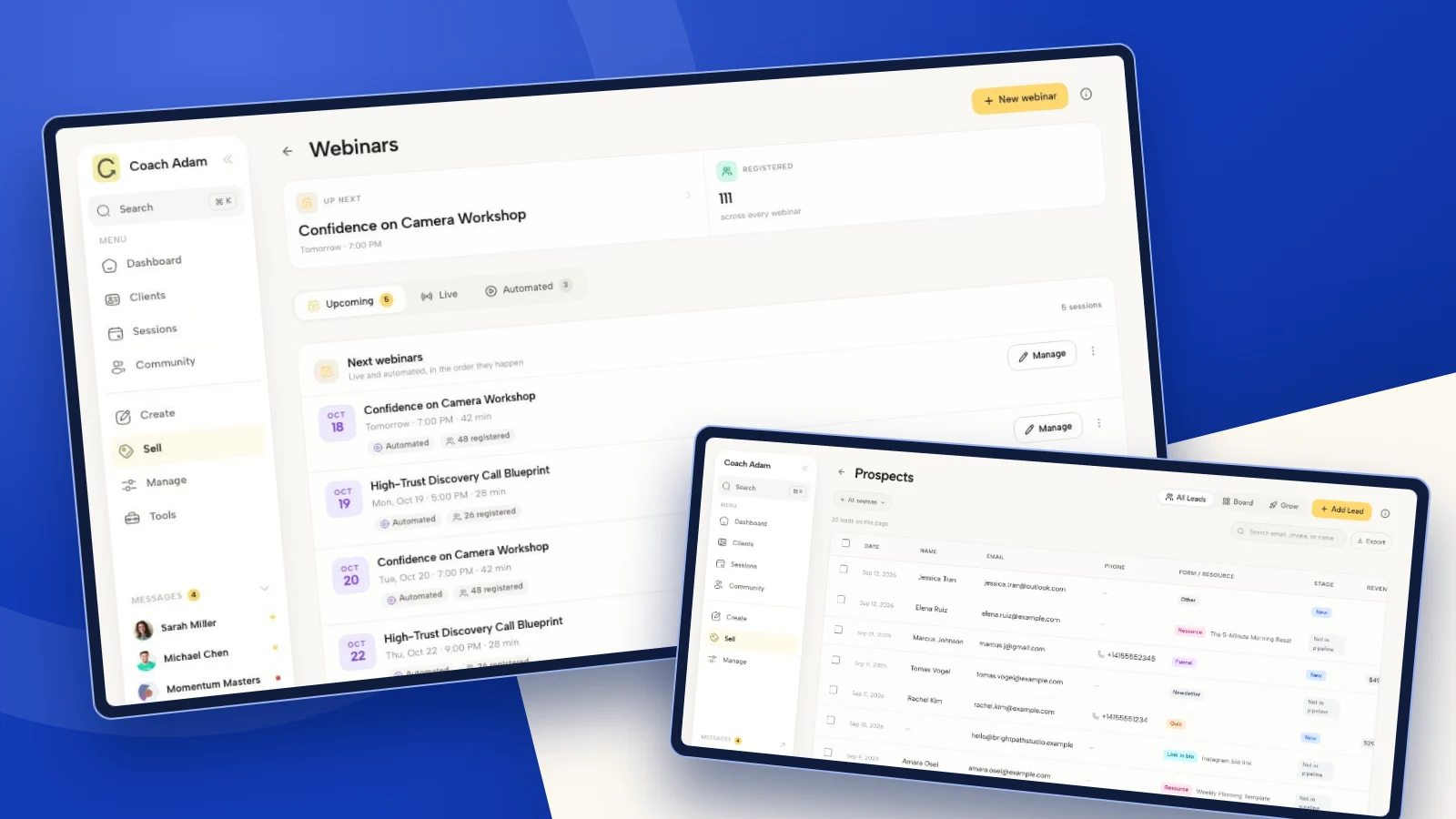
Once there is genuine interest, check the event-to-inquiry journey before promising it. Try the interactive Coachful demo to inspect the webinar, form, email and scheduling surfaces shown here. Use your pilot brief as the test: the software should support the responsibilities you agreed, not invent the partnership for you.