Unlock Growth: Sales Funnel Template for Coaches

Coachful
You’re probably doing the hard part well.
Your clients get breakthroughs. They stay longer than expected. They refer friends. But your pipeline still feels uneven. One month you’re juggling calls, follow-ups, and onboarding. The next month you’re wondering why so many “interested” people went quiet.
That usually is not a coaching problem. It is a funnel design problem.
Most sales funnel template advice was built for software, e-commerce, or high-volume lead gen. Coaching is different. You are not selling a gadget or a free trial. You are asking someone to trust you with a personal or professional transformation. That trust has to be earned before the sale, reinforced during onboarding, and deepened after the first engagement.
A good coaching funnel does not feel pushy. It feels clarifying. It helps the right people move forward and helps the wrong people opt out early.
Why Your Coaching Practice Needs a Different Kind of Sales Funnel
Generic funnel advice breaks down fast in coaching.
You read that you need a lead magnet, a landing page, a few emails, and a sales call. Technically, that is not wrong. Practically, it often falls flat because those assets are usually built for transactional buying behavior. Coaching buyers do not move like that. They hesitate, compare, question fit, and often need to feel understood before they ask about price.
That mismatch is why many coaches say things like:
- “I hate selling.” What they usually hate is pressure without connection.
- “My audience engages but doesn’t book.” Interest is there, trust is not fully formed.
- “Consult calls feel random.” The funnel is attracting curiosity, not commitment.
- “I get referrals, but cold leads rarely convert.” Referrals borrow trust. Your funnel has to build it from scratch.
A standard sales funnel template rarely addresses those barriers. Generic content often skips over discovery calls, trial sessions, and long nurturing windows, even though coaches depend on those moments to convert trust-based relationships. One review of the template market notes that nurtured leads make 47% larger purchases, yet generic templates still do a poor job showing coaches how to structure those conversion moments around trust and relationship building (future-code.dev on sales funnel templates and coach-specific gaps).
What coaches are selling
You are selling three things at once:
A result Better leadership, more energy, stronger boundaries, business growth, emotional clarity.
A relationship The client wants to know whether you “get” them.
A process They need confidence that your method can carry them from where they are to where they want to be.
That is why I prefer thinking in terms of a Trust Funnel rather than a pure transaction funnel.
Practical shift: Stop asking, “How do I get more people to book?” Start asking, “What does a qualified prospect need to believe at each step before booking feels safe and obvious?”
What does not work
A few patterns consistently fail coaches:
- Aggressive CTAs too early “Book now” before value has been demonstrated.
- Lead magnets that attract everyone Broad freebies create busy inboxes and weak consult calls.
- Discovery calls used as education sessions If the funnel does not pre-educate, the call turns into unpaid teaching.
- No post-purchase path Coaching clients do not disappear after payment. They move into onboarding, delivery, renewal, referral, and sometimes upsell.
A coaching sales funnel template has to support that full relationship. If it does, selling feels cleaner, lighter, and far more consistent.
Mapping Your Client's Journey from Stranger to Raving Fan
The easiest way to fix a weak funnel is to stop staring at stages from your side and start looking from the client’s side.
The classic structure still matters. The AIDA model was introduced in 1898, and modern funnels still show an average drop-off of 50-70% from awareness to consideration, which is why nurturing between stages matters so much (Databox on sales funnel dashboards and history).
For coaching, I map the journey in five stages. The labels are simple. The thinking behind them is not.
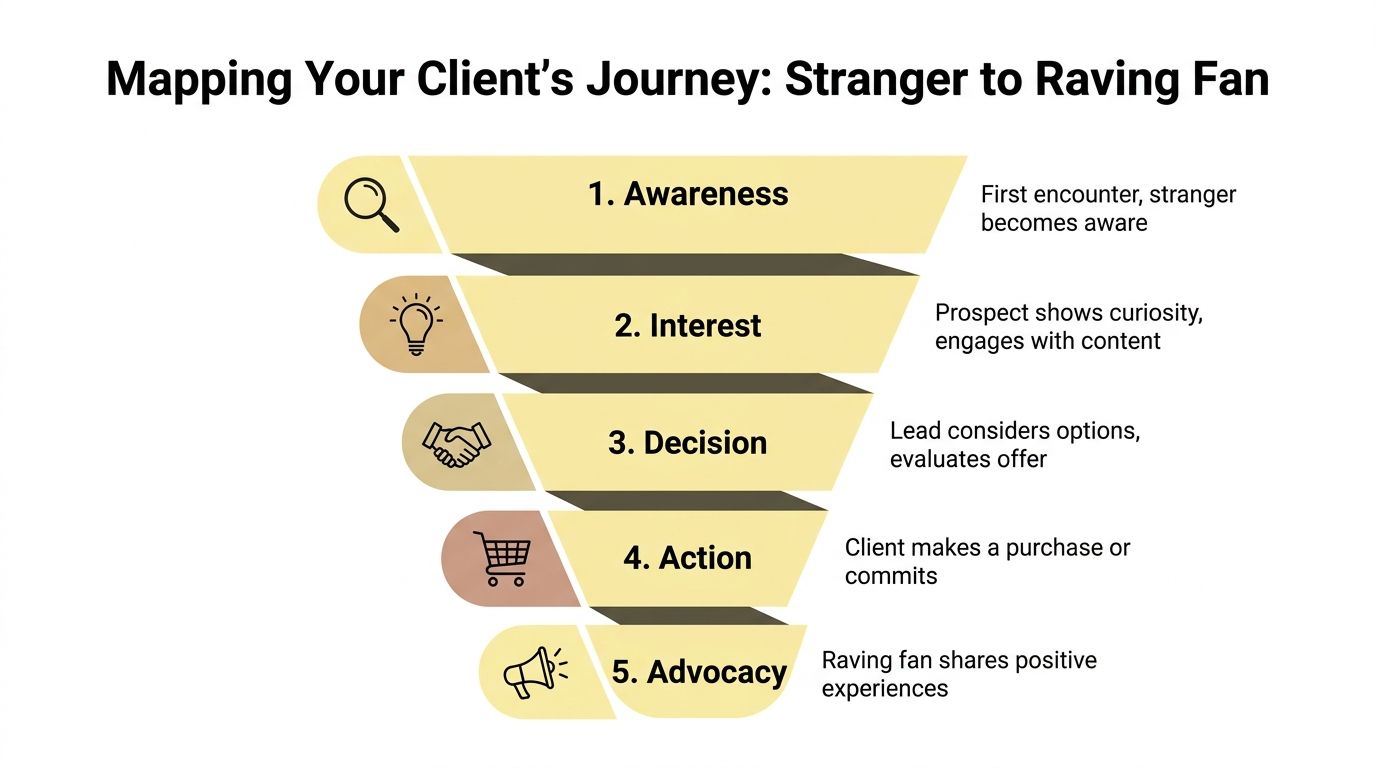
Awareness
This is the first contact.
A prospect sees a LinkedIn post, podcast clip, workshop mention, referral intro, or article. They are not thinking, “I want to hire a coach today.” They are thinking, “That sounds like me.”
For a leadership coach, that might be a post about giving hard feedback without losing trust. For a health coach, it might be a short lesson on why high performers crash in the afternoon. For a life coach, it could be a message about over-functioning and resentment.
Your job here is not to impress. It is to create recognition.
Use at this stage:
- Short educational posts
- Contrarian observations
- Simple checklists
- Problem-aware podcast clips
- Focused landing pages tied to one issue
Engagement
Now the prospect leans in.
They download something, reply to an email, watch a training, read more than one article, or follow you for a while. They are curious, but still cautious.
Often, coaches get vague at this stage. They post inspiration when the prospect needs specificity.
A better move is to offer one micro-win. Not a complete solution. Just enough progress to make your method feel real.
Examples:
| Coaching niche | Better engagement asset | Why it works |
|---|---|---|
| Executive coaching | A feedback prep worksheet | It solves an immediate leadership problem |
| Business coaching | A lead follow-up script | It shows practical thinking, not fluff |
| Health coaching | A weekly energy audit | It creates self-awareness quickly |
| Career coaching | A promotion conversation planner | It connects directly to a high-stakes moment |
Evaluation
This stage most generic funnel templates mishandle for coaches.
The prospect is not only asking whether coaching works. They are asking whether you are the right guide.
Their inner dialogue usually sounds like this:
- “Will this person understand my situation?”
- “Is this too basic for me?”
- “Will I be judged?”
- “What happens after I pay?”
- “Is this worth prioritizing now?”
At this stage, your funnel needs proof, clarity, and fit.
That can include:
- An email that explains your process
- A page describing who you help and who you do not
- A short client story
- A low-pressure invitation to a consult
- A FAQ that handles practical concerns
Key takeaway: Coaches do not need more persuasion at evaluation. They need less ambiguity.
Enrollment
This stage marks the decision point.
The prospect books, applies, replies to your invitation, or moves into a proposal or package conversation. A smooth enrollment stage removes friction. It does not create more hoops.
What helps:
- Clear next steps
- Simple scheduling
- Short intake forms
- Direct package language
- Boundaries around who the offer is for
If your consult calls feel draining, the problem often started earlier. Weak awareness and engagement create messy enrollment.
Advocacy
A lot of funnels end at the sale. Coaching funnels should not.
A satisfied client can become a renewer, referrer, testimonial source, group-program joiner, or champion inside a company. This stage merits its own design.
A few examples:
- A business coaching client finishes a program and joins a mastermind.
- An executive coaching client refers a peer after a successful leadership transition.
- A wellness client shares a written reflection that helps future buyers trust your method.
That is the full path. Stranger to engaged prospect. Evaluating buyer. Enrolled client. Raving fan.
Crafting the 'Yes' Moment with Lead Magnets and CTAs
The “yes” moment is small on the surface.
Someone gives you their email. Clicks a button. Requests a guide. Watches a short training.
But that tiny commitment shapes your whole funnel. It determines who enters, what they expect, and whether future conversations feel aligned or forced.
A weak lead magnet says, “Join my list.” A strong one says, “I can help you solve this specific problem right now.”
That distinction matters because lead quality matters. A well-defined funnel that uses targeted lead magnets can produce a 16% higher win rate on deals by attracting better-fit prospects from the start (Dashly on sales funnel metrics and lead qualification).
Stop making broad freebies
Many coaches create a PDF that sounds useful but attracts the wrong crowd.
Examples of broad offers:
- “10 tips for a better life”
- “My productivity guide”
- “Business growth checklist”
Those offers get downloads. They do not always get buyers.
The better question is: What micro-problem does my ideal client want solved this week?
Here are stronger examples.
Three lead magnet examples that pull in better-fit prospects
Life coach example
A coach helping high-achieving women with boundaries offers a one-page tool called The People-Pleasing Reset Before Difficult Conversations.
Why it works: it speaks to a real moment, not a vague aspiration. The right person immediately feels seen.
Business coach example
A coach who helps consultants close premium clients offers The Discovery Call Notes Template That Keeps Sales Calls Focused.
Why it works: it attracts people already having sales conversations, which is a much better buying signal than general “business tips.”
Health coach example
A coach working with burnt-out professionals offers The Afternoon Energy Audit.
Why it works: it promises awareness plus a fast insight. The prospect does not need to “believe in coaching” yet. They just need to want relief.
Write CTAs like invitations
Pushy CTAs trigger resistance, especially in coaching. The buyer is already evaluating trust. If the language feels manipulative, they back away.
Weak CTA examples:
- Buy now
- Act fast
- Don’t miss out
Better CTA examples for coaches:
- Get the worksheet
- See where your energy is leaking
- Download the call prep guide
- Find out what is stalling your progress
- Watch the short training
Notice the difference. These CTAs promise clarity, not pressure.
Tip: Your CTA should match the emotional temperature of the moment. Cold traffic needs a soft next step. Warm prospects can handle a stronger invitation.
A simple filter for your next lead magnet
Before you build anything, test it against these questions:
- Specific problem Can one ideal client immediately say, “Yes, I need that”?
- Fast win Can they get value quickly without a long explanation?
- Method preview Does the asset show how you think?
- Fit filter Does it attract the right buyer and subtly repel the wrong one?
If you need fresh angles, reviewing strong examples from content creation sites for coaches and marketers can help you spot formats that are practical, not generic.
This short video is also useful if you are refining the entry point of your funnel and want to think more clearly about offer positioning.
What the best lead magnets do
They do not prove you know everything.
They prove you understand one painful, timely problem and can guide someone through the first layer of it. That creates momentum. It also makes the next CTA feel natural.
A good sales funnel template starts there. Not with more content. With a better first yes.
Automating Connection with Email Nurture Sequences
Most coaches lose momentum right after the opt-in.
Someone downloads the lead magnet. They are interested right now. Then they hear nothing for days, or they get a lifeless welcome email followed by random newsletters. The emotional temperature drops, and the lead goes cold.
That is why your nurture sequence matters so much. It keeps the conversation moving while trust is still forming.
For coaches, the sequence should not feel like a drip campaign from a software company. It should feel like a thoughtful progression toward clarity and fit. Standard templates often fail independent coaches because they ignore stages like mutual fit assessment and commitment to transformation, even though those are often established during nurture (Mural on sales funnel templates and personalized pathways).
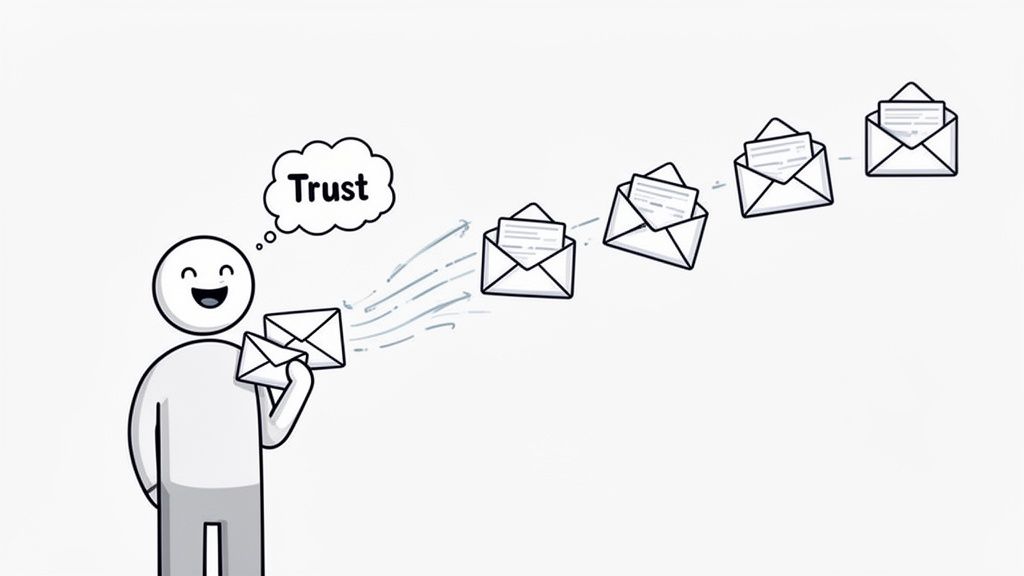
The five-email sequence I recommend
You do not need a giant automation tree to start. A tight five-email sequence is enough.
Email one delivers the promised value
This email should go out immediately.
Keep it plain. Deliver the asset. Reinforce why it matters. Give one instruction for using it.
Example angle for an executive coach:
“You downloaded the feedback prep worksheet. Start with the section on naming the core outcome you want from the conversation. Most leaders skip that step and end up sounding either vague or overly sharp.”
No pitch. No biography. Just value and a calm next step.
Email two builds personal trust
Now the lead knows what you offered. They still may not know why you are credible or why this work matters to you. At this point, a short personal story helps. Not your life story. A relevant moment.
Examples:
- You burned out while performing well on paper.
- You watched smart founders stall because they could not lead difficult conversations.
- You saw high-capacity professionals keep solving surface problems while avoiding the underlying one.
The point is emotional resonance, not self-disclosure for its own sake.
Email three creates an aha moment
This email should reframe the problem.
A business coach might explain that inconsistent sales often come from weak follow-up systems, not poor offer quality. A life coach might show that resentment is often a boundary issue, not a time-management issue. A health coach might explain that energy crashes are often tied to daily patterns clients have normalized.
At this point, the prospect thinks, “That’s exactly what I’ve been missing.”
Practical rule: Teach enough to create movement. Do not teach so much that the reader gets a complete solution without needing your help.
Email four introduces proof without sounding rehearsed
Many coaches either avoid proof or overdo it.
Avoiding proof leaves doubt untouched. Overdoing it makes the sequence sound salesy. The middle ground is a brief client story focused on the shift, not hype.
A useful structure:
- Starting point What was happening before?
- Intervention What changed in how they approached the issue?
- Outcome What became easier, clearer, or more sustainable?
Keep it grounded. Specific beats vague praise.
Email five makes the invitation feel safe
At this point, you ask for the next step.
The mistake is treating every email subscriber as if they are ready to buy. They are not. They may be ready to explore fit.
That wording changes everything.
Good invitation language:
- “If you want help applying this to your situation, you can book a conversation.”
- “If you’re weighing support and want to see whether we’re a fit, you’re welcome to reach out.”
- “If this pattern feels familiar and you want a structured path through it, we can talk.”
That is very different from “Buy my package now.”
A simple sequence map
| Job | Tone | |
|---|---|---|
| 1 | Deliver value | Clear and direct |
| 2 | Build trust | Personal and relevant |
| 3 | Reframe the problem | Insightful |
| 4 | Reduce doubt with proof | Grounded |
| 5 | Invite the next step | Gentle and confident |
If you are building this inside a CRM or automation platform, practical workflow examples from GoHighLevel training for coaches and agencies can help you think through timing, triggers, and sequence setup.
What to avoid in nurture
A few things weaken coaching email funnels fast:
- Long theory-heavy emails Good for your ego, bad for reply rates.
- Premature selling Asking for a consult before trust has formed.
- Too much inspiration, not enough specificity Readers need concrete insight.
- One-size-fits-all messaging A founder, a burned-out manager, and a career-transition client hear the same words differently.
When email nurture works, it feels surprisingly human. The prospect feels understood before they ever hit reply. That is the whole point of automation in coaching. Not to remove intimacy, but to scale it.
Tracking Your Funnel's Health and Profitability
A sales funnel template is only useful if it tells the truth.
Many coaches track activity and call it progress. More subscribers. More booked calls. More conversations. Those numbers can look encouraging while the business itself stays inconsistent or unprofitable.
The right dashboard is often smaller than anticipated.
The three funnel checks that matter most
Lead magnet conversion quality
Do people who opt in look like potential clients?
A high download count means very little if the wrong people are entering the funnel. Review actual lead quality. Are these the kinds of people you want to coach? Do they match your niche, your price point, and your method?
Here, many coaches get distracted by vanity metrics. Broad content often creates broad lists.
Discovery call booking rate
If people download and open emails but do not book, the friction is usually in one of three places:
- The offer feels too vague
- The sequence teaches but does not invite
- The prospect is interested in the topic, not committed to change
Booking rate is a behavior metric. It tells you whether interest is maturing into intent.
Close rate by fit, not just by volume
Some coaches celebrate every booked call. That can become expensive in time and energy.
Look at who closes and why. If your call calendar is full but the right people rarely move forward, your top-of-funnel messaging is likely attracting the wrong segment.
Profitability is the metric that keeps you honest
Experienced operators think differently in this area.
You do not want more clients at any cost. You want the right clients under healthy terms. Financial tracking matters because apparent wins can hide bad economics. One analysis gives a clear example: a 40% win rate can be a bad sign if it depends on 25% discounts (McCracken Alliance on the financial metrics most companies miss).
That matters in coaching more than many admit.
Examples of “wins” that may not be wins:
- You discounted heavily to get a yes
- You onboarded a client who needed far more support than the package covered
- You said yes to a poor-fit client because the month looked quiet
- You filled the calendar with one-off buyers who never renew or refer
Key takeaway: Revenue tells you what came in. Profitability tells you whether the funnel is healthy.
A lean coaching funnel scorecard
You do not need fifty metrics. Start with this:
| Metric | Question it answers |
|---|---|
| Lead magnet opt-ins | Is the topic pulling attention? |
| Lead quality notes | Are the right people entering? |
| Email replies | Is trust building? |
| Discovery calls booked | Is curiosity turning into intent? |
| Calls closed | Is the fit strong? |
| Average client value | Is the offer model working? |
| Renewal or referral notes | Are clients satisfied enough to continue or recommend? |
Review this monthly. Not obsessively. Just consistently.
The biggest mistake is optimizing for motion instead of results. A healthy coaching funnel should make it easier to predict demand, protect your time, and improve client quality. If the numbers look busy but your work feels heavier and your margins feel thinner, the funnel needs adjustment.
Putting Your Coaching Sales Funnel into Action
Most coaches do not need more ideas. They need a simpler build order.
If you try to create everything at once, the funnel stalls in draft mode. The better move is to build one clean path from first contact to booked conversation, then improve it with real feedback.
Your first 30 days
Week one Define the audience and the specific problem. Not “everyone who wants growth.” Something narrower, like new executives struggling with authority, founders with weak follow-up, or professionals dealing with recurring burnout patterns.
Week two Create one lead magnet that solves a micro-problem. Write one landing page. Add one CTA. Keep the message tight.
Week three Write the five-email nurture sequence. Focus on clarity, fit, and momentum. Do not over-polish. Finished beats perfect.
Week four Set up scheduling, test the full path yourself, and start driving traffic from your existing channels. Watch where people drop off. Tighten that step first.
A practical checklist
- Map your five stages Awareness, engagement, evaluation, enrollment, advocacy.
- Build one entry asset One lead magnet is enough to start.
- Use one clear CTA Avoid multiple competing next steps.
- Write nurture before promoting Do not collect leads into silence.
- Track quality, not just quantity Good leads beat noisy lists.
- Review profitability A busy funnel can still create bad business.
If your offer sits at the premium end, sharpening the sales conversation itself matters too. Studying high-ticket sales training for coaches and consultants can help you structure consults so they feel collaborative instead of awkward.
A strong sales funnel template does not turn you into a slick marketer. It gives your coaching business a steady rhythm. The right people find you, understand your method, and arrive at the conversation already warmed by trust. That changes everything. Your content becomes more focused. Your calls become cleaner. Your client roster becomes more stable.
And the best part is this. You do not need a giant machine. You need a thoughtful one.
Coachful brings the moving parts of this funnel into one place, from onboarding and scheduling to payments, messaging, renewals, and client progress tracking. If you want a cleaner way to run a coaching practice without stitching together multiple tools, explore Coachful.