Sell PDF Documents Online: A Coach's Playbook for 2026

Coachful
You probably already have a PDF product half-built. It lives in client notes, workshop slides, onboarding emails, voice notes you meant to organize, and that folder of “resources I send all the time.” The problem isn't that you lack material. The problem is that turning lived coaching expertise into something buyable can feel oddly vulnerable.
A lot of coaches stall here. They think, “If I sell a PDF, won't it look small compared to my coaching?” Or they swing the other way and try to write a full ebook, then lose momentum because the project gets too big, too vague, and too hard to price.
The better move is simpler. Treat the PDF as a client asset. Not a random download. Not a watered-down version of your coaching. A structured tool that helps someone reach a result faster, with less friction, and with more consistency than they would on their own.
That shift changes everything when you sell PDF documents online. You stop asking, “What can I write?” and start asking, “What part of my process do clients repeatedly need help applying?”
Turning Your Coaching Wisdom into a Scalable Asset
A coach I'd recognize in any niche usually sounds like this: “My clients keep asking the same questions, and I'm answering them well. I just don't want to repeat myself forever.” That's often the first signal that a PDF product is viable.
The strongest PDF offers rarely begin as “content ideas.” They begin as repeated client friction. A business coach notices founders struggle to prepare for sales calls. A life coach sees clients freeze when setting weekly priorities. An executive coach keeps rebuilding the same reflection prompts after difficult stakeholder conversations. Those patterns are product opportunities.
Your notes are probably more valuable than you think
Coaches tend to underestimate the commercial value of their process because it feels obvious to them. If you've guided someone through the same obstacle enough times, you likely have a sequence, a framework, a checklist, or a set of prompts that already works in practice.
That's the seed of a real digital asset.
A useful reason this model has held up for so long is that digital reading and downloadable documents became normalized at scale when Amazon launched the first Kindle in 2007, helping establish mass-market demand for paid digital reading material. Combined with the near-zero reproduction cost of digital files, that created a durable business model for selling expertise in formats like PDFs, as noted in SendOwl's guide to selling PDFs online.
A PDF can do more than bring in direct revenue
For coaches, the file itself is often only part of the value. A PDF can function in several roles at once:
- Lead-in product that helps someone buy from you before committing to coaching
- Pre-session diagnostic that gives structure to discovery calls
- Onboarding tool that gets new clients moving before session one
- Program support asset that increases accountability between meetings
- Standalone low-lift offer for people who aren't ready for private coaching
Practical rule: If the PDF makes your coaching process easier to start, easier to deliver, or easier for the client to follow through on, it's not “just a file.”
That's why coaches are unusually well positioned here. You're not guessing what people need. You hear objections, confusion, procrastination patterns, and implementation breakdowns every week. Most creators have to research that from scratch. You already sit inside the problem.
Think productized process, not passive income fantasy
“Passive income” is what gets advertised. Productized expertise is what matters.
A PDF that helps a client prepare, decide, reflect, plan, or follow through can scale your impact without diluting your service. In some practices, it even improves the paid coaching experience because the client arrives more prepared and leaves with clearer next actions.
That's the mindset shift. You're not selling pages. You're packaging part of your method into a format clients can use right away.
Creating a PDF Your Clients Will Actually Buy
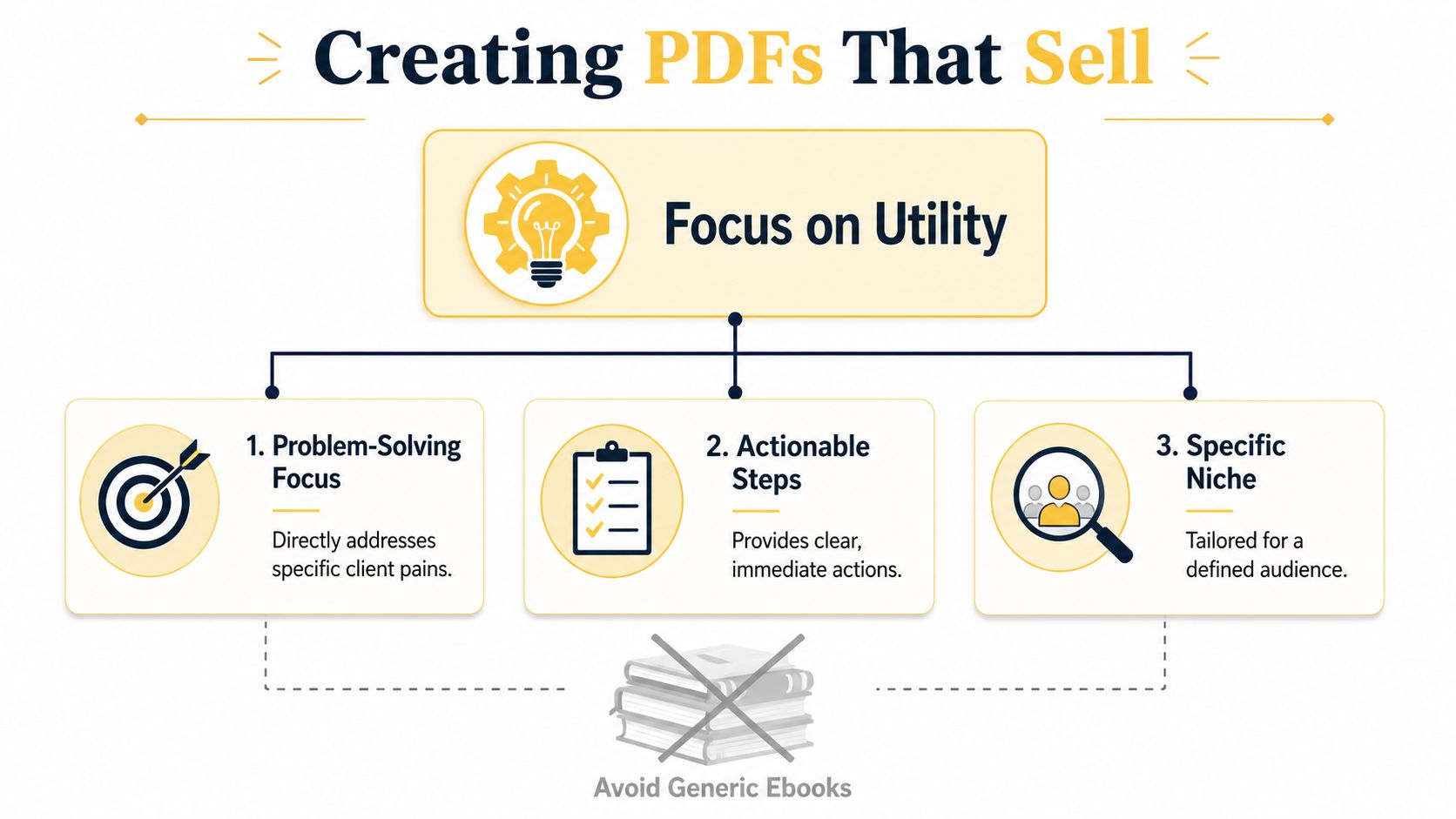
The fastest way to waste time is to write a generic ebook nobody asked for. Coaches do this because it feels safe. “I'll put my philosophy into a polished guide” sounds productive. It usually isn't.
Clients buy tools that help them do something specific.
Start with a recurring pain, not a topic
The U.S. Small Business Administration recommends validating ideas with market research before building, using methods such as surveys, questionnaires, focus groups, in-depth interviews, and competitive analysis. For coaches, that means confirming a recurring client problem and checking whether people already pay for related solutions before you design the PDF, according to the SBA's market research and competitive analysis guidance.
Here's the practical version of that advice. Before you open Canva, ask:
What does my client repeatedly get stuck on?
Not “what interests them.” What slows them down, creates anxiety, or causes avoidance?Do they want information or a decision tool?
More theory isn't the primary requirement. What's needed is a worksheet, script, prompt set, planning template, or checklist.Are they already spending money nearby?
If they buy coaching, software, training, or templates to solve adjacent issues, that's a useful signal.Can I tie this to a moment of use?
“Use this before your first sales call” is stronger than “read this guide when you have time.”
Utility beats length every time
A coach doesn't need a long document to create value. A short, sharp tool often sells better because the buyer can imagine themselves finishing it.
Consider the difference:
Weak offer
“Mindset Ebook for Success”Stronger offer
“Weekly CEO Reset Workbook for founders who end every week overwhelmed”Weak offer
“Communication Guide”Stronger offer
“Difficult Conversations Script Template for managers giving corrective feedback”
That's the heart of streamlining digital product sales. The product becomes easier to describe, easier to price, and easier for the buyer to say yes to when it solves one defined problem.
A buyable PDF usually sits close to action. If the buyer can use it today, they can value it today.
Three coach-friendly PDF formats that work
Worksheets and workbooks
These fit coaches naturally because they drive reflection and implementation. A life coach might turn a weekly review ritual into a guided planner. A health coach might package habit-tracking prompts with check-in questions clients already use.
Assessments and diagnostics
These work well when clients need clarity before they need advice. An executive coach could sell a leadership friction self-audit. A relationship coach could create a communication patterns assessment with interpretation notes and next-step prompts.
Playbooks and templates
These are especially strong when clients face repeat scenarios. A business coach might package discovery call questions, objection-handling prompts, and follow-up scripts into one toolkit. A career coach might offer a job search accountability playbook with networking templates and interview prep worksheets.
Validate with conversations you're already having
You don't need a giant research project. Start inside your current practice.
- Review session notes: Look for the same obstacle showing up across clients.
- Mine your emails and DMs: Notice the questions people ask before they buy coaching.
- Test the language live: Describe the PDF idea on a call and listen for immediate interest or confusion.
- Look at adjacent offers: If people buy planners, templates, or assessments nearby, your offer may need stronger positioning, not a totally new idea.
What usually doesn't work is building first and validating later. Coaches pour energy into design, title tweaks, and formatting, then discover the underlying problem wasn't specific enough.
Pricing Your PDF for Perceived Value and Profit
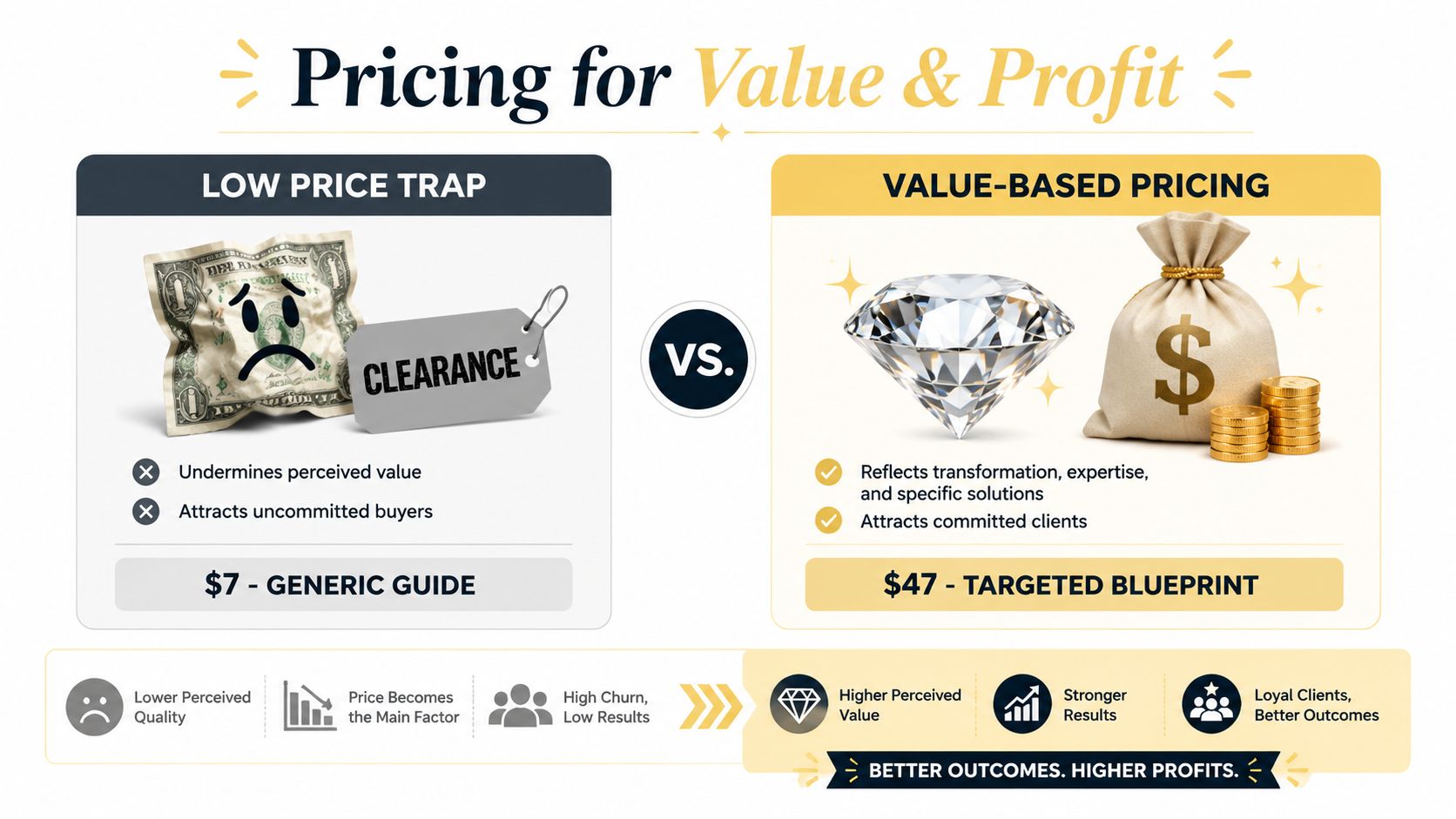
The hardest pricing question isn't “What should I charge?” It's “How do I avoid pricing this in a way that makes me look either cheap or unrealistic?”
Most coaches know they shouldn't charge based on page count. Then they still do it indirectly. They think, “It's only a PDF,” and lower the price before the market ever responds.
That's how good work gets trapped in commodity pricing.
Price the outcome, not the file
The more useful question is this: what does the buyer get to avoid, accelerate, clarify, or complete because they used your PDF?
Industry guidance increasingly points toward result-based PDF packaging. Instead of generic ebooks, creators are finding more traction with worksheets, assessments, playbooks, and templates tied to a concrete outcome. That framing is especially useful for coaches who can position a PDF as a pre-session diagnostic or accountability tool, as discussed in FlippingBook's guide on selling PDFs online.
If your PDF helps a client show up prepared, make a decision, organize a launch, run a better conversation, or stay consistent between sessions, that's where the value sits.
Three pricing structures that make sense for coaches
Single offer pricing
This is the simplest setup. One PDF, one price, one clear promise.
It works well when the product is tightly scoped, such as a planning workbook, a script pack, or an onboarding checklist. The key is that the buyer knows exactly who it's for and what it helps them do.
Tiered offer pricing
This is often easier for coaches than trying to force all value into one file.
For example:
- PDF only
- PDF plus a short review call
- PDF bundled with feedback or implementation support
This structure protects the lower-friction sale while giving buyers a way to pay for access to your judgment, not just your document.
Bundle pricing inside your service
Sometimes the most profitable use of a PDF isn't selling it alone. It's including it inside a package to strengthen the offer.
A confidence coach might include a decision-making workbook in a private program. A business coach might use a client scorecard as part of onboarding. In those cases, the PDF increases the perceived depth of the service and saves delivery time.
What low pricing silently communicates
Low prices don't just reduce revenue. They can also attract buyers who want information without commitment.
That's a problem for coaches because your best work usually requires application. A vague, underpriced guide often lands in a downloads folder and stays there. A focused, outcome-based asset feels more like a tool and less like disposable content.
Pricing checkpoint: If your offer solves a meaningful problem in a specific moment, don't price it like a throwaway download.
A coach selling a quarterly planning workbook, for example, shouldn't ask, “Is this too much for a PDF?” The right question is, “What is it worth to a client to stop drifting for the next quarter and make cleaner decisions this week?”
That's the frame buyers use when the positioning is strong.
Choosing the Right Platform to Sell and Deliver Your PDF
Most coaches don't need a complicated tech stack. They need a selling setup that handles payment, delivery, and access cleanly enough that buyers never have to think about it.
That matters more than people admit. Friction at checkout or messy delivery makes a small product feel unprofessional fast.
A practical standard is to use a platform that automates hosting, payment, and file delivery, then test the buyer experience on desktop and mobile before launch. Sellfy notes that its checkout supports PayPal and Stripe, while Kajabi highlights automated delivery through websites and email funnels built around free samples or lite versions in its advice on how to sell PDFs online.
Platform Options for Selling Your PDF
| Platform Type | Best For | Pros | Cons |
|---|---|---|---|
| Marketplace | Coaches who want speed and simple setup | Fast to launch, built-in buying behavior, low setup burden | Less brand control, more price comparison, weaker direct client relationship |
| E-commerce plugin | Coaches with an existing WordPress site | More control over branding and buyer path, flexible setup | More technical upkeep, more moving parts, more testing required |
| All-in-one platform | Coaches who want PDF sales connected to broader delivery | Payments, delivery, and client experience in one place, easier to scale into programs or bundles | Monthly platform commitment, feature set may be broader than you need at the start |
When a marketplace makes sense
If you want to validate an idea without much setup, a marketplace can be useful. It lowers the technical barrier and gives you a quick way to see whether the offer resonates.
The trade-off is positioning. Your PDF sits next to other products, often in a comparison-heavy environment. That can push buyers toward lower-cost options unless your product is sharply differentiated.
When plugins fit best
If you already have a WordPress site and you're comfortable managing tools, plugins can work well. This route gives you more control over the product page, post-purchase flow, and brand presentation.
The downside is maintenance. Coaches underestimate how annoying it is to troubleshoot payments, mobile formatting, or broken delivery emails when several systems are stitched together.
Why many coaches prefer all-in-one tools
The all-in-one category tends to fit coaches who want fewer moving parts. You can sell the PDF, collect payment, deliver access, and often connect the product to your wider client ecosystem.
If you want to build a website for coaches, this route can also simplify the brand side of the business because your product pages and coaching presence live closer together.
One option in this category is Coachful, which supports digital product delivery and gives buyers access through a branded library. That model is useful when the PDF is part of a bigger client journey rather than a one-off download.
What to test before launch
Before sending traffic anywhere, check the basics.
- Readability: Open the PDF on phone and desktop. Make sure fonts, spacing, and fillable elements still work.
- Link integrity: Click every link inside the file. Don't assume exported links carried over correctly.
- Checkout flow: Buy your own product. Watch for clunky forms or unclear confirmation messaging.
- Delivery experience: Confirm the buyer knows where the file lives and how to access it later.
A smooth delivery experience raises trust. A sloppy one makes even strong content feel improvised.
The right platform isn't the most feature-rich one. It's the one you'll maintain, and the one your clients can use without friction.
Protecting Your PDF from Piracy and Misuse
The fear is real. You spend time building something useful, and then your brain goes straight to, “What if someone forwards it to ten people?”
That concern stops a lot of coaches before they launch. It shouldn't. Piracy risk is a business consideration, not a reason to avoid creating digital assets altogether.
You don't need perfect protection
You need sensible deterrence and professional delivery.
For coaches, the more important issue often isn't hardcore DRM. It's access-controlled delivery. That includes tools like expiring links, permissioned libraries, and managed access for sensitive client-facing resources. Since digital goods are easy to copy, secure handling becomes more important when PDFs include client-sensitive or proprietary information, as discussed in Locklizard's overview of selling PDF documents securely.
In practice, that means a simple worksheet for the public may need light protection, while a diagnostic used inside a leadership program may need tighter control.
Practical layers that make sense
Here are the protections that usually matter most:
- Personalization: Add the buyer's name or email inside the file or delivery record when possible. Casual sharing drops when people know the asset is tied to them.
- Controlled delivery: Use expiring links or a member library instead of a loose file attached to an email.
- Permission boundaries: Keep higher-value or sensitive PDFs inside a portal where access can be managed.
- Clear terms: Tell buyers what they're allowed to do. Most legitimate clients respect boundaries when those boundaries are obvious.
What doesn't help much is obsessing over impossible guarantees. Someone determined to misuse a file may still find a way. Your goal is to reduce casual sharing, protect sensitive content, and keep the buying experience trustworthy.
If your file is copied, respond like a business owner
There's also a psychological shift here. Don't treat misuse as proof that digital products are flawed. Treat it as an operational issue you know how to handle.
If you discover your PDF has been reposted without permission, it helps to understand how to file a DMCA notice. That gives you a practical next step instead of leaving you stuck in frustration.
A quick walkthrough can help you think more clearly about your options:
Protecting a PDF isn't only about stopping bad actors. It also signals to good clients that you handle their materials professionally.
That's especially important if your PDF supports coaching with confidential prompts, internal frameworks, or business-sensitive planning tools.
Simple Promotion Strategies to Find Your First Buyers
Coaches often overcomplicate launch plans because they think marketing a PDF requires an entirely new content machine. It doesn't. Your first buyers usually come from proximity, not scale.
That means people who already know your work, have seen your thinking, or have a smaller version of the problem your PDF solves.
Start with the audience you already have
If you've got an email list, past clients, social followers, podcast listeners, or workshop attendees, you already have a starting point. The mistake is announcing the product like it's a book release instead of introducing it like a practical tool.
Lead with the pain and the use case.
A better message sounds like this:
Clients kept getting stuck between sessions on weekly planning, so I turned my planning framework into a workbook they can use every Monday morning.
That lands better than “I created a new PDF.”
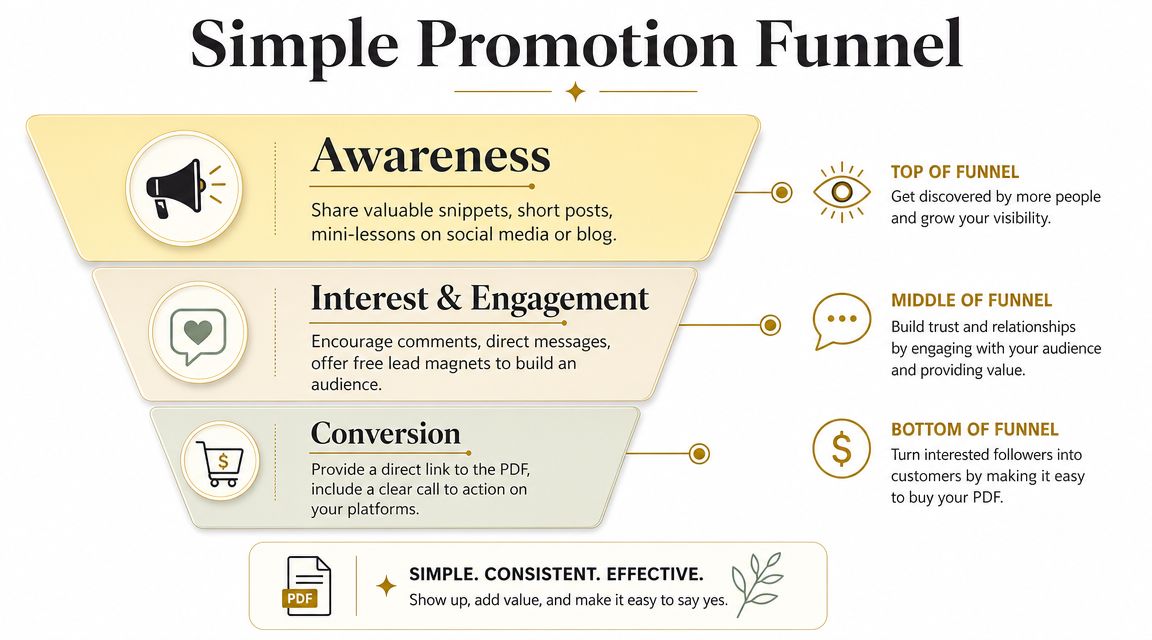
A simple promotion rhythm that busy coaches can sustain
You don't need to be everywhere. Pick one steady path and repeat it for several weeks.
Use short content that previews the tool
Post a small slice of the framework. Share one prompt, one checklist item, one mistake the workbook helps correct, or one before-and-after client scenario without revealing private details.
Offer a free sample or smaller asset
A sample can capture interest before the sale. If you want a practical refresher on what makes a useful opt-in, ReachLabs.ai's lead magnet guide is a solid reference for thinking through the role of a free resource in your funnel.
Make the next click obvious
If you mention the PDF on Instagram, LinkedIn, or anywhere else, don't bury the path to purchase. Use a clear link in bio for coaches so people can find the product page, sample, or waitlist without hunting for it.
What to say on the landing page
A lot of product pages fail because they describe contents instead of outcomes.
Don't just list pages, modules, or file format. Explain:
- Who it's for: “For new managers preparing for difficult feedback conversations”
- What problem it solves: “Helps you stop avoiding the conversation and know what to say”
- How it's used: “Use it before the meeting to script, structure, and prepare”
- What's inside: prompts, scripts, worksheet pages, examples, templates
- Why this is different: it reflects your coaching process, not recycled information
Soft launch before you push hard
Start with a small circle. Past clients, warm subscribers, workshop attendees, and peers can give you fast feedback on positioning and usability.
Ask simple questions after purchase:
- What made you buy?
- What almost stopped you?
- Where did you get confused?
- What did you use first?
Those answers usually improve the product page faster than guessing.
Launch reminder: Your first goal isn't reach. It's message clarity. A small number of attentive buyers can teach you more than a broad, lukewarm audience.
When coaches sell PDF documents online successfully, it usually looks less dramatic than people expect. They pick a narrow problem, package a useful tool, set up clean delivery, and talk about it consistently where trust already exists. That's enough to create momentum, and momentum is what turns one PDF into a repeatable revenue stream.
If you want one place to sell digital downloads, organize client resources, and keep your coaching delivery under control, Coachful is built for that broader workflow. It helps coaches package their expertise without juggling separate systems for delivery, client management, and growth.